Craig Olson
Craig Olson is a former student of Thomas Nozkowski and regular contributor to the Rail. He is also an artist who lives and works in Minneapolis, Minnesota.
As I write from Minneapolis, surveillance helicopters circle over my neighborhood. They’ve been here since December of last year.
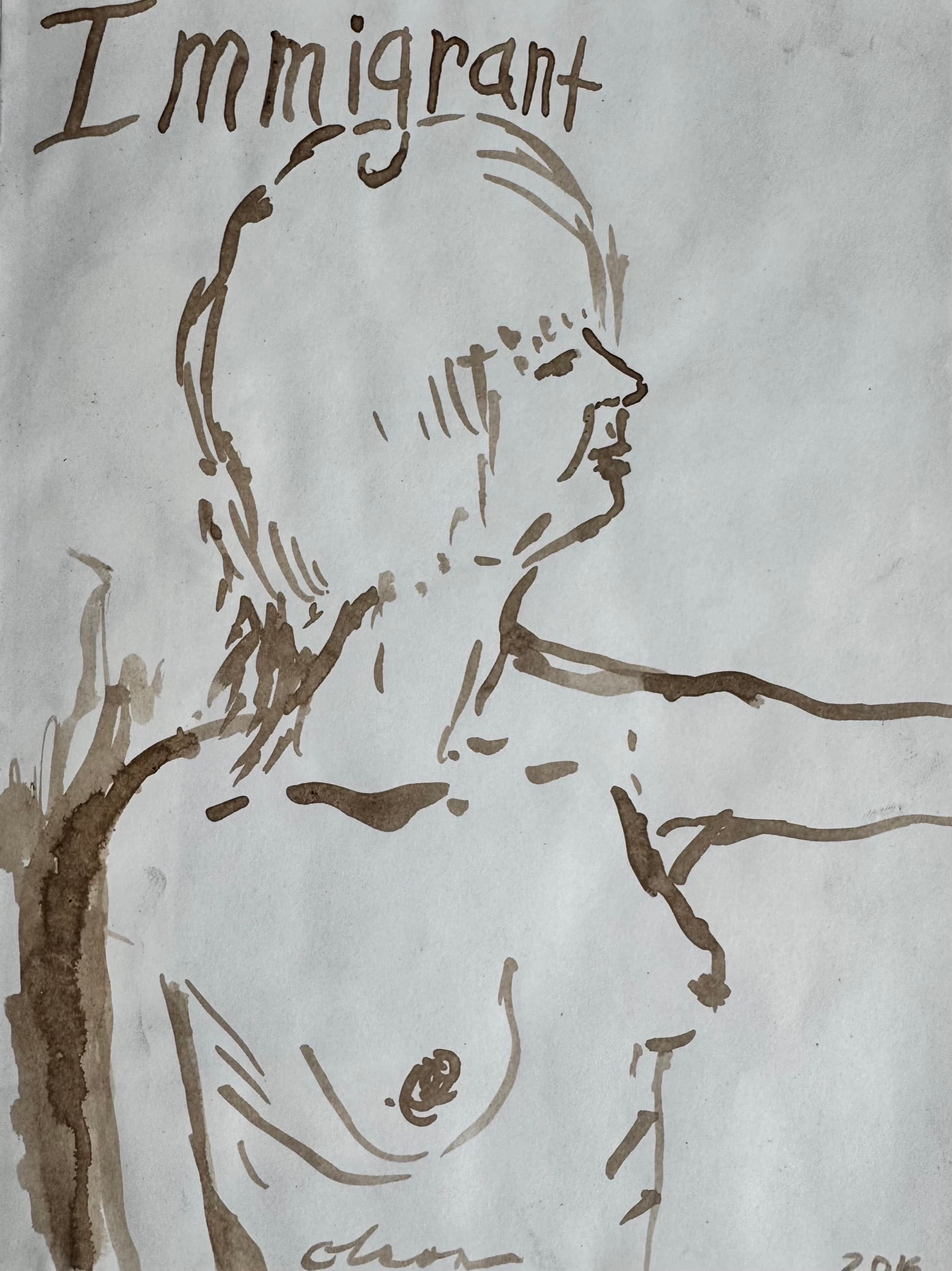
By David Carrier, Craig Olson, David Levi Strauss, Jennifer R. Gross, Chris Martin, Jason Rosenfeld, David Goerk, and Sid Sachs
Tom was one of the first postwar artists to question the heritage, hubris, and clichéd bloat of Abstract Expressionism. His intelligence transformed art as a political act; the creation of exquisite canvases that would fit in humble homes and not necessarily be destined for corporations or institutions

Those who feel the truth of 14th century German theologian Meister Eckhart’s words, “When the soul wants to experience something she throws out an image in front of her and then steps into it,” might do well to consider Franck André Jamme’s latest book, Tantra Song: Tantric Painting from Rajasthan from this point of view.
The following collaboration was inspired by the text “How to Proceed in the Arts,” by Frank O’Hara and Larry Rivers reprinted in “Frank O’Hara: Art Chronicles 1954-1966” (Braziller, 1975). Their “detailed study of the creative act” is a smelling salt for the bureaucratic tool in us all.

Obscurity of expression is natural to the psyche. Prime example, our dreams; mere glimmerings of our esoteric selves. There are also rare instances in which these obscurities are conjured through an interaction with the exoteric, or the physical world of objects and beings.

September 2010ArtSeen
HEAT WAVES IN MY CORTEX Charles Burchfield, British Petroleum, and The Invisible Fire
There is a rumbling from the void. Light withdraws and there is movement in the darkness. Another great heaving, something roars through the depths toward the surface. It is formless.

With Weights and Measures, Francie Shaw continues her evolution into a remarkably poignant interpreter of images. This collection of 36 drawings uses black ink and brush on white paper as the only tools for her malleable, sparse drawings.

Stanley Whitney has been exploring the fundamentals of painting for over 30 years. His recent geometric abstractions flow from one to the next and then back again through color, line, position, surface, and depth. Anchored in their physical substance they transcend mere matter-of-factness and open the mind to complex geometries of thought and feeling, what Agnes Martin once referred to as “non-objective experiences.”

Norman Bluhm was an artist dedicated to a type of artistic output and way of life that stressed the beauty, mystery, and passion of the human drama. This exhibition, encompassing 50 years of work, is a testament to that drama and a stunning example of Abstract Expressionism’s cultural inheritance.

Conrad Marca-Relli was born in Boston, Massachusetts in 1913 and died in Parma, Italy in 2000. The child of Italian immigrants, he was primarily a self-taught artist who received little formal training. After finishing high school in 1930, he studied for a year at the Cooper Union. He would go on to become a member of the New York School’s first generation, and a pioneer of what would come to be called Abstract Expressionism.

Jack Youngerman is 83 years old. His is an aesthetic of quasi-formal organic forms and images that ride the line of geometry, where reversible positive/negative relationships spiral through our comprehension like smoke in a soap bubble, elusive and clean.

A week after the opening of his exhibit of a new group of paintings the painter Don Voisine visited the Rail’s Headquarters to talk with Assistant Art Editor Ben La Rocco, and contributing writer Craig Olson about his life and work.

Any experienced coyote knows the only reasonable response to a trap is to dig it up, turn it over, and defecate on it. It’s an offering to the trapper’s pride, a piss stain on assumptions of rational authority. By confusing the roles of predator and prey, the coyote keeps things interesting, reminding us we’re not the only beings with a sense of humor.

Where do we turn when the end of our civilization confronts us? This isn’t exactly a new question for artists.

John Altoon (1925-1969) was said to be a boozing, boisterous braggart with reckless intensity and an appetite for destruction. Imposing, swarthy, and diagnosed as schizophrenic in his late 30s, he was plagued by bouts of depression, paranoia, and manic episodes that often turned caustic and ugly, at times involving the destruction of his own work.

When Tibor Freund (1910-2007) died last year in Queens, it went largely unnoticed. In his 97 years, the Hungarian modernist experienced much change in the world, to say the least.

There’s something buried in these paintings, hovering at the cusp of recognition. It’s a fleeting something or other that at times appears as parody, and at others as a sincere meditation on the medium of a medium (or market gone mad?), and it hits home in both contexts.

Ten years ago the late, great Pat Hearn teamed up with Matthew Marks for the brazenly titled Painting Now and Forever, Part I. Billed as a “highly subjective, celebratory survey of contemporary painting” it featured over 40 artists, old, young, alive and dead.

The six paintings in Same Enemy Rainbow resound across the shell-shocked no man’s land sprawling between dream and reality, metaphor and material—where black naturals and white sharps attack with a yard dog ferocity amplified through a Vox Continental, and the witness is left rubbing her waterlogged ears wondering if what just happened was actual or not.

Earl Cunningham (1893-1977) was an odd, solitary artist who expressed an inexpressible yearning out of time and place, a sense of the wild, the unseen, the unknowable. He articulated a vision of the landscape that exists somewhere between memory and experience, twisted into a seaman’s knot of American vernacular imagination.

Dave Miko offers perplexing painting for perplexed people, unsettling and comforting in the same tentative breath. Suffice it is to add that the paintings are quiet, unostentatious, and unpredictable, with the bulk of the show consisting of recently completed text-based paintings. The shimmering elegance of their surfaces is the result of oil paint on aluminum sheets.

Like a homemade blade to the golden throat of the status quo, the eight paintings in Freeze Frame are convincing and sharp. For the most part, the eight women who make up this show have chosen not to stray too far from a plainclothes abstraction that can range from the personal and passionate to the hell-for-leather. In other words, there’s enough quality stuff here to light a fire in every train yard oil drum from Maine to the Mobile Bay—they mean what they’re doing and it shows. As a group-show thankfully lacking some contemptible curatorial theme, it allows for enough pushback among the paintings to keep things interesting, difficult, and open. It’s a reminder that art can happen on a local level, where people argue and have something to say, as opposed to some faceless, nameless, global mass of intellectual morality.

In the midst of preparations for his current exhibition at Mitchell-Innes & Nash Gallery in Chelsea ( January 26–March 1, 2008) Chris Martin welcomed painter and Rail contributing writer Craig Olson to his Williamsburg studio to discuss his life and work.

An insistently repeated image, as in advertising, creates a nullifying emptiness through the manufacture of desire. This is no new rag. However, remove commodification and mechanical reproduction from the equation, and we find ourselves caught in a limbo between want and need.

Chuck Webster’s most recent thicket of images triggers a response from somewhere between the senses, a place where the eye’s ear is activated through optically tympanic vibrations.

Death has many children, and there are Giants in the marshes still. You may not see them, perhaps—but they are there, and the only bulwark of safety is in a land of patient, faithful hearts.

This is some strange, gutbucket picture making. Like an electric guitar, sounding tinny and raw without amplification, or the taste of a stone after days without water, Don Van Vliet’s uncouth, dry pictures claw their way out at us.

There’s a tumbledown, pieced-together ambience to Jim Lee’s current exhibition at Freight + Volume. If you haven’t been to this gallery, it’s an excellent, small, cramped room.

With New Paintings Andrea Belag makes it clear how much she grows with each new exhibition. Four years on from the last time I saw her work (at the Bill Maynes Gallery) she has reinvented her practice yet again, giving us some of the most accomplished, not to mention downright beautiful, painting to be seen anywhere.

Mark Grotjahn’s recent exhibition of oil paintings qualifies as a half-waking Modernist dream. Unlike his exhibition earlier in the year at the Whitney Museum, where kaleidoscopic, electric colors crashed into dense perspectival distortions, these paintings are given a deeper, darker timbre.

In an article for New Scientist magazine in October of 2006, John Orrock, a biologist at the National Center for Ecological Analysis and Synthesis in Santa Barbara, California, was quoted, “The sad truth is, once the humans get out of the picture, the outlook starts to get a lot better.” The same could be said for Richard Bosman’s latest body of work.

In the late 1970’s and early 1980’s Thornton Willis was making paintings of monolithic, geometric forms. These early works were characterized by dominating wedge shapes with worked surfaces and rough-hewn edges—the telltale signs of angsty Abstract Expressionist process.

One of the revitalizing shots to abstract painting has been the continual critique of its legitimacy by practitioners within the field of painting itself. This dialogue has created a healthy and necessary antagonism that has pushed abstraction well into the twenty-first century, despite the many claims of its imminent death.

Sean Scully has been making unfashionably large, abstract oil paintings for over twenty years. His current exhibition, Wall of Light, is no exception. Begun in 1998, the paintings range in size from the imposingly large to the intimately small, but rarely anything in between (with the exception of several watercolors and prints).
