Ben La Rocco
Ben La Rocco is a contributor to the Brooklyn Rail.
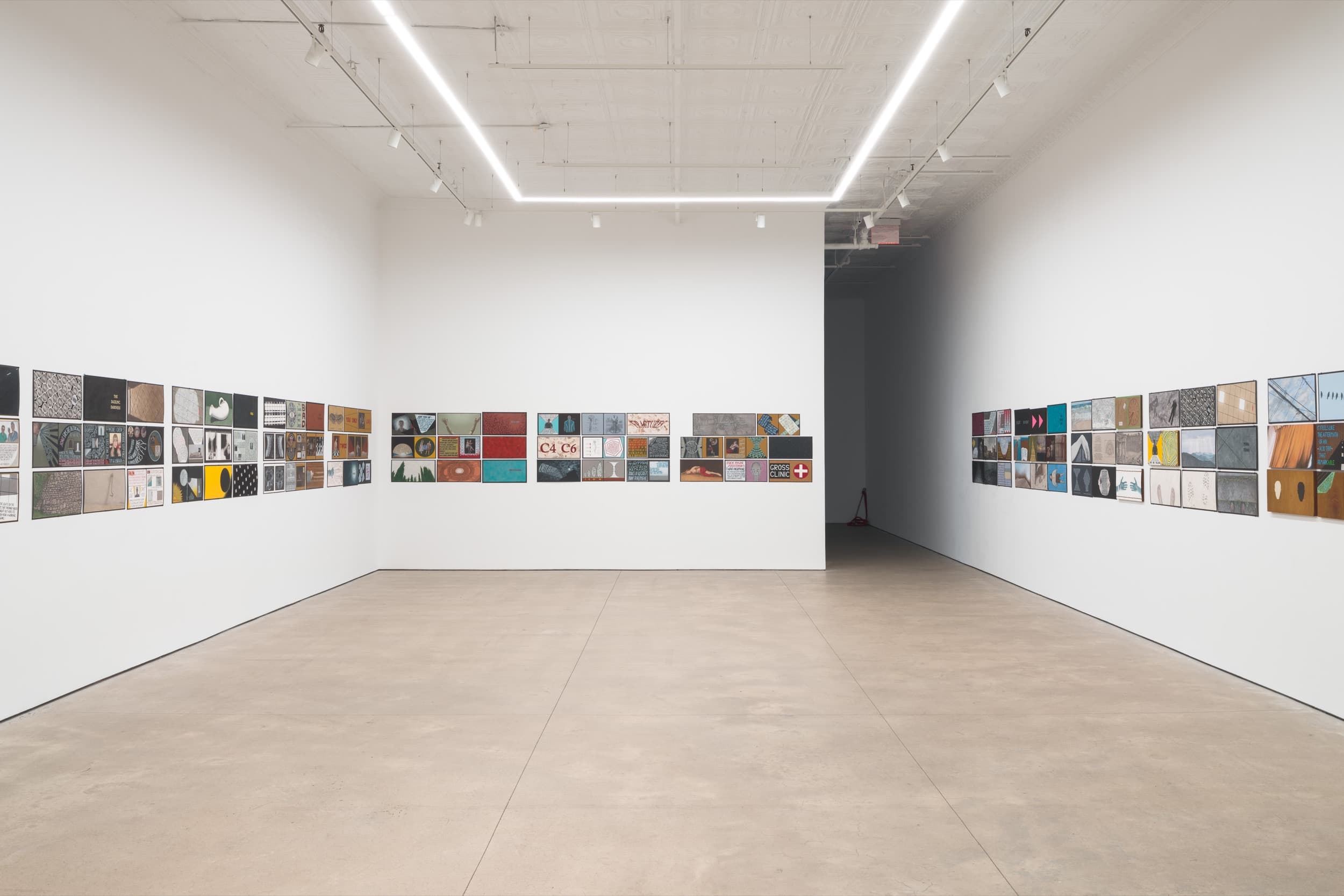
In 2004, rehearsing a trapeze performance elaborating his preoccupation with Caravaggio, John Kelly fell and broke his neck. He spent 15 hours in the hospital and a year recovering. The monumental graphic memoir A FRIEND GAVE ME A BOOK (2016-2025), currently on display at P·P·O·W, grew from this experience.
Don’t go to the Dream House prepared to relax. This is not “dream” as in ideal, or as in sleep. Instead remember, when you climb to the third-floor landing at 275 Church Street, that “dream” is meant in the ancient Vedic sense of fundamentally real. And, as we all know, the very real can be very hard.
In his book, Sculpture: A Journey to the Circumference of the Earth (Broken Jaw Press Inc, 2004), sculptor Robin Peck travels far and wide, immersing himself and his readers in foreign landscapes to ruminate on the nature of sculptural experience.
It is important to look long and hard at the early paintings of Nicholas Krushenick as they appear on the walls of Garth Greenan Gallery 50-plus years after they were made.
Norbert Prangenberg: The Last Works is on display at Garth Greenan Gallery in Chelsea. There are a lot of firsts in this exhibition of last works.
Clive Bell said the job of an art critic was to be a signpost pointing toward what was worth looking at. That’s always stuck with me for its succinctness. There’s been a whole lot of talk in recent years about the role of art critics, the importance of art criticism and so on, mostly among art critics.
Linda Francis has been making paintings and drawings since the early ’80s using concepts in astronomy and physics as the starting point of her thinking and exploration of form.
Tarkovsky is the only artist explicitly invoked by Jensen in the exhibition, press release notwithstanding. The film he invokes, Andrei Rublev, is the story of a painter, so a specific equation is made here between Tarkovsky’s art and that of painting.
The following collaboration was inspired by the text “How to Proceed in the Arts,” by Frank O’Hara and Larry Rivers reprinted in “Frank O’Hara: Art Chronicles 1954-1966” (Braziller, 1975). Their “detailed study of the creative act” is a smelling salt for the bureaucratic tool in us all.
On the occasion of her installation of Reveal at John Davis Gallery (September 15 – October 9), the Brooklyn Rail’s Ben La Rocco visited sculptor Gillian Jagger at her horse farm and studio in Kerhonkson, NY to discuss her life and work.
Though both are now deemed historical phenomena, there is still a Hudson River School and a New York School of painting. Both are in evidence at BRIK Gallery, Catskill, New York, in an exhibition entitled 7 New York Painters, so named for its participants’ ongoing connection to both New York City and the Hudson Valley.
Walking home on Bushwick Avenue this evening, I crossed paths with a gray cat. I was walking east when he emerged from behind some garbage cans five paces up. I saw from his lean musculature and dingy fur that he was stray.
“Berthot is stuck.”
“Is he?”
“Yes, he is stuck in a place, but he’s stuck the way humans get stuck, and if you’re stuck that way, then he’s right.
“Is he?”
“Yes, he is stuck in a place, but he’s stuck the way humans get stuck, and if you’re stuck that way, then he’s right.
By Ben La Rocco
When I look at Stanley Lewis’s paintings, I see places I’ve known. Though Lewis lives in Leeds, MA, to me these are New Jersey spaces, because those are what I know. They take me back to meandering walks through Teaneck, Montclair, and Bergenfield, to the familiarity of tree-sheltered suburbs with urban-scented air.
I wasn’t there, but sometimes I feel like I was. Andy Warhol was there, drinking and smoking with Morrissey and Janis Joplin, their table piled with a giant salad bowl and empty beer bottles all over the place.
Recently, I saw Picasso in the Metropolitan Museum of Art with a woman more beautiful than the paintings, which were very beautiful. We walked from one to the next and I could see her seeing the paintings, which was so much better than looking at them myself.
If religion died in the 19th century and became art, then there is no better place to see art than in a former church. Exhibitions at the Parrish Art Museum in Southampton are accessed through the nave, where the worshippers once sat and circumambulated via the crossing and transepts. A former church, the Parrish seems a less presumptuous place to exhibit art than many contemporary galleries. In fact, it is rather homey.
Yun-Fei Ji is among the few remaining adherents to a once-great tradition now besieged from within and without. The arts of Chinese landscape painting and calligraphy evolved over millennia in symbiotic relationship to a culture now in the throes of its second massive revolution since the 1940s—communist, then capitalist.
As American art drifts back toward its literary roots, the Jewish Museum has mounted a timely exhibition with an ill-chosen title. Alias Man Ray, at the Jewish Museum, is a comprehensive survey of Man Ray’s 60-year career as an artist, and what an artist he was. But Man Ray did not seek an alias, or an escape.
Sharon Horvath is exhibiting new paintings at Lori Bookstein Gallery. I never imagined what paradise might look like—I never thought of its looking like anything at all—until I looked at these paintings.
On June 26th at a Chelsea bar called The Park, I was among a group of listeners as poet Jeremy Sigler described the inauguration of an ongoing intermedia event entitled Sculpture, in which a person (or persons) is invited by Sigler’s secretary to occupy a darkened room, naked and silent, with Sigler, also naked and silent, for one hour.
A week after the opening of his exhibit of a new group of paintings the painter Don Voisine visited the Rail’s Headquarters to talk with Assistant Art Editor Ben La Rocco, and contributing writer Craig Olson about his life and work.
on the occasion of viewing Pierre Bonnard: The Late Interiors, November 25–April 12, 2009, Metropolitan Museum of Art.
James Little's exhibit De-Classified: New Paintings will be on view at June Kelly Gallery through June 9, 2009.
Entitled Instruments of Argument, John Newman’s exhibition at the New York Studio School might have been called 14 Pearls, after Richard Tuttle’s 20 Pearls, for the gem-like quality and small scale that contribute to the fragile, delicate quality shared by both artists.
Inspired by the experience of standing alone in the first room of the exhibition: Van Gogh and the Colors of the Night at the Museum of Modern Art, December 2008
One of art’s longstanding bugaboos is the perceived difference between “rigorous” geometric art and “intuitive, expressive” art. If, however, such dark, dull formulations allow artists like Ronald Bladen to shine more brightly, then perhaps they aren’t all bad.
Ron Gorchov’s painting “Serapis” looms like a guardian over those who enter the artist’s current exhibition at Nicholas Robinson Gallery. “Serapis” is unmistakable as the work of any other painter than Gorchov.
If you stand up close to Merrill Wagner’s painting “Overcast” at her current exhibition Thoughts of Form and Color at Sundaram Tagore Gallery, be careful when backing up. You may trip over “Mars Violet,” a neat block of painted slate and marble just rearward.
The Miguel Abreu Gallery is low lit for “Free Way,” Raha Raissnia’s composite 35mm slide projection and 16mm film. Her big black and white paintings and small drawings don’t suffer from the dimming, a testimony to the toughness of all Raissnia’s work—you can see it in the dark.
J.M.W. Turner (1775-1851) has been recognized both as a leading representative of the sublime in landscape painting and a harbinger of the Modernist temperament that would endeavor to do away with exactly such literary influences in art. Of the sublime Turner was well informed, while of the Modern mind he could only have guessed.
Two recent exhibitions at the Metropolitan Museum of Art give insight into our heritage from the tradition of European art. The first is Poussin and Nature: Arcadian Visions (February 12 – May 11) and the second is Courbet (February 27 – May 18). Incredibly, Arcadian Visions is the first exhibition devoted exclusively to Poussin’s landscape painting. Courbet is the artist’s first full retrospective in 30 years.
Stephen Rosenthal’s new paintings are hard to differentiate from one another in words. To describe one is, with little variation, to describe any of them. They are all painted in ochre and grays, with forms hazily suggested in darker pigments that give the impression of an undifferentiated landscape perceived out of focus.
I still remember the disappointment I felt when Agnes Martin died in 2004. Of all the artists whose lives overlapped with my adult life, she’s the one I would most liked to have met. There are two reasons why she is so singularly important to me.
Thought, as I experience it, is generally an unpredictable, often murky process. Sometimes a whole strain of interesting thought may spring on me fully formed and unannounced, one facet leading smoothly into the next, complete and beautiful. If I’m lucky, I have a pencil handy. But those are rare and beneficent days. For the most part, the act of thinking is a muddled, disappointing and tedious journey over well-worn ruts and patches of quicksand up to my neck.
Cy Twombly’s stubbornly poetic painting is on display in en exhibition at Gagosian Gallery entitled A Scattering of Blossoms and Other Things.
Simplicity in a work of art can shock. It has been mistaken for crudeness as with Courbet’s reductive brand of realism; for arrogance as with Duchamp’s readymade; and for mere inadequacy as with Judd’s early work. In each case, an artist’s insight into how art could communicate more clearly caused viewers to balk
A body of work spanning de Kooning’s career from the early ’40s through the late ’80s is on display at Gagosian’s 21st Street gallery in an exhibition entitled Willem de Kooning: The Last Beginning.
In his new show at Betty Cuningham, Gordon Moore proves that he is dedicated to evolving as a painter without abandoning the path he has determined for himself.
In the deeper recesses of my psyche, I preserve the ideal of the artist as a perennial radical—someone consistently at odds with convention in life and art, whose unorthodox choices often incite awe and bewilderment. I realize that characterizing artists as improvisational spirits is stereotypical and even a little juvenile. I understand the maturity and discipline it takes to stick with the arts beyond one’s early years and how the accompanying self-deprivation can curtail many avenues of expression that one might otherwise be inclined to explore.
In order to pass muster with the critical establishment, art today needs to be a critique. It must reveal an awareness of cultural perceptions dating back as far as the 60s such as: “America has a racist history,” or “Male sexuality tends to objectify females,” or “High art is about cultural snobbery.”
In Abby Leigh’s painting, a naturalist’s sense of empiricism coexists with a mystic’s sense of wonder. In her previous show at Betty Cuningham, entitled “Systems,” the naturalist in Leigh was dominant.
When Lincoln Capla died of cancer in 2006 at the age of 36, he left over 2000 paintings behind. Throughout his career he returned to a set of motifs, a sampling of which comprises his mini-retrospective at Capla Kesting Fine Art. All the selections are from this millennium and all his themes are represented.
Looking at Bill Jensen’s paintings demands effort and openness. Their emotion runs the gamut of experience with touching vulnerability and imposing force.
On the occasion of Mike Womack’s first one-person exhibition at ZieherSmith Gallery on West 25th Street in Chelsea, the Brooklyn Rail’s Ben La Rocco visited the artist in his Clinton Hill studio to discuss his work.
Barry Le Va’s current show at Mary Boone is restrained to the point of discomfort. Large chunks of cast resin and rectilinear segments of aluminum are positioned around the gallery according to an impenetrable logic laid out in drawings on view in the gallery’s small rear office. Telltale signs of pointed decision-making are everywhere apparent but the show is obstinate in its refusal to reveal the reasons for those decisions.
The Number Paintings by Alfred Jensen at Pace Wildenstein is a great exhibition. Superlatives such as this are generally of little use in criticism, but every so often you see something that reaffirms your love for art, reminds you how it is truly constituted and reveals why it is so hard to come by.
Brice Marden’s paintings are hard to love. Their sheer composure leaves little room for intimacy. Even within the austere arena of monochromatic painting, the muted green-gray of “Nebraska” (1966) is cool and removed.
To a certain degree, Picasso is behind the eight ball in Picasso and American Art, which sets out to demonstrate that for each aesthetic territory staked out by an American painter, Picasso had already been there. “That man missed nothing,” in the words of Jackson Pollock, quoted at the exhibition’s entrance.
Jim Long, fellow contributor to the Brooklyn Rail, is exhibiting four monumental tondi, entitled For Jaganatha 1 through 4 in a show organized by Rackstraw Downes at CUE Art Foundation.
Rudy Burckhardt, best known for his photography, films and beguiling autobiography, Mobile Homes, also made extraordinary paintings of everyday life. In “29th Street Panorama” Burckhardt records every detail of the water towers, windows and brick buildings visible from the rooftop from which he worked.
Sideshow Gallery’s current exhibition of works on paper by Sasha Chermayeff and Chuck Bowdish is a case study in the challenges on the road to making art. In the front room, Chermayeff exhibits what one might call roller paintings. She uses brayers—soft rubber rollers usually used for inking lithographic stones, etching plates or woodblocks—roughly four inches wide to apply one color at a time in curving arcs and swirls on 18” x 24” mid-weight paper.
In an exhibition entitled word play, signs and symbols, Knoedler and Company has insightfully paired collages and drawings by James Castle with a selection of Walker Evans’ late SX 70 Polaroids. Both artists found a way to flourish in isolation.
In Art as Experience, John Dewey describes form in art as, “the operation of forces that carry the experience of an event, object, scene and situation to its own integral fulfillment.”
The survey of paintings by Fairfield Porter (1907–1975) at Betty Cuningham comes as a welcome corrective. Under-championed in his own time, Porter is due full acknowledgement for the scope of his contribution to painting.
Mike Cockrill’s current exhibition of paintings at 31 Grand is entitled Over the Garden Wall. One part John Currin, two parts Balthus, Cockrill’s garden is a place where childhood play meets adult sexuality in an elixir equally suggestive and nostalgic.
Gelah Penn is exhibiting an installation entitled “Detour” at Kentler International Drawing Space in Brooklyn.
In his current show at Max Protech gallery, as in his career to date, Thomas Nozkowski demonstrates an absolute commitment to easel painting.
It seems at times that there are no fresh tracks to be made in dance, or in any of the arts. No matter where you step, at least one footprint can be found. Dance Theater Workshop’s Fresh Tracks series stands in defiance of this jaded view; the audition-based program aims to ferret out new choreographic voices. Sometimes, it even succeeds.
When you think of the French tradition in painting, you think of Poussin, Delacroix, and Ingres. Monet comes to mind. Braque, Matisse, and Léger follow along with all the foreigners who flocked to Paris at the turn of the 20th century to help make it the center of the international art world.
Chris Wilmarth wrote country music and loved it enough to contemplate giving up sculpture for it. Like his sculpture, his songs are without frills. They’re rough around the edges and wistful, with a strong dose of nostalgia straight out of the blues. His voice is high and nasal and has a bit of Dylan and a bit of Guthrie in it. Hank Williams was his favorite.
We’ve got post-feminism, post-structuralism, and post-Marxism, all enveloped by post-modernism.
Where do language art and biology meet? Can they be seen to have a common root and might any one of the three exist in its particular form contingent only on the forms of the others?
One of the great challenges of painting the landscape is overcoming one’s romantic response to it. This is just what much of the Hudson River School failed to do. In their work, the artist’s emotional response to the natural world replaces a true feeling of nature, of the world as it is. Strong landscape painters avoid this fate by coming to grips with history, examining its products and learning from them.
Metaphor Comtemporary Art’s show of the American Abstract Artists (AAA) is remarkable for several reasons. Metaphor is a relatively young gallery that has established a reputation for showing young artists. The AAA, established in 1936 for the purpose of promoting abstract art at a time when it was genuinely embattled, is anything but young. The presence of such a group in such a gallery is a view into history through a very contemporary lens. The show’s second distinction rests with the AAA itself and its newfound openness to curators.
Ron Gorchov is from a generation of painters singled out by Barbara Rose as passionately committed to painting as a transcendental art.
A founding member of the Tanager Gallery and intimate associate of the 10th Street School, Charles Cajori has had an extraordinary career steeped in the history of twentieth-century art.
At sunset in the Bronx in the gardens of Wave Hill, the light slants through the open windows and doors at Glyndor House. From inside, the smell of fruit trees in bloom seems to press in from all directions.
The first major exhibition of contemporary Indian art in the United States is currently taking place at the Asia Society and the Queens Museum. It is entitled Edge of Desire and is composed of five sections—Location/Longing, Unruly Visions, Transient Self, Contested Terrain, and Recycled Futures—each intended to address another aspect of Indian art and the changing culture that produces it.
Raising the Bar is an apt title for Sideshow’s exhibition of the paintings of Thornton Willis and James Little because it’s what these two painters do for the painters who succeed them. This is what a painter’s painter does: He opens a door for other painters onto the history of the art and shows that history to be rich in possibilities.
In 1974, Harold Rosenberg, one of Saul Steinberg’s earliest and most eloquent supporters, wrote that “Cubism… which in the canon of the American art historian is the nucleus of twentieth-century formal development in painting, sculpture and drawing, is to Steinberg merely another detail in the pattern of modern mannerisms; in a landscape, he finds no difficulty in combining Cubist and Constructivist elements with an imitation van Gogh ‘self-portrait.’”
At artMoving, Aron Namenwirth exhibits abstract paintings that critique contemporary politics
Five Miles gallery is currently exhibiting painter Arlingon Weithers and sculptor Matt Freedman. Considering their divergent interests, the two are perhaps a bit too close in style to be adequately distinguishable in a single exhibition.
Of the quality of Vincent Katz’s confessional poetry on the walls of Bruno Marina Gallery, I am little qualified to judge, except to say that it is touching in its intimacy.
At Canada Gallery on the Lower East Side, Rosson Crow exhibits a cohesive set of baroque interior paintings.
Sometimes in painting exhibitions, one piece jumps out to indicate a direction the other paintings might have taken but didn’t. This is the case at Jon Gregg’s show entitled Heads, Hands and Leaves at 55 Mercer.
Darren Bader seems preoccupied with the point of intersection between the real and the fictive. Hence his fascination with film, his interweaving of myth and personal narrative. Hence his use of real world objects, primarily food, as sculpture at Rivington Arms
Bradley Wester exhibits painting, collage, and relief in his current show at Bruno Marina Gallery.
The wine is served in goblets at the opening of Crossing the Bridge at Axelle Fine Arts, an international organization founded in 1994 to bring French art to the States. This evening on Smith Street, however, Axelle is showcasing its own young artist-employees.
The temptation of complacency in making art is nearly irresistible, particularly when one attains a modicum of success with one’s work.
Do you remember your childhood drawings? If you’re a boy, they were probably small stick men enacting unspeakable scenes of violence. If you’re a girl, horses and princesses, I suppose.
Sebastiaan Bremer’s art concerns surface and association.
The challenge to orchestrating group shows is in coherence. Given a theme, how do you integrate the differing approaches of various artists to it in order to produce an exhibition with a message?
Mary Hambleton’s large paintings on panel at Littlejohn strive after complexity but attain only earnest enthusiasm.
In a manageable show of six paintings in Art Moving’s snug space, Adam Simon wrestles with ideas about consumer culture and its effects on human interaction and activity.
Before going to Figureworks Gallery, I had the fortunate experience of seeing Rebecca Stenn perform at the Joyce. Her company put on a playful dance and onstage musicians provided the score. The best moments came towards the end when the musicians ceased observing the dance from behind their instruments and began to take part. Unexpected scenes followed: a cellist feigned the murder of a dancer with his cello; a slight female slung the tattooed bassist over her shoulders.
Another painting, entitled "Rush," shows a monarch butterfly descending on a bottle of liquid incense in the same halcyon landscape, capturing Wilson’s concern with heightened pleasure as a form of distraction. Toys serve such a purpose for children as aids in creating imaginative fantasy. Drugs and the entertainment and forgetfulness found in barrooms serve similar ends for adults,
Four quickly executed watercolors begin Joel Longenecker’s exhibition at N3 Project Space. Each relies on a lattice-work of blue, green, and earth tone brush strokes for structure. The resulting grid is wide open with plenty of gray ground showing through. The marks themselves are aggressive. They cut swiftly, threatening to break free of the grid holding them. The spontaneity of these small watercolors highlights Longenecker’s gestural style of painting and shows the artist at his best: intense and impatient.
"Where did he buy these?" was my first thought on seeing "Counterintelligence," Danny Goodwin’s live aerial feeds of the residences of George W. Bush and three members of his cabinet. In a row of four, just to the left of the door at Jack the Pelican, the small monitors screening the feeds are quite convincing.
Inka Essenhigh paints on plastic plates; her studio floor is littered with them. Steve Mumford’s studio is right next door to hers. Tara Donovan works out of her home. She watches TV to pass the time. Fred Tomaselli carefully catalogues his collage material, separating noses from butterflies from flowers in neatly arranged rows behind plastic sheets. Matthew Ritchie has a beautiful parquet floor in his studio. He reads quantum theory.
In her new show, Andrea Belag does a lot with a little. The ten oil paintings that line the wall at Bill Maynes Gallery are touched very lightly with little paint. Their surfaces glisten liquid smooth due to the gloss varnish that covers them and the sable brush Belag uses to paint them. They seem to have been painted in one sitting. The raw canvas shows at times. Each mark, scumbled, wiped, pulled, or pushed, seems fresh.
Enter Priska C. Juschka anytime before October 20th, and you’ll see an average-sized painting entitled "Blight" on your left. It’s part of Laurie Thomas’s current show Chandeliers. It’s special because, in a show full of very good paintings, it’s a great one. Its composition is simple. In the upper left-hand corner, small ochre circles hover in the milky white ground that covers most of the surface.
Chris Caccamise’s intimate paper sculptures are as engaging to encounter as the title of his current show at Star 67 gallery, The Secret Tornado and the Power of Being a Beast. He meticulously crafts the tiny automobiles, reservoirs, trains, and homes that compose his miniaturized world, covering the final sculpture with a thick coat of enamel paint. This last gesture gives the work an artificial veneer that facilitates the young artist’s gentle jabs at pop culture and high art.
Gandalf Gavan and Susanna Heller face off with floor to ceiling drawings at Sideshow Gallery. The exhibition is called Out of Line after the rigorous line both artists use to pull their drawings together. The works, well installed by Richard Timperio, create an exciting atmosphere in the gallery. Gavan adds a couple of sculptures to the mix and Heller contributes over twenty-five small paintings of New York.
In the corner of the D.U.M.B.O. Arts Center on a small pedestal sits a video monitor. Across its screen flash alarming images, the product of artist Istav Kantor’s pessimistic vision of future human sexuality entitled "The Trinity Session Video." Figures scantily clothed in wires, keyboards, and aluminum gyrate to the rhythm of discordant mechanical sounds.
Erika Rothenberg’s white letters stand out on black board with the week's schedule at Ronald Feldman. It starts off Monday with a meeting for abused spouses and finishes Saturday with a lesson in "parenting your clone." Don’t miss the mid-week informational session on finding love on other planets.
Despite its pageantry and craftsmanship, Andy Yoder’s exhibition In a Perfect World is baffling. Yoder presents a giant pair of black wingtip shoes that mostly fill Plus Ultra’s limited space, turning the gallery into a sort of oversized shoebox. The odor in the space and the shiny surface of the shoes reveal that they are made of licorice.
Diagonals whip the length of James Little’s six large canvases at L.I.C.K. LTD Fine Arts. Adjacent lines converge at the paintings’ edges to form a series of multicolored wedges of varying dimensions flip-flopping through each image. Little reinforces this triangular architecture with intense, repetitive brushwork and flawless attention to surface.
They’re literally up in arms at Parker’s Box. A set of economically built display cases lines the left-hand wall as you enter. They’re all full of guns. Wires run down from the ceiling to light florescent bulbs under the cases’ upper shelves. Along with the makeshift tables made of boards on sawhorses, these metal-framed cases give the space the aura of a military training camp.
Imagine being caught inside a claustrophobic soap opera in which the generic characters and superficial lines are constantly encroaching on your space. Dawn Clements provides visitors to Drawings, her latest show at Pierogi 2000, with just such an experience.


![Rivane Neuenschwander, "Zé Carioca no.4, A Volta de Zé Carioca [The Return of Zé Carioca]" (1960). Ediçao Histórica, Ed. Abril (2004) [detail]. Synthetic polymer paint on comic book pages. Thirteen images, each 6 ¼ x 4". The Museum of Modern Art, New York. Fund for the Twenty-First Century, 2005.](/_next/image/?url=https%3A%2F%2Fstudio.brooklynrail.org%2Fassets%2F3cc6994b-504a-4219-9285-e6d23bd899fc.jpg&w=3840&q=75)