Charlotte Kent

Charlotte Kent is Associate Professor of Visual Culture at Montclair State University, an Editor-at-Large for the Brooklyn Rail, and an arts writer.

What is drawing? It seems so obvious until I notice that it applies to personal sketches, completed artworks, diagrams, watercolors, and some softwares. It is a fundamental practice, but dismissed in the historical hierarchy of the arts as the simplest form, and so low value. It’s deeply personal, but a professional necessity.
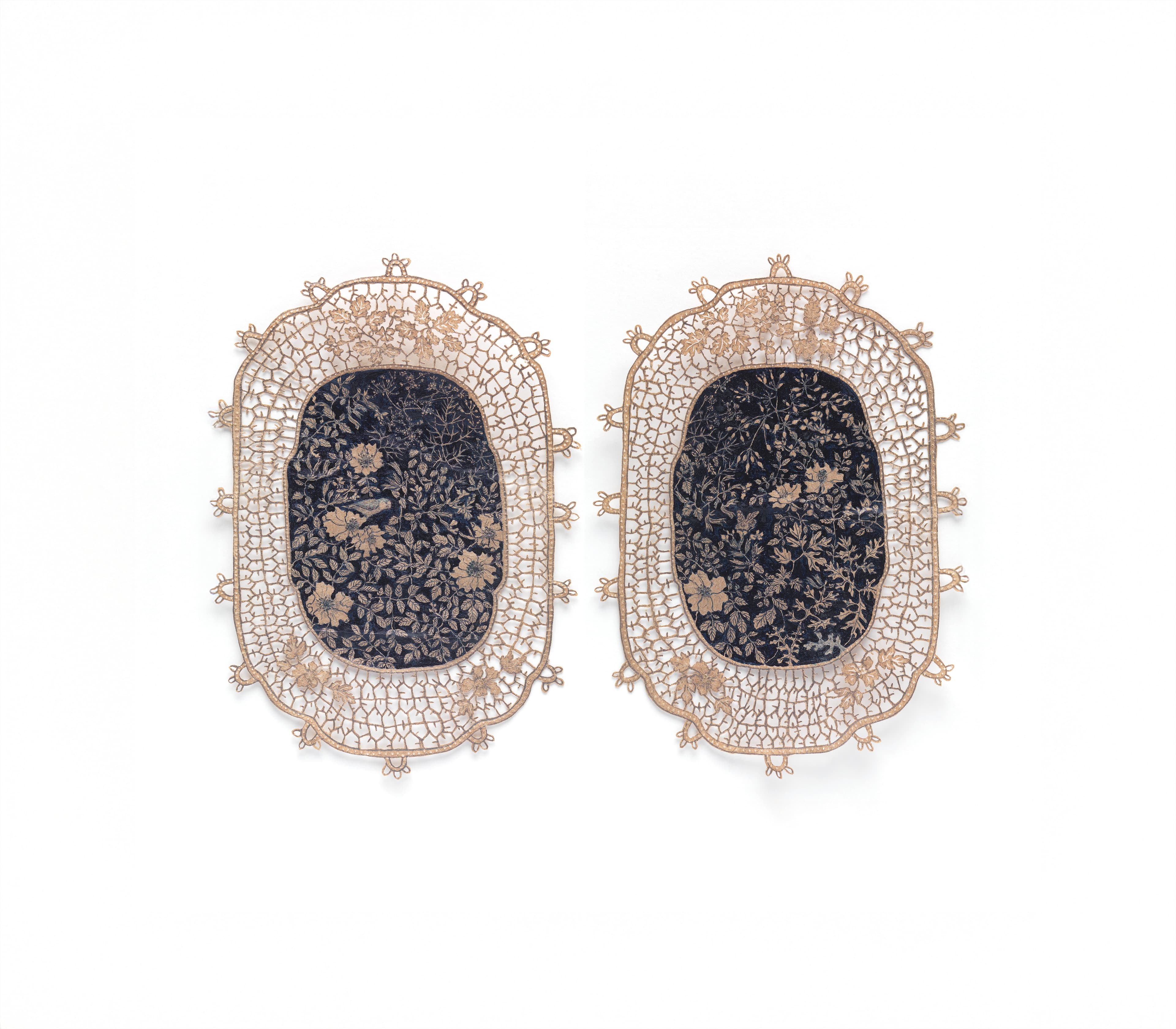
Jasmin Sian, if i had a little zoo, 3, 2013. Ink, graphite, and cutouts on deli-bag paper, diptych: 5 × 3 1/2 in. (12.7 × 8.9 cm) each. Collection of Jasmin Sian. © Jasmin Sian. Courtesy the artist and Anthony Meier, Mill Valley.

Occasionally, some thing hits. Perhaps for being just the right amount of caffeinated, or the light streaming through the window in just the right way, or seeing something after a tiring day … this thing resonates. For lack of a better word, we call it art. And once that happens, all hell breaks loose.
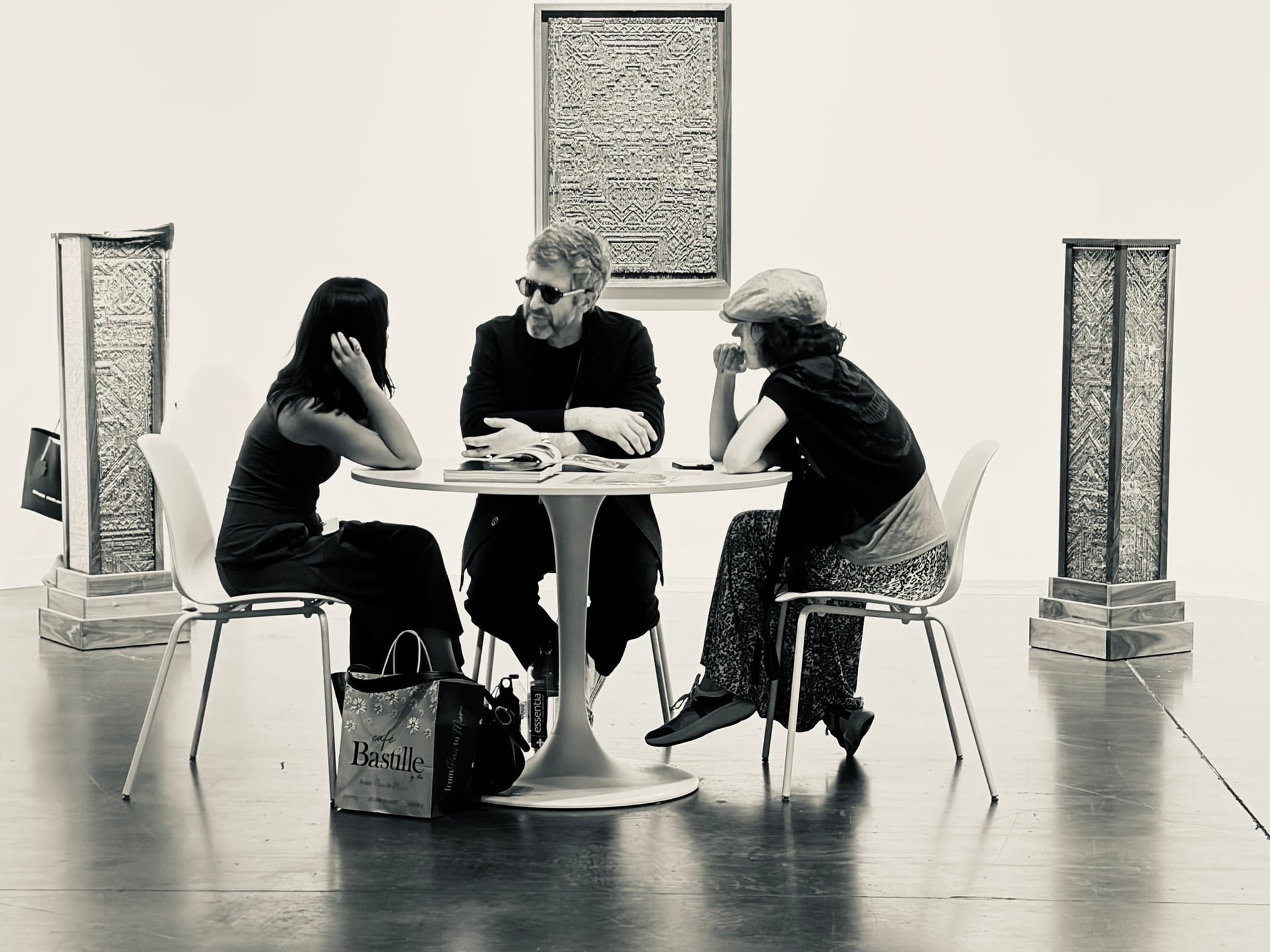
Left to right: Eleonora Brizi, Adam Berninger, and Charlotte Kent at Art Basel Miami, 2025. Works by Michael Kozlowski, Tessellations: Sia (wall relief, 2025), and Tessellations: Broken Pixel (floor sculpture, 2025). Photo: Kelly LeValley Hunt.

Artists’ recent approaches to machinic agents showcase the designed attributes of different systems. Artist and environmental engineer Tega Brain wisely pointed me towards the Critical Engineering Manifesto (2011–21), written by Julian Oliver, Gordan Savičić, and Danja Vasiliev, which offers a guide for how creative misuse can help us resist totalitarian systems.

Sarah Rothberg, FOREVER MEETINGS: SCRAMBLED ZONE, 2025. Custom software (developed with Unity3d + Node.JS, Ollama + Llama 3.2 (local LLM), Coqui AI (local TTS), avatar sculpted using Oculus Medium).

Just like the mind is not a computer, memory is so much more than information. By all accounts, memory includes forgetting, as well as the ability to recall. There is a danger in our frailty, the ease with which history gets reshaped or erased. At the same time, it’s in the certainty of this uncertainty that how and what we piece together matters.

Sean Fader, Left: Documentation of Sony Digital Mavica, Right: Detail of image from Sony Digital Mavica, 2020.

What might we gather in looking and thinking more carefully? As we proceed with vital concerns for our planet, global and immediate communities, and the arts in all their forms, a critical engagement with AI may disclose ideas and practices for other causes that matter to us.

Brendan Dawes, Altarpiece: The Divinity, 2025. Archival print on Hahnemühle Photo Rag Metallic 340 Paper, designed with Houdini, Stable Diffusion, Flux1-schnell-fp8 models, proprietary LORAs and Comfy UI.

Though much of the work I will encounter in Japan has been described to me or identified in various articles as nostalgic, I found the term disorienting.

Saeko Ehara, Untitled, 2024. Personal photographs, ComfyUI, Adobe. Courtesy the artist.

Last month, I ended this column on an argument made by the philosopher Jennifer Corns that agency may be best served when we consider our various agentive forms. Thinking in multiples challenges us because it presents different perspectives, and so requires considering assorted contexts. This moment around generative “AI” has some artists trying to express how “artificial intelligence” is not a single thing, and how it is a medium of quantities.

Michael Mandiberg, Topic 32, Pose 13, Gesture 2 (shock, surprise, mouth, etc.), 2024. Pigment print made from 64 found photographs selected and sequenced by custom AI and Machine Learning software. Courtesy the artist.

Posthumanist theories, science and technology studies, and social constructivism have argued for the way in which one is never isolated and independent, but a being influenced by and influencing an environment. So what kind of agency is possible regarding the climate crisis or generative AI? 

Novel Protocols for Networks and Agency

Eno isn’t one film, but many, and the viewer’s response is complicated by this iterability; now in its fourth generation, change is part of its discourse. The nature of digital is to make variation and modularity possible. A generative film takes advantage of that quality.

Generative Film’s Potential: Eno
This two-part column focuses less on a specific show or event, but reflects on this idea of the avant-garde to observe its dramatically shifting application to art movements and practices. Part one focused on the nineteenth and twentieth century references. This second part continues last month’s history of the term avant-garde, to consider its application to media art.
Ward Shelley, Who Invented the Avant Garde, Redux, 2020. Toner, ink, and acrylic on mylar30.625 x 65.19 inches. Courtesy Ward Shelley and Pierogi Gallery.
This two-part column focuses less on a specific show or event, but reflects on this idea of the avant-garde to observe its dramatically shifting application to art movements and practices. The first part focuses on the nineteenth and twentieth century references with the second part examining its relevance to media art.
Munetsugu Satomi, K.L.M., 1933. Collection of William W. Crouse. Courtesy Poster House.
Amidst the consumerist frenzy after Thanksgiving, it might seem gruesome to think about ye old cashola, but two shows at the Morgan Library offer humorous images as well as strange moral presumptions that invite comparison to the frameworks of our own era. Money is a technology. So is language.
Hieronymus Bosch, Death and the Miser. Oil on panel. The Netherlands,'s-Hertogenbosch, ca. 1485–90. National Gallery of Art, Washington, D.C., 1952.5.33 / SAMUEL H. KRESS COLLECTION.
Joel Meyerowitz never stops. With shows this fall in Berlin, London, Paris and, locally, in Montclair, New Jersey, Meyerowitz also presents photographs from his archive daily through an online platform, Fellowship. His energy is inspiring. His excitement for the medium, contagious.
Portrait of Joel Meyerowitz. Pencil on Paper by Phong H. Bui.
For a while, I have avoided the word crisis as it refers to our ecological condition because it seemed to provoke an intellectual standstill, the kind of dismay that concludes effort or even further consideration. Recent chatter about the AI crisis appeared similar. The crisis in arts funding did the same. There are even claims of a crisis in any social imaginary. Recently, however, I have begun to wonder if the permanent crisis of the humanities might not provide a different attitude towards crisis across these different areas.
Morehshin Allahyari, ماه طلعت Moon-Faced (2022-23). Courtesy the Ford Foundation. Photo: Sebastian Bach.
The UN Secretary-General announced through a press briefing on September 6, 2023 that “climate breakdown has begun. Our climate is imploding faster than we can cope with extreme weather events hitting every corner of the planet.” Later in the month, Poster House opened We Tried to Warn You! Environmental Crisis Posters 1970–2020. The show introduces the history of our national environmental efforts but also goes beyond them to present international posters.
Milton Glaser, Give Earth A Chance, 1970. Poster House Permanent Collection. Courtesy Poster House.
Musical Thinking doesn’t simply beat the drum of aesthetics as politics, but provides a context in which to remember that politics are aesthetic and, as will shortly be evident with another election cycle, provide many a song and dance. Grayson’s curatorial sensibility tunes difficult content into a poignant show representing the diversity of this nation that some of its representatives insist on denying.
ADÁL, West Side Story Upside Down, Backwards, Sideways and Out of Focus (La Maleta de Futriaco Martínez), 2002. Suitcase, flat-screen LCD monitor, single-channel digital video, color, sound; 12:51 minutes, 14 x 20 x 7 inches. Smithsonian American Art Museum, Museum purchase through the Luisita L. and Franz H. Denghausen Endowment, 2013.20A-B, © 2002, ADÁL. Courtesy the artist and Smithsonian American Art Museum.
On August 16, Mitchell F. Chan launched a wry and ambitious work that used baseball as a vector through which we might better understand the statistical presumptions of our datafied existence. The incisive socio-political and economic critique wrapped in the trojan horse of gameland’s choose your own adventure makes The Boys of Summer a revelatory experience.
Mitchell F. Chan, Helen Lee, The Boys of Summer, 2023. Digital Asset.
At the end of April, the gallery Nunu Fine Art opened in New York City with works by the Cuban multi-media artist duo Ariamna Contino & Alex Hernández Dueñas about glacier retreat and sea level rise, the collection of climate data by researchers and its marginalization by political forces, and therefore the necessity for an environmental ethics driven by cultural effort.
Ariamna Contino & Alex Hernández Dueñas, Reverse, 2023. Salt water, reverse osmosis mechanism, handmade activated carbon and resin filters, and ice maker, dimensions variable. Photo: Martin Seck.
Because this month I had the honor of acting as Guest Editor for the Critics Page, where I invited global curators and scholars to contribute a word they’d like to see or never see again in the discourse around art and technology, I thought I would develop this month’s column around the words that artists use and encounter about their practice—across media. So I asked them what silly, uncomfortable, or productive term they encountered. It could be something said to them or something they say to themselves. Leaving aside the linguistic debates around performative utterances, words act around art as a network of ideas, a system if you will, or a kind of scatterplot of imaginative relations.
A Language Cairn: Artists on Their Practice
The words we bring to art intend, at best, to translate the perceptual realm into the linguistic, anchoring sensation through definition. But, as we all know, that often doesn’t occur. The well known essay, “International Art English” by Alix Rule and David Levine skewers that premise, as does Tom Wolfe’s The Painted Word (1975) nearly forty years earlier, and a decade before that Susan Sontag’s “Against Interpretation” resisted language’s simulacrum of art. So on, down the line. And yet, words also serve to support, promote, highlight, associate, and adore the art they describe.
Portrait of Charlotte Kent. Pencil on Paper by Phong H. Bui.
Though much attention has been given recently to certain artists’ experimentations with AI, best described and dismissed as spectacle (in the true Debord sense), any number of artists have challenged and even mocked the technology and its specious claims to neutral operating systems or unconditional utility.
Image by Fernando Diaz with Mashinka Firunts Hakopian. For The Institute for Other Intelligences (X Artists’ Books, eds. Ana Iwataki and Anuradha Vikram, design by Becca Lofchie).
Two museum shows opened in February about art and technology that, combined, span the last seventy years and present some of the different discourses surrounding the convergence of these two fields. I’ll Be Your Mirror: Art and the Digital Screen, curated by Alison Hearst at The Modern Museum of Fort Worth presents nearly every contemporary medium from paintings and installations to games and face filters in an expansive exhibition of fifty artists across twelve sections touching on some of the major psycho-social outcomes of our mediated landscape. Coded: Art Enters the Computer Age 1952-1982, curated by Leslie Jones at LACMA includes prints, video, textiles and sculptural objects that admirably present a historical trajectory of artists’ experimentations with the possibilities of computational devices across those early years, when design limitations foregrounded composition and structure. Those constraints also contributed, occasionally, to a kind of didacticism, for which the field remains frequently derided.
Gretchen Bender, Total Recall, 1987, Eight-channel video on 24 monitors and three rear projection screens; 18 minutes, 2 seconds. Installation view, Red Bull Arts New York, March 6-July 28, 2019. Courtesy the Gretchen Bender Estate and Sprüth Magers. © Gretchen Bender Estate. Photo: Lance Brewer.
On the occasion of Christian Marclay’s exhibition at the Centre Pompidou, the artist sat down with Charlotte Kent for a wide ranging conversation on the various entry points to his work. In the edited version below, they discuss Marclay’s long-standing fascination with doors and transitions—obscure, improvised, and ongoing.
Portrtait of Christian Marclay, pencil on paper by Phong H. Bui.
’Tis the season of giving, and artists—more than most—donate works for auctions and benefits to support schools, charities and institutions. They donate work that represents their hard earned labor in the name of exposure, by complicated requests from current collectors or supporters, and for the possibility of being brought into significant collections. For most, it’s a wary offering, aware that indifference even in this out-of-market context can nevertheless be a mark against their markets. As many have noted before, lawyers don’t donate their services nor doctors their treatments. What if it didn’t have to be this way?
Rhea Myers, Titled (Information as Property as Art) [Ethereum Null Address], 2022. PDF file. Collection Buffalo. Courtesy the artist and Buffalo AKG Art Museum.
Loy’s poetry is deftly woven across this biography, both to present life experiences in her own words, as well as highlight her extraordinary ability to turn language into insight.
Mary Ann Caws’s Mina Loy: Apology of Genius
The last couple weeks have been dominated by conversations about political life alongside a slew of panels about our future with virtual spaces, most frequently called Web3 or the metaverse. Anxieties about both are appropriately rampant. Amidst this nail-biting, I was reminded how artists across media can shift the dialogue out of despair without launching into resolved utopian thinking.
Sharon Hayes, We Won't Go Back, 2022. Acrylic paint and newsprint (May 2020-June 2022) on textile, 32  x 53  inches. Courtesy the artist and Tanya Leighton, Berlin and Los Angeles.
Time is a socio-technological system with profound organizing qualities that feels, these days, exceedingly oppressive. There’s never enough time! For anything. Calendars are the earliest containing device with the purpose of determining a social order; the history of the Roman calendar reveals the role of international and national politics that play out across each new temporal infrastructure. Our temporal orders have been designed through the global proclamation of Greenwich Mean Time in 1884 by colonial empires, the apocalyptic anxiety provocations of the doomsday clock established in 1947, the insistent instant-ness of digital time since the 1970s exacerbated by strings of video chat meetings of the last couple years, and the frenetic branding of our social/professional lives demanded by transnational corporate technology’s mediation of everyone and everything, all the time. It’s a mess.
Raphael Arar, Capitalist Clock, 16..5 x 4.5 x 4.5 inches. Courtesy the artist.
My last column addressed generative art, a practice in which artists often use data sets to create complex works about our world. But where does that data come from? And, more importantly, can the aestheticization of data ignore its historical context or the privacy issues of its contemporary context?
Sasha Stiles, Poet, Unprotected, 2022; Virtual palimpsest of digitally rendered poetry on aged, analog paper; mp4, TRT: 1 min 30 sec. Image courtesy of the Artist and EPOCH.
This column aims to focus on art that engages technology as a medium or a topic. We live in a digital culture and I have found that I better understand the technologies I use, as well as what to reject, in no small part through the thoughtful efforts of artists. I’ve grasped the subtleties of coding and computational design by hearing about how artists struggle with it. I’ve reconsidered the history of art because it suddenly seems so strange that the last five hundred years of creative practice could be presented as if these artists were not responding to, discussing, and adopting technologies ranging from perspective, gross anatomy, printing, navigational charts, biological categories, camera obscuras, trains, electrification, photography, moving image, and here we start to get into the more recent technologies that are so easily disdained: television, computers, the internet, social media
Installation view: Tezos Booth, Art Basel, 2022.
Ultimately, the point is not to leave new technologies, which are value-neutral to begin with, to technocrats, commerce and the military complex alone. Art is also part of our society, and it should deal with the tools of today’s society.
Herbert W. Franke with Charlotte Kent
This spring, the Rauschenberg Foundation partnered with Mnuchin Gallery and Gladstone Gallery to present two distinct but connected exhibitions that portray the lightness and irreverence that is integral to his works’ continued success.
Robert Rauschenberg, Untitled (Venetian), 1973. Tire tread, wood, and water, 28 x 78 x 55 5/8 inches, variable. © Robert Rauschenberg Foundation. Courtesy the foundation and Gladstone Gallery. Photo: Ron Amstutz.
We need works like Technelegy to help us mediate the complex relationship we have with technology—to go beyond the terror or shame that proliferates in media reports.
Sasha Stiles’s Technelegy
The curators, Tina Rivers Ryan and Paul Vanouse, focus their broad agenda through four themes: the use of digital technologies for passive (but not always effective) surveillance, how identities are shaped by technology, the erasure of marginalized communities, and the active reassertion of control.
Visitors with A.M. Darke's 'Ye or Nay?, 2020, in Difference Machines: Technology and Identity in Contemporary Art at Albright-Knox Northland, on October 16, 2021. © A.M. Darke. Photo: Jeff Mace for Albright-Knox Art Gallery, Buffalo, New York.
Charlotte Kent profiles the Foundation for Contemporary Arts and finds the the venerable institution as nimble and necessary as ever.
Poster for 9 Evenings: Theatre & Engineering, 1966. Design by Robert Rauschenberg. © Robert Rauschenberg Foundation.
At stake in the new Pace group exhibition Convergent Evolutions are the questions of who gets to be seen, when, and how. The exhibition of 17 artists who range across 60 years, multiple media, and assorted styles brings together poignant contemporary concerns about representation.
Lucas Samaras, Panorama, 1983. Polaroid Polacolor II assemblage, 50 3/4 x 16 1/4 inches overall. © Lucas Samaras. Courtesy Pace Gallery.
There is a light touch here that nonetheless manages to be immersive. The retrospective is selective in its offerings, and though much is necessarily missing, there is no sense of lack, but rather encouragement to seek out more on your own.
Gregg Bordowitz addressing AIDS Activists during protest in NYC. 1988. Gelatin silver print, 8 x 10 inches. Courtesy the artist. Photo: Lee Snider.
The seven artists included in this exhibition offer variations on the idea of digital sculpture, and through that format press against the fraught discourse of the un/real within digital art.
Claudia Hart, kiki.object, 2021. 3D-rendered animation, certificate 2400 × 1800 pixels; 1200 × 900 pixels. Animated GIF, JPEG. Courtesy Feral File.
As expressions of mortal transience, commodity culture, or composition, still lifes make us pause. Across photography, video, mixed reality, and a variety of digital arts, the 15 artists in Still/Live at the Katonah Museum of Art find new methods for modernizing the genre. Curator Emily Handlin brings together a selection of works that exhibit an interest in the history of still life in order to expand its range of meanings and expression for our own time.
Sharon Core, 1610, 2011. Archival Pigment Print, 19 x 14 3/4 inches. © Sharon Core. Courtesy the artist and Yancey Richardson, New York.
Year Zero offers a compelling argument for dismissing distinctions between physical and digital art as Auriea Harvey's digital and material practice merge in this impressive body of sculptural works.
Auriea Harvey, Webcam Movies, 1999. Video (color, sound), CRT monitor, media player, 5 min 56 sec, loop, 17 1/2 x 16 1/2 x 17 inches. Courtesy bitforms gallery, New York. Photo: Emile Askey.
Ladders appear across spiritual traditions linking the lower and upper, the earthly and material with the everlasting and transcendent.
Installation view: William Corwin: Green Ladder, Geary Contemporary, New York, 2021. Courtesy Geary Contemporary.
The goal of MoMA’s Engineer, Agitator, Constructor: The Artist Reinvented, 1918–1939 is to showcase the ways that artists participated in spreading radical new ideas made urgent by World War I and the 1917 Russian Revolution. The exhibition largely focuses on activity in what would become the Soviet Bloc, as artists enthusiastically adopted new print and distribution technologies, and embraced a geometric, abstract aesthetic that dramatized their rejection of the decadent, bourgeois parlor.
John Heartfield (born Helmut Herzfelde), The Hand Has Five Fingers (5 Finger hat die Hand) (Campaign poster for German Communist Party), 1928. Lithograph, printed by Peuvag-Druckerei, Berlin. 38 1/2 x 29 1/4 inches. The Museum of Modern Art, New York.
Mary Mattingly’s recent photographs in Pipelines and Permafrost stitch together a story of geologic deep time for the imagination. The New York-based artist has always woven ecological concerns into her public works and photography practice, committed to helping audiences question how the land and water resources as well as the products and presumptions of our lives came to be.
Left to right: Mary Mattingly, The Gualcarque River, 2020. Chromogenic dye coupler print, 72 x 18 inches. For Berta Cáceres, her daughter, and their work continuing the fight against the Agua Zarca dam along the Gualcarque River in western Honduras on territory inhabited by the indigenous Lenca Peoples. A Controlled Burn, 2020. Chromogenic dye coupler print, 60 x 18 inches. For the stewards of traditional ecological knowledge that have worked for generations promoting healthy forest growth with controlled fire application. Rematriation, 2020. Chromogenic dye coupler print, 72 x 18 inches. For the Green Belt Movement, led by Nobel Peace Prize winner Wangari Maathai. Maathai received the Nobel for leading an effort to plant 30 million trees in Africa, that has led people to do similar work around the world. © Mary Mattingly. Courtesy Robert Mann Gallery.
In The Archive to Come, curators Clark Buckner and Carla Gannis invited artists to contribute a work of their choice that responded to “questions of loss, memorialization, crisis, and re-invention … questions about what we value and want to preserve as we work to recover from their ravages and build for the future.”
Installation view: The Archive to Come, Telematic Media Arts, 2020.
Hart travels in hyperreality, thinking through media archeologies and post-photographic practices, but is also a draughtsperson and painter. All of this merges forcefully in bitforms’s exhibit, which recognizes the failures of so many Eurocentric utopias, and yet engages modernism in a way that releases any hold those artists, designers, political and cult leaders once had.
Claudia Hart, The Orange Room, 2019. Video animation (color, sound), media player, screen or projector, dimensions variable, landscape orientation, 5 minute loop. Courtesy bitforms gallery, New York. Photo: Emile Askey.
Moving past familiar questions about art, machines, autonomy, and authorship that have been around since the invention of photography, the generative artworks on view through Kate Vass’s website offers a chance to think about our respective starting points, the steps we take, and how rules apply in this game of life.
Manolo Gamboa Naon, Mantel Blue, 2018. Courtesy Kate Vass Galerie.
Online exhibits provide a different viewing experience. If all these works were in the Lower East Side gallery, you might walk in, look around, occasionally watch one of the time-based works, perhaps put on headphones for sound, and meander to the next piece. The online configuration asks for greater engagement, something that surprises many by requiring a conscious commitment to the work.
Shi Zheng, Umwelt [sim], 2020. Video (sound, color), media player, screen or projector. Dimensions variable, landscape orientation, 7 min 13 sec, loop. Courtesy bitforms.
The charming critters by Iwan Effendi and Mulyana presented in Jumping the Shadow, curated by John Silvis at Sapar Contemporary, invite reflections on our empathy towards lives (that only seem to be) beyond our own.
Installation view: Mulyana & Iwan Effendi: Jumping the Shadow,  Sapar Contemporary, New York, 2020. Courtresy the artist and Sapar Contemporary.
Amidst the rise of online viewing rooms for shows we might not otherwise see, Lehmann Maupin made the decision to provide us backgrounds to shows we have. In Developing TiME LiFE, the gallery presents studies (available for sale) as well as information from Hernan Bas about the process for his most recent fall 2019 show.
Hernan Bas, The Sip In, 2019. 84 x 108 inches. Courtesy the artist and Lehmann Maupin, New York, Hong Kong, and Seoul.
Her whole approach is an impressive refutation of a technical world. The gesture of the hand, with all its imprecision, is so very human. The messiness is a surprising oasis.
Rita Ackermann, Mama, War Wall, 2019. Oil, china marker, and pigment on canvas, 76 x 74 inches. © Rita Ackermann. Courtesy the artist and Hauser & Wirth. Photo: Thomas Barratt.
It is a cathedral to art, and Reed has produced altars to the art and history of painting. Only that makes them sound serious and stern, possibly boring, and these are not that. Most notably, there is humor throughout.
David Reed, #713, 2017-19. Acrylic, oil, and alkyd on polyester, 28 x 112 inches. © 2020 David Reed/Artists Rights Society (ARS), New York. Photo: Rob McKeever. Courtesy Gagosian.
The figures falling off walls in Robert Morris. Monumentum 2015–2018, at Rome’s Galleria Nazionale, seem like an extension of the Baroque city’s architectural and sculptural tradition. The works in this show's situation in Rome provides a different set of perceptual relations than when the same body of work was displayed in New York.
Installation view: Robert Morris: Monumentum 2015–2018, Galleria Nazionale d'Arte Moderna e Contemporanea, Rome, 2019–20. © 2019 The Estate of Robert Morris / Artists Rights Society (ARS), New York. Courtesy Castelli Gallery.
McCullers’s work evokes a sense of alienation—both from society and, crucially, from oneself. However, to many she also represents an enthusiastic, if not necessarily fully consummated, embrace of her own desires.
Installation view: The Heart is a Lonely Hunter, Equity Gallery, New York, 2019. Courtesy Equity Gallery.
“Computer graphics is a young and new way of aesthetic communication; it integrates human thinking, mechanical handling, logic, new possibilities of drawing, and incorruptible precision of drawing—a new DUKTUS!” So wrote Manfred Mohr in 1971 celebrating this “duktus,” the Latin term for handwriting, also used in German to acknowledge the individual peculiarities of a medium or someone’s style.
Manfred Mohr, Cubic Limit, 1973–1974. 16mm film, black and white, silent, with digital transfer, 4 min. Courtesy bitforms gallery, New York.
The lighting for Gina Beavers’s exhibit The Life I Deserve is Instagram perfect. That seems only fitting for paintings based on social media posts and aware that they will return there as #art #museum #artselfie or even, in a potential throwback to 2015, #museumselfie. The artist’s #Foodporn series from 2014 gets particular attention, though the newer series based on makeup tutorials had some snapping pics as well. All this begs the question, what are we looking at?
Gina Beavers, Local Pasteurized Beef, 2014. Acrylic on canvas. Courtesy the artist.
Motherhood is a role partly defined by its expectation to survey, observe, and discern, so the work also shows the shifting roles of surveillance within familial
Julia Scher, Information America, 1995, Metal office desk, 5 9" NTSC monitors with metal, wall brackets, 13" color monitor, plastic and vinyl signage, 3 black-and-white surveillance cameras, removable lenses, transformers, 2 homing bridging switchers, 2 time-lapse recorders, Amiga A1200HD computer, Sony WatchCam, 2 media players, desk lamp, office chair, wires and cables. Overall dimensions variable (desk: 29 x 60 x 30 inches). Courtesy Ortuzar Projects.
Looking back, I think I started reading stories about art because I tired of eros and arate. In the wrath of The Iliad or Woolf’s The Waves, through the passion of Shakespeare’s Romeo and Juliet or Nabokov’s Lolita, humanity’s highs and lows were exhausting.

Close

Home