Art and TechnologyOctober 2023
We Have Tried to Warn You: From Climate to AI

Word count: 2252
Paragraphs: 21
The UN Secretary-General announced through a press briefing on September 6, 2023 that “climate breakdown has begun. Our climate is imploding faster than we can cope with extreme weather events hitting every corner of the planet.” Later in the month, Poster House opened We Tried to Warn You! Environmental Crisis Posters 1970–2020. The show introduces the history of our national environmental efforts but also goes beyond them to present international posters. Raised in the shadow of Nixon’s political betrayal, I remain disconcerted by this bad guy’s good effort in his 1970 State of the Union address that called attention to our climate condition: “The great question of the seventies is, shall we surrender to our surroundings, or shall we make our peace with nature and begin to make reparations for the damage we have done to our air, to our land, and to our water?”
The proclamation of Earth Day later that year was part of a bipartisan effort that also produced the Clean Air Act, the Environmental Protection Agency, and contributed to the formation of Greenpeace in 1971 and the UN Environment Programme in 1972. We Tried to Warn You! is a small show organized around air, water, land and fire with extensive didactics that contextualize the events depicted or alluded to in posters and the poster designers’ own commitments to environmental causes.
Many of the posters urge viewers to repair what we have done to nature, just as Nixon states above. This tactic aims to produce a sense of responsibility, but many have pointed out recently how it retains a distinction between humans and nature. We are a part of nature. The Milton Glaser poster Give Earth a Chance (1970) offers one attempt at visualizing this by putting a floating planet inside a room. Stasys Eidrigevičius’s poster for the 1989 Ecological Seminar has birds blending into a head, a kind of posthumanist, companion species model of planetary cohabitation.
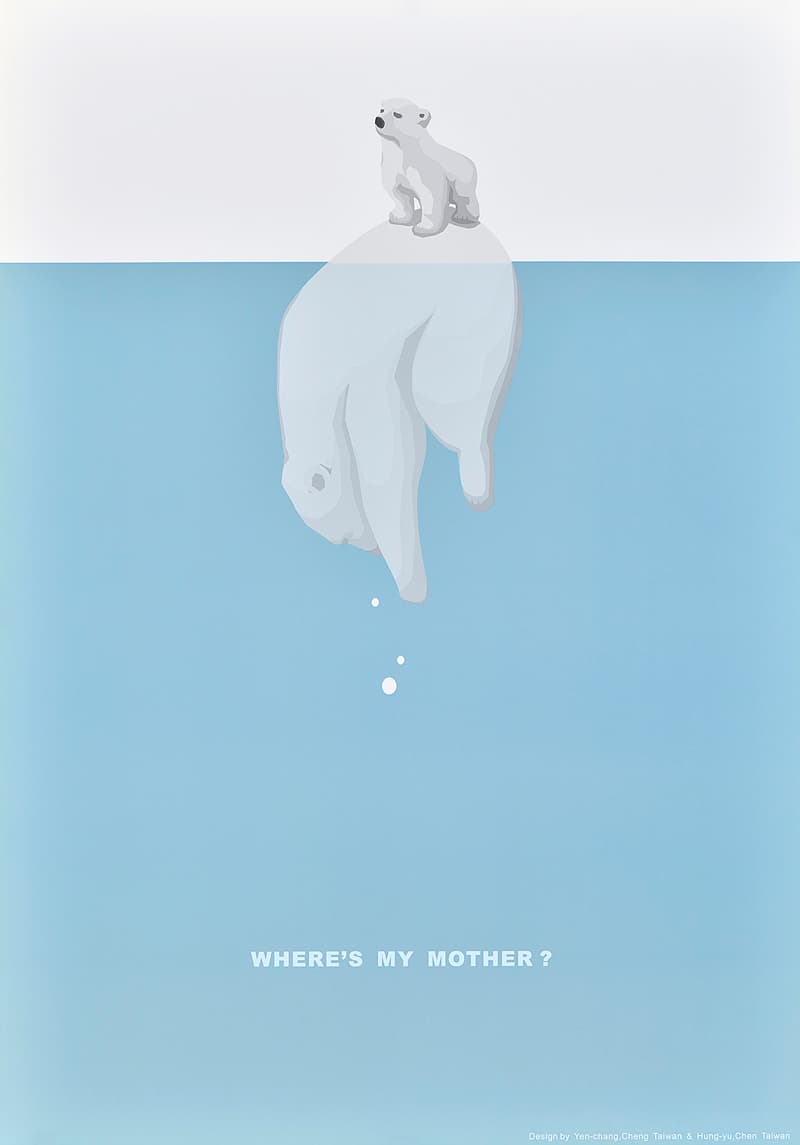
Yen-chang Cheng & Hung-yu Chen’s Where is My Mother? (2008) shows a polar bear cub standing on the mostly submerged body of another bear with the title in small white letters floating in the blue expanse of the poster. It’s simple and heartbreaking. It may traffic in natalist sentimentality, but it also tangentially introduces the toll of consumption driving climate chaos as a kind of iceberg, whose tip is layers of loss—and death.

This is not a cheerful exhibition, but neither is the topic. Even childhood iconography like Sesame Street gets appropriated by Winston Tseng for Countdown to Mass Extinction (2022), which he illegally displayed on walls and bus stops around NYC in 2022. Such renegade actions become necessary when business has the power to curtail political or cultural efforts towards change.
Eric Carle, famous for The Very Hungry Caterpillar, produced For Every Child a Tree, as part of the 1982 UNEP conference in Kenya. The arboreal concern stemmed from the mass decimation of forests in South America after the World Bank subsidized highway development and agricultural settlements. The museum didactics share the statistic that deforestation of the Amazon reached nearly an acreage the size of New Jersey per year. Efforts to plant trees over the last forty years notwithstanding, current estimates of rainforest destruction increased to the equivalent of nearly two New Jerseys annually.
Other posters about air and car emissions include reminders that the oil industry knew the effect of fossil fuels by July 1977 but hid that information. The Exxon senior scientist James Black stated that the most obvious way “mankind is influencing the global climate is through carbon dioxide release from the burning of fossil fuels,” and a year later explained that “doubling of the C02 concentration in the atmosphere would produce a mean temperature increase of about 2°C to 3°C over most of the earth.” The degree of misconceptions promoted by the oil industry is well known, including its problematic shift in responsibility to individuals through a carbon footprint estimator.

There are obvious parallels to our current frustrations with technology empires. Their products have a negative social, political, human rights, labor, and environmental impact, which have been well documented by psychologists, ethicists, journalists, artists, and former employees, as well as most of us from sheer experience. Posters may be used for propaganda but also to inform. So, how can we learn from the last fifty years of environmental messaging to better address our AI moment?
The recent play by Annie Dorsen, Prometheus Firebringer, imagined the lost play of Aeschylus’s trilogy to address the rise of AI, specifically image and text generators. The performance lecture was structured in a fluctuation between two sets of content. On the right side of the stage, Dorsen sat at a desk reading a lecture about tragedy and the impact of technology that she formulated from an assortment of books, interviews, and even social media comments, all of them cited on a screen behind her. In the center of the stage was a mask derived from an image generator with a speaker in its mouth that spoke AI text-generated content as Prometheus; further left were five masks on posts representing a Greek chorus of orphan children, likewise using large-language-model-generated text. On one side, the influence derived from reading. On the other side, algorithmic construction. This structure worked nicely for the argument Dorsen was making, but the use of the Prometheus plays confused the issue for me.

Prometheus gifts humankind with fire and “blind hope” to help them survive when Zeus wishes to exterminate them. The first enables humans to survive, the second hides from them the knowledge of their death so that they may pursue life spiritedly. For these gifts, Prometheus is condemned to an eternity of having his ever-regenerating liver eaten daily by an eagle (or vulture).
The third and lost play of Aeschylus, Prometheus the Fire-Bringer, is rumored to be about Prometheus’s knowledge of something that would destroy Zeus and how sharing that secret leads to a reconciliation. Prometheus’s gifts have led to his symbolizing technology. The historical context of the Aeschylus plays is the rise of democracy and defeat of tyrants in Ancient Athens, such that Prometheus represents the support of the people in the face of authoritarianism. Thus, we get Prometheus as technology that helps people defeat the bad.

This doesn’t align with the message I thought Dorsen was presenting in her production of Prometheus Firebringer.
Prometheus and the chorus in her play are materializations of a technology that her lecture implicitly rejects. Given the structural set-up and oppositional stance, her lecture and its ideas would seem to become Zeus, that is the tyrant, who has Prometheus suffer, bound to a rock. Prometheus tells the tyrant a secret to keep him in power, and thus gets to return to Olympus… so, this representative of technology will share the black box secret to ensure the tyrant stays in power? Didn’t we just see this with Cambridge Analytica and the 2016 US election? Except that the tyrant in her play’s structure is represented by quotes from everyday people and a stream of intellectuals that I find reasonable and would struggle to call tyrants. Nor do they have any power currently to maintain in the face of the black box software and hardware companies that are our technological overlords. Perhaps if we (because, after all, the quotes Dorsen uses are meant to represent us and our thinking) got power then we could bind them to a rock and only free them if they tell us about their hidden algorithms? I found myself contorted trying to make the play retain its sense-making construct.

It was also hard to make sense of her position given the timing. The actors’ and screenwriters’ guilds had been on strike, specifically in opposition to the situation that her play manifests: six chatbots for actors and half a play “written” by an algorithm. Granted, her play shows the weirdnesses of prompt-based software–since its portions alternated between stilted, inopportunely amusing, repetitive, and such—but, to be quite honest, a Greek chorus often feels that way. And, here again, I struggled. A Greek chorus was meant to represent an enlightened moral stance, one usually ignored to the detriment of the character. So then, we should attend to the meaningless syntax of text-based generators?
That would be difficult if the accessibility prompter for the hard-of-hearing in the theater was any indication, as it had such a difficult time interpreting the chat bots that much of the text was garbled or lost. For a moment, I thought this was an intentional part of the performance: an AI could not understand an AI, but I could understand that an AI could not understand the AI and so knew that I could not understand what was happening (based on the text shown). Maybe this shows that accessibility and translation still need human agents, although that point was made at the cost of actual accessibility.

The greater difficulty was that I enjoyed the play. I liked the structuring and comparison of influence versus algorithm. I enjoyed the masks. I thought the funny voices of the chatbots worked. The bad algorithmic text amused me. It seemed to make sense… until one thought about it, as I have tried to show. That is the danger, and it is not a danger derived from the technology.
The ease with which we can deride or dismiss what these technologies do means we apply that rejection with the mindlessness that these machines represent. Our human talent is to think through the complexities of symbolism and analogies, rhetorical devices and constructs. We must do that if we are to oppose the tyrannical power these systems are being granted. Prometheus Firebringer wound up operating as spectacle about AI, an entertaining presentation of what the audience already thought. It did not open up new ways of thinking about these technologies to enhance our opposition. If tragedy is an emergency brake on accelerationism, as the lecture portion at one point stated, then it is worth remembering that tragedy is a literary form where one’s hubris is one’s downfall. In this play, I am not sure whose hubris or what hubris is leading to whose downfall.

The only extant line of the lost Aeschylus play is “Quiet, where need is; and talking to the point.” Talking about how these algorithmic systems appear in our lives is white noise to the real conversation about what to do about them. Just as the Poster House show’s title clearly states, we have been warned, explicitly, over and over again.
I am well aware that billions of dollars have been spent developing these language and image generators. A similar amount has been spent on bots and surveillance systems that are racist, sexist, etc., etc.… If someone made a child’s doll that randomly spewed the biased content that these algorithmic softwares provide police, education, insurance, and so on, we’d have the product removed from shelves no matter how much money the toy company had spent in manufacturing. If a printing press regularly slammed a worker’s fingers so that the person could not themselves write after a while, that would be an objectionable product. If a car has regularly malfunctioning brakes, it is pulled from the stock line. With all due respect to the labor and time spent producing these generators, if the companies can’t ensure that their product doesn’t produce viable products for an equitable society, then we can ask them to recall the product, fix it and… that isn’t the end of the story.
The reason people like me keep saying we need to deal with these technologies is because even if they are fixed, they will return. But to what end? For what purpose? The same fill tool that people use in Photoshop contributes to fake images and video content. The same cleverness that provides you with the searches you want online, tracks you. The computers that calculate the acceleration of climate change themselves demand huge amounts of energy. And yet, as Karen Bakker showed in The Sounds of Life: How Digital Technology Is Bringing Us Closer to the Worlds of Animals and Plants (2022), we can also learn about what we have ignored through these computational systems. We are in a quandary that demands careful critique, not easy derision, nor pat rejection. In terms of AI (the panoply of algorithmic softwares, predictive and surveillance technologies that the term represents), this is our 1970. It's my blind hope that we can engage complexity in today’s warnings, and not ignore them as in past ecological efforts, or as one scholar recently wrote: “Works of imagination can play a crucial role in raising awareness, provided we succeed in avoiding the sterile dichotomy of credulous techno-optimism and a priori dystopic representations.” We are part of nature and technology is part of us.
Charlotte Kent is Associate Professor of Visual Culture at Montclair State University, an Editor-at-Large for the Brooklyn Rail, and an arts writer.