Annabel Keenan

Annabel Keenan is a New York-based writer specializing in contemporary art and sustainability. Her work has been published in the Art Newspaper, Hyperallergic, and Artillery Magazine, among others.

Upon entering In Caravaggio’s Light, it’s clear the museum sought to mirror the drama of the Baroque in the design of the exhibition.
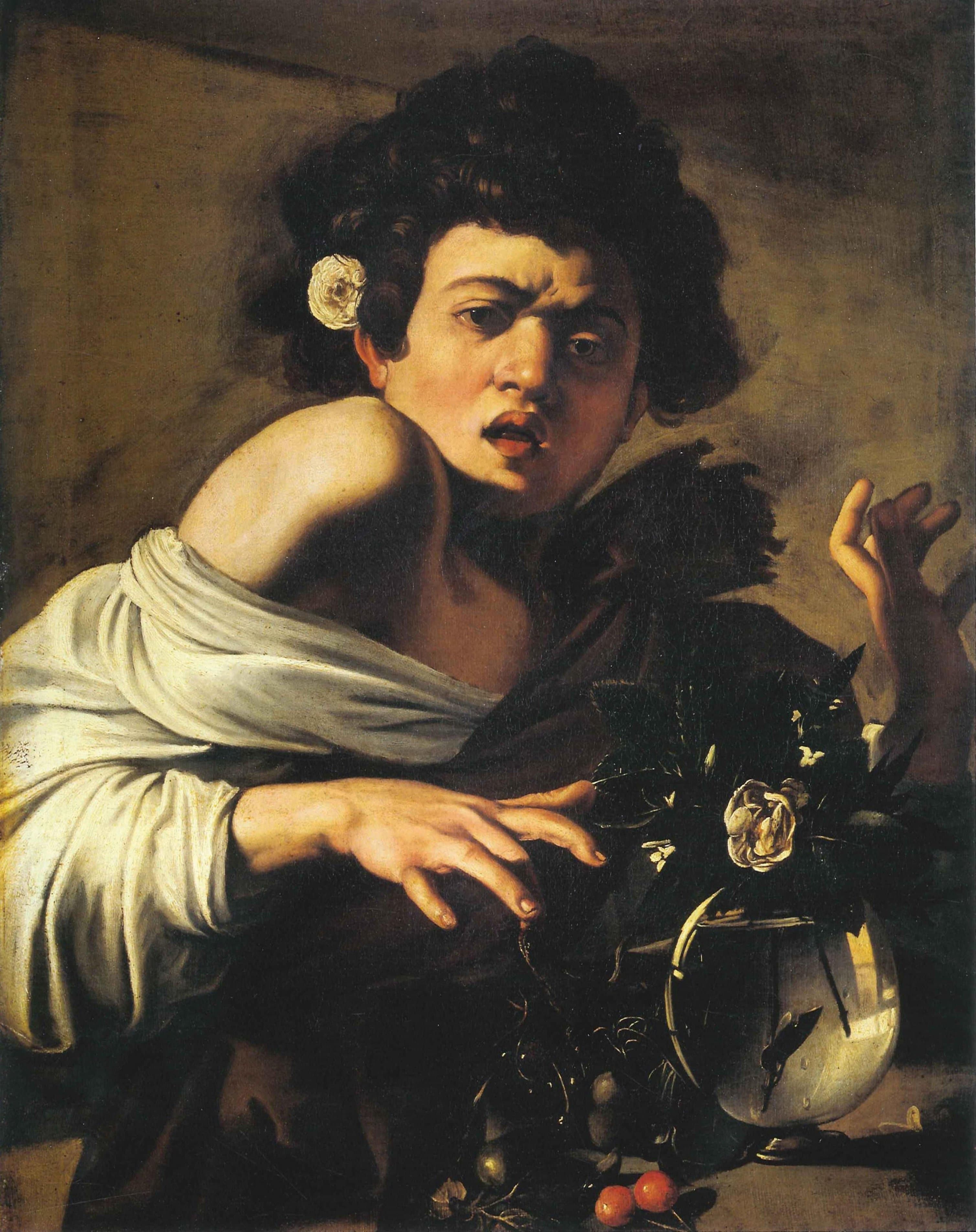
Michelangelo Merisi da Caravaggio, Boy Bitten by a Lizard, ca. 1596–1597. Oil on canvas, 25 ⅘ × 20 ⅔ inches. Courtesy Fondazione di Studi di Storia dell’Arte Roberto Longhi, Florence, Italy.

LOOK HERE celebrates creativity and tenacity, highlighting each person’s devotion to their crafts, which range from ceramics and mixed media sculptures to works on paper. The artists’ personalities come through in their work—the things that fascinate them and make them want to continue to create.

Installation view: LOOK HERE, Haverford College, Cantor Fitzgerald Gallery, Ardmore, PA, 2025. Courtesy Haverford College’s Cantor Fitzgerald Gallery.

Upon first glance, Caleb Hahne Quintana’s figurative paintings on view in A Boy That Don’t Bleed are captivating, their vibrant jewel tones contrasting moody dark shadows.

Caleb Hahne Quintana, Hour Without Shadow, 2024. Oil on linen, 24 x 46 inches. Courtesy the artist and Anat Ebgi.

With Northern Lights, the Buffalo AKG Art Museum underscores the shared experiences of artists drawing inspiration from the planet’s largest land biome: the boreal forest.

Edvard Munch, Vampire in the Forest, 1924–25. 78 ⅛ × 53 ⅛ inches. © 2025 Artists Rights Society (ARS), New York.

There’s an almost obsessive quality to Marc Handelman’s “Terra nullius” series (2024– ). At first glance, the paintings—uniform in size and bearing earthy hues, sometimes with barely visible imagery—resemble monochromatic abstract compositions that are often arranged in similarly colored grids. “Terra nullius” consists of 239 paintings, a selection of which are on view in West After West at Sikkema Malloy Jenkins.

Installation view: Marc Handelman: West After West, Sikkema Malloy Jenkins, New York, 2025. Courtesy Sikkema Malloy Jenkins.

Roughly twenty years ago, Emin returned to painting, a selection of which is on view in Tracey Emin: I Loved You Until the Morning at the Yale Center for British Art. Though three bronze sculptures of partial figures are also in the exhibition, it showcases her skill as a painter.

Tracey Emin, I Followed you to the end, 2024. Acrylic on canvas. Courtesy Yale Center for British Art. © Tracey Emin. Photo: Ollie Harrop.

With Future Fossils at MassArt Art Museum, Ginger Gregg Duggan and Judith Hoos Fox curators behind the duo c2 (curatorsquared) query in their wall texts, “If life as we know it were to come to a sudden stop, what would archeologists find decades from now? … When [the works are] viewed together as the remains from some kind of apocalypse, we get a glimpse into our current way of living.”

Julian Charrière, Metamorphism XX, 2016. Artificial lava, molten computer waste, Corian plinth, steel, and white glass, 22 1/10 x 9 4/5 x 9 4/5 inches. Courtesy the artist and Sean Kelly, New York, Los Angeles. Photo: Chi-An Chu.

Gala Porras-Kim’s The motion of an alluvial record is part of a year-long, multi-sited project organized by Storefront for Art and Architecture that explores the relationships between water and land, using swamps as a conceptual structure to reveal the socioeconomic and ecological complexities of wetlands.

Gala Porras-Kim, Rain portrait (Chaac’s lacrimatory), 2024. Condensation from regulated environment based on Yucatán weather report, plexiglass, container, 22 x 29 x 3/16 inches. Courtesy Storefront for Art and Architecture. Photo: Luis Corzo.

For his first solo show in New York, The Provocateurs at Charles Moffett, Keith Jackson uses his work to give life to a part of his family history that until recently he had never heard of: the 1937 displacement of 12,000 farmland tenants and workers in the Missouri Bootheel and the subsequent sharecropper protests of January 1939.

Keith Jackson, The Architects, 2024. Oil on canvas, 84 × 72 inches. Courtesy the artist and Charles Moffett. Photo: Daniel Greer.
A grisaille, airbrushed painting of a vagina overlooks the bustling Tribeca neighborhood through a window from where it hangs at P·P·O·W. Cropped and zoomed-in, the image could easily be mistaken for an abstract painting of hazy, gray hills.
Betty Tompkins, Why do you make me hurt you, 2023. Acrylic on canvas, 24 x 24 inches. Courtesy Betty Tompkins and P·P·O·W, New York.
There is an age-old notion of the artist’s practice as a solitary one in which creativity is born over the course of long hours in the studio. Barring a nomadic or collaborative practice, there is truth to this romantic vision—artists do often work alone—yet there is a constant companion inherent in the creative process: the studio itself. The International Studio & Curatorial Program (ISCP) has filled this role for over two-thousand artists and curators from more than 105 countries over the last thirty years.
ISCP's first ever artist-in-residence Cody Choi (left) with visiting critic and curator Dan Cameron (right) at ISCP's first location in Tribeca, Manhattan, 1994. Courtesy International Studio & Curatorial Program (ISCP).
Collaboration and community are at the heart of Marie Watt’s practice. The interdisciplinary artist explores her Seneca Nation and German-Scot heritage while at the same time imbuing references to music, pop culture, and Greco-Roman mythology into her work. Watt combines texts and motifs from these diverse sources to consider how material and visual culture hold personal and collective meanings.
Marie Watt, Companion Species (Ancient One), 2017. Cast bronze, reclaimed wool blanket (artist's grandmother's), western walnut base, 5 x 10.75 x 11.125 inches. Edition. 8/10. Published by the artist. Collection of Jordan D. Schnitzer. © Marie Watt.
In a refreshing display of collaboration, two galleries across the Lower East Side are staging a joint solo show of Ethiopian artist Hana Yilma Godine. Spread across Fridman Gallery and Rachel Uffner Gallery, A Brush in the Universe features new and recent mixed-media paintings of still lifes and otherworldly women inspired by mythology, Ethiopian history, and religious iconography.
Hana Yilma Godine
, Single painting #10, 2022.
 Oil and fabric on canvas
, 45 x 80 inches. Courtesy the artist, Fridman Gallery and Rachel Uffner.
Sandra Cinto has given a gift to New Yorkers. As winter weather stakes its claim on our collective mood, Cinto has managed to capture the warmth of her São Paulo, Brazil, studio in an aptly titled solo show May I Know How to be the Sun on Cloudy Days at Tanya Bonakdar Gallery. In new acrylic paintings, Cinto depicts luminous skies, landscapes, and oceans of blue and gold filled with fine, yet densely populated lines that reveal clouds, spiderwebs, mountains, and waves.
Sandra Cinto, May I Know How to be the Sun on Cloudy Days, 2024. Acrylic and permanent marker on wall, 148 1/2 x 489 inches. Courtesy the artist and Tanya Bonakdar Gallery, New York / Los Angeles.
It’s a story heard all too often: the government declares eminent domain and razes minority communities in the name of urban renewal. With this, families are displaced or cut off from resources and each other as roads, parks, and railways promote growth for wealthier or more powerful stakeholders. In destroying communities, culture is also lost as buildings that brought people together for generations disappear, taking with them the activities they used to house.
Melvin Smith, jitterbug #10 , 2009. Paper collage on matboard, 14 x 11 inches. © Melvin Smith. Courtesy the artist and Fort Gansevoort, New York.
Spineless: A Glass Menagerie of Blaschka Marine Invertebrates, the current exhibition at the Mystic Seaport Museum, highlights another body of work, the glassmakers’ meticulous, scientifically precise marine invertebrates.
Museum of Comparative Zoology, Harvard University, MCZ:SC:288 Glaucus lineatus. © President and Fellows of Harvard College.  Photograph by Joe Michael.
Dana James creates harmony out of contrasts. In mixed media, abstract paintings, she varies her mark-making, ranging from luminous, cloud-like layers to sparse dashes of distinct, bold brushstrokes. She combines materials, sometimes adding paper and metallic foil, and using oil, acrylic, encaustic, pencil, pastel, and pigment.
Dana James, Dancing in Pantone, 2023. Acrylic, oil, and pigment on canvas, 40 x 36 inches. Courtesy Hollis Taggart.
The subjects of Keiran Brennan Hinton’s paintings are straightforward. He depicts the world around him, portraying nothing more than what he is able to observe. His domestic scenes are relatively ordinary, adorned with personal items—nothing scandalous, overly symbolic, or too revealing of the owner’s character—in simple interiors that are not mundane, yet not quite distinctive. His views of forests and lakes are beautiful, but then again, many such features of the natural world are beautiful. Taken at face value, Brennan Hinton’s content is in a Goldilocks Zone: not boring, not exciting, but rather, firmly pleasant.
Keiran Brennan Hinton, Bedside Table, 2023. Oil on linen, 56 x 44 inches. Photo by Laura Fin. Photo courtesy the artist and Charles Moffett.
In Flags of Our Mothers, Raven Halfmoon honors her Caddo heritage and ancestors while pushing back against Indigenous silencing. With monumental hand-built stoneware sculptures filling the galleries of The Aldrich Contemporary Art Museum, she claims space for Indigenous peoples, herself included. The sheer size and weight of the figural sculptures command attention. As she works, Halfmoon considers the lived experiences of her ancestors—their traditions and the impact of colonization—and seeks to empower her community and uplift their stories. At the same time, she reflects more broadly on the rich heritage of Indigenous peoples, as well as their own tragedies as colonizers forced them off their land. The evidence of her emotions is preserved in the glaze, divots, indentations, and figures that adorn the surfaces of her work.
Raven Halfmoon, HASINAI (Caddo): Our People, 2021. Stoneware, glaze, 105 x 42 x 38 inches. Courtesy the artist and The Aldrich Contemporary Art Museum.
For Eros, his first solo show with Alanna Miller, Texas-based artist RF. Alvarez reflects on the evolving notion of home. Eros unfolds like a day in the artist’s life, or perhaps many days blended together. The richly colored narrative paintings (all 2023) are based on memories of fleeting moments, as well as photographs of the life Alvarez has built with his husband in Austin. The viewer is offered an intimate look at the people and experiences that comprise their home.
Installation view: RF. Alvarez: Eros, Alanna Miller, New York, 2023. Courtesy the artist and Alanna Miller. Photo: Daniel Greer.
For her first-ever U.S. solo show, Full Scale at Fridman Gallery, Ukrainian artist Lesia Khomenko considers the unique experience of witnessing and documenting a war from afar. Like the rest of Ukraine, Khomenko’s life was upended when Russia invaded in February of 2022. As she fled the country, she left behind her physical world, as well as the less tangible aspects of daily life. Particularly crucial for Khomenko was the lack of information on the situation inside Ukraine and the loss of easy contact with her loved ones, including her husband, Max, who is fighting in the war.
Installation view of Lesia Khomenko: Full Scale at Fridman Gallery, 2023. Courtesy Fridman Gallery.
In her first US solo show, Riptide at Charles Moffett, Julia Jo embarks on a journey of self-discovery, examining interpersonal relationships in figural paintings that are obscured with swirls of body parts, hints of objects, and glimpses of interiors. Jo’s works are all intimate, rooted in the artist’s own experiences of moving from Seoul, her birthplace, to the US, where she has continuously relocated, a journey that left her with truncated relationships, miscommunications, and in a constant state of reintroduction and reinvention.
Installation view: Julia Jo: Riptide, Charles Moffett, New York, 2023. Courtesy the artist and Charles Moffett. Photo: Thomas Barratt.
Shields brings together just a handful of new and historic paintings, sculptures, and works on paper by Günther Uecker, creating a petite, elegant homage to the German artist’s 70 years of work. Throughout his career, Uecker’s main materials have included nails, graphite, and paint. He embraces the nuanced associations of nails in particular, considering the industrial use of the material to build and protect. For his newest body of work made in pandemic isolation, Uecker reflects on the layered function of a shield as an object to defend oneself from harm and a marker of self-identification in family crests and personal symbols.
Installation view: Günther Uecker: Shields, LGDR, New York, 2022. Courtesy LGDR.
In her debut US solo show, Re-Education at SculptureCenter, Berlin-based artist Henrike Naumann explores the power of design to disseminate specific messages and align with larger ideologies.
Henrike Naumann, Horseshoe Theory (detail), 2022. Henrike Naumann: Re-Education, SculptureCenter, New York, 2022. Wayfair "Stonehenge" bench, brown plastic folding chair, faux bois chair with bone faux fur, Adirondack-style 1990s high chair, Shaker one-step stool, Charles Rennie Mackintosh "Hill House"-style chair, walnut faux fur chair, Staples "Westcliffe" bonded leather computer chair, kneeling chair, rust brown recliner, antique horn chair, antique child's rocking chair, bone chair, milking stool; dimensions variable. Courtesy the artist. Photo: Charles Benton.
Reflecting on the complex consequences of indentureship, the show explores how these four artists respond to their shared diasporic heritage.  
Andrea Chung, House of the Historians, 2022. Sugarcane bark and leaves, sweetgrass, excelsior and floral twine, dimensions variable. Courtesy Ford Foundation Gallery. Photo: Sebastian Bach.
Women at War is an exhibition, a history lesson, and an effort to preserve Ukrainian nationalism and culture. Hosted by Fridman Gallery and presented with Voloshyn Gallery, the group show features leading Ukrainian women artists who tell complex stories of war and life in Ukraine. Curated by Monika Fabijanska, Women at War addresses over a century of conflict, touching on the impact of both World Wars, the eight years of fighting that followed the annexation of Crimea in 2014, and the present-day war.
Alevtina Kakhidze, Strawberry Andreevna #3, 2014, ink drawing, 16.5 x 15 in ©Alevtina Kakhidze. Courtesy  the artist and Fridman Gallery.
When titling her first institutional solo show at the Aldrich Contemporary Art Museum, Milano Chow reflected on the role of a title as the first impression of a show. Embracing this frontline nature, she chose Prima Facie, which translates from Latin to first impression.
Milano Chow, Façade (Profumeria), 2021. Courtesy the artist and Chapter NY, New York, and Bel Ami, Los Angeles. Photo: Jason Mandella.
Throughout this show, this feeling of being part of a larger, timeless community with shared interests and activities continually emerges.
Paul Himmel, Dog in Central Park, c. 1955. Gelatin silver print. Museum of the City of New York. Gift of Joy of Giving Something, Inc., 2020.10.198. Courtesy of the Estate of Paul Himmel.
Parallel Phenomena brings together dynamic works by Outsider artist Susan Te Kahurangi King and three “insiders” whose work has often resisted the artistic mainstream: Carroll Dunham, Gladys Nilsson, and Peter Saul.
Susan Te Kahurangi King, Untitled, ca. 1967–70. Crayon, ink, colored pencil and graphite on paper, 10.25 x 8.25 inches. Courtesy Andrew Edlin Gallery, New York.

Close

Home