
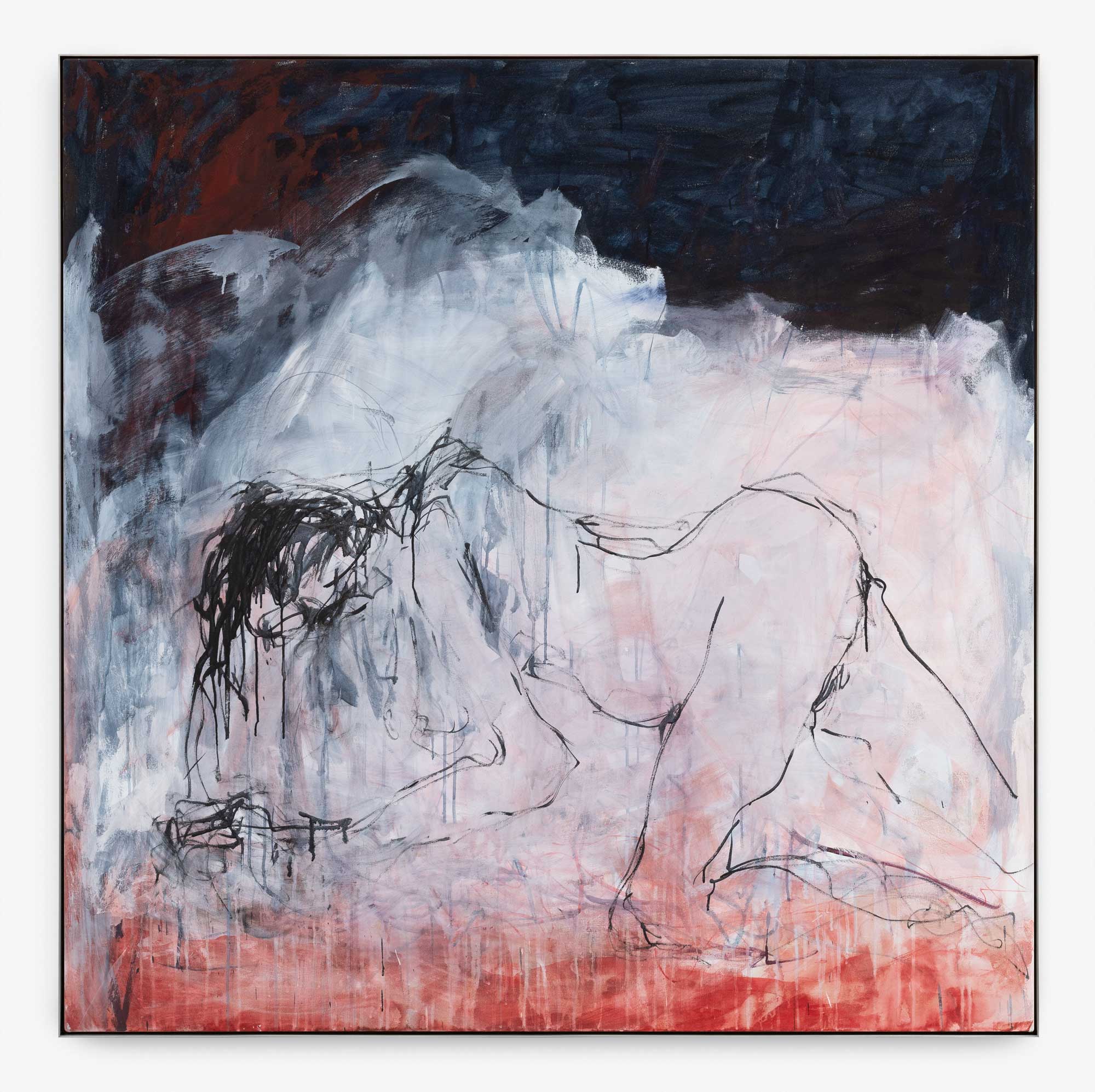
Tracey Emin, I Followed you to the end, 2024. Acrylic on canvas. Courtesy Yale Center for British Art. © Tracey Emin. Photo: Ollie Harrop.
Word count: 915
Paragraphs: 9
Yale Center for British Art
March 29–August 10, 2025
New Haven, CT
I was never a huge fan of Tracey Emin’s work. I, like many others, viewed her as a radical whose identity as a Young British Artist (YBA) and celebrity seemed to precede and overshadow her artistic practice. To me, she was synonymous with her well-known installations like My Bed (1998), a work comprised of a soiled bed surrounded by condoms, stained underwear, and empty alcohol bottles. This detritus offered hints of what the artist undertook to create the piece, a period of four days in which she remained in bed and consumed only alcohol. The work was highly divisive and often viewed as nothing more than an unmade bed. I agreed with the critics that Emin had a tendency to put provocation over artistic merit, and create work whose only goal was shock value. Then, I discovered Emin’s paintings.
While much of her career has been synonymous with mixed-media installation, neon signs bearing her handwriting, and appliqué, Emin began as a painter, but tabled the discipline in the 1990s when male painters dominated the field. Turning to the mediums she became known for, Emin found her own fame, imbuing raw emotion into her practice with intense fervor, as if driven by an unquenchable need to express the complexities of the human condition—sex, desire, pain, sickness, and everything in between. Her choice of installation amplified this sense of urgency. The seeming immediacy of the work—yielding cries of “anyone could do that”—belied the profound psychological experience the artist went through to create it.

Tracey Emin, Black Cat, 2008. Acrylic on canvas. Courtesy White Cube Gallery. © Tracey Emin. Photo: Todd-White Art Photography.
Roughly twenty years ago, Emin returned to painting, a selection of which is on view in Tracey Emin: I Loved You Until the Morning at the Yale Center for British Art. Though three bronze sculptures of partial figures are also in the exhibition, it showcases her skill as a painter. Everything I knew about Emin shifted when I studied these works. What I viewed as shock value—the gross aftermath of sex, for example—I suddenly understood as human nature that I had been too afraid or too immature to admit was relatable. My Bed isn’t about a soiled bedroom, but rather the real emotions the artist went through to create it. Emin’s work does stir a reaction, but this reaction is not her goal. Her work is rife with dichotomies and reminders of the human capacity for love and heartbreak, happiness and sadness, desire and disgust, vulnerability, and pain.
Painting seems to slow Emin’s pace, tempering her uncontrollable urge to express herself. In doing so, her process of self-discovery unfolds in distinct bursts captured in layers on the canvas. In From The Mountain to The Lake (2022), Emin has painted a washy, abstract landscape with a tangle of limbs in the foreground, outlined in black. There is spontaneity in her application of paint, but the delineation between foreground and background suggests she revisited the work, allowing the landscape to dry before responding to an urge to add figures. It’s possible she did: Emin’s longtime creative director, Harry Weller, will sometimes hide canvases to prevent her from overworking them.
As with all her work, Emin wrestles with human experiences in her paintings, often depicting a nude female figure. At times, she adds text, like the poem seen in I Followed you to the end (2024), which addresses an unknown subject or subjects, expressing love and loneliness. The “end” she names might be a nod to failed relationships, or perhaps is a reference to her own mortality. Indeed, Emin has grappled with the topic since being diagnosed with bladder cancer in 2020, undergoing an extensive emergency surgery to remove her bladder, ovaries, part of her vagina, and other body parts. Now Emin lives with a urostomy bag, an appendage visible in some works. In And It was Love (2023), the bag appears, its tube attached to a stoma on her naked recumbent body. Between her legs is a head, perhaps caught in a passionate act. Or perhaps the scene is of one of transformation, like the removal of cancerous cells spewing from her body in rich, bloody hues.
Tracey Emin, You Kept it Coming, 2019. Acrylic on canvas. Courtesy the artist and Xavier Hufkens. © HV-Studio.
In her paintings, Emin appears to be learning to live with her body rather than fight against it. A cancer diagnosis comes as a shock, and life can rapidly shift from living to become focused on surviving. Rather than shy away from what was undoubtedly a traumatic change, Emin lays bare her new reality, approaching its complexities with the same raw vulnerability as she approaches all her subjects, even taboo topics like rape and abortion.
Perhaps Emin can be misunderstood, obfuscated by lazy interpretation of her tabloid persona. Or perhaps her message is loud and clear, just not one that every viewer wants to hear. Indeed, much of the discourse surrounding her work has misogynist undertones—and overtones. That the exhibition curator Martina Droth resisted the temptation to include blockbuster installations Emin is known for is a testament to the strength of the artist’s painting practice. There’s a dialogue to be had between the disciplines, but focusing on painting forces the viewer to forget Emin’s YBA notoriety and creates a fresh lens through which to view her work. Emin’s work—all of her work—is honest and raw. To truly see her, we have to accept the indecorous reality of the experience of being human and all the complexities that come with having a body.
Annabel Keenan is a New York-based writer specializing in contemporary art and sustainability. Her work has been published in the Art Newspaper, Hyperallergic, and Artillery Magazine, among others.