In Caravaggio’s Light
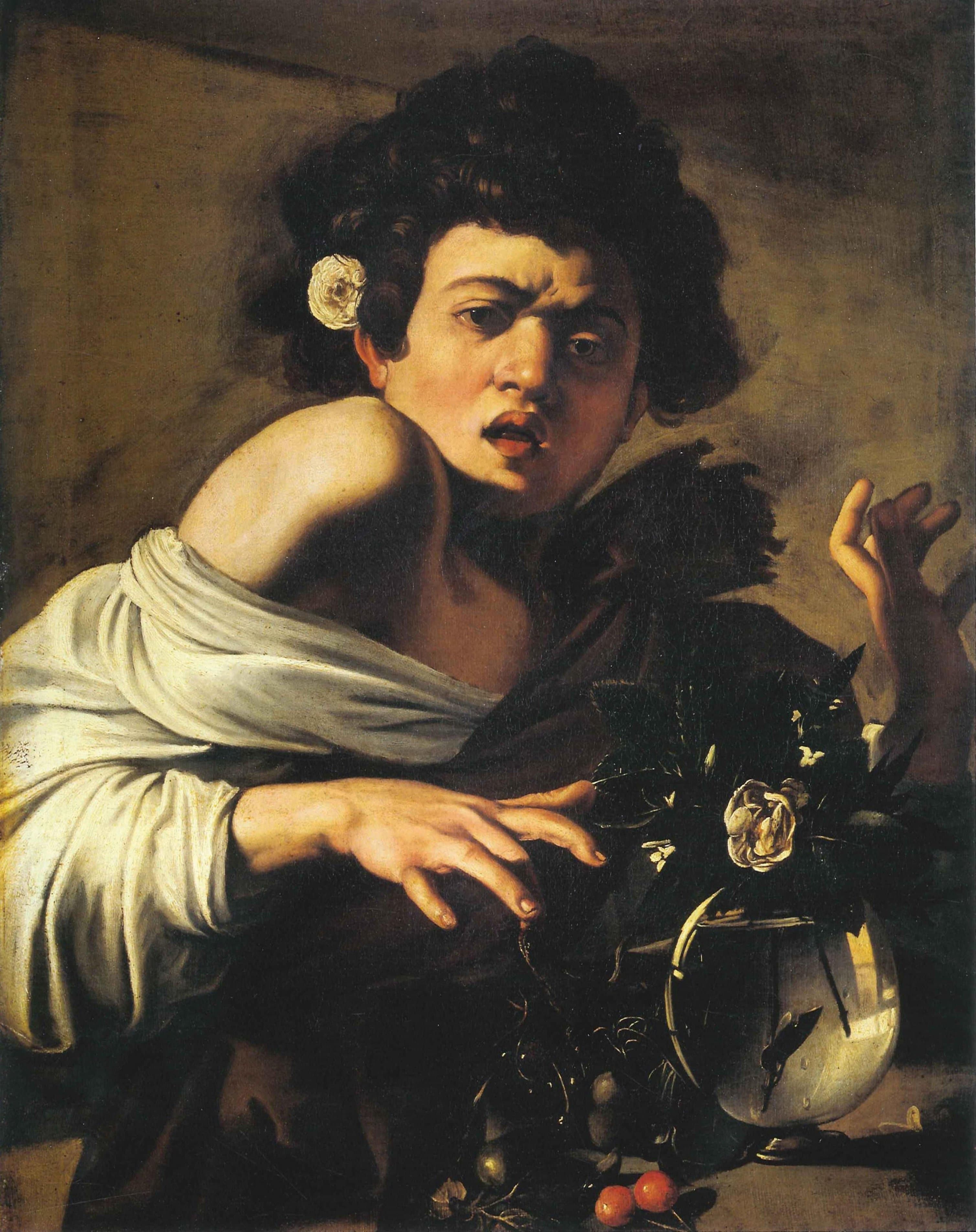
Michelangelo Merisi da Caravaggio, Boy Bitten by a Lizard, ca. 1596–1597. Oil on canvas, 25 ⅘ × 20 ⅔ inches. Courtesy Fondazione di Studi di Storia dell’Arte Roberto Longhi, Florence, Italy.
Word count: 1070
Paragraphs: 12
Museum of Fine Arts, St. Petersburg
October 25, 2025–March 22, 2026
St. Petersburg, Florida
In 1610, Michelangelo Merisi da Caravaggio died in Porto Ercole, Italy, after four years on the run. The Baroque master had lived a violent life of debauchery in Rome, with tales of brawls filling police reports. The final offense that led to his exile was the death of a man whom Caravaggio was alleged to have killed, though some accounts say the event was an accident. Regardless, the artist left Rome for Naples, Malta, and then Sicily, before a final attempt to return to Rome. Throughout, he continued to find himself involved in violent affrays and was the target of vindictive attacks—but he also left a trail of his artwork along the way. As he moved through Italy, he also made an indelible impact on his fellow artists, gathering admirers who sought to mimic his style: dramatic, emotional scenes (often religious) with relatable figures as opposed to the idealized ones popular at the time. Above all, Caravaggio’s works were characterized by the intense contrasts of light and dark called chiaroscuro. Known as Caravaggisti, the artists whom Caravaggio influenced spread his style far and wide, changing the course of art history.
Caravaggio had an uncanny ability to capture the essence of nighttime in Rome—the dark corners of narrow streets, light shining through ruby red wine, the tight quarters of a tavern where one might drink and converse with friends or target an enemy. Despite my focus on contemporary art, Caravaggio has always been my favorite artist, and any opportunity to see his work in person is welcome. By some estimates, there are fewer than one hundred Caravaggio paintings in existence, fewer than ten of which are in public collections in the United States. Some of his most famous works were done in situ and remain within the Italian churches for which they were commissioned. Many artworks have undoubtedly been lost over the four hundred years since they were made. Yet for several months, one of two known versions of his famous Boy Bitten by a Lizard (ca. 1596–1597) has been on view for visitors to In Caravaggio’s Light: Baroque Masterpieces from the Fondazione Roberto Longhi at the Museum of Fine Arts, St. Petersburg, Florida. Joining Caravaggio’s painting is a selection by his followers—many rarely seen outside Europe—that charts the diffusion of the master’s style from Italy to France, Spain, and the Netherlands.

Installation view: In Caravaggio’s Light: Baroque Masterpieces from the Fondazione Roberto Longhi, Museum of Fine Arts, St. Petersburg, Florida, 2025–26.
Upon entering In Caravaggio’s Light, it’s clear the museum sought to mirror the drama of the Baroque in the design of the exhibition. The galleries are painted a deep blue, with some walls covered in fabric, as they might have been in stately homes of the period. The rooms are relatively dark, mimicking the settings in which the artworks would have been created and displayed, with limited lighting that amplifies the play of light and dark. Visitors must walk under a dense curtain to enter the main gallery, recalling the draped fabrics seen in Caravaggio’s own compositions, where cloth becomes a tool of theatrical revelation and concealment. This curtain does more than separate rooms; it stages a moment of anticipation for the star of the show: Boy Bitten by a Lizard.
Arranged chronologically, the exhibition needs this heightened theatricality, as the centerpiece—the only work by Caravaggio himself on view—comes early in the timeline. Boy Bitten by a Lizard confronts the viewer with youthful vulnerability sharpened by surprise and pain, a poignant encapsulation of Caravaggio’s naturalistic intensity. The lush surfaces of fruit and flowers, rendered almost tactile, show Caravaggio’s radical dismantling of the traditional hierarchies between genres, collapsing still life and figure painting into an emotionally potent whole. That this and the other forty-some works on view are from the private collection of Roberto Longhi is a testament to the Italian scholar’s eye and passion for the Baroque.
A particularly striking example of the work of the Italian Caravaggisti emerges in Andrea Vaccaro’s David with the Head of Goliath (ca. 1630), a painting that distills the Old Testament narrative into a scene of raw, electrifying immediacy. The young David, still breathless from combat, exclaims over his improbable triumph, the severed head of Goliath rendered with a visceral realism that feels palpably indebted to Caravaggio. Vaccaro’s contrasts of light and dark shadow further this connection and reveal a painter deeply attuned to Caravaggio’s innovations while maintaining a measured, Neapolitan refinement.

Matthias Stom (Stomer), Annunciation of Samson's Birth, ca. 1630–1632. Oil on canvas, 39 × 49 inches. Courtesy Fondazione di Studi di Storia dell’Arte Roberto Longhi, Florence, Italy.
Meanwhile, Italian artist Mattia Preti’s The Concert (ca. 1630–35) demonstrates how Caravaggio’s legacy could exert influence indirectly—by way of subject matter, staging, and the cosmopolitan artistic exchanges that took place in seventeenth-century Rome. Preti depicts three musicians around a table against a plain, dark background, their fine garments sharply modeled in a way that recalls Caravaggio, even decades after his death. Painted in silvery tones that convey a moonlit setting, the figures look almost sickly, as if life has been drained from their bodies.
Resonance can also be discerned in works such as Dutch artist Matthias Stom’s Annunciation of Samson’s Birth (ca. 1630–32), in which light becomes an active agent of narrative revelation, illuminating figures that both emerge from and recede into darkness. With luminous colors, the angelic figures appear more idealized than one might expect in a work by Caravaggio himself.
Later still, Guido Reni’s Virgin and Child with the Infant Saint John the Baptist (ca. 1640–42), bears similarities to Caravaggio in the realistic figures depicted. Yet the departure from strong contrasts of light and dark and the overall ashy palette offer hints of the Rococo style that would dominate Italian art as the Baroque approach fell out of fashion toward the end of the century.
The show continues through the mid-1700s, as scenes of everyday life replace the religious and classically inspired images of the Baroque. In these later works, like Pilgrim at Rest (ca. 1730) by Giacomo Ceruti, the intense drama of Caravaggio gives way to quiet repose.
Walking through the galleries, it’s hard not to feel transported into the world of Caravaggio and the aesthetic conversations left in his wake. The succession of works unfolds like a cartography of the painter’s creative afterlives, yet the work of each Caravaggisti reflects their own particular surroundings and taste. In Caravaggio’s Light is not a retrospective focusing on a singular genius, but a meditation on Caravaggio’s influence across cultures and generations.
Annabel Keenan is a New York-based writer specializing in contemporary art and sustainability. Her work has been published in the Art Newspaper, Hyperallergic, and Artillery Magazine, among others.