Ann C. Collins

Ann C. Collins is a writer living in Brooklyn. She holds an MFA in Art Criticism and Writing from the School of Visual Arts.

“Seeing comes before words,” writes art critic John Berger. I think of Berger’s words as I encounter, for the first time, the mysterious sincerity of Robert Bergman’s photographs. An abundance of these works are featured in The Lost Beauty of Humankind: Robert Bergman’s Portraits in the Hill Collection, an exhibition impeccably curated. 
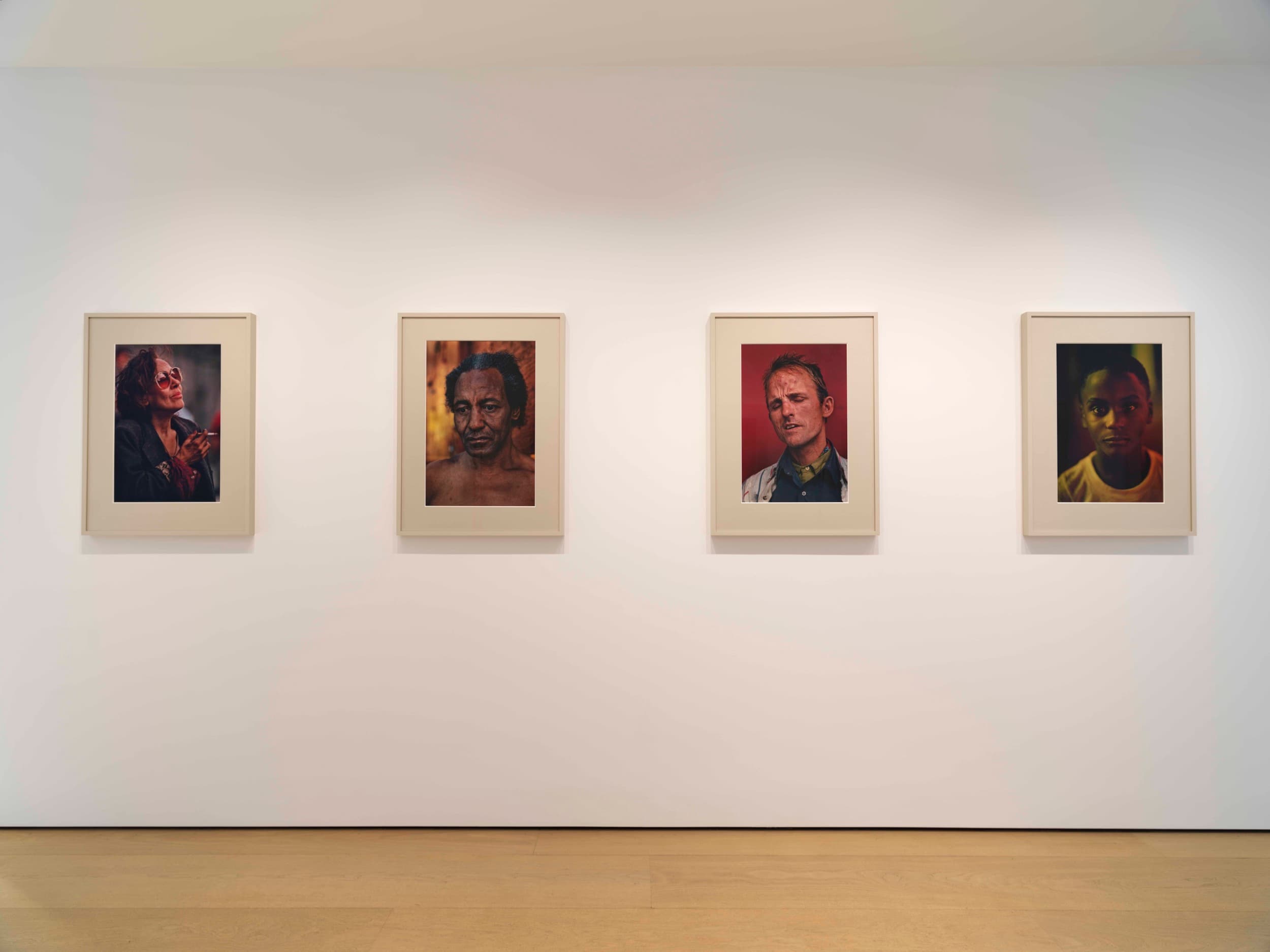
Installation view: The Lost Beauty of Humankind: Robert Bergman's Portraits in the Hill Collection, Hill Art Foundation, New York, 2026. © Hill Art Foundation. Photo: Bruce M. White.

Hanging in the vestibule of David Kordansky Gallery, Passport neatly sets up Odili Donald Odita: Shadowland, an exhibition that brings together the artist’s recent and older works with those of his father, the late Nigerian artist and academic Dr. Okechukwu Emmanuel Odita. The result is a powerful immersion in color and form enriched with considerations of time, legacy, and art making’s endless potential to foster both personal connection and political disruption.
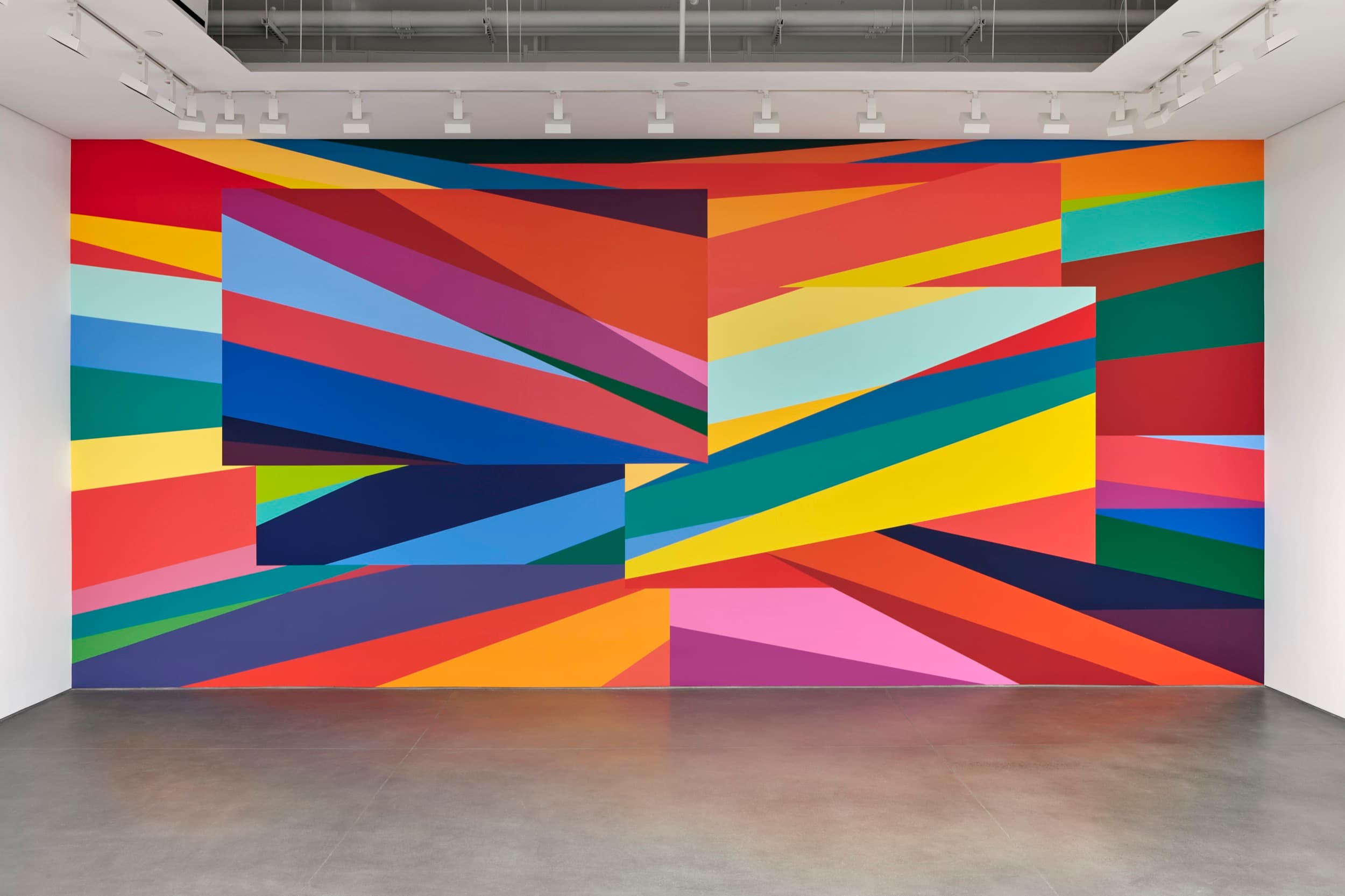
Odili Donald Odita, Revolution Action, 2026. Acrylic latex on wall, 155 x 336 inches. Courtesy David Kordansky Gallery. Photo: On White Wall Studio.

In Long Pose (2025), the titular work of Ruby Sky Stiler’s exhibition at Alexander Gray Associates, these caryatids are tasked—as caryatids have been since ancient times—with the burden of supporting architectural elements with resilience and grace
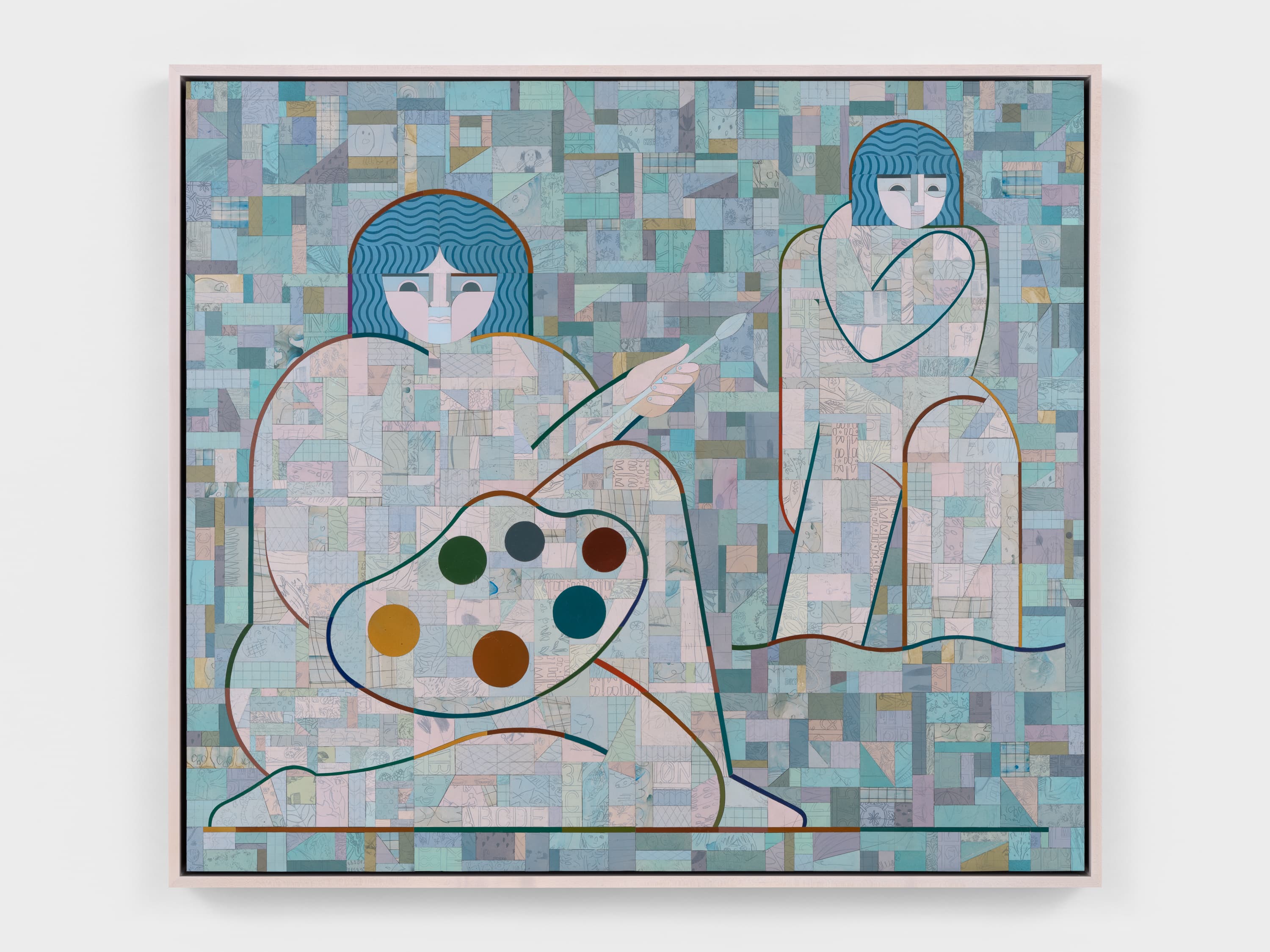
Ruby Sky Stiler, Artist with Bather, 2025. Canvas, acrylic, pencil, jade, and adhesive on panel, 44 × 50 inches. © 2025 Ruby Sky Stiler. Courtesy the artist and Alexander Gray Associates.

Ellen Levy brings Ray Johnson’s life and art into a cohesive if somewhat unorthodox form in her biography of the artist, A Book about Ray. Beginning with the premise that not all stories must be told chronologically, Levy approaches Johnson’s life in the form of a fugue.

Ellen Levy’s A Book about Ray

Into the Shining Dark at Welancora Gallery brings together nine of DuVerney’s new and recent works on paper which together present her attentiveness to Black womanhood, lineage, community, and survival. Through a series of impeccably rendered portraits and works of cut paper, she builds a constellation of separate women’s stories into a framework of ongoing solidarity that invites viewers to recalibrate narratives of collective history.

Oasa DuVerney, BLACK POWER WAVE as Virgin of Guadalupe, 2025. Graphite on hand cut paper, 44 × 30 inches. Courtesy the artist and Welancora Gallery.

Tracing the threads, I find you at Sikkema Malloy Jenkins presents Teresa Lanceta's substantial weavings of wool and cotton, striated in dense colors, along with painted fabrics embroidered with hermetic signs and works on paper informed by centuries-old traditions of ornamentation and iconography.

Teresa Lanceta, LA ETERNIDAD HUMANA. LEONOR DE PLANTEGENET #2, 2024. Wool and cotton, 79 7/8 x 22 1/2 inches. © Teresa Lanceta. Courtesy Sikkema Malloy Jenkins, New York.

Questions of how painting works—its illusions and intentions, what it is per se—thread their way through Merlin James's exhibition, Hobby Horse, and it is in this investigation that the artist pushes form and aesthetics.

Installation view: Merlin James: Hobby Horse, Sikkema Malloy Jenkins, New York, 2025. Courtesy Sikkema Malloy Jenkins.

For London-based artist Catherine Goodman CBE, drawing and painting are meditative acts, whether performed in the silence of her studio or the landscapes that call her back time and again. She infuses her practice with inspiration gleaned from poetry, film, travel, and memory. Goodman and Ann C. Collins met over Zoom to talk about Silent Music, Goodman’s exhibition at Hauser & Wirth that presents large-scale abstract paintings that pulse with her expressive brushwork and vivacious use of color. 

Portrait of Catherine Goodman, pencil on paper by Phong H. Bui.

Lieu Non Lieu presents a cohesive array of works that question the certainty of physical form and self-recognition across more than thirty years of artmaking.

Installation view: Paul Wallach: Lieu Non Lieu, Fergus McCaffrey, New York, 2025. Courtesy Fergus McCaffrey.

I try to make sense of the suddenness of color—chartreuse, canary, and cerulean—that unexpectedly follows the gray and beige work-a-day palette of the previous room as Sylvia shifts to landscape, painting a grassy lawn that stretches out to a coppice of golden trees. A low ridge rises behind them. Puffs of clouds, white, silver, yellow, and gray, drift through a perfect sky. I take it in for a moment, then inch closer. 

Sylvia Plimack Mangold, A September Passage, 1984. Oil on linen, 60 x 90 inches. Courtesy the artist and Craig Starr Gallery.

Stop Making Sense serves as both title and reproach. The exhibition presents sixteen of Henni Alftan’s recent paintings, each irresistibly imbued with a narrative potential that threatens to leap from work to work and unite the images scattered across the walls of Karma into one cohesive throughline.

Henni Alftan, Black Umbrella (In-between), 2023. Oil on linen, 57 1/2 x 38 1/2 inches. © Henni Alftan. Courtesy the artist and Karma.

Visual AIDS was formed in 1988 by a small group of curators and arts writers who were confounded by the lack of agency mustered by the art world in the face of the ongoing AIDS epidemic. “This organization has always thought of itself as an activist organization,” says Carlos Gutierrez-Solana, Treasurer of Visual AIDS, “but I think a lot of people don’t understand that there’s all kinds of activism. And quite honestly, my being alive today is an activist act. This organization existing is an activist act.”

Kay Rosen’s “AIDS ON GOING GOING ON” projected on the façade of the Guggenheim Museum for Day With(out) Art 2015. Photo: Elliot Luscombe.
Anchoring her work in deeply saturated colors, American artist Maja Ruznic channels her subconscious into haunting paintings in which figures materialize from geometric and amorphous forms. Confident in the hybrid space she has found between figurative and abstract traditions, she evokes an unsettling sadness tinged with a sense of the mystical and the cathartic.
Portrait of Maja Ruznic, pencil on paper by Phong H. Bui.
In their final body of work, artist Nancy Brooks Brody, who died of ovarian cancer in December of 2023, retains their fidelity to minimalism and a deeply personal studio practice, creating seven vertical works of tissue paper on canvas that make up Nancy Brooks Brody: Ode at Klaus von Nichtssagend Gallery.
Nancy Brooks Brody, Untitled, 2023. Tissue paper on canvas, 60 x 38 inches. Courtesy the artist and Klaus von Nichtssagend Gallery.
For more than thirty years, Spencer Finch has chased the evanescence of experience, deconstructing the physics of perception and rebuilding it into work that rebalances the way we see while underscoring the sheer delight of being. Equal parts poet, documentarian, and mad scientist, he traverses mediums, moving from installation to sculpture, painting, works on paper, prints, photographs, light works, public projects, and artist books.
Portrait of Spencer Finch, pencil on paper by Phong H. Bui.
Following the uproar induced by the 1936 International Surrealist Exhibition in London, British artist Eileen Agar, whose work had been included in the show, traveled to Ploumanac’h in Brittany for a rest. Mesmerized by the dramatic rock formations lining the coast, she purchased a Rolleiflex camera and created a series of photographs that evinced her belief in the formation of the surreal by nature.
Installation view: Eileen Agar: Flowering of a Wing, Works 1936-1989, Andrew Kreps Gallery, New York, 2024. Courtesy Andrew Kreps Gallery.
For her three-channel video installation Night Watching (2019), artist Rineke Dijkstra filmed fourteen cohorts of people after hours in the Rijksmuseum in Amsterdam as they looked at Rembrandt’s The Night Watch (1642). Positioning her cameras head-on in front of her subjects, Dijkstra documented their collective and individual ways of engaging with the painting, capturing their conversational meanderings and private moments of wonder.
Rineke Dijkstra, Night Watching, 2019. 3-channel HD video installation, with sound; 35 minutes, looped. Installation at Marian Goodman Gallery, London, 2020.  © Rineke Dijkstra. Courtesy the artist and Marian Goodman Gallery. Photo: Lewis Ronald.
A single line drawn across a plane may be the most forthright representation of time, presenting it as a continuous and irreversible sequence of events. But the perception of time is often different in actual experience. For artist Richard McDonough, it is evidenced in layers and the patient building up of surfaces.
Richard McDonough, House Full of Time (Green), 2023. Acrylic on linen on panel, 84 x 72 inches. Courtesy Europa.
Lining the walls of Candice Madey gallery, the series is the centerpiece of light takes time to reach us, an exhibition of fourteen new works (all 2023) by Stacy Lynn Waddell, who transposes the art historical narratives of nineteenth-century American painting and midcentury photography into gilded compositions that speak to contemporary issues of climate change, inequity, and race.
Stacy Lynn Waddell, Untitled #7 (awakening after the Gulf Stream and the Hurricane), 2023. Composition gold leaf, variegated metal leaf, silver leaf and Japanese colored silver leaf on handmade cotton/abaca paper, 29 inches (paper diameter). Courtesy the artist and Candice Madey, New York.
“The name of this tune is Mississippi Goddam,” Nina Simone announced during her 1964 concert at Carnegie Hall. “And I mean every word of it.” A response to the assassination of Medgar Evers and the 16th Street Baptist Church bombing in which four little girls were killed, events which had occurred the previous year, Simone’s expression of grief, frustration, and anger became an anthem of the ongoing Civil Rights Movement; its debut marked a sharp turn towards the political in the singer’s career. Nearly sixty years later, artist Dread Scott links Simone’s songs of protest to the present-day, creating four large screen-prints on canvas in which contemporary images acknowledge the continuation of hatred and violence directed towards Black Americans, women, and LGBTQ+ communities.
Dread Scott, Pirate Jenny (Gold), 2022. Screenprint and gold leaf on canvas, 56 x 84 inches. Courtesy the artist and Cristin Tierney.
“To emigrate,” John Berger writes in And Our Faces, My Heart, Brief as Photos, “is always to dismantle the center of the world, and so to move into a lost, disoriented one of fragments.” For artist Ficre Ghebreyesus (1962–2012), who fled Eritrea during the period of Red Terror, after the country was annexed by Ethiopia, those fragments became the basis of a visual language that filled the images he made with flashes of memory from his early life and evocations of the loneliness of transience. Two dozen of his paintings and pastels make up Ficre Ghebreyesus: I Believe We Are Lost at Galerie Lelong.
Ficre Ghebreyesus, Untitled, ca. 1991–95. Oil on canvas, 12 x 12 inches. © The Estate of Ficre Ghebreyesus. Courtesy Galerie Lelong & Co.
Francois-Marie Banier’s Writings & Pictures, a small yet ebullient sampling of nearly sixty years of artmaking, provides a snapshot of an artist’s practice that is as unconstrained as it is prolific. Persistently following inspiration and impulse, Banier refuses categorization and has worked in whichever collisions of medium and style best serve his continuous need to create.
Installation view: François-Marie Banier: Writings & Pictures, Miguel Abreu, New York, 2023. Courtesy Miguel Abreu.
One man rests on a bended knee, his hands clasped at his chest in a gesture of gratitude. In the distance, a patchwork of green fields studded with fruit trees give way to silvery mountains and a blue sky. The luminescence of Constant’s materials infuses the scene with life. Spirits seem to move, the landscape breathes. Working its charm, the drapo induces a visceral sense of place: I feel as if I am inside of the image, even as I am standing in the gallery looking at it.
Myrlande Constant, Erzulie Dantor, 2022. Beads, sequins, and tassels on fabric. 25 x 27.5 inches. ©Myrlande Constant. Courtesy of the artist and Fort Gansevoort, New York.
While the pictures retain distinct traces of the images from which Platéus works, his titles nudge viewers to riff on the visual and textual clues he presents, freely allowing their own associations to bubble up. It is his hope that new possibilities of interpretation will arise with each encounter as viewers interact with the works, revealing the ways in which seeing is a deeply personal—and perhaps a bit magical—act.
Benoît Platéus, Hieroglyph Machine, 2022. Oil on cotton canvas, 51.25 x 61 inches. © Benoît Platéus. Courtesy the artist and signs and symbols, New York.
More than 180 of Meret Oppenheim’s works—paintings, sculptures, object constructions, drawings, collages, and prints—are jam-packed into Meret Oppenheim: My Exhibition, an ebullient if at times overwhelming retrospective.
Meret Oppenheim, Object (Objet), 1936. Fur-covered cup, saucer, and spoon, cup 4 3/8 inches diameter; saucer 9 3/8 inches in diameter; spoon 8 inches long, overall height 2 7/8 inches. The Museum of Modern Art, New York.
In January of this year, Nash Glynn fell in love with a loft in an old warehouse building near the Seaport. She had been living and working in Brooklyn for years, in an industrial corner of Greenpoint, but as the pandemic lifted, she was looking for a change. The space, filled with sunlight and the salty breezes that blow inland from New York Harbor, gave her exactly that.
Portrait of Nash Glynn, pencil on paper by Phong H. Bui.
Use of the photo image in reworking narratives lies at the heart of Our Selves, an exhibition at the Museum of Modern Art of ninety photographs made by women artists.
Installation view: Our Selves: Photographs by Women Artists from Helen Kornblum, The Museum of Modern Art, New York, 2022. © 2022 The Museum of Modern Art. Photo: Robert Gerhardt.
In every photo, Sherman’s sense of light and shadows is breathtaking, her images as beautiful as they are unnerving.
Cindy Sherman, Untitled, 1980. Chromogenic color print, 16 x 24 inches. © Cindy Sherman. Courtesy the artist and Hauser & Wirth.
Pulling from the strata of nearly-forgotten objects and ephemera, Andrew Lampert, the show’s curator who also edited the book, pieces together an abundance of samplings that align as much with Wegman’s fidelity to writing and language as with his conceptual occupations and absurd humor.
Installation view: William Wegman: Writing by Artist, Sperone Westwater, New York, 2022. Courtesy Sperone Westwater, New York.
Wolves, we all know, are not to be trusted. They disguise themselves in sheep’s clothing or wait at the door for impending ruin. They come as a howl in the darkness, their presence heard but not seen. To cry wolf is to raise a false alarm, thereby forfeiting trust and belief. In music, a wolf sometimes lurks in a stringed instrument, often a cello.
Wolf Tones
Perception comes gradually, when the mind is quieted enough for awareness to seep in, and even then, it is never fixed. Mingling visual and aural work, lineage and legacy, Jennie C. Jones: Dynamics infuses the Guggenheim Museum with minimalist abstractions and tonal callings. The first Black woman to have a solo exhibition in Frank Lloyd Wright’s iconic rotunda, Jones throws open long-held narratives of art history, expanding the tracings of inspiration and influence to include both Black and female histories. Mining a vein of work in which paintings stand as sculptures, music is rendered in graphic statements, and color becomes a source of light, Jones’s work throws us off balance, requires us to shift and reposition ourselves in response to her slow reveals. As her gentle harmonics roll down from the oculus, the space itself seems to sway and expand.
Portrait of Jennie C. Jones. Pencil on paper by Phong H. Bui
Organized by The New Museum’s artistic director Massimiliano Gioni with curator Gary Carrion-Murayari and curatorial assistant Madeline Weisburg, American People is jam-packed with more than forty years of Faith Ringgold’s most prominent work.
Faith Ringgold, American People Series #20: Die, 1967. Oil on canvas, two panels, 72 x 144 inches. The Museum of Modern Art, New York. © Faith Ringgold / ARS, NY and DACS, London, courtesy ACA Galleries, New York 2022. Digital Image © The Museum of Modern Art/Licensed by SCALA / Art Resource, NY.
Ahmed Alsoudani’s work carries memories of trauma and the loneliness of exile. His distinctive vocabulary throws viewers into spaces roiling with the complications of being as shapes and colors struggle to co-exist. Settling in to look at his work, I find that the initial shock of his imagery softens as the familiarity of his forms elicits a feeling I can only describe as a deep empathy, a recognition of our collective state.
Portrait of Ahmed Alsoudani, pencil on paper by Phong H. Bui.
Winfred Rembert’s series examines America’s shameful and not-too-distant history with heartbreaking honesty, bearing witness to the ferocious opposition waged against civil rights and the use of incarceration as a means of silencing individuals.
Installation view: Winfred Rembert: 1945–2021, Fort Gansevoort, New York, 2021. Courtesy Fort Gansevoort, New York. Photo: Jeremy Lawson.
Jones is most at home at the intersection of music and art history, building hybrids of the two while questioning her place within the legacy of the latter: How does the work of a Black woman artist fit into a tradition dominated by white men? Turning music into objects and objects into auditory experiences, she troubles the boundaries of any category in which she might be contained and does so with elegance and control.
Jennie C. Jones, Dark Glissando, 2021. Architectural felt, acoustic panel, and acrylic on canvas, 51 x 48 x 4 inches. Courtesy Alexander Gray Associates.
Gathering materials that are aged, processed, transmuted, and repurposed, Johnson does not set his focus on fixed objects but in the way things evolve over time.
Installation view: Rindon Johnson: Law of Large Numbers: Our Bodies, SculptureCenter, Long Island City, 2021. Courtesy SculptureCenter.
11 small paintings—Hill calls them “spells”—line the walls of the gallery. For each, the artist soaks paper in Crisco oil infused with tobacco, allowing it to dry before sewing on small trinkets and mementos found on walks through her neighborhood in Vancouver. The spells are colored with washes of oil paint, and further embellished with magazine cutouts, cigarettes, beer-can tabs, and tobacco buds.
Gabrielle L'Hirondelle Hill, Cousin, 2019. Pantyhose, tobacco, thistle, spider charm, dandelion, and thread, 6 x 4 x 7 1/16 inches. Private Collection, Vancouver. Courtesy the artist and Unit 17, Vancouver, and Cooper Cole, Toronto © Gabrielle L'Hirondelle Hill.
Curators Randall Griffey and Kelly Baum gather more than 100 of the artist’s paintings, watercolors and drawings in Alice Neel: People Come First, a retrospective of the 60 years Neel spent transposing New York and its citizens into work that bears witness to the struggles of everyday life in the city as much as it dignifies the individual.
Alice Neel, Andy Warhol, 1970. Oil and acrylic on linen, 60 x 40 inches. Whitney Museum of American Art, New York. © The Estate of Alice Neel. Courtesy the Metropolitan Museum of Art.
Ann C. Collins profiles the CUE Art Foundation.
CUE Art Foundation's gallery at 137 West 25th Street, New York, NY 10001. Courtesy CUE Art Foundation.
Pistoletto’s art lies not so much in the physical objects he creates, but in what happens to us when we encounter them, and in the potential they inspire.
Michelangelo Pistoletto, The Free Space, conceived 1976 / fabricated 2020. Steel, 110 1/4 x 141 3/4 x 141 3/4 inches. © Michelangelo Pistoletto. Courtesy the artist, Lévy Gorvy, and Galleria Continua. Photo: Anabel Paris & Jérôme Taub.
In her exhibition minijobs at Page (NYC), the Stockholm-based artist Astrid Kajsa Nylander builds a collection of paintings that revel in the possibilities of the diminutive sewing notion while challenging the relegation of women’s artmaking to realms of craft and hobby.
Astrid Kajsa Nylander, yellow minijob #4, 2019. Oil on canvas, 8 x 8 inches. Courtesy the artist and PAGE (NYC).
Parenthood is essentially a temporary arrangement, but one that can provide an abundance of joy even in the most ordinary moments. Billie Zangewa refines this muddle of emotion in eight fabric collages that make up her current exhibition.
Billie Zangewa, Heart of the Home, 2020. Hand-stitched silk collage, 53 1/2 x 43 1/4 inches. Courtesy the artist and Lehmann Maupin, New York, Hong Kong, Seoul, and London.
McCorkle’s camera moves are minimal. She allows her images to linger on screen. Things feel informal and sincere, allowing the viewer to settle in and listen.
Installation view: Summer McCorkle: des abends, 2020. Installation view. Two-channel HD video, 16mm film and 35 mm black & white slide still film to digital transfer. Running time: 14:07. Courtesy Smack Mellon. Photo: Etienne Frossard.
The paintings show the empty streets of Smith’s neighborhood, seen during his morning and evening walks through a city in lockdown. Choosing a cool palette of greens and blues for street and sky, Smith creates a forlorn environment into which he angles houses and buildings in vibrant hues of red, yellow, and pink.
Josh Smith, Untitled, 2020. © Josh Smith. Courtesy the artist and David Zwirner.
As COVID-19 restrictions continue, finding art that can be fully experienced while ensconced at home requires diligence. Earlid, an online audio gallery developed and curated by Joan Schuman, presents work that lives as comfortably online as anywhere else.
Blanc Sceol, Under, 2020. Courtesy the artists.
Circling the gallery, I felt bolstered by the communities of women the artist assembles. Fraleigh does not show them “at work,” but relaxing together—something I, like so many women, feel guilty admitting I need.
Angela Fraleigh, Our world swells like dawn, when the sun licks the water, 2019. Oil and acrylic on canvas, 90 x 198 inches. Courtesy the artist. © Angela Fraleigh.
Akashi’s installation is mesmerizing, taking on an almost fetishistic significance. The hands cradle and explore the surfaces of her glass objects without regard for whatever pathogen might be lurking in this moment of rabid hand-sanitizing.
Installation view: Kelly Akashi: Mood Organ, Tanya Bonakdar Gallery, New York, 2020. Photo: Pierre Le Hors. Courtesy the artist and Tanya Bonakdar Gallery, New York / Los Angeles
It may be that history, as Winston Churchill said, is written by the victors, but a deep satisfaction can be had for those who redraft it. Cree artist Kent Monkman does just that for the Metropolitan Museum of Art’s inaugural Great Hall Commission. Monkman reverses the European gaze, presenting Indigenous people as heroes who welcome and rescue invading newcomers.
Kent Monkman, Welcoming the Newcomers, 2019. Acrylic on canvas, 132 x 264 inches. Photo: Joseph Hartman.
The exhibition’s centerpiece is a pivotal work in the Saar’s career that blended the mystical imagery the artist was using in her ongoing printmaking practice with political and biographical elements to form a self-portrait assemblage.
Betye Saar: The Legend of Black Girl’s Window
The Met façade was finished in 1902, but the niches have remained empty ever since, largely unnoticed by museum visitors and passersby—until now. Kenyan-American artist Wangechi Mutu fills the spaces with statues of Afro-futuristic women who employ the pedestals as thrones, inaugurating what will be an annual commission for the museum’s façade.
Wangechi Mutu, The Seated I, 2019, for the Facade Commission: Wangechi Mutu, The NewOnes, will free Us, 2019. Courtesy the artist and Gladstone Gallery, New York and Brussels. Image courtesy the Metropolitan Museum of Art. Photo: Bruce Schwarz.
In two large-scale sculptures, ParaPivot I (2019) and ParaPivot II (2019), she erects a series of black powder-coated steel frames ranging from 8 to 12 feet high, which intersect at their bases and fan out in different directions, forming an array of geometric shapes that shift and change with an almost kinetic quality as viewers wander between and around them.
Installation view: The Roof Garden Commission: Alicja Kwade, ParaPivot, The Metropolitan Museum of Art, 2019. Courtesy the artist; 303 Gallery, New York; KO?NIG GALERIE, Berlin/London; and kamel mennour, Paris/London.Courtesy the Metropolitan Museum of Art, Photo: Hyla Skopitz
The tension between forced confinement and self-designed sanctuary lies at the heart of Leigh’s art-making, which spans sculpture, installation, video, and social practice: the show takes its name from the 1861 memoir of slave-turned-abolitionist and writer Harriet Jacobs
Simone Leigh, Jug, 2019. Bronze, 84 1/2 x 49 1/2 x 48 3/4 inches. Courtesy the artist and Luhring Augustine, New York. Photo: David Heald © 2019 The Solomon R. Guggenheim Foundation.
In 1971, Simone Fattal invited a camera crew into her kitchen in Beirut to help her create a video self-portrait. The footage shows the then 29-year-old artist dressed in a white shirt tied at her waist. She repeatedly tucks her shoulder-length hair behind her ear as she speaks.
Simone Fattal, Man and his shadow, 2009. Glazed stoneware. 9.8 x 4.3 x 1.6 inches. Courtesy the artist and kaufmann repetto, Milan / New York; Balice Hertling, Paris; Karma International, Zurich / Los Angeles.
It started with a passport. For artist Barthélemy Toguo, movement through the world was tethered to the small book he was required to carry when he traveled, within which his progress could be tracked at every border he tried to cross.
Installation view: Barthélémy Toguo: Urban Requiem, Galerie Lelong & Co., New York, 2019. © Barthélémy Toguo. Courtesy Galerie Lelong & Co., New York.
In medieval Europe, tapestries were hung in castle rooms to keep out drafts and cold. Richly decorated with religious scenes or myths, these woven lengths of cloth provided the household occupants, even those who were illiterate, pictorial stories that engaged and enlightened.
Christina Forrer, Untitled (brown background), 2018. Cotton, wool, linen, silk and watercolor, 123 x 88 inches. Courtesy Luhring Augustine.
Turkish artist Banu Cennetoğlu, in her first US solo exhibition at SculptureCenter, curated by Sohrab Mohebbi with Kyle Dancewicz, assembled an archive of every video file and photograph she has taken over a twelve-year period into one continuous reel.
Banu Cennetoğlu, 1 January 1970 – 21 March 2018 · H O W B E I T · Guilty feet have got no rhythm · Keçiboynuzu · AS IS · MurMur · I measure every grief I meet · Taq u Raq · A piercing Comfort it affords · Stitch · Made in Fall · Yes. But. We had a golden heart. · One day soon I'm gonna tell the moon about the crying game, 2018, installation view, SculptureCenter, New York, 2019. Video, images, sound; 22 parts, 46,685 files. 128 hours and 22 minutes. Metadata: 687 pages, 11.7 x 16.5 inches. Commissioned and produced by Chisenhale Gallery, London. Courtesy the artist and Rodeo, London/Piraeus. Photo: Kyle Knodell.
On a bleak, late December afternoon in late December, the heavy door to Pioneer Works in Red Hook gives way to a dark stairwell that serves as the gallery’s vestibule. Overhead, an imposing video monitor holds a silent black-and-white image of a hand, palm open, fingertips twitching in and out.
Maria Antelman, Disassembler, installation view, Pioneer Works, New York, 2018 – 2019. © Dan Bradica.
In conspiracy theory parlance, false flags are acts of violence covertly staged as diversions by governments which then blame terrorist groups. As the exhibition’s springboard, the concept is used to lure the viewer into a state of mind in which no one is to be trusted and nothing is as it seems.
Tim Trantenroth, Camera Remake 2, 2018, Oil on paper. Courtesy of the artist.

Close

Home