Julie Rubio’s The True Story of Tamara de Lempicka & The Art of Survival
Julie Rubio crafts a biography out of the many voices of her interviewees, solidly making the argument that this was an artist wronged by time and art-world trends.
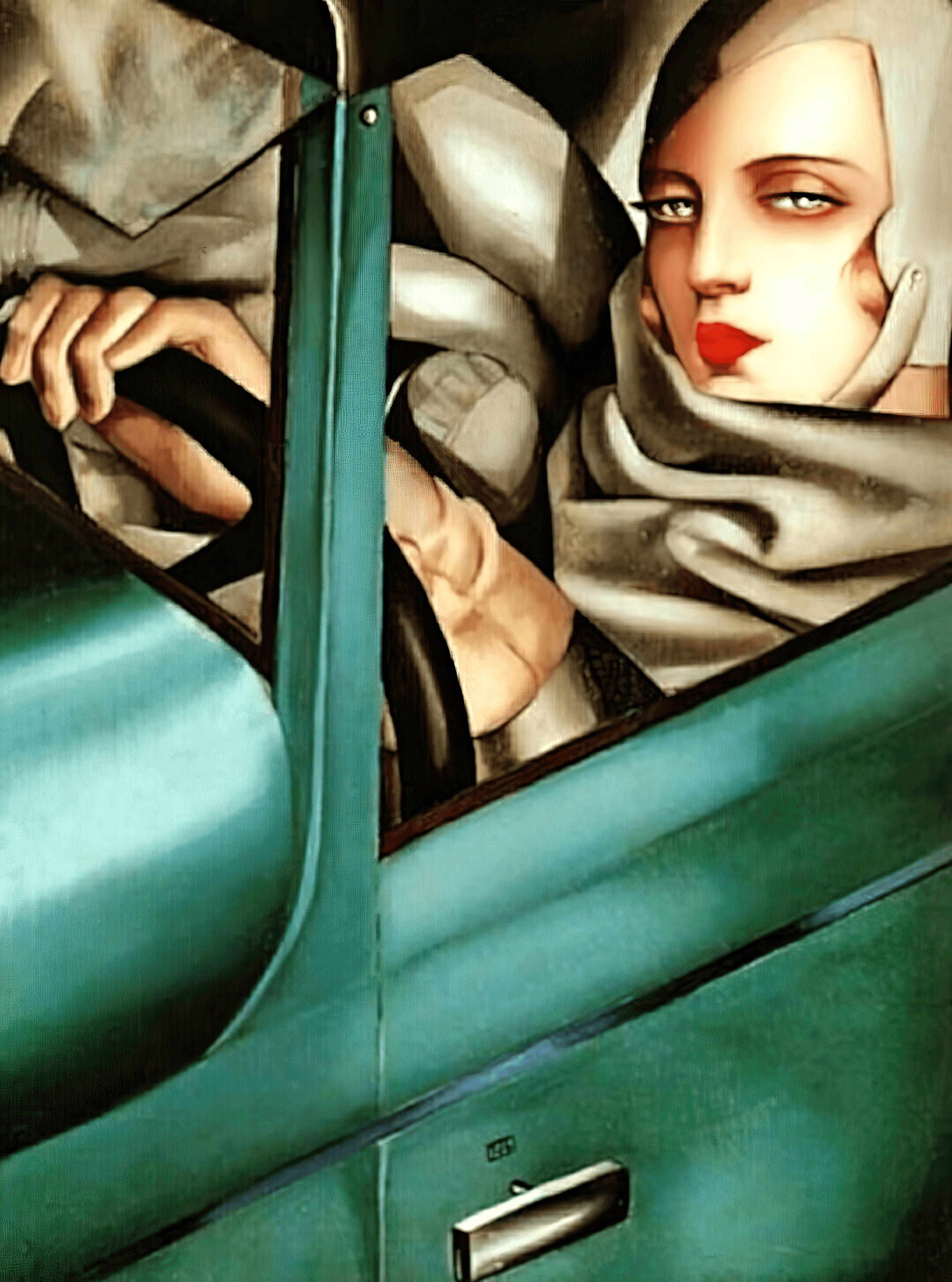
Tamara de Lempicka, Autoportrait (Tamara in a Green Bugatti), 1929. © 2024 Tamara de Lempicka Estate, LLC / ADAGP, PARIS / ARS, NY.
Word count: 1461
Paragraphs: 9
Julie Rubio
AMC Empire 25
April 9–16, 2026
New York
As celebrity profiles continue to proliferate on America’s mainstream media platforms, there sadly remains a dearth of stories about mere mortals, no matter how exceptional. In the current landscape, it is difficult to make, let alone distribute, a documentary about an artist, especially one with anything less than a major global following. Against such likelihoods, Julie Rubio’s film, The True Story of Tamara de Lempicka & The Art of Survival breaks through to tell the unlikely success story of an artist Rubio asserts was one of the early twentieth century’s most important, if underappreciated, female painters. In her portrait of the titular Polish-born painter, Rubio traces an art-making practice that combined Mannerism, Futurism, and a healthy dose of Cubism, leading Lempicka to create images that have managed to remain popular for close to a century, even as she faded into obscurity. If the mission of the film is to tell Lempicka’s forgotten story, thus introducing her to contemporary viewers, included within that narrative is the artist’s strategic creation and management, within the social structures she occupied, of a recognizable identity—what we think of today as “branding.” In her time, Lempicka, whose artmaking was also her livelihood, promoted herself as both an innovator and bon vivant, a central figure in the cultural explosion that occurred in Paris after World War I; yet the celebrity status she cultivated proved fleeting. Intent on reversing this, Rubio builds her film from a collection of overlapping anecdotes from Lempicka’s family and the observations of art world bona fides, spinning out a portrait of an artist determined to create a splendid body of work that would, moreover, provide social ascendance and financial stability, protections against the impending atrocities of twentieth-century Europe.

Tamara de Lempicka with Miss Cecelia Myers, 1940. Photo: ACME Photo Collection of Richard and Anne Paddy, USA.
Tamara de Lempicka was born Tamara Rosa Hurwitz in 1894 to a wealthy Jewish family in Warsaw, Poland. Her father abandoned the family when she was five. When she was nine, her maternal grandmother grew concerned for Lempicka’s health (she often faked a cough) and brought her to Italy, where they explored churches and museums filled with Renaissance art, inspirations for the young girl’s burgeoning hobby. In 1915, Lempicka married Polish lawyer Tadeusz Łempicki. Believed to be a member of the Tsar’s secret police, he was arrested by the Soviets at the start of the Russian Revolution. Upon his release, the couple fled to Paris where Tadeusz fell into a deep depression, becoming despondent and unable to work. Their daughter Kizette was born in 1916, adding to their financial struggles, and the couple divorced shortly after. Alone and without the financial support of a husband, Lempicka considered turning to prostitution, but at the suggestion of her sister, architect Adrienne Górska, she began painting portraits, first of her daughter and a neighbor. She eventually sought commissions to paint aristocrats and socialites, hosting outrageous parties during which she lured potential patrons into her studio. Photographs from the artist’s years in Paris (there are many) show a woman chicly dressed with painted lips and heavily lined eyes, a look that replicated the glamor of a Hollywood star and embodied the Art Deco aesthetic of her canvases.
As Rubio makes clear, Lempicka pursued her art as fervently as her financial survival, refining what became her signature style: angular renderings of figures that seem to push against the boundaries of her canvases as shining cities or geometric abstractions rise in the background. In addition to commissioned portraits, she worked with models in her studio, creating wonderfully stylized images that transcend the era she was capturing. Group of Four Nudes (1925) is a powerful composition of unabashed female eroticism, in which the heroic gestures and muscular definition of her subjects’ bodies are complimented by their perfectly painted crimson lips. La Belle Rafaëla (1927) which boldly features a mostly nude woman pulling a red garment from her shoulder, her back arched in pleasure, is a glorious study of light and shadow. But Lempicka was also a business woman, and her paintings were her trade. She grew her popularity by designing covers for Die Dame, a German magazine that catered to the interests of the modern woman. Of her most enduring images, Autoportrait (Tamara in a Green Bugatti) (1929), appeared on its cover in 1929. It features Lempicka behind the wheel of a green luxury car dressed in yards of silver fabric and helmeted in a gray cloche hat, coldly regarding the viewer. This was followed by Young Woman in Green (Young Woman with Gloves), about 1931, another renowned painting in which a woman draped in a slinky emerald dress and white gloves turns down the brim of her hat, creating a shadow across her eyes. Impersonal, perhaps mysterious, the women in her images project an inner strength and independence of spirit assumed to be highly coveted by Die Dame readers.
Sadly, Rubio seldom lingers long enough on any of the paintings to allow the viewer to get a good look. Her visual pacing leans towards the staccato, with images deployed in an ever-changing slideshow that runs over a bed of unrelenting interviews. My sense of Lempicka’s art came not from a long close study of them on screen, but from the repeated use of them to illustrate passages of interviews. What Rubio does do well, however, is craft a biography out of the many voices of her interviewees, solidly making the argument that this was an artist wronged by time and art-world trends.
We learn that public favor turned when Lempicka flaunted relationships with her female models and a close woman friend. Her affair with Austro-Hungarian aristocrat Raoul Kuffner, a married man, was seen as scandalous. After the death of Kuffner’s wife in 1933, the two were married. Fearing the rise of the Nazi regime and the onset of war, the couple fled to the United States and settled in Los Angeles in 1939. Lempicka’s work was given a few exhibitions in New York, San Francisco, and Milwaukee, but as the American art world fixed its gaze on Abstract Expressionism and other movements of the time, Lempicka failed to gain the success she had hoped for. After her husband’s death, she joined her daughter in Houston, Texas and eventually moved to Cuernavaca, Mexico, where she quietly found new inspiration for her paintings in the landscape and inhabitants of the area.
The film takes an interesting turn in the aftermath of Lempicka’s death. In 1987, her daughter, Kizette de Lempicka-Foxhall published a biography and a quirky, if propitious, fan-base grew. Rubio investigates this thoroughly and without judgement, but in doing so, misses an opportunity to critically evaluate how the machinery of branding has changed in the current day. Evidence of Lempicka’s greatness is implied by a photograph of Barbra Streisand seated in her home in front of Lempicka’s Adam and Eve (1932). Much is made of Madonna’s collection of several Lempicka works and their appearance in several of her videos and the stage design of her 1990 Blond Ambition and 2024 Celebration tours. While I would not discount either’s tastes, holding up their interest in the artist as proof of her brilliance seems too easy. Lempicka, a Broadway musical, opened in 2024 to tepid reviews and closed after forty-one performances. Nevertheless, Rubio generously includes interviews with the play’s writer, composer, and star, all of whom attest to Lempicka’s greatness as both artist and muse. Strangest of all is a scene of Lempicka’s great-granddaughter dressed as the artist and climbing into a green Bugatti for the production of an NFT.
Thankfully, Rubio balances such eccentric moments with more trustworthy testimonials to Lempicka’s work from art historian Dr. Paula Birnbaum, Dr. Furio Rinaldi, curator of drawings and prints at the Fine Arts Museums of San Francisco, and Rowland Weinstein of Weinstein Gallery. They make the point that if, for a period of time, the art world moved beyond Lempicka’s stylized interpretations of Jazz-Age Europe, it seems her work is now under a well-deserved reconsideration as women artists are finally being given equal footing. The notion may be a bit overwrought, but what Rubio does best is present an enormity of images of Lempicka’s work, from early watercolors done when she was a child to her masterpieces from the 1920s and 1930s and—most intriguing of all to me—the images made in Mexico at the end of her career. The sum total is a body of work anchored by the steady hand of an artist intent on reinventing her work time and time again. More than anything that is said, presenting these continuously throughout the film makes the strongest case that Lempicka deserves a second, more sustained look.
Ann C. Collins is a writer living in Brooklyn. She holds an MFA in Art Criticism and Writing from the School of Visual Arts.