Merlin James: Hobby Horse
Word count: 794
Paragraphs: 7

Installation view: Merlin James: Hobby Horse, Sikkema Malloy Jenkins, New York, 2025. Courtesy Sikkema Malloy Jenkins.
Sikkema Malloy Jenkins
February 21–April 5, 2025
New York
Consider the small boy with the wide-brimmed hat and sheriff’s badge who stands in the corner of the garden, straddling a broomstick hobby horse in Merlin James’s painting Hobby Horse (Garden) (2025). Is he a child at play, circling the grassy edges of the yard, hopping and galloping alongside the brick and mortar walls that confine him? Or is he, as his game implies, a cowboy riding the range, loner and hero of the American West? Perhaps he is a stand-in for the artist, Merlin James, who prefers to remain silent on questions about the identities of his figures or what his images might mean.
In his 1951 essay, Meditations on a Hobby Horse or the Roots of Artistic Form, E. H. Gombrich posits that the hobby horse functions as a representation of and substitute for a real horse, thus fulfilling the needs of the child who plays with it. The same can be said, he continues, of figurative imagery and the needs of the artist. The boy on his hobby horse, tacitly present in a number of the nearly two dozen works that make up Merlin James: Hobby Horse at Sikkema Malloy Jenkins, becomes whatever James needs: a memory of an earlier self, a point of connection for viewers, a repeating motif placed within compositions that arouse memory and evoke nostalgia as they probe the nature of representation and association.

Installation view: Merlin James: Hobby Horse, Sikkema Malloy Jenkins, New York, 2025. Courtesy Sikkema Malloy Jenkins.
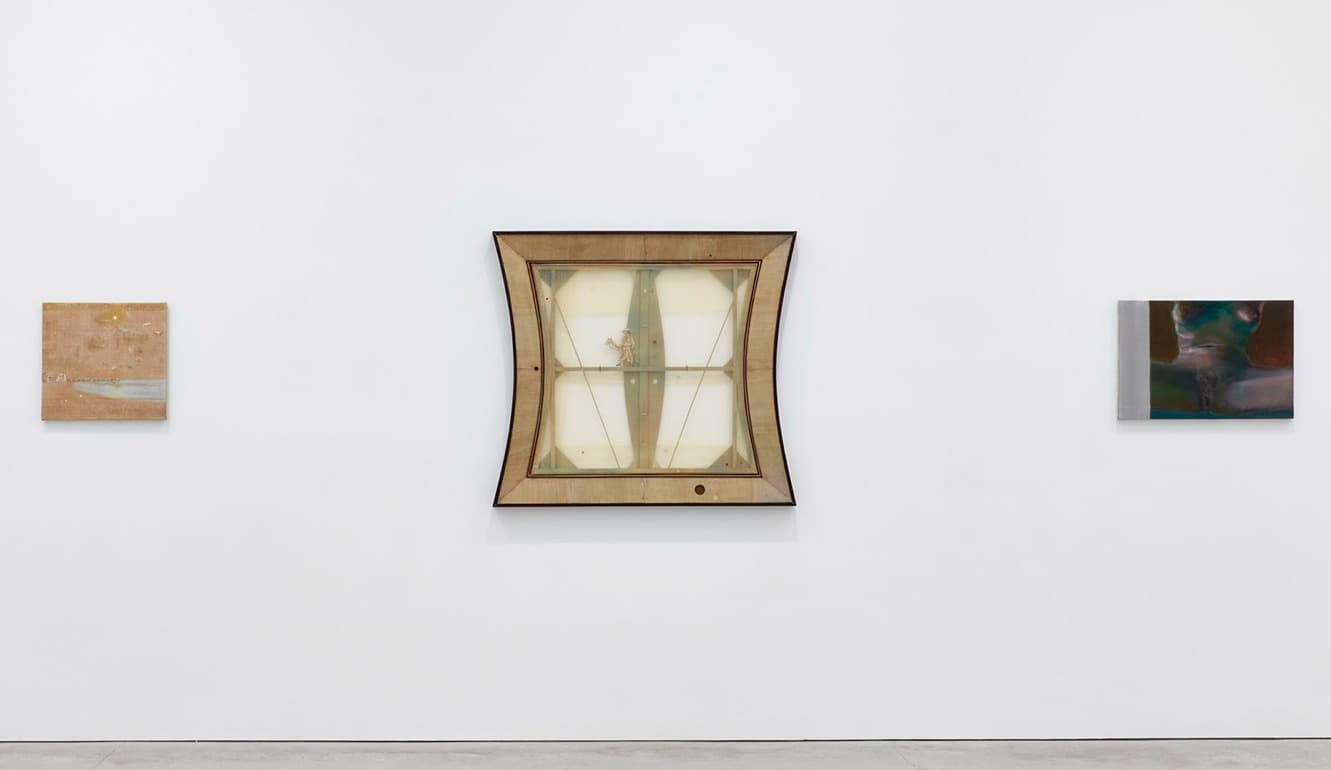
In The Oval Rug (2024–25), the boy canters through the same back yard as in Hobby Horse (Garden), but in a wider composition that reveals more of the setting. Here, a cat slinks past a fenced-in flower bed near an old table and rug that have been left outside. The painting’s canvas is stretched over a non-rectilinear form; its sloping sides are matched by a white ovoid in the center of the picture that distorts perceptions of the work’s dimensions—from across the gallery, it appears to be two separate paintings hanging on a white wall. In the mixed-material work Hobby Horse (2024–25), the little cowboy canters along a measuring stick, his scale spelled out in centimeters. A tiny set of white wooden stairs and a section of miniature fencing, both in scale with the boy, complete the compositional elements. Stretcher bars sheathed in gauze hold the painting-without-canvas construction together within the curved sides of an artist-made wooden frame.
Questions of how painting works—its illusions and intentions, what it is per se—thread their way through the exhibition, and it is in this investigation that James pushes form and aesthetics. In a series of five paintings, each featuring the Boundary Gardens bandstand, an open Victorian structure in an East London park, James contemplates the impact color and context on a recursive object. The muted palette of Grey-Green (2024) shows a forlorn view of the bandstand and its environs on a winter day, the trees around it bare of leaves, the surrounding streets empty of passers-by. The world of Bandstand (Meeting) 2024, glows an ochre-gold as James focuses on the stairs that lead from street to bandstand, capturing a moment when one figure descends just as another rises into view, the two about to meet. From Above (2024) is a vertical composition rendered in shadowy blues, greens, and violets in which the bandstand appears quite small when seen from the perspective of a window or rooftop. It is twilight. The town is quiet and a flock of crows has come home to roost in the trees. Examining the scene from painting to painting, things begin to imprint, the nuanced variations create shifts in mood as the bandstand becomes something that, although I have never seen it, I feel as if I know.
Installation view: Merlin James: Hobby Horse, Sikkema Malloy Jenkins, New York, 2025. Courtesy Sikkema Malloy Jenkins.
What intrigues me most, however, are James’s landscape paintings, which balance the experience of sincerely looking with the process of observing one’s perceptions. Acrylic paint barely dapples a surface of roughly-woven jute in Pier (Jute) (2024), suggesting a white house seaside a pale wash of blue sea. Two seabirds hover in a mottled sky, under a pearl-sized yellow sun. The artist’s marks are minimal here—so much depends on the field of brown jute fabric—yet it is easy to agree that what we see is a seascape, easy, at James’s suggestion, to imagine the salty air and the sounds of the water. Untitled (Pier, Yellow) (2024–25), echoes Turner’s atmospheric seascapes with its washes of yellow and its dot of sun that bleeds through a tangle of storm clouds. The painting is framed with wooden rulers, evidence of the artist’s process and presence, which recall the boy on the hobby horse, also a product of art making, still beckoning us into the image.
Ann C. Collins is a writer living in Brooklyn. She holds an MFA in Art Criticism and Writing from the School of Visual Arts.