
Word count: 487
Paragraphs: 7
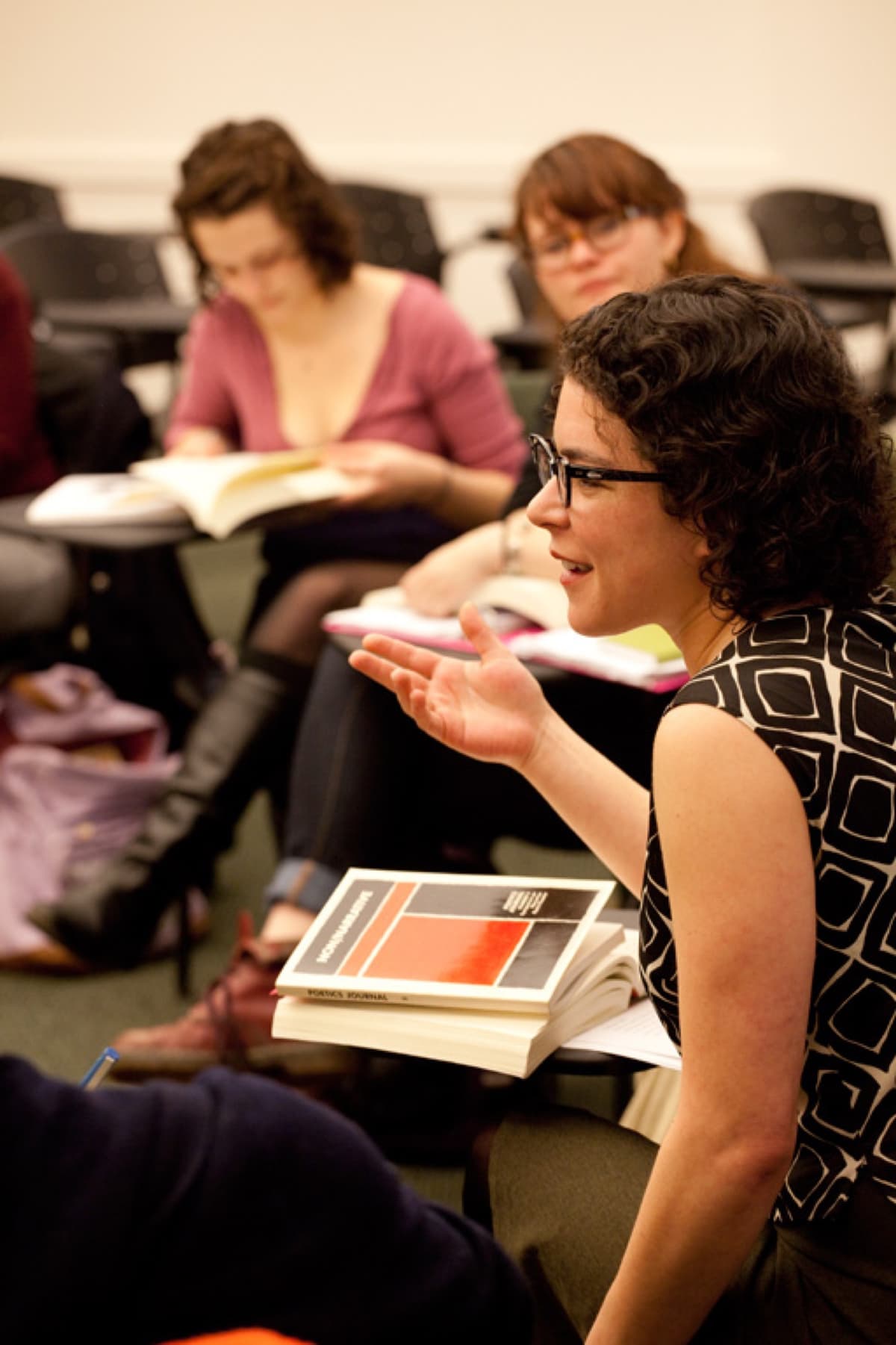
Cole Heinowitz teaching at Bard College. Photo: Scott Barrow.
I remember standing in the humid dining hall in August reading Cole’s name and the name of the class on the course list. This was my first interaction with her. The name of the class was something like “Sexuality and the Monstrous in Gothic Literature.” I was endeared, but I didn’t take that class. I did take the next one the following semester, then two more. At some point she became my general advisor and later she became my senior project advisor and some years after that she wrote my recommendation for my MA. We reconnected this fall, the weekend after I had just done my IVF insemination procedure. She ran a workshop called “Poetry as Coexistence.” The first few days of my embryo’s cellular development emerged absorbing the tones of Cole’s voice, her particular way of talking.
Cole taught me how to read and how to write. She taught me about a certain lack of distance between a reader and a text. The immersion into syntax, the meaning of a comma, a space, a letter. She brought out in me a great passion for work, work that did its own thing away from whatever trend or style was the highlight of the moment. Serious work. Her greatest comment to me was that my (sort of crazy, unwanted by the rest of my board) senior project had integrity. She taught me that writing could be risky, wild, inclined towards sonorous animation with its own particular flair, and still make sense, still hold a reader’s gaze, still make an argument. Something I’m still learning. She could read a line of John Keats, turn it around in her mouth, and get something out of us; thoughts that didn’t occur to occur before her reading.
There is no separation between how she taught me to read and write and how I read and write the world today as a psychoanalyst, writer, and future mother. There is no separation between the strange intelligence that led us to meet each other one more time before her untimely death, and the intoxicating beauty of my (daughter’s) coming birth. The earth has many secrets to tell. Language tries to tell them, often failing, and in that failure is where we might discover something like truth. Thank you, Cole, for your time here: ablaze with reverence for your students, for the fires of artistic chaos, bound to honor assemblages of all forms of matter—sexuality, monstrosity, plants, dead authors, sky beings, the old and the new—pieces of a gem circulate through the air. Like the authors she studied, she could listen to the commonest of places seeking the sublime—the ordinary hustle of the earth’s ecstatic reverberations. She could speak a word so seductively it made you want to understand.
pieces of gems
listen to the water…
—CB 2025
Cornelia Barber is a poet and psychoanalyst in New York City. She is the author of Spring Street (1080 Press), Pink Metal (Big Lucks Press) and Unconditional (Dancing Girl Press). You can read her work in The Ersatz Experience, RISS – Zeitschrift für Psychoanalyse, 1080 Press, Prelude, and elsewhere.