Billy McEntee

Billy McEntee is Theater Editor at the Brooklyn Rail and a freelance critic. He teaches at The School of The New York Times and Kennedy Center. His play The Voices in Your Head was a 2025 Drama Desk Award nominee for Unique Theatrical Experience. 

Created and performed by American Sing-Song (musical duo Jake Brasch and Nadja Leonhard-Hooper) and presented as a work-in-progress for one night only, HOMO ERECTUS is set in 2131 but looked like readings have for eons.
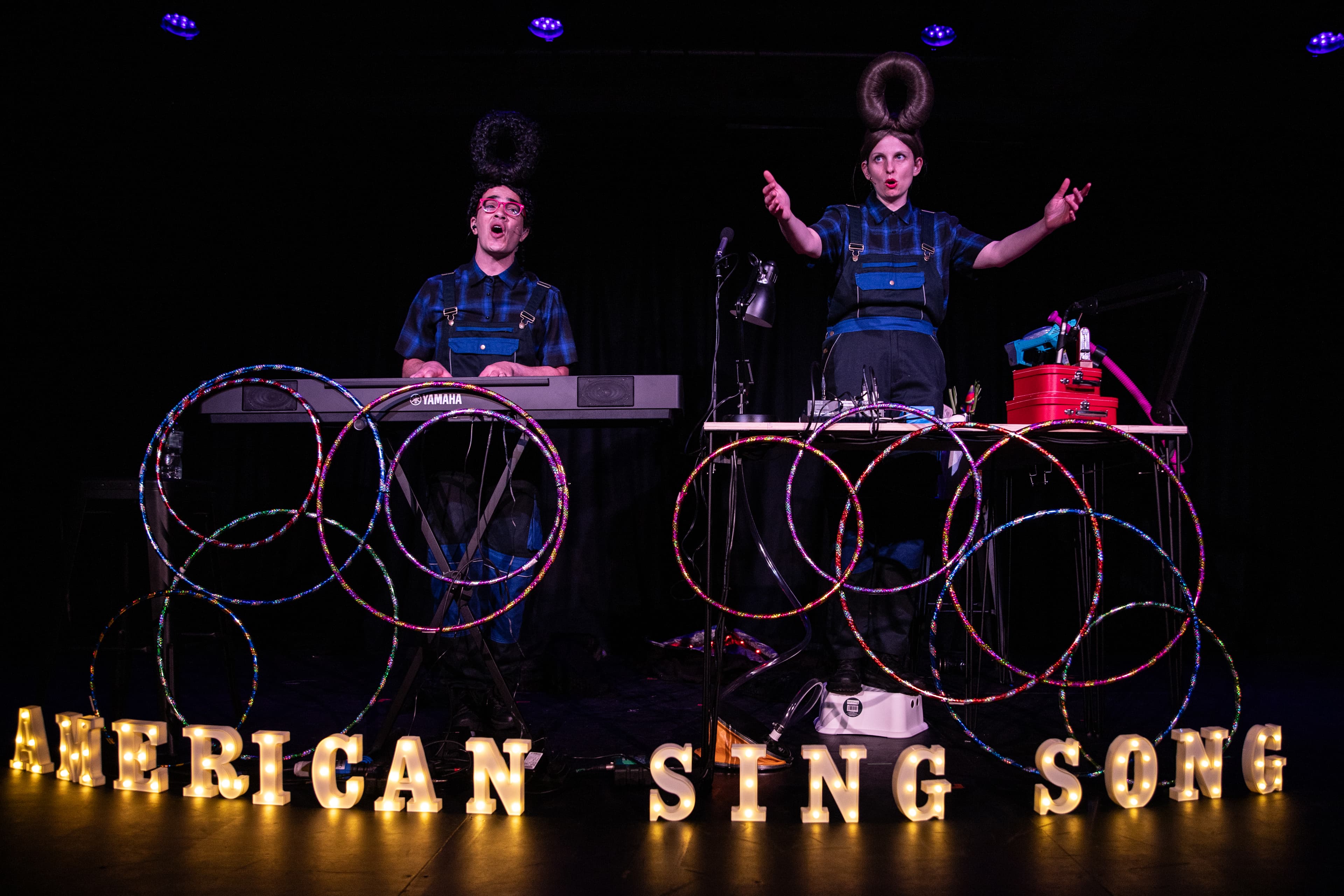
Jake Brasch and Nadja Leonhard-Hooper, American Sing-Song. Photo: Michael Aiden.

January is a flush month in New York theater as festivals import or give a leg up to some of the experimental scene’s most curious artists. That’s a superlative right there, and ten more will follow—for the first time, the Brooklyn Rail is celebrating the end of festival season with crowd-sourced honorifics. 
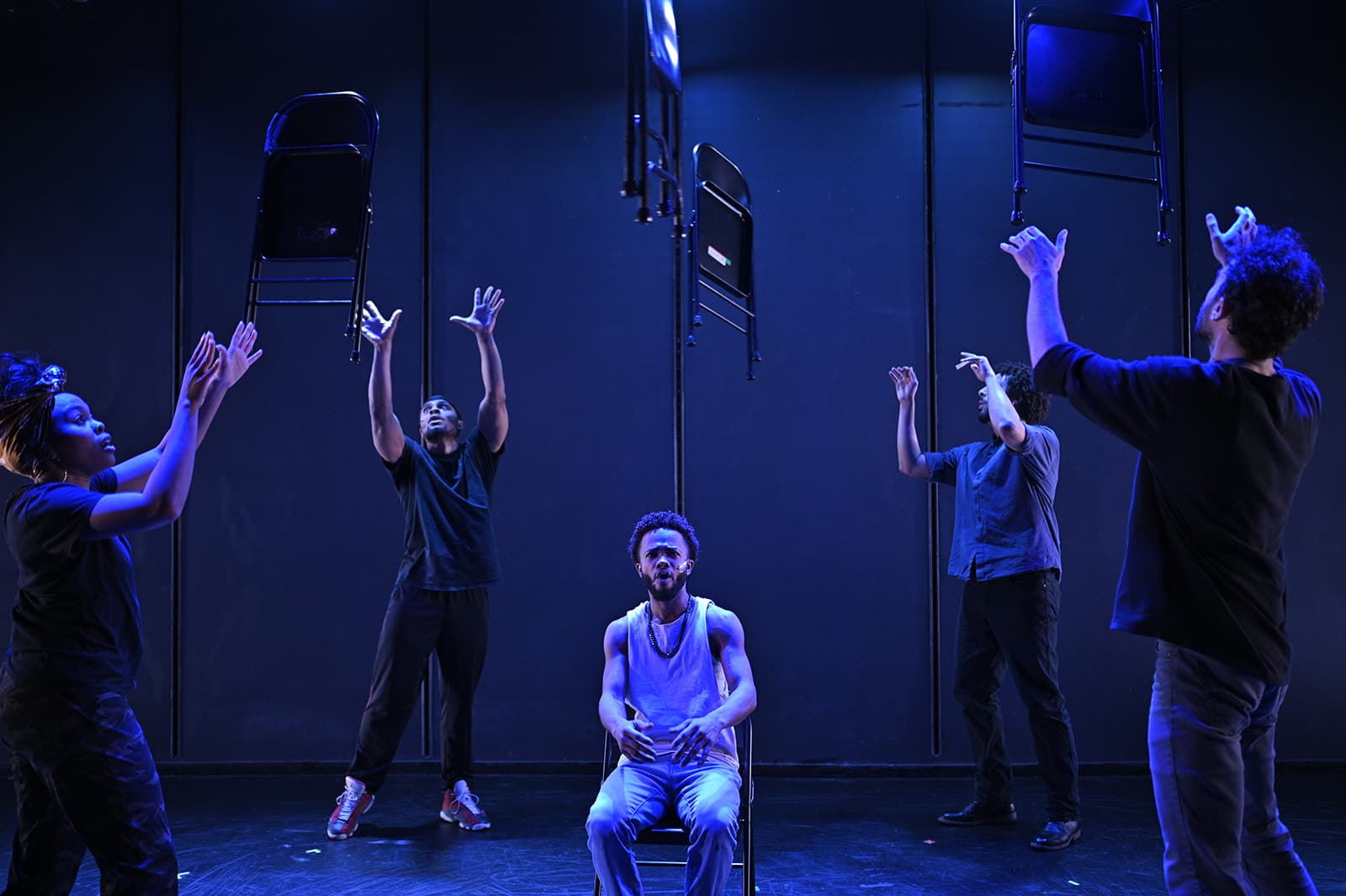
The cast of Try/Step/Trip. Photo: Thomas Mundell, MundellModernPixels.

Plotless but vibey, What to Wear revolves around themes of consumerism, vanity, and the metaphorical temptation of a well-cooked duck.

St. Vincent and Hai-Ting Chinn in What to Wear.

A musical pageant written by Patrick Lazour, Daniel Lazour, and Mark Sonnenblick, Nativity performed December 13 and 14 at St. Mark’s Church in-the-Bowery. Or maybe it’s The Nativity: that article appears on the program but not the social media graphic. What writer likes titling their work?
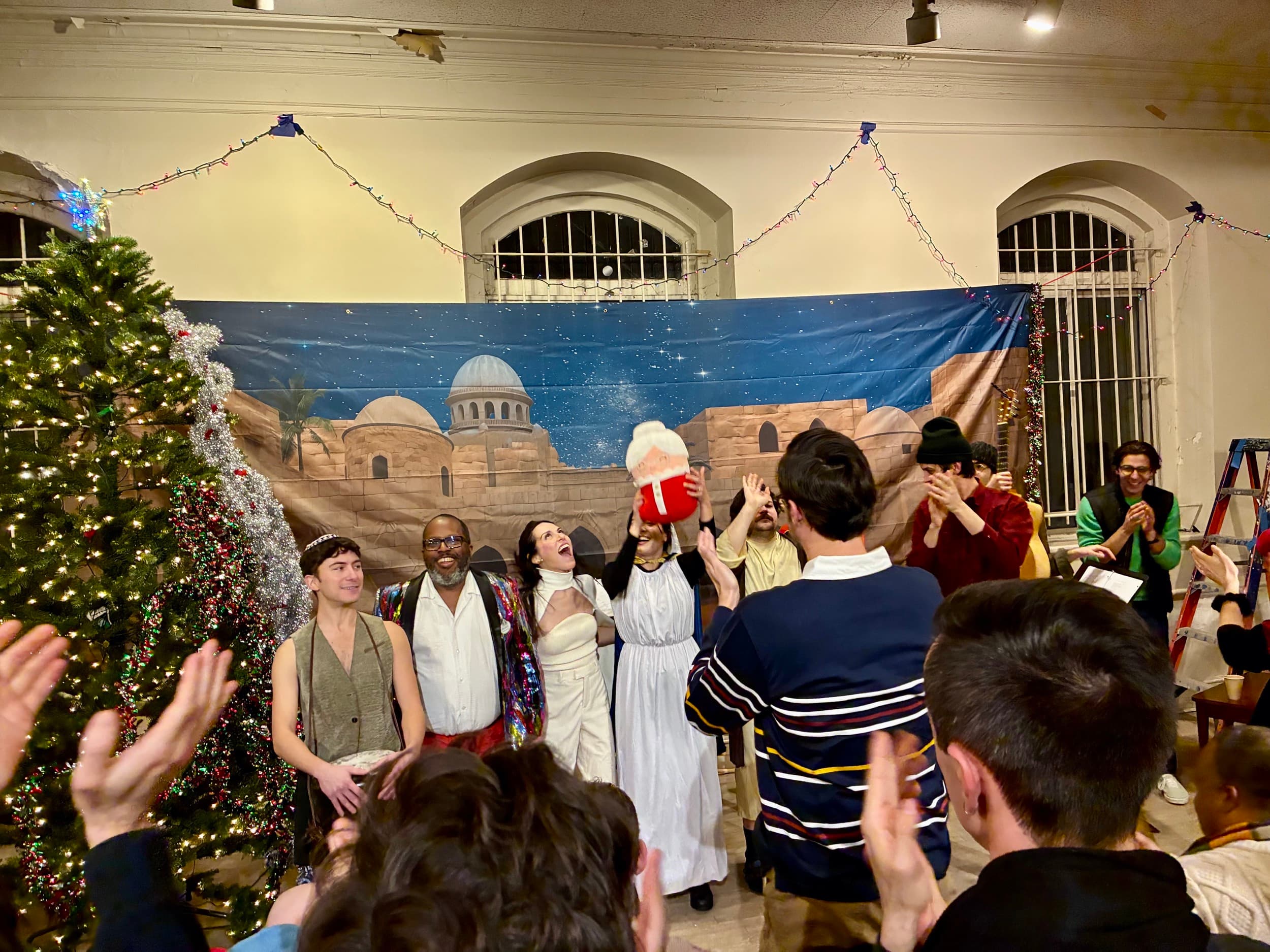
The cast and team of Nativity. Photo: Billy McEntee.

If Annie Baker’s Circle Mirror Transformation arrived at the dawning of the Obama administration, a moment of mainstream political “Hope,” Nazareth Hassan’s Practice debuts at its antithesis. If acting exercises are used as a vehicle to manifest self-esteem and connection in Baker’s play, they are wielded as tools for manipulation and exploitation in Hassan’s.
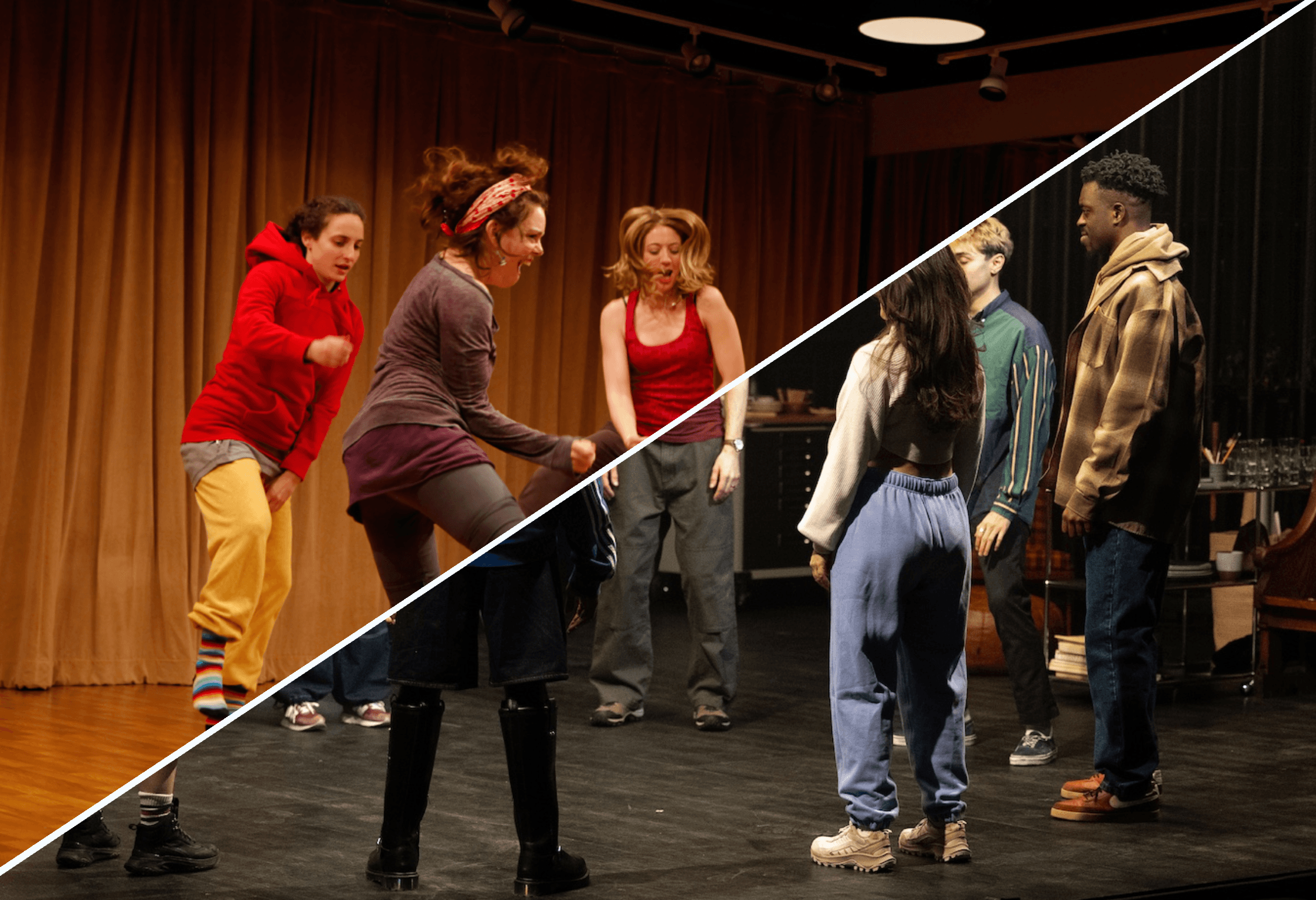
The companies of Annie Baker’s Circle Mirror Transformation (photo: Joan Marcus) and Nazareth Hassan’s Practice (photo: Alexander Mejía, Bergamot).

Now running on opposite sides of the East River, David Cale’s Blue Cowboy (at The Bushwick Starr) and Jen Tullock’s Nothing Can Take You From the Hand of God (co-written with Frank Winters at Playwrights Horizons) are both solo shows, but even that similarity is harder to detect in productions that take wonderfully distinct approaches to single-actor staging.

David Cale. Photo: Maria Baranova.

Dambudzo arrives at a time of increased hunger for experiences that gather humans in unique ways when streaming services’ unlimited options have increased isolation. Screens can dampen imagination—a computer is at your fingertips—but chipaumire’s work champions curiosity.

nora chipaumire's Dambudzo. Photo: Billy McEntee.

There is a lived honesty to Bubba Weiler’s writing, which settles cozily into its regional setting like sitting back on the family couch.

Quincy Tyler Bernstine and Michael Chernus. Photo: Emilio Madrid.

Created by Times Square Arts Public-Artist-In-Residence Maia Chao and choreographed by Lena Engelstein, American Idle performed three times on July 9 in Duffy Square, feet from the fire hydrant-red TKTS steps.

Maia Chao, American Idle, 2025. Photo: Maria Baranova for Times Square Arts.

A new arts series at Williamsburg’s Domino Square curated and creative-produced by Public Assembly and Ellpetha Tsivicos, Sugar, Sugar! offers free performances each Wednesday and Thursday in June. No-cost, public, and outdoor summer series are vital—and in being no-cost, public, and outdoors, they tend to feature recognizable programming to catch a larger audience. Leaning experimental, Sugar, Sugar! brings multidisciplinary fare normally reserved for specific venues (or basements) into the open air.

Lena Engelstein at Sugar Sugar. Photo: Maria Baranova.

The women of A(U)NTS!, too, are workers, childless, and unsure of the dizzying, dazzling land just beyond their own.

Zoë Geltman, Jehan O. Young, and Megan Hill in A(U)NTS!. Photo: Kevin Frest.

Donald Barthelme Humors You, devised and directed by Olivia Facini ran at Theaterlab April 10 through 13, and Letter of Intent, written, directed, and designed by John Jesurun, ran April 2 through 13 in a new venue, Apartment 1, a ground floor residence in a West Village brownstone.

Zachary Desmond and Lucas Iverson in Donald Barthelme Humors You. Photo: Travis Emery Hackett.

In Raja Feather Kelly’s BUNNY BUNNY, which ran at The Invisible Dog Art Center March 13–15, the direction is urgent, the choreography dynamic, and the text saltless. Where Kelly offered a maximalist meal, Joshua William Gelb’s [Untitled Miniature] addressed surveillance in a more distilled form.

Joshua William Gelb in [Untitled Miniature]. Photo: Marie Baranova.

Sayings don’t translate cleanly across languages. From Mongolian, an expression for love translates to “their heart is as white as milk and their hands as intricate as a key.”

Om Raj Raut in Tongues. Photo: Yuxiang Wang.

Broadway scenic design has become increasingly reliant on digitally rendered backdrops. That trend makes sense. A minimal physical set can be less expensive, and a digital design can feel appealingly contemporary. How the physical and digital elements work together, however, can prove tricky.

Idina Menzel and Khaila Wilcoxon. Photo: Matthew Murphy and Evan Zimmerman.

Amando Houser is starring as and in DeliaDelia! The Flat-Chested Witch!, their solo show intimately at home at the Brick Theater through December 14..

Amando Houser with an audience member. Photo: Billy McEntee.

There’s an increasingly antiquated term for gay people who don’t have sex: a non-practicing homosexual. Increased LGBTQ+ acceptance has made the term something of a relic, however its spirit endures in the career of openly gay star Jim Parsons. The characters Parsons has played, on stage and screen, reflect larger questions about which ones audiences can expect to have sex—and, sometimes, how fully human they are allowed to be.

Jim Parsons and the cast of Our Town. Photo: Daniel Rader.

In We Are Your Robots, creator and performer Ethan Lipton, performing as a robot who looks and sounds a whole lot like creator and performer Ethan Lipton, shares, from his digitized well of encyclopedic knowledge, that his favorite word is mencolek.

Darren Criss, Helen J Shen. Photo: Matthew Murphy and Evan Zimmerman.

Ian Reid’s charming, gently-pitched comedy, Heaven is a place in the sky, which completed its week-long run directed by Jake Beckhard at The Tank on September 8, is not the first play to dig into how the economics of caregiving impact the minutiae of relationships. 

The cast of Heaven is a place in the sky. Photo: Amar Ahmad.
There’s a great reverence for performance in Marta Nesspek Presents. The play’s characters, a traveling troupe of actors, set up their projection before they, together, trace a rectangle on its screen with their hands in an act mirroring a religious rite.
The company of Marta Nesspek Presents. Courtesy Twenty-Three Point Five Degree Tilt Theater Company.
Williams, in both Events in 2022 at the Brick Theater and now, in Coach Coach—running through June 13 as part of Clubbed Thumb’s annual new play festival, Summerworks—gestures, with a clown’s goofiness and an anthropologist’s precision, at the ludicrous pseudo-commodities we purchase and peddle to give life meaning.
In Coach Coach, the Ouroboros of Self-Improvement
While Raja Feather Kelly is celebrated for his choreography, he is now marking his Off-Broadway debut as a playwright with The Fires, at Soho Rep. through June 16. Kelly, in a piece almost devoid of dancing, is keenly attuned to characters’ movement, and, as a writer, equally invested in their desire to be understood, and as such, loved.
L-R: Phillip James Brannon, Ronald Peet, Sheldon Best, Beau Badu. Photo: Julieta Cervantes.
Orlando (2003) is its own meditation on metamorphosis, and it’s Ruhl’s most direct engagement with gender fluidity. Featuring one performer as Orlando and an ensemble of discernible size to play every other part, Ruhl’s script suggests “as few as three gifted transformational virtuosic actors or as many as you can fit on a stage and pay.”
Taylor Mac in Orlando by Joan Marcus.
Inside 1-800-3592-113592’s fictional Jersey mall, director and choreographer Lisa Fagan has performers create a centerpiece fountain out of Dunkin Donuts cups, spilling water from one cup into another. A sales lady in leopard-print heels clops around, touches every surface, and pretends to know how to connect with customers. Elsewhere, a soft rock band forms and jams out.
CHILD. Photo: Maria Baranova.
Somehow, community persists, whether it’s between an admin and their followers or generations of theatermakers. Through Admin Reveal and The Following Evening, Escarciga, Browde, and Silverstone offer a window into their conversations so that they might inform our own—in how we appreciate, contextualize, and engage with art.
Abigail Browde, Paul Zimet, Ellen Maddow, and Michael Silverstone. Photo: Maria Baranova.
In its current iteration, now playing through December 16 at Nancy Manocherian's the cell theatre, cryptochrome trades out Bushwick grit for Chelsea couth without sacrificing intimacy or intention.
Tiresias, from the Exponential Festival's run of cryptochrome. Photo: Walter Wlodarcyzk.
Entering the theater, audiences pass through a pink, uterine canal. What beaded curtains did for sixties parties, this passageway accomplishes for Soho Rep. visitors. Thrill—jumpy and irresistable—awaits on the other side.
Becca Blackwell in Snatch Adams and Tainty McCracken Present It's That Time of the Month, 2023.
(pray), nicHi douglas’s religious choreopoem, also empowers those who may be forgotten and subverts norms while plunging the well of faith. In (pray)’s many vibrant hymns, common reverent words get a matrilineal makeover—“amen” turns into “again,” and “father” becomes “freedom”—bringing focus less to Jesus and more to the community church enables.
Amara Granderson and the company of (pray). Photo: Ben Arons.
A PlayCo commission now running at 122CC, 9 Kinds of Silence by Indian theatermaker Abhishek Majumdar posits that nationalism may be just as haunting as battlefield scars post-conscription.
Hend Ayoub and Joe Joseph. Photo: Cindy Trinh.
Medeiros will usher you, in silence, down dark, winding stairs, hovering the light near your feet as you descend. The shifting step directions disorient; the journey brings to mind exiting a new subway station, from which, after emerging, north feels like south. Except, instead of climbing up out of the ground, you’re spelunking in Queens.
Joseph Medeiros’s projector.
The Embrace, Miles Greenberg’s live installation, has a gentle conceit: two performers who do not know one another silently embrace in a glass box for six hours.
Two performers in Miles Greenberg's The Embrace at Faurschou. Installation view. © Faurschou. Photo: Olympia Shannon.
Grief Hotel, commissioned by Clubbed Thumb, is a black comedy. It’s also a container for all the ways in which no one knows how to carry sorrow. And it’s—for the multiple relationships depicted within—a liminality, that sneaky moment when no one’s sure whether the tide is coming in or going out.
Check into Grief Hotel: Wading through Woe with Liza Birkenmeier’s Latest
Since Rent’s 1996 Broadway debut, Michael Greif’s gritty-polished production has been mimicked in high schools, community theaters, and regional houses across the country. At Paper Mill Playhouse, Zi Alikhan’s rendition immediately distinguishes itself. Yes, there are still baggy sweaters and colorful folding chairs, but as a production this Rent is as much elegy as it is musical.
Terence Johnson as Collins and Zachary Noah Piser as Mark in Rent, directed by Zi Alikhan. Photo: Evan Zimmerman.
“Grey” is an apt qualifier for the house in Levi Holloway’s play. For one, like Holloway’s ghost story, the color is eerie; the hue is associated with fog, drear, and mystery. But grey also suggests a vague middle ground, neither black nor white. En route to her father’s home, Max (Tatiana Maslany) and her husband Henry (Paul Sparks) are driving between two places—wherever they came from and wherever they are heading, locations that are never fully defined. The house they stumble into is an in-between.
Sophia Anne Caruso, Laurie Metcalf, Eamon Patrick O'Connell, Tatiana Maslany, Alyssa Emily Marvin, Paul Sparks, and Millicent Simmonds in Grey House. Photo: MurphyMade.
The first time I saw Merrily was at Fair Lawn High School in New Jersey in 2008; Stephen Sondheim apparently attended a performance and spoke to the cast. I remember being amazed by the score, confused by the story, but moved by the ending—in that amateur production’s final gesture, as the chorus refrains “me and you” during “Our Time,” antihero Franklin Shepard’s piano comes back on stage and he, alone, faces it. Maria Friedman’s production, now sold out at New York Theatre Workshop, concludes with a similar visual, and an idea clicked: music is the you to Franklin’s me, the thing he cares most about and what he has to lose when the people who make him sing fade away, dimming like distant stars.
Lindsay Mendez, Jonathan Groff, and Daniel Radcliffe. Photo: Joan Marcus.
If you’ve dreaded going back into the office, Events confirms the return may be worse than you imagined. Much, much worse.
EVENTS, featuring Brian Bock and Claire Siebers. Photo: Travis Emery Hackett.
Evanston Salt Costs Climbing, directed by Danya Taymor and produced by The New Group, is a song for the striving: a love letter to those who feel too much, who can’t help but give and give of themselves even if it comes at their own expense. Such characters exist throughout Arbery’s other plays, including the wounded Emily in Heroes of the Fourth Turning and saintly Isabel in Plano.
Jeb Kreager and Ken Leung. Photo: Monique Carboni.
New York’s theater scene is not an ecosystem short on gay plays. However when it comes to showcasing all the colors of the LGBTQ+ rainbow, these plays predominantly come in one shade: white and gay. To fill in the gaps and build bridges to underrepresented communities, Adam Odsess-Rubin founded the National Queer Theater.
Drowning in Cairo by Adam Ashraf Elsayigh, directed by Celine Rosenthal. With actors Arif Silverman (L) and Fady Kerko (R). Photo: Sean Valsco Dodge.
Theaters have been shuttered for a record number of days: with Broadway venues currently closed through at least June 7—and many Off-Broadway theaters following suit—we are quickly approaching our 100th day without communing together. It has had a devastating effect on the industry, and none have felt this seismic shift more acutely than its artists.
The play feels simultaneously apiece with our politically confused world and also contained totally unto itself. “I'm interested in writing plays that feel like microcosms of the ‘larger world,’” Einspanier said. “At the time of writing, I was thinking a lot about the struggle towards kindness. We talk a lot about conflict (drama!) in the theater—I wanted to explore care, and how we might embody it onstage.”
Let Constraints Set You Free
The Obie and Lucille Lortel award-winning theater company started out in 1989 producing solely the work of Filipino American writers; while that has evolved, so has the theater’s definition of what a “Ma-Yi play” is. And that’s a strength: in a company whose ethos and blessings are fortified by its creators, each new playwright brings with them—to Ma-Yi’s numerous productions and artistic programs—their own world and experiences to expand and delight the company’s evolving landscape of thought-provoking, envelope-pushing American plays.
A scene from Haruna Lee's Suicide Forest, a production of The Bushwick Starr in collaboration with Ma-Yi Theatre Company. Photo: Maria Baranova.
Prior to rehearsing for Novenas for a Lost Hospital, cast member Ken Barnett saw his relationship to the titular medical center, St. Vincent’s, as twofold.
Left to right: Ken Barnett and Justin Genna in Novenas for a Lost Hospital at Rattlestick Playwrights Theater. Photo: Julieta Cervantes.
In her surreal new comedy You Never Touched the Dirt, the wealthy Lis have lived detached from the land that nurtures them while also paying exorbitant prices to enjoy its unspoiled splendor in a private lakeside community somewhere outside Shanghai. Zhu Yi’s play is a bonkers, tilted, and utterly delightful eclogue; naturally, experimental mainstay Ken Rus Schmoll directs this New York premiere that bows at Clubbed Thumb’s Summerworks starting June 3.
(L to R) Holly Chou, Kenneth Lee, and John D. Haggerty rehearsing for Clubbed Thumb's production of You Never Touched the Dirt. Photo: Zhu Yi.
Arbery—tender, clement, and an exposed nerve who shines with a quiet charisma—does not intend to be the center of attention, even as his career is exploding, and so it seems fair that he wouldn't force a principal role on anyone else, even a fictional character.
Playwright Will Arbery on the set of Clubbed Thumb's production of Plano.  Photo: Peter Bellamy.
With two searing world premieres in one season, Jeremy O. Harris isn’t making a splash; he’s summoning a tidal wave.
Playwright Jeremy O. Harris.  Photo: Andre Wagner.  Courtesy The New Group.
Sam Hunter’s plays are tightly constructed, hauntingly beautiful, and hold a striking alchemy of contradictions: his works are small, despite the vast lands on which they’re set, and they’re also poignant, despite—or perhaps because of—their lack of sentimentality.
Noah Robbins and Edmund Donovan in Clarkston, part of Lewitson/Clarkston at Rattlestick Playwrights Theater. Photo by Jeremy Daniel.
The Hearth, Greer’s new theater company that she co-founded with Emma Miller is creating a fire for female artists to gather around. Or, more literally, “The Hearth tells the stories of women,” as the company’s website states.
Athena, by Gracie Gardner, directed by Emma Miller.  Pictured, L to R: Abby Awe and Julia Greer. Photo by Mike Edmonds.
Instrumental music, when expertly crafted, often shimmers with something beneath its surface, a spring-loaded energy set for flight. Without words to act as release, the body turns to other solutions—dance, most notably, but in the case of Brooklyn-based band TIGUE, perhaps something more surreal.
TIGUE (Amy Garapic, Carson Moody, Matt Evans) at the Archway in Dumbo. Photo: David Dyte.

Close

Home