In American Idle, An Urban Aorta Dramatized
Word count: 1381
Paragraphs: 33
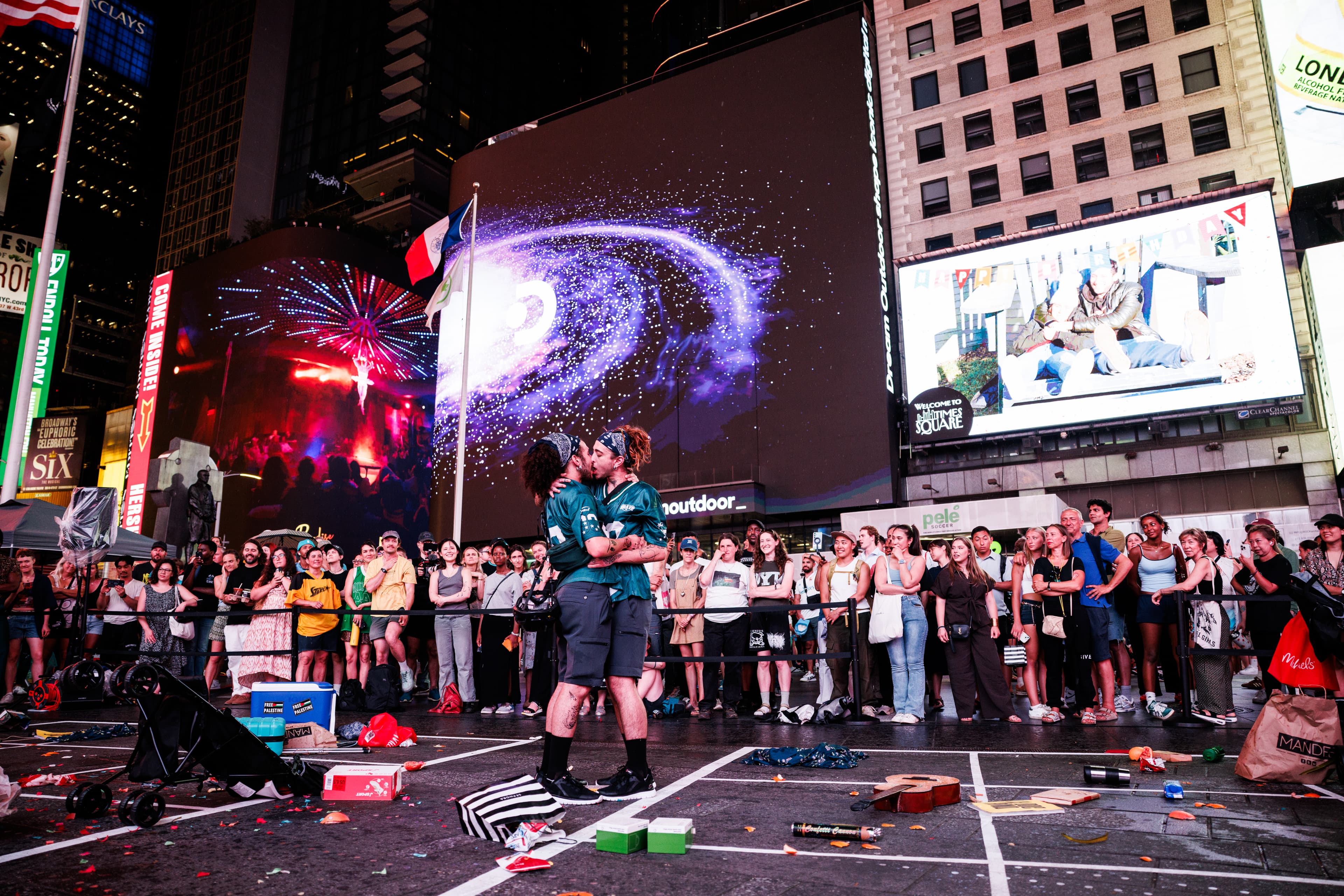
Maia Chao, American Idle, 2025. Photo: Maria Baranova for Times Square Arts.
American Idle
Choreographed by Lena Engelstein
Duffy Square
July 9, 2025
New York
It took a moment for my eyes to spot the difference.
A woman milled around a studio apartment-sized rectangle, barred off by a stanchion belt. Then, another entered. Seeing one was to see both: a dozen feet apart, the women mirrored each other’s footsteps and had the same tight braids, same denim overalls, and same Gen Z sunglasses in Millennial pink.
Were these twins? No: a closer look told me the performers had slightly different skin tones. Plus, they snapped open LaCroixs milliseconds apart. American Idle, the movement piece they kicked off, asked me to notice distinguishing details in a place where everyone tries flowing together: Times Square.
Created by Times Square Arts Public-Artist-In-Residence Maia Chao and choreographed by Lena Engelstein, American Idle performed three times on July 9 in Duffy Square, feet from the fire hydrant-red TKTS steps. I caught the middle performance, at 6 p.m., a time of day I wouldn’t wish Times Square on anyone, even Republicans, who were already there: a boy, about eight, wore a MAGA hat, which matched his mom’s, as they zipped past the performance pen.
They weren’t the only ones on the move. There were commuters, competing Elmos, and those guys shouting, “Comedy show tonight!” Twins, whether in matching hats, Sesame Street costumes, or white-collar uniforms, were omnipresent.
An urban aorta, Times Square’s bloodstream pulses and pulses despite being packed with fast food chains. Standing still in it, I thought I’d cause a clot, but if I moved, I’d lose my place at the stanchion. I kept still, an idle American awaiting American Idle.
Around me, nonstop bodies found a rhythm, as did, above me, nonstop ads. On one jumbotron, there were Chicago girls in black bowler hats saucily straddling chairs, then FIFA players looking determined with nose pores the size of golf balls, and then Grand Slam promoting its Big Apple memorabilia with a chunky arrow pointing to the store itself, just below the sign. The video repeated: girls, pores, arrow, girls, pores, arrow.
Chao and Engelstein understand the cadence, and absurdity, of girls, pores, arrow. Mimicking the loop of Times Square ads, American Idle featured a cast of ten doubles copying their partners’ moves and then, at overlapping intervals, repeating those moves anew.
Middle-aged women with visors lost in a crowd, surfer bros schlepping newly acquired house plants out of the fray, dads fanning shirts to let in some air, damnit: the pairs of performers reflected the unglamorous kinetics of the masses around them.
I watched the piece, and then the public beyond it. If there were minute differences between the paired performers, such distinctions were no greater than those between performer and public.
Almost everyone in Times Square, I also noticed, was holding something: phones and selfie sticks, but also to-go plastic containers and big brand snacks and bags with all the ampersands—H&M, D&G, M&M’s. Overwhelmed or not by New York, tourists quickly adopted a flow of shop and swerve.

Maia Chao, American Idle, 2025. Photo: Maria Baranova for Times Square Arts.
Engelstein captured such capitalist naturalism in her pedestrian choreography. Ever on the go, performers threw some Lay’s down the chute and sucked Tootsie Pops, but, in exaggerated displays, also smeared Cheetos dust onto their sweat-beaded faces and guzzled Polar seltzers until bubbles poured down cleavages. Meanwhile, a duo sprayed pasty extremities with suntan lotion. A gracious breeze turned the air beachy—New York can be foul and forgiving.
Times Square has no shortage of street performers. Competing with a Lady Liberty on stilts and breakdancers with flashier moves and louder speakers, American Idle caught an audience on all four sides of the pen. Crowd psychology worked: onlookers summoned more. Blasting pop songs (“Lucky,” “Everytime We Touch”) helped, as did other familiar ones (“Lo, How a Rose E’er Blooming”). In my head, each song conjured a product that might accompany it for a seasonal marketing campaign.
Skyhigh ads for Moulin Rouge! and a Smurfs movie, and some other one starring Liam Neeson with a pink gun, all stared down at a performance whose aesthetic was anything but mainstream while existing, literally, in it. I wondered how many of the passersby—who were growing, and not leaving—might call this work experimental. I wondered if that mattered at all, and how often people get to experience an art form that rarely enjoys financial support.
Appearing in the new performance series Sugar, Sugar! last month, Engelstein drove a car through Williamsburg’s Domino Park in another maximalist display. She is becoming a leader of public performance, and her rogue jocularity matches the scale of her makeshift stages. The work is practical: igniting a fierce sense of collective imagination, the performances draw eyes, and, by nature of the amoeba shape of a crowd, an ability to watch other people watch the performance and piece it together, together. Others’ expressions can be hard to deduce in the dark of a traditional theater, but in daylight, we confront the blobby shape of a curious work and define its edges as one. Theaters may always struggle, but al fresco stages are everywhere, if activated.
Even at a glance, hustling parents understood what was happening in American Idle.
“They’re just mimicking the billboard ads, that’s their art,” one woman said, trying to get from A to B without losing her kids to the gravitational pull of avant garde performance.
Later, a dad behind me gave a forceful whistle. Two small heads in front of me instinctively spun around and disappeared into the stream. “Ay, dios mio,” another woman said when two femme performers kissed.
American Idle was accessible without sacrificing cleverness, and it appealed to a spontaneously formed crowd spanning various ages, artistic diets, and languages. In recognizable and oddball acts that parrot and suggest tourist movement, the audience could recognize itself—and more foreign creatures.
Midway, the performers became other city characters: flapping pigeons, then dockside fish with gaping mouths waiting for food embodied through cupped hands, palms up, hungrily clapping.

Maia Chao, American Idle, 2025. Photo: Maria Baranova for Times Square Arts.
Casting further increased accessibility. The performers are surely professional, but it’s a compliment that they came across as ordinary. Yes, one younger performer did a standing flip here and there for flourish, but no performer looked or was costumed like they danced for New York City Ballet. Boxing American Idle’s performers in a rectangle, then, was like framing a laundry receipt: the everyday is now art.
Some just wanted to stand in Times Square and have a spectacle to record. Compared to their phone-free neighbors, however, their expressions were blank: videos are flat. Gazing back up at pores, girls, arrow, the garish videos became an eerie carousel. Never evolving, they felt dead and became predictable.
The humans below, however, were anything but. Their attempt to stay in sync only highlighted their inconsistencies. The two lost women unfurled maps seconds apart—a spell was broken, and I rooted for them to secretly lock eyes and refind their groove.
“I AM RIGHT IN THE MIDDLE, AND I CAN’T SEE YOU,” one of the lost women cried on her phone.
From the sidelines, someone played along and shouted, “I’m right here!” The woman replied, “You’re not who I’m looking for!”
People do love a game, and a chance to connect. Just consider the quintessential Times Square activity: counting down to New Year’s.
Shifting through tourist tableaus throughout American Idle—group selfie, rush hour foot traffic, Central Park picnic complete with squirting mouths to enact fountains—the performers ended by huddling together to watch the ball drop.
At the stroke of their fictional midnight, each twin found their other. I’m always looking for a fresh self on January 1. The couples found theirs, and look how striking the resemblance: new year, same shit.
Everyone greeted themself—the surfer bros bumped chests, the queer bois kissed, the dads patted shoulders. But then there were the lost women, whose maps and phone calls had yielded no reunion.
As “Auld Lang Syne” rang, and the couples around them embraced, the two middle-aged women in visors peeked over heads but struggled to find each other. I got misty.
They gave up and exited the performance area. The women missed one another but at least found other tourists, whose hungry current had room for two more.
The cast of American Idle features the following performers, with devising partners marked with an asterisk: Aeon Andreas, Miguel Alejandro Castillo Le Maitre*, Paola Castro, Marin Day*, Jack Dexter, Nyeema Raynn Dimitriou, Natalia Heaven Dimitriou, Benin Gardner, Isa Goldberg, Ben Hard*, Katrina Leung, Bob Murphy, Yurika Ohno, Iliana Penichet-Ramirez, Ampersand Paris*, Molly Ross, Parker Sera, Lisa Tracy Taber, Nicholas Troncoso, and Coco Villa.
Billy McEntee is Theater Editor at the Brooklyn Rail. He won the 2024–25 George Jean Nathan Award for Dramatic Criticism, and his plays The Voices in Your Head and Slanted Floors were Drama Desk–nominated for Unique Theatrical Experience.