Tony Leuzzi

Tony Leuzzi is an author. His books include the poetry collections Radiant Losses, The Burning Door, and Meditation Archipelago, as well as Passwords Primeval, a collection of his interviews with American poets.

More than forty years ago, the Jewish Publication Society of America released In New York: A Selection, a collection of Moyshe-Leyb Halpern poems translated from Yiddish into English by Kathryn Hellerstein. 
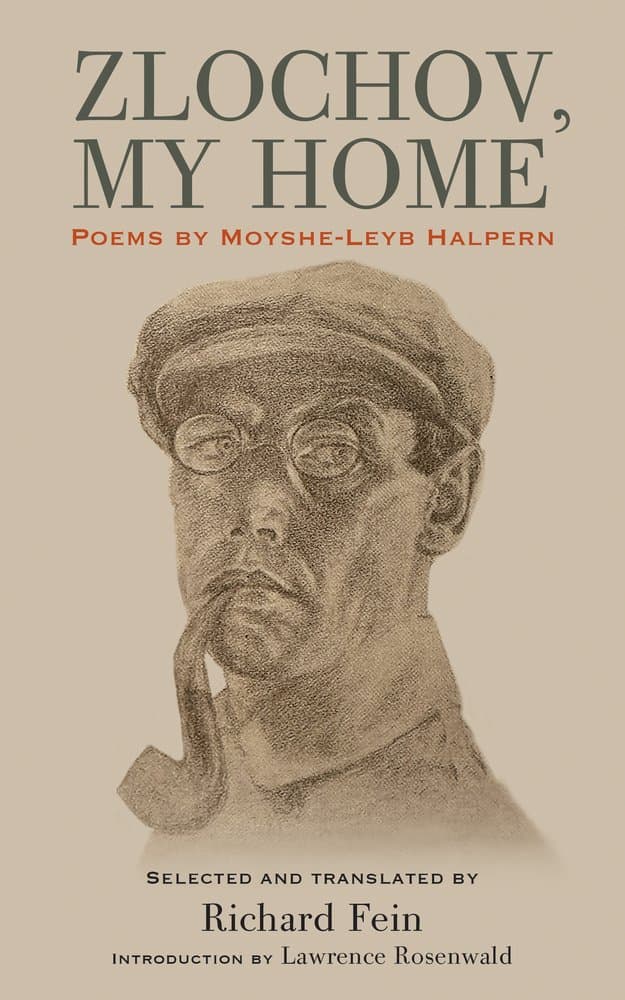
Zlochov, My Home: Poems by Moyshe-Leyb Halpern

My interview with Joan Larkin was conducted through email and phone conversations across a two-week period in July 2025. In 2012, she and I interviewed each other for a feature in the Huffington Post—an experience I still cherish, given her generous responses as well as her genuine curiosity about my work.

JOAN LARKIN with Tony Leuzzi

Perhaps best known for his award-winning short fiction (Off in Zimbabwe), as well as for his nonfiction, Rod Kessler belongs to a genus of prose stylists who also compose verse poems, a prestigious subgroup that includes some of the finest writers of the language.

ROD KESSLER with Tony Leuzzi

Whether as the result of foresight or just plain good timing, we are fortunate, then, for the November 2024 release of Kareem James Abu-Zeid’s stellar translations of poems by Najwan Darwish, a forty-six-year-old Palestinian poet widely considered a leading voice in Arab-language literature.

Najwan Darwish’s No One Will Know You Tomorrow: Selected Poems 2014–2024

The following conversation shows two poets inviting each another into their creative spaces, allowing draft stages of their work to be scrutinized through careful, patient reading. The subjects of the discussion included, as they must, matters beyond craft.

WILLA CARROLL with Tony Leuzzi

Indeed, one of Ukraine’s most accomplished poets, Ostap Slyvynsky, is also a poetry citizen par excellence, giving voice to people and points of view that might otherwise be erased through violence. His nine poems from Words for War exhibited an intriguing formal tension, sound historical awareness, and oblique yet deeply personal allusions. I, enthralled, eagerly waited for some American press to issue a full volume of translations.

Ostap Slyvynsky’s Winter King
What a relief and joy then it has been to encounter poet Katie Manning’s Hereverent, a collection of poems which, again in the words of Cairns, provides “an inclusive corrective to pharisaical anxieties that have, of late, threatened to erode the compassion and joy of the Gospel.”
Katie Manning with Tony Leuzzi
Tony Leuzzi is a poet, visual artist, and educator. The author of four poetry collections and editor of one anthology, he is also a frequent contributor to the “Books” section of The Brooklyn Rail.
Edited by Dana Levin and Adele Elise Williams, the Meyers project was, among other things, a labor of love, not only for Levin and Williams, each of whom in their own way regard the poet, who died in 1979, as their teacher and mentor, but also for Daniel Meyers, the poet’s son. Daniel’s efforts to ensure his father’s legacy culminated in the publication of In a Dybbuk’s Raincoat: Collected Poems (University of New Mexico Press, 2007)—a handsome, impeccable volume that did not impact the poetry world as it should have and is now, tragically, out-of-print.
Bert Meyers: On the Life and Work of an American Master
Spring 2023 saw the release of a book that should be essential reading for anyone invested in the study of twentieth-century Irish literature and, more specifically, certain cultural and aesthetic intersections between Irish and American letters since 1965. The book is Edward (Ed) J. O’Shea’s Seamus Heaney’s American Odyssey (Routledge), a well-researched and compassionate examination of the 1995 Nobel Laureate’s experiences in and affiliations with the United States, its writers, and its politics.
Ed O'Shea with Tony Leuzzi
In our discussion below, McCarter provides numerous insights into Ovid and articulates several key decisions that informed her translation of his poem. “I wanted to prove, mainly to myself, that it was possible to write a poetic translation, an accurate translation, and a feminist translation all in one,” McCarter says.
Stephanie McCarter with Tony Leuzzi
Earlier in our discussion, printed below, Sugarman noted a “moral risk of representing the Holocaust in literature … in domesticating the unspeakable horrors of the Shoah … using aesthetic conventions to grasp the ungraspable.”
Yerra Sugarman with Tony Leuzzi
Poet Luther Hughes and Rail Contributor Tony Leuzzi discuss Hughes's new book, A Shiver in the Leaves.
Luther Hughes with Tony Leuzzi
From an interview that follows Das’s new collection of poetry, Exile Poems: In the Labyrinth of Homesickness, the writer says, “I am a Bengali and Bangladeshi first. Some people want to define me by my religion, but I want to be known by my culture, which is Bengali.”
Tuhin Das's Exile Poems: In the Labyrinth of Homesickness
As the first book of its kind, Suncranes illuminates the perspectives of a place and its people largely unknown to English-language readers.
Simon Wickhamsmith with Tony Leuzzi
Because Levin is honest and self-interrogating, her desire for clarity yields more questions than answers. When human life seems predicated on “exchanges of suffering,” rigid definitions and reductive moralities must give way to something akin to possibility and mystery. Taken alone, her confident yet searching point of view compels. Combined with her attention to matters of sound and craft, the poems in Now make memorable music.
Dana Levin with Tony Leuzzi
February 22, 2022 marks the release of Ultramarine, the third volume in Wayne Koestenbaum’s trance poem trilogy. This project, which began with The Pink Trance Notebooks (2015) and continued with Camp Marmalade (2018), is remarkable for many reasons, not least of all for the distinct tonal differences (or: colors) between the respective volumes.
Wayne Koestenbaum with Tony Leuzzi
In her own words, Seuss describes frank: sonnets as “a memoir in a string of sonnets,” an ambitious project that challenges notions of what an individual sonnet or sonnet sequence can contain.
Diane Seuss with Tony Leuzzi
As the title of the book suggests, Prufer accomplishes this through an inventive, supple storytelling style that binds memories and hypotheticals to various fictional forms. The bulk of the collection is comprised of poems in which multiple narratives initially run parallel, then gradually angle towards one another and ultimately intersect.
Kevin Prufer’s The Art of Fiction
By her own admission, she is neither an American nor Romanian writer, citing instead her identity as an immigrant poet. This is not some superficial pose. On every page of Cemetery Ink, Moscaliuc keeps one foot in both worlds, laying claim to neither, yet sensitive to the rhythms and nuances of lives lived there—and throughout the globe.
Mihaela Moscaliuc’s Cemetery Ink
Distinguished by its gritty realism, Rainbow Milk is among the more convincing debuts I have read in years.
Paul Mendez’s Rainbow Milk
Albert Mobilio is a poet and critic whose poems exhibit a highly critical intelligence. On the other hand, as demonstrated in the following discussion, his critical acumen can be as aesthetically rewarding as his poems. Each role informs the other.
ALBERT MOBILIO with Tony Leuzzi
Broadly speaking, the central theme of Cardinal is “traveling while black in America”; but like individual stars in a cluster orbiting some galactic center, each of Daye’s poems emits its own light: any single moment of illumination is as crucial as the panoramic view.
TYREE DAYE with Tony Leuzzi
With Hold Me Tight, the poet’s newest collection, Schneiderman does not rest on his laurels or try to repeat the formula of his former books. As he admits below, each of his projects is markedly different from the one that precedes it. This acknowledgement demonstrates the poet’s searching intelligence as he finds new ways to mine persistent obsessions.
JASON SCHNEIDERMAN with Tony Leuzzi
“I want language to approximate the kind of conversation one might have some evening, talking about real things, serious things, but not feeling especially dire, and the talking is happening just as one’s thinking about it, so that the thought and the expression of the thought are happening simultaneously.”
JOHN GALLAHER with Tony Leuzzi
Barnett insists “It’s not too late to fight back. / Calamity et al! / Get up, we love you!” Thus a wake up rally cry is wryly supported by an allusion to—of all things—Frank O’Hara’s “Poem (Lana Turner has collapsed!).” Surely one of many reasons why Catherine Barnett’s Human Hours packs such a powerful punch is that its creator has synthesized her sources without straining for effect. Barnett succeeds through understanding and sympathy.
CATHERINE BARNETT with Tony Leuzzi
It has been thirty-three years since Bob Kaufman died semi-homeless of a pulmonary embolism. In America, the poet is often remembered for observing ten years of silence following the assassination of John F. Kennedy. In France, upon the publication of his first, most-famous book, Solitudes Crowded with Loneliness (1965), he was christened “The Black Rimbaud.”
Bob Kaufman, 1982. Photo: Chris Felver.
Sze is a dynamic writer whose vision and aesthetic evolve as he evolves. Although his poems are still built around vivid, often startling juxtapositions, the nature of those juxtapositions, as well as the intent behind them, has changed.
Sight Lines
The following discussion reveals that Satterlee’s venture into translation was shaped not by some lofty, lifelong ambition but circumstance and opportunity.
THOM SATTERLEE with Tony Leuzzi
Rivard’s robust yet rueful poems may tilt towards elegy but the poet himself possesses a terrific sense of humor: this is punctuated by a winsome smile and utterly mischievous laugh.
Given our times, a cynic might be excused for assuming Something for Everybody, the title of Anselm Berrigan’s most recent book of verse, is an ironic indictment of well-intentioned yet over-simplified gestures towards equity and inclusion.
Anselm Berrigan’s Something for Everybody
The first book I ever read by Timothy Liu was Word of Mouth: An Anthology of Gay American Poetry (Talisman House, 2000).
TIMOTHY LIU with Tony Leuzzi
Some movies allow us to escape the otherwise inescapable realities of our lives. Others remind or inform us of experiences removed from our own. Still others provide a language and imagery that help articulate personal struggle. While all of these functions are evidenced in Donna Masini’s resonant new collection 4:30 Movie, the last is most central to the poet’s conception.
Donna Masini’s 4:30 Movie
Writers of elegy are compelled to remember their dead, even when they can’t forget them. Therefore, the art’s best practitioners offset despair with a sense of affirmation.
Sheryl St. Germain's The Small Door of Your Death
One of the most dis­­tinctive collections of verse published in the United States this year features the poems of a Danish cognitive scientist in translation. This is not a condemnation of the current state of American poetry, which is as rich and varied as it’s ever been, but an uninflated testament to the highly original work of Per Aage Brandt. Up to this point, Brandt has been largely unknown to readers of English-language poetry.
Per Aage Brandt's If I Were a Suicide Bomber
“That’s an awful lot of me,” Kevin Killian observed when I sent him proofs of the interview that follows this introduction—“Do we need it all?” On the surface, such candid self-effacement seems unlikely in a writer whose work is so searching and confident, but Killian’s apparent lack of ego may be connected to his fascination with makeshift art.
Kevin Killian
In the James Kriegsmann, Jr. photograph that adorns the cover of Second Nature, Patricia Carlin’s new collection of poetry, a grafted orange tree laden with fruit rises from a square of dirt among cobblestones.
Patricia Carlin's The Art of the Underneath: Second Nature
When Bill Knott’s death at the age of seventy-four was reported on March 12, 2014, a number of friends, fans, and professional associates questioned the truth of the story.
Knott Knowing
Tony Leuzzi’s books include Radiant Losses and The Burning Door, both collections of poems, and Passwords Primeval, a book of interviews with 20 American poets. His next book, Meditation Archipelago, will be published by Tiger Bark Press in early 2018. 
May Day, the name of Gretchen Marquette’s debut collection of poetry, is richly ambiguous. On the basis of the title poem, and another called “Song for the Festival,” one might think the central metaphor of the book is a spring celebration commencing rebirth.
All the Furious Living and all the Furious Dying
Tony Leuzzi and Tod Marshall have never met, but their work has been in conversation since 2012, when Leuzzi finished Passwords Primeval,his book-length collection of interviews with contemporary poets. Marshall had worked on a similar project from 1991 – 2002; his book, Range of the Possible, explored the same genre: the meticulously researched literary interview.
TOD MARSHALL and TONY LEUZZI
Terese Svoboda is one of few contemporary American writers who possess a global consciousness. From 1987’s All Aberration to 2013’s Dogs are Not Cats, each of her six previous poetry collections captures what is claimed in the final sentence of “The Dead Dance” from Laughing Africa (1990).
The Global and the Local
Distinguished for both supple, vigorous movements of language and a restless, sometimes searing honesty, Klein’s style is unmistakably his own. Whether a compact verse poem or a longer-scale scene from one of his memoirs, his work vibrates with an almost devastating energy that is a natural extension of his physical presence.
Living Between the Imagined and the Real MICHAEL KLEIN with Tony Leuzzi
“There’s nothing good about ill-timed death,” Kathleen Ossip asserts in “Oh, wow, mausoleums,” the final poem in The Do-Over, the poet’s third book of poems. “Nor about the death of love. That poetry glamorizes them disturbs me.” Plainspoken and unsentimental, this passage typifies the tone and subject of Ossip’s newest collection, a bold procession of elegiac meditations and ode-like gestures that never hide behind gossamer veils of rhetoric to soften unforgiving truths.
Elegies for Existence
“How could I feel / what wasn’t there?” James Tolan writes as doubting Thomas in his two-part poem, “Carravaggio’s Thomas.” This confrontation with palpable absence is a recurrent theme in Mass of the Forgotten, Tolan’s first book of poems.
TO BE FLOODED ONCE MORE: JAMES TOLAN In Conversation with Tony Leuzzi
“I was born into a world that no longer exists,” Mary Ruefle told me as we sat down to lunch at a Mediterranean restaurant in Rochester, NY. Although referring to how entrenched electronic devices are in our daily lives, and how terribly sad it is that more and more people have never known what it feels like to be off the grid for a day, let alone a week, she appeared to be talking about more than iPads and Bluetooths.
The Life-Long Sentence MARY RUEFLE with Tony Leuzzi
Tony Leuzzi is the author of Radiant Losses (New Sins Press, 2010) and The Burning Door (Tiger Bark Press 2014). In 2010, BOA Editions released Passwords Primeval, Leuzzi's interviews with 20 American Poets.
In 1936, the great Spanish poet Miguel Hernández wrote: I am tired of so much pure and minor art . . . I don’t care for the puny voice that goes in ecstasy standing before a poplar, that fires off four little verses and believes that now everything has been done in poetry.
In his redoubtable essay “Tradition and the Individual Talent,” T. S. Eliot wrote, “No poet, no artist of any art, has his complete meaning alone. His significance, his appreciation is the appreciation of his relation to the dead poets and artists.” I wonder how Eliot might have assessed the work of David Lehman, a poet whose recently published New and Selected Poems demonstrates time and again that one’s ongoing engagement with poets dead or alive need not mask personality or stifle innovation.
Posing Questions to the Universe
Some poets seize and refine a particular aesthetic until their procedures can take them no further. Others are more searching and allow specific projects or concepts to determine changes in their approach from book to book.
Here was a writer who absorbed and transcended aspects related to the most salient literary movements in European literature from the first half of the 20th century.
The Wet Flame of Your Tongue: Translating Yvan Goll NAN WATKINS with Tony Leuzzi
“Rise up, Mrs. Oakley, you are not alone!” Mary Ruefle exclaims at the end of “County Fair,” a sad yet comic poem about a woman who loses in all seven categories of a baked goods competition.

Close

Home