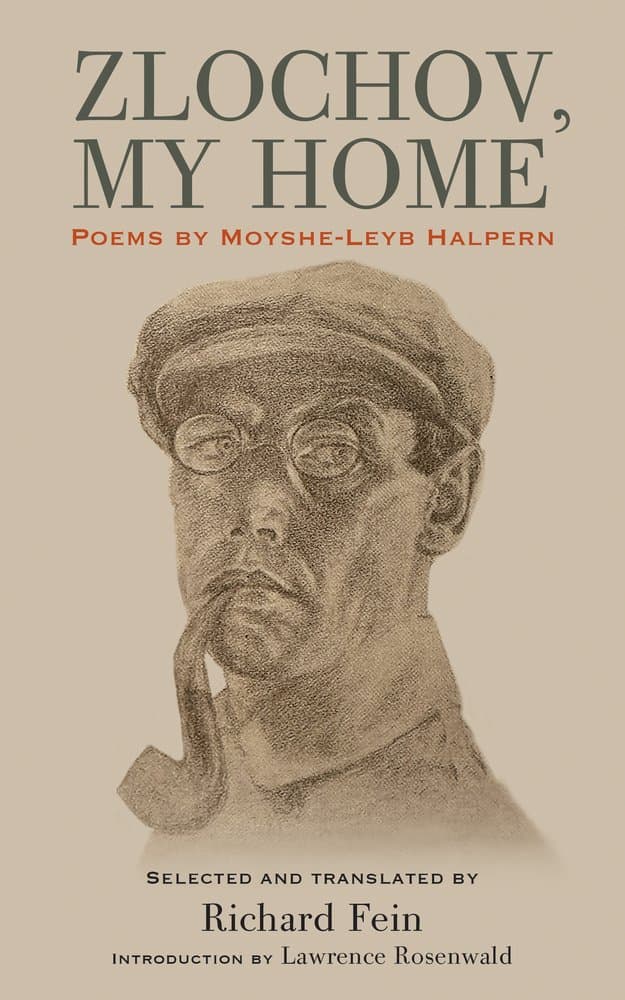
Zlochov, My Home: Poems by Moyshe-Leyb Halpern
Word count: 1111
Paragraphs: 11
Translated from the Yiddish by Richard Fein
Excelsior Editions, 2026
More than forty years ago, the Jewish Publication Society of America released In New York: A Selection, a collection of Moyshe-Leyb Halpern poems translated from Yiddish into English by Kathryn Hellerstein. This collection, which showcased versions of approximately one-third of Halpern’s original 1919 text, In New York, proved a landmark in American letters, for it not only introduced English-language readers to a poet that scholar Ruth Wisse has called “perhaps the most powerful voice in the entire history of Yiddish poetry,” but provided modern poetry enthusiasts with a fuller picture of certain innovations in verse beyond traditional Western European and Anglo-American canons. Moreover, Hellerstein’s graceful, crystal-clear renditions afforded readers a unique glimpse into one writer’s experience during the Jewish diaspora of the late-nineteenth/early-twentieth centuries. Even in translation, Halpern’s passionate urgency was evident. “The engine stirs up wake,” he observes in one section of “In a Foreign World,” a long serial poem that tracks with considerable intimacy the poet’s journey from Zlochev, Galicia, (Austria-Hungary) to America: “The ship departs, / And watching people waving from the shore, / I feel a strangeness in my heart of hearts. / Minute by minute, we’re distanced more and more.” Said distance is both literal and metaphorical. The ship that carries Halpern across the Atlantic inches further from sources of love and familiarity towards a place that will leave him, as he admits in later stanzas, “bewildered” and “struggling” with loneliness and isolation.
This poem—and many others from In New York: A Selection—articulate a moving, valuable perspective of the immigrant experience through literature. However, this theme is only one facet of Halpern’s approach. Intense, ironic, often satirical and occasionally mercurial, the poet’s range resists quick summation, in part because his relationship to the home he fled induced both nostalgia and hostility: “Long for home and hate your homeland,” he declares in the opening line of “Homesickness.” There, Halpern’s pronounced alienation occupies a space as complex and authentic as Richard Wright, or other searching modernists. Clearly, he had much to offer the curious reader. One might be excused for assuming, then, that In New York: A Selection marked the start of a period in which Halpern would receive sustained attention through frequent translation and publication. Sadly, this was not to be. Although generous samplings of his work appeared in both The Penguin Book of Modern Yiddish Verse (1987) and American Yiddish Poetry (1986), Halpern has remained virtually unknown to readers beyond select enthusiasts of Jewish and Yiddish literature. This is why poet Richard Fein’s fresh translations of Halpern, now available through Excelsior Editions, are especially welcome.
“In a Foreign World” does not appear in Fein’s Zlochov, My Home: Poems by Moshe-Leybe Halpern, but this omission signals one of the collection’s strengths. As Lawrence Rosenwald notes in his “Introduction,” Fein’s selection differs from the three aforementioned projects because he features many poems formerly not rendered into English. The basis for the selection appears to have been personal—Fein translating those poems which best engaged his interests—and equitable. In addition to In New York, Halpern’s two other collections are The Golden Peacock (1924) and Moyshe-Leyb Halpern, Volumes I and II (1934). If history has privileged portions of In New York above the other titles, Fein’s Zlochov takes a definitive step to balance this. More than anything else, Zlochov, My Home makes a compelling case for full translations of each of Halpern’s books.
Of particular interest are Fein’s versions of poems from The Golden Peacock, in which Halpern exploits and extends ballad forms for a wide range of effects. Drawing equally from ancient Yiddish folklore and post-industrial urban environments, these ballads reframe certain literary and cultural practices, such as repetition and metrical play, through ironic, sharply-observed commentaries on contemporary life. In “The Bird”—a poem in which the narrator refuses to open the door for fear the bird on the other side will try to steal the cheese he hides in his ass—the intentional crudeness of the refrain undercuts traditional poetic imagery to more than merely comic effect. So great is the narrator’s distrust that he and the bird are locked in an interminable stasis. Seven years later, “I ask him, ‘My Brother let me out.’ / And he asks me, ‘let me in.’” No resolution is afforded. Elsewhere, Halpern’s use of ballad forms accommodates a variety of themes, such as proletarian politics (“Hey, Jew, My Brother!”); the foolish strivings of man (“Man the Ape”); and the earthy pleasures of shtetl communities (“You’ll Never Catch Me Saying”). The title poem, also a ballad, deserves special mention as a study in ambiguity: as in “Homesickness,” the poet’s relationship to homeland oscillates between yearning and revulsion, a fascinating case study in simultaneous avowal and disavowal.
In all cases, I agree with Rosenwald’s assessment that Fein is “a superb poet . . . [who] has a wonderfully grounded, authentic diction. The words he chooses are alive, surprising, direct, unguarded.” Where poems from Zlochov, My Home have been translated elsewhere, the comparison is instructive: Fein is less concerned with reproducing end rhymes or establishing a metrical flawlessness (Hollander) than he is with foregrounding Halpern’s distinctive point of view. The result is striking—and contemporary.
Perhaps the best example of that point of view can be seen in Halpern’s sonnet, “Considering the Bleakness”:
Considering the bleakness
and the hoarse animal roar,
you would think it a desert
where a sick, old lion
crawls around a rock,
looking for a place
to lie down and die.
In truth, it was a vacant city
where a madman, on all fours,
was crawling around,
circling a collapsed house,
dragging from behind
a skull on a rope
tied to his belt.
Wherever the source of this “vacant city”—be it one destroyed by one of many wars that occurred in or near the Pale of Settlement, or in a shtetl following periodic pogroms—the vivid horror recorded here is both a testament to what has passed and an eerie premonition of what will come in the years immediately following the poet’s premature death in 1932. That turn in the eighth line undercuts readers’ expectations with cinematic clarity: the “bleakness” described there is, to my way of thinking, more immediate and heart-rending than anything in “The Waste Land.”
Clearly, we have much to learn from reading Moyshe-Leyb Halpern’s poems in translation. They show us the complex ripple effects of the Jewish diaspora; they represent an intense flowering of Yiddish verse before that language’s systemic erasure; but perhaps most of all, they survive as an authentic, moving account of one individual’s rejection of certain scripts and ideologies in favor of an honest appraisal of his world.
Tony Leuzzi is a writer and a visual art maker. His most recent collection of poems, Fog Notes, was a 2023 finalist for the Big Other Poetry Award. Passwords Primeval collects twenty of his interviews with American poets. He is a frequent contributor to the Brooklyn Rail.