David Whelan

David Whelan is an artist living in the Hudson Valley, New York.

For Hans Hofmann, painting was an exercise in creating relationships, an opportunity to see colors and shapes react to one another—often dramatically, in formal wrestling matches that create a dynamic sense of space. Never planning his paintings ahead of time, Hofmann made intuitive decisions on the canvas, allowing the process to take him somewhere unknown.
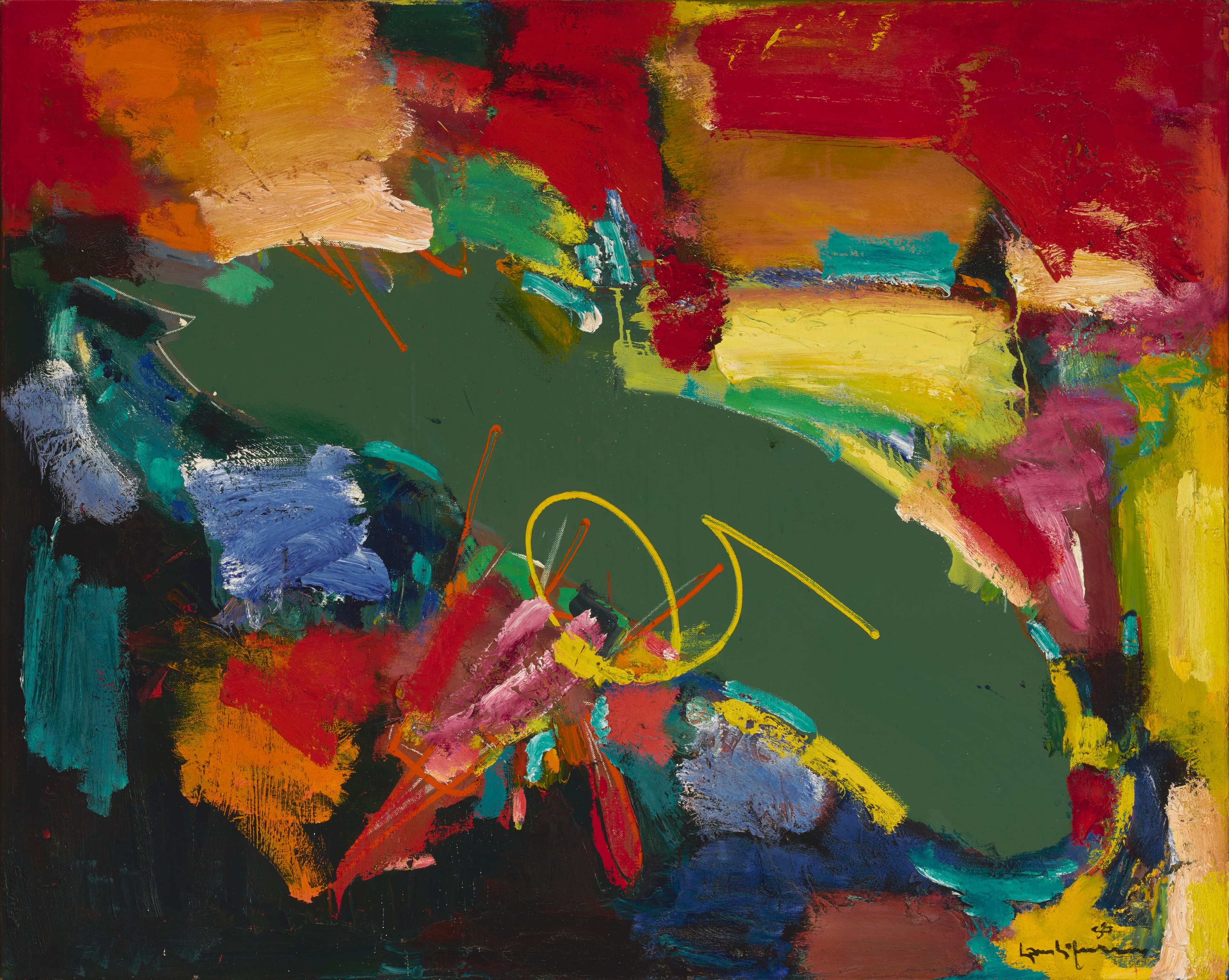
Hans Hofmann, The Pond, 1958. Oil on canvas, 40 × 50 inches. Courtesy Yale University Art Gallery. Photo: With permission of the Renate, Hans & Maria Hofmann Trust/Artists Rights Society (ARS), New York.

In his exhibition SHIPPING at Headstone Gallery, Richard Bosman represents the most ubiquitous thing we experience as consumers: packaging. However, Bosman’s deadpan representations have a nautical tinge, directing our attention to global trade networks and the shipping containers that transport our goods.

Richard Bosman, Made in China, 2025. Dispersion (Sherwin Williams house paint) on cardboard, backed by gator board, 39 ½ × 32 ½ inches. Photo: Courtney Dudley.

Maurice Freedman was a quintessential modernist, painting what he saw from everyday life while channeling his inner vision. The artist split his time between New York and Maine, the journey between a well-trodden path beloved by many artists.

Maurice Freedman, Times Square, 1940. Oil on canvas, 18 × 42 inches. Courtesy Greenhut Galleries.

In Diana Horowitz’s exhibition Light is a Place at Bookstein Projects, we see a row of small-scale paintings, intimate and portable, depicting subjects that range from the Manhattan skyline to hilltop towns in Italy, cows grazing in a field, and the momentary release of fireworks at night.

Diana Horowitz, Upper Manhattan, Haze, 2021. Oil on aluminum, 5 x 7 inches. Courtesy the artist and Bookstein Projects.

In Lynne Drexler’s current exhibition, Color Notes, one sees a genuine exploration of color through experimentation and play rather than theory, inviting us to see color with immediacy and revel in the experience.

Lynne Drexler, Cismont, 1962. Oil on canvas, 68 × 85 1⁄4 inches. © 2024 Lynne Drexler by permission of the Lynne Drexler Archive.
When the Zadock Pratt Museum asked sculptor Cal Siegel to curate objects from its archive he approached the museum as a raw material. He is an expert craftsman who provides solid foundations for his work in both form and concept, but he also plays irreverently with formal contradictions, accepting found objects, glass, and ceramics into his work.
Installation view: Cal Siegel: Whose Folk, Zadock Pratt Museum, Prattsville, New York, 2024. Courtesy Zadock Pratt Museum.
Plastic containers, milk cartons, eggs, skulls, medical gear—these are all objects meant to shelter or lend structure, common objects that protect the inside from the outside, preserving something within from the chaos beyond. In his current exhibition at Underdonk, Michael Sims recombines these objects into new, often unsettling, configurations, compelling us to consider our own defenses and glimpse the ways in which we’re held apart from a world of heightened tension.
Michael Sims, untitled (helmet), 2024. Bones and colored epoxy on glazed stoneware, 11 x 10 x 27.5 inches. Courtesy the artist and Underdonk.
Eric N. Mack’s current exhibition at Paula Cooper Gallery demonstrates a virtuosic understanding of fabric’s material characteristics, as well as its emotional range. Mack creates forms by hanging found fabric on solid supports such as the frame of a painting or a free-hanging armature.
Eric N. Mack, Satin and fluid evening dresses, 2023. Assorted fabric, steel, 117 x 78 x 55 inches. © 2023 Eric N. Mack. Courtesy Paula Cooper Gallery, New York. Photo: Steven Probert.
At twenty-six feet high, Roy Lichtenstein’s Bauhaus Stairway Mural (1989) towered over me, projecting a playful spirit despite the seemingly impersonal means of its creation. I was awestruck by the monumental scale of the painting, imagining the energy that goes into creating an artwork of this size. But as I stood there longer, the novelty faded away and I began to feel a sense of detachment, wondering how to make a deeper connection. 
Roy Lichtenstein, Bauhaus Stairway Mural, 1989. Oil and Magna on canvas. 26 feet 5 3/4 inches x 17 feet 11 3/4 inches. © Estate of Roy Lichtenstein. Courtesy Gagosian. Photo: Rob McKeever.
The 1980s were formative years for Peter Halley, a New York artist best known for geometric paintings evoking prisons and cells, painted in florescent colors with industrial techniques. His dual shows currently on view at Karma and Craig Starr offer a privileged view into the artist's earlier experimental work.
Peter Halley, ​​Red Wall, 1980. Acrylic on canvas, 27 1/2 x 35 inches. Courtesy the artist, Craig Starr, and Karma.
In Lois Dodd’s comprehensive exhibition Natural Order, now on view at the Bruce Museum, the artist’s unique approach to observation is laid bare. Dodd’s paintings of modest subjects read like field notes, recording her perception of the immediate environment. The frenetic energy and physicality of her work reminds us that making sense of the world is not an instant phenomenon.
Lois Dodd, Natural Order, 1978. Oil on linen, 50 x 38 inches. Hall Collection. Courtesy Hall Art Foundation. © Lois Dodd. Image courtesy Alexandre Gallery, New York.
A solid band of Patriot blue stretches across the back gallery of Sikkema Jenkins, creating a powerful backdrop for Mark Thomas Gibson’s large, thinly framed drawings and paintings. In Gibson’s exhibition WHIRLYGIG!, bad things are off the rails. Cartoonish images of marching boots, steampipes, hooded masks and ominous hands show us a world of non-stop conflict, frozen in a state of perpetual alarm.
Mark Thomas Gibson, All A Go (Steampipes and Hands), 2022. Ink on canvas, 66 1/8 x 86 1/4 inches. © Mark Thomas Gibson, courtesy Sikkema Jenkins & Co., New York. Photo: Jason Wyche.
Gaby Collins-Fernández’s solo exhibition To A Portrait unraveled my defenses. Borders give me a sense of calm and control, but the six wall-height paintings on view at Anonymous escape these boundaries, giving a broader dimension to one’s psychic, emotional, and bodily life. Words and images entwine and stretch past their limits, shattering into fragments of human desire. The work sneers at my guarded caution in its excess, passing up my small world for one with much more fascinating, beautiful complication.
Gaby Collins-Fernández, Mask Rapture, 2022. Oil and acrylic paint, digital photocollage print on beach towel and chiffon, 68 x 52 inches. Courtesy the artist and anonymous gallery.
Snow days are coveted by those who tire of winter gray, bringing the excitement of flurries and the stillness of bright snow banks to an otherwise bleak landscape. The ten artists exhibited in Snow Day, the Drawing Room’s latest exhibition, tap into this attraction. Snow as a subject goes to the heart of something in all works of art: the attempt to capture something fleeting.
Lois Dodd, Sunlight on House, 1982. Oil on Masonite. Photo credit: Jenny Gorman. Courtesy the Drawing Room, East Hampton.

Close

Home