Cal Siegel: Whose Folk
Word count: 690
Paragraphs: 7

On View
Zadock Pratt MuseumWhose Folk
May 25–July 28, 2024
Prattsville, New York
When the Zadock Pratt Museum asked sculptor Cal Siegel to curate objects from its archive he approached the museum as a raw material. He is an expert craftsman who provides solid foundations for his work in both form and concept, but he also plays irreverently with formal contradictions, accepting found objects, glass, and ceramics into his work. Whose Folk presents selections from the Zadock Pratt collection along with the unique works Siegel made in response to it (all 2024), reaching through history into the contradictions that make us human.
In the corner of the first gallery, a small metal cannonball sits atop a writing desk, displayed on a wooden stand carved by the artist. The round projectile appears as banal as a paperweight, but its simplicity and humble, elemental shape are quietly corrupted by the inherent violence of its purpose. It suggests a frightening humility—the deadly potential of the things we overlook. I felt the heaviness of the cannonball as a lump in my throat.
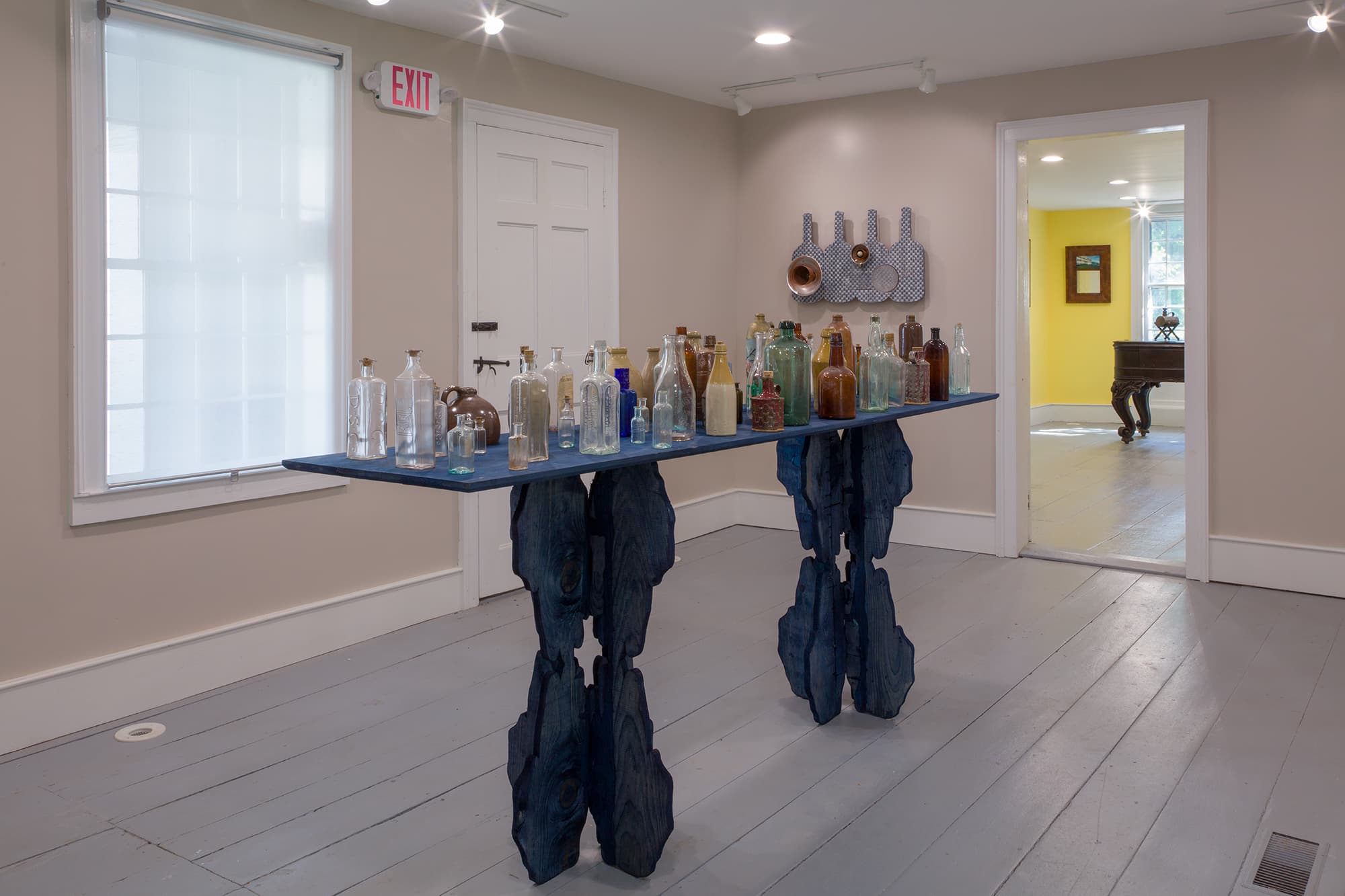
A wood panel is shaped in the silhouette of four bottles in a row, its surface carved into a raised checkerboard pattern and painted silver. A series of funnels push out of the metallic backboard like a whack-a-mole game, their openings facing the viewer head-on. They reminded me of trumpet bells, suggesting a kind of amplification. But the opposite is also true. A funnel guides fluid into a container, enclosing and quieting, forcing fluid into a new, more disciplined, shape. It's an object that connects two domains. It fills but will never actually be filled itself, not unlike history. He points emphatically in this direction with the title, It did it did it did it, as if to remind us that history is a process at once filled, forced, and contained. The words are insistent, like answering a question over and over. It’s like the stories we tell so often that they become an essential part of ourselves, while simultaneously losing their meaning.
In Muffler #4, something is being thrown up. A partial barrel is mounted to the wall, its center hole plugged by a wooden stopper. Hanging from this plug is a cascade of objects strung together by a white rope. The rope falls through and among the objects, coiling gently near a vent on the floor, which as a result looks more like a shower drain. I wondered if these cast out things represent elements of Siegel’s psychic life, digested parts of himself, expelled here and displayed between plug and drain.

In the center of the dimly lit, final room of this complex exhibition is a single, ambiguous sculpture, Whose Folk. What initially looks like a single ladder-back chair is actually a group of chair-forms fused into a single cage-like structure, narrow and elongated in its black wooden frame. It is strained and tense. The room is cordoned off by a rope at the threshold, turning sculpture and space into a picture, simultaneously heightening and thwarting the desire to enter. I found myself thinking about my own desire to be with others, to pull up a chair and share space, and how easy it is to be kept at a distance by a fear of getting too close.
Many of us go to museums to feel a sense of comfort, enjoying the sense of resting on a solid foundation of history. The works in Whose Folk operate within this foundation, bringing our own internal contradictions out when we least expect it, turning known objects into unknown, and reminding us that history is malleable and flawed. The exhibition’s holes, gaps, and imperfections are held together with impeccable attention to craft and detail, and in them we find a fundamentally human desire: to connect the past with the present, while adhering to whatever ethic, system, or belief lets us hold it all together for another day.
David Whelan is an artist living in the Hudson Valley, New York.