Christian K. Kleinbub

Christian K. Kleinbub was Professor of Art History at Ohio State University and is now Co-Director of the New Foundation for Art History. His books include Vision and the Visionary in Raphael (2011), winner of the 2013 Gustave O. Arlt Award in the Humanities from the Council of Graduate Schools, and Michelangelo’s Inner Anatomies (2020). Other publications on subjects such as the visibility of angels, representational conflicts between antiquarianism and Christianity, the senses, printmaking, and the paragone of painting and sculpture, have appeared in edited volumes and leading specialist journals such as The Art Bulletin, Renaissance Quarterly, Word and Image, and The Burlington Magazine. His current book project is focused on Leonardo da Vinci.

It can feel faintly absurd to write about the early Italian Renaissance painter Fra Angelico (b. ca. 1395; d. ca. 1455). From the vantage of a secular and skeptical age, the familiar descriptions of his saintliness can sound either entirely disingenuous or impossibly naïve.
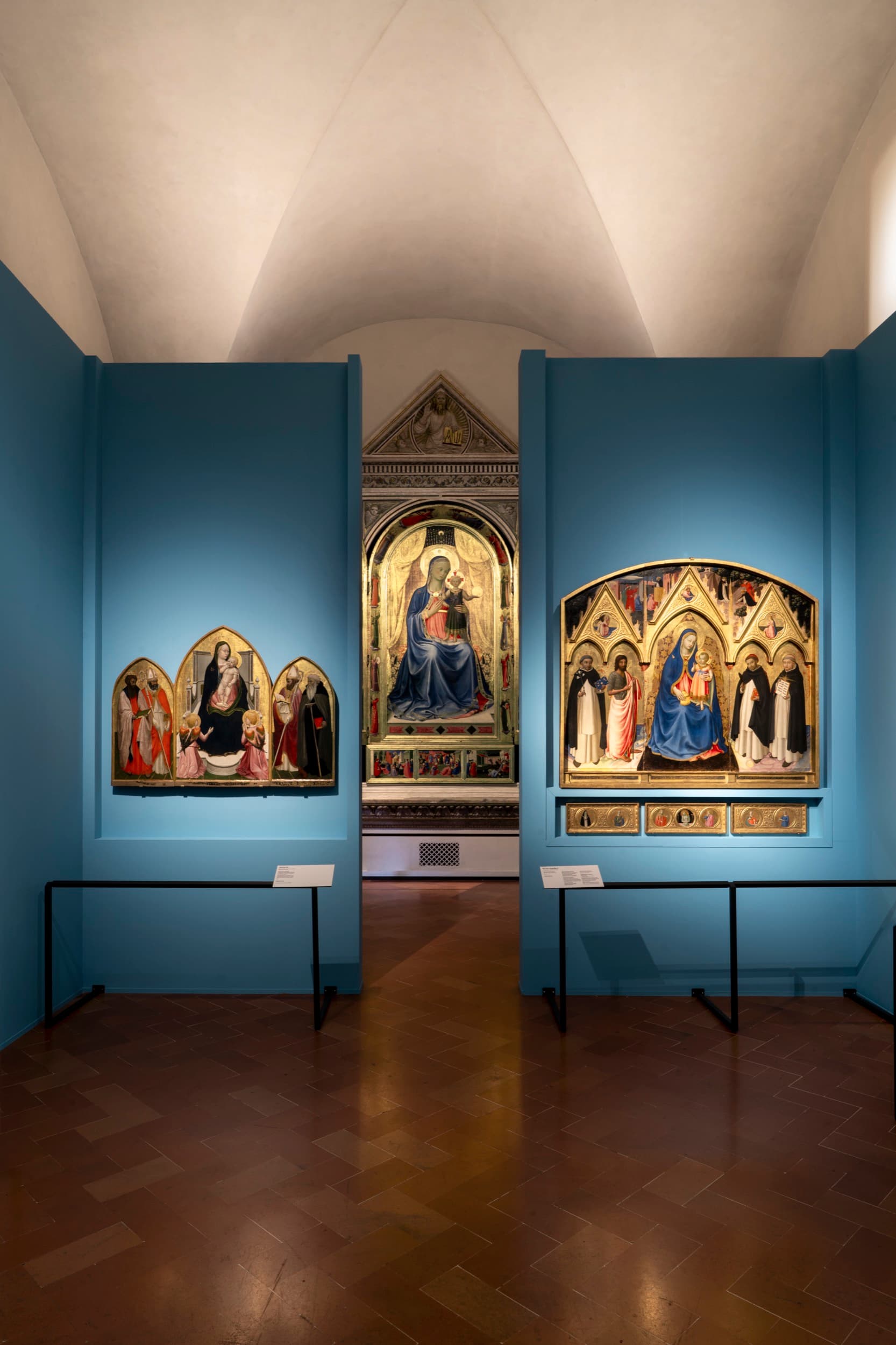
Installation view: Fra Angelico, Palazzo Strozzi e Museo di San Marco, Firenze, 2025–26. Courtesy Palazzo Strozzi e Museo di San Marco. Photo: Ela Bialkowska, OKNO Studio.
Surveys of the later careers of important artists are often risky affairs. For every exhibition that rightly redresses the neglected late work of a particular artist, there is another that unwittingly confirms the impression of stagnation or decline. Yet, in the case of one of the most famous of all artists, the sculptor-painter-poet-architect Michelangelo Buonarroti (1475-1564), who lived until he was nearly 90, we must modify our usual expectations of apex and trajectory.
Michelangelo Buonarroti, Study for the 'Last Judgment,' c. 1540. Black chalk on paper, 9.25 × 11.5 inches. 1534–36. © The Trustees of the British Museum.
During the COVID-19 pandemic, many art historians have reframed their work to address issues of health and medicine. For others, the attendant isolation and lack of mobility associated with this crisis have led them to reexamine their intellectual approaches. Authored by five leading art historians who have published on the subjects of art, medicine, and health, the responses that follow reflect on the questions: How have we attempted to make sense of the pandemic experience with a view to the histories we study? In what ways might the recent health crisis be better framed in terms of the tribulations of health and medicine of the past?
The Met’s riveting new exhibition, Juan de Pareja, Afro-Hispanic Painter, is a curious amalgam. Although the show does present a selection of Pareja’s paintings, offering an overview of his little-known oeuvre for the first time, it is far from being a traditional, single-artist exhibition.
Diego Velázquez, Juan de Pareja, 1650. Oil on canvas, 32 x 27 1/2 inches. The Metropolitan Museum of Art, New York, Purchase, Fletcher and Rogers Funds, and Bequest of Miss Adelaide Milton de Groot (1876-1967), by exchange, supplemented by gifts from friends of the Museum, 1971, 1971.86. Image © The Metropolitan Museum of Art.

Close

Home