ArtSeenDecember/January 2025–26
Fra Angelico
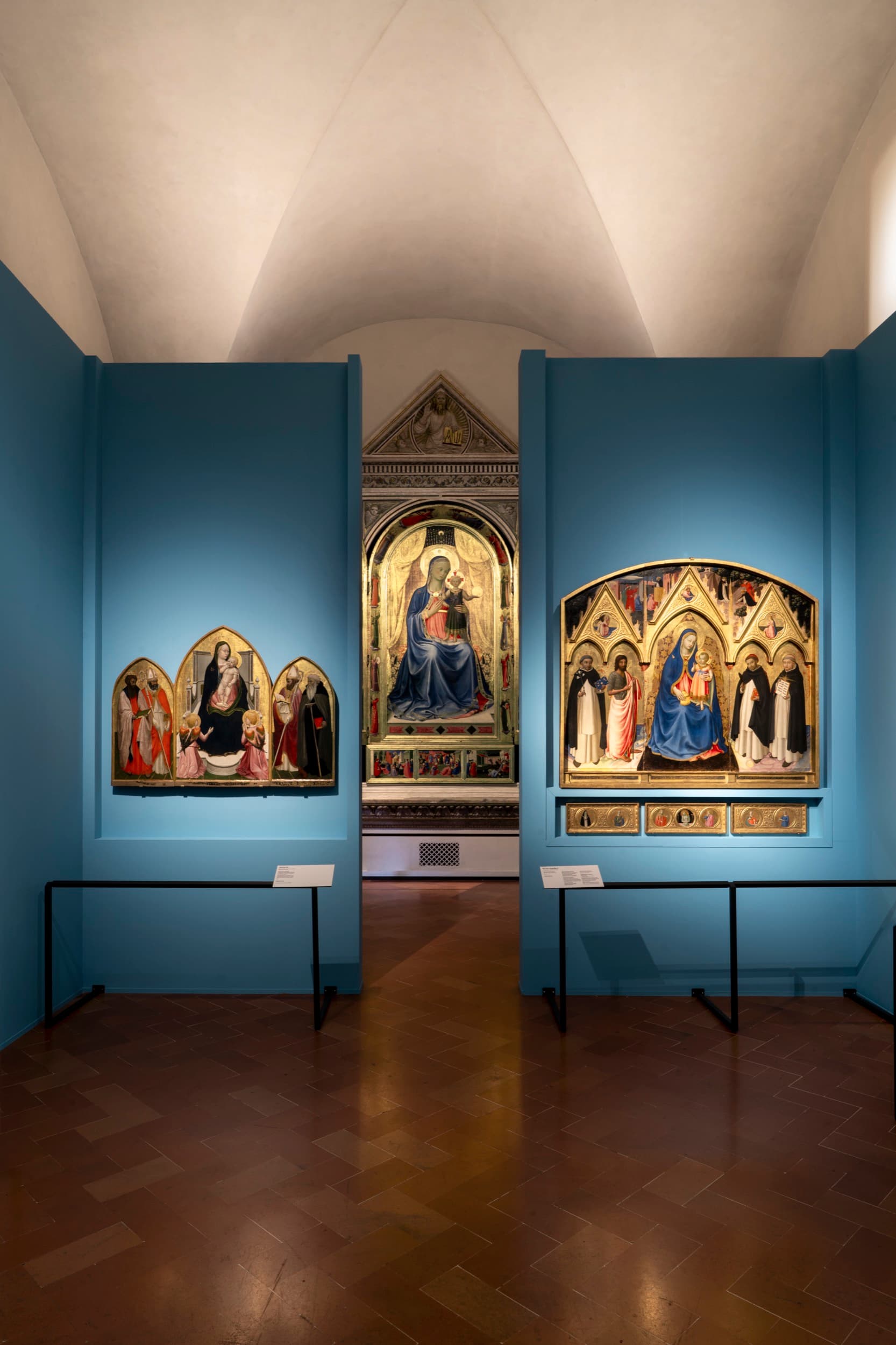
Installation view: Fra Angelico, Palazzo Strozzi e Museo di San Marco, Firenze, 2025–26. Courtesy Palazzo Strozzi e Museo di San Marco. Photo: Ela Bialkowska, OKNO Studio.
Word count: 1398
Paragraphs: 15
September 26, 2025–January 25, 2026
Florence
It can feel faintly absurd to write about the early Italian Renaissance painter Fra Angelico (b. ca. 1395; d. 1455). From the vantage of a secular and skeptical age, the familiar descriptions of his saintliness can sound either entirely disingenuous or impossibly naïve. We are told of the humble friar-painter who, as prior of his monastery, never spoke an angry word; who prayed before painting; who wept while depicting the Crucifixion; who refused the archbishopric of Florence, one of Europe’s most powerful sees. Even Giorgio Vasari, the sixteenth-century artist-biographer who gathered these accounts, was amazed, chastising churchmen of his own time for falling so far short of this example. The friar’s epitaph frames things in this way: “Let me not be praised because I seemed another Apelles, but because I gave my riches, O Christ, to Thine.”
How much does Fra Angelico’s painting bear out these testimonies? That is one question I asked myself as I visited the blockbuster two-venue exhibition of the artist’s work, the largest such retrospective since 1955, now showing in Florence at the Palazzo Strozzi and the Convent of San Marco, the artist’s Dominican home. Surveying the voluminous body of work in the exhibition, I found myself conducting a simple thought experiment: what would we have made of Fra Angelico if we knew less about him?
Fra Angelico occupies an equivocal position in art history. He is sometimes cast as a second Giotto: a religious mystic, a reactionary figure who resisted the secular energies of the Renaissance. Yet he was also unmistakably of his moment, fully engaged with the technical and perceptual revolutions of early fifteenth-century painting. Like Masaccio—whose radical use of single-point linear perspective helped define the new pictorial language—Fra Angelico adopted perspective early and showed a keen interest in rendering the visible world convincingly. He was particularly attentive to the effects of natural light and may have been the first European painter to incorporate a recognizable landscape into his painting, a scene of the Visitation, from the Cortona Altarpiece (not in the show).

Installation view: Fra Angelico, Palazzo Strozzi e Museo di San Marco, Firenze, 2025–26. Courtesy Palazzo Strozzi e Museo di San Marco. Photo: Ela Bialkowska, OKNO Studio.
Still, Fra Angelico never projected the aura of an artistic rebel. Although most painters of his generation devoted the bulk of their output to sacred subjects, he seems to have had no interest in secular ones at all. When he embraced naturalism, he did so selectively, often tempering its force. In representing religious mysteries, he sometimes relied on pictorial paradox—what Georges Didi-Huberman famously called ”dissemblant similitudes”—as a way of giving visual form to the inexpressible. And even as many contemporaries stripped their paintings of the vivid colors and glinting gold associated with earlier traditions, Fra Angelico retained them gladly, intensifying the celestial splendor of heavenly scenes.
Yet the current exhibition shows in wonderful detail how Fra Angelico was highly adaptable, working across an unusually wide range of media: illuminated manuscripts, intimate devotional panels, monumental fresco cycles, and complex multi-panel altarpieces. He collaborated readily with other artists, including Lorenzo Ghiberti, and attracted patrons who wanted religious subjects not only from the Church and his Dominican order but also from Florentine guilds and the laity. Piety did not preclude professional fluency.
Nor was he called “angelic” without reason. Angels proliferate throughout the exhibition—perhaps no artist painted more of them. Fra Angelico’s angels typically appear as exquisitely beautiful, androgynous, lissome figures, fair-haired and winged. Within that type, however, he achieved remarkable variation: angels in shimmering, varicolored robes; angels with feathered or golden wings; angels militant and demure; angelic choirs and orchestras. His most beloved images remain the Annunciations, in which the Archangel Gabriel announces to Mary that she will bear Christ. These scenes are notable not for dramatic rupture but for contemplative stillness. They exude a blossoming radiance, expanding our consciousness before a world-altering moment.

Installation view: Fra Angelico, Palazzo Strozzi e Museo di San Marco, Firenze, 2025–26. Courtesy Palazzo Strozzi e Museo di San Marco. Photo: Ela Bialkowska, OKNO Studio.
This emphasis on celestial reward points to Fra Angelico’s sustained meditation on the afterlife. His visions of heaven are compelling for their gentle sensuality. In an early Last Judgment (ca. 1425–28) painted for Santa Maria degli Angeli, Christ presides over a landscape in which the blessed and the damned are carefully separated. Bathed in luminous blue and gold, the saved embrace, sing, and dance in a flowering garden. Saints crowned with blossoms join hands with angels in a round dance; reunited friends stroll in eternal sunlight. The delicacy of color, the glimmer of gold, the elegance of gesture, and the fluttering of garments all seem to anticipate the bliss of this transfigured realm.
Look again, though, and another register comes into view. Fra Angelico’s hells are rarely discussed, yet they reveal a startling intensity. In the same Last Judgment, demons herd the damned with merciless efficiency. The damned gnaw their hands in despair, lamenting their fate. Most harrowing is a woman wrenched forward by a long metal hook piercing her grotesquely stretched tongue, which protrudes hideously among her bared teeth and gums—a punishment whose cruelty borders on the obscene. One cannot help but speculate about the sin it signifies: blasphemy, deceit, seduction? In another depiction of the Last Judgment, from the Silver Chest of Santissima Annunziata (ca. 1450–52), an angel forcibly removes a kneeling imposter who attempts to pass among the saved. The message is unambiguous: grace cannot be stolen.
If Fra Angelico often yields to Masaccio in narrative dynamism, he was fully capable of visceral expression when the subject demanded it. His Massacre of the Innocents (ca. 1450–52), also from the Silver Chest, is devastating. Children lie dead in their mothers’ arms, bleeding from their little necks and heads. Mouth agape in a silent scream, a desperate mother drags her fingernails like a bloody rake through the face of the soldier whose dagger lodges in her child’s jaw; another cradles her son’s lifeless head on the ground, bent over in the futile effort to revive him. These passages are almost unbearable. Before them, no attentive viewer can remain unmoved.

Installation view: Fra Angelico, Palazzo Strozzi e Museo di San Marco, Firenze, 2025–26. Courtesy Palazzo Strozzi e Museo di San Marco. Photo: Ela Bialkowska, OKNO Studio.
Such scenes complicate the image of Fra Angelico as a serene, otherworldly painter. They also inform our reception of reports of the friar who wept while painting Christ’s suffering. His early Deposition of the Cross (ca. 1432–34)—with its solemn crowd lowering Christ from the cross—shows a collective grief that is restrained yet deeply felt. Emotional control here does not negate intensity; it concentrates it.
Across these extremes—paradisal pleasure and bodily horror—certain constants emerge. Chief among them is light. Fra Angelico uses light not merely to describe surfaces but to comprehend them fully. It caresses bodies, excavates hollows in the earth, reveals hidden recesses, and glances off ceilings, walls, and curtains, carrying reflected color throughout the pictorial space. Like his contemporaries, he sometimes delighted in telling details that exceed narrative necessity: a staircase that explains how a figure reached a balcony; one Apostle trimming his toenails before Christ washes his feet.
One of the exhibition’s quiet revelations is the sheer pervasiveness of Fra Angelico’s work in fifteenth-century Florence. Through the unprecedented reconstruction of dismembered altarpieces removed from their original church settings, a fuller sense of the city’s pictorial geography emerges. In this matter, the decision to situate part of the exhibition in San Marco proves crucial. There, in the spaces he decorated for his fellow friars, Fra Angelico’s holistic vision becomes palpable—from the illuminated manuscripts in Michelozzo’s serene library where they were housed to the frescoes lining the dormitory cells and corridors. The final galleries at the Palazzo Strozzi extend this narrative to his later Roman period, including tinted drawings that may record lost frescoes from the papal palace. His angels, it turns out, were industrious emissaries, shaping devotional imagination far beyond Florence.
Seen together, the works in this retrospective reveal Fra Angelico’s remarkable range. Adept at every scale and medium, he was anything but a dutiful pedant. Crucially, he did not avert his gaze from suffering, which paid the wages of sin, securing eternal life for the righteous. The stakes, as he understood them, were thus absolute. Where Masaccio built his pictorial world from the ground up, beginning with the everyday, Fra Angelico worked from the top down. Light anchors his naturalism, but it is not merely physical. It is metaphysical: a sanctifying force that renders even humble objects—a three-legged stool—worthy of his attention. From this perspective, nothing is mundane. What matters is proximity to the source of light. And that, ultimately, is what Fra Angelico painted.
Christian K. Kleinbub was Professor of Art History at Ohio State University and is now Co-Director of the New Foundation for Art History. His books include Vision and the Visionary in Raphael (2011), winner of the 2013 Gustave O. Arlt Award in the Humanities from the Council of Graduate Schools, and Michelangelo’s Inner Anatomies (2020). Other publications on subjects such as the visibility of angels, representational conflicts between antiquarianism and Christianity, the senses, printmaking, and the paragone of painting and sculpture, have appeared in edited volumes and leading specialist journals such as The Art Bulletin, Renaissance Quarterly, Word and Image, and The Burlington Magazine. His current book project is focused on Leonardo da Vinci.