ArtSeenDecember/January 2025–26
Eric N. Mack: Fishers of Men
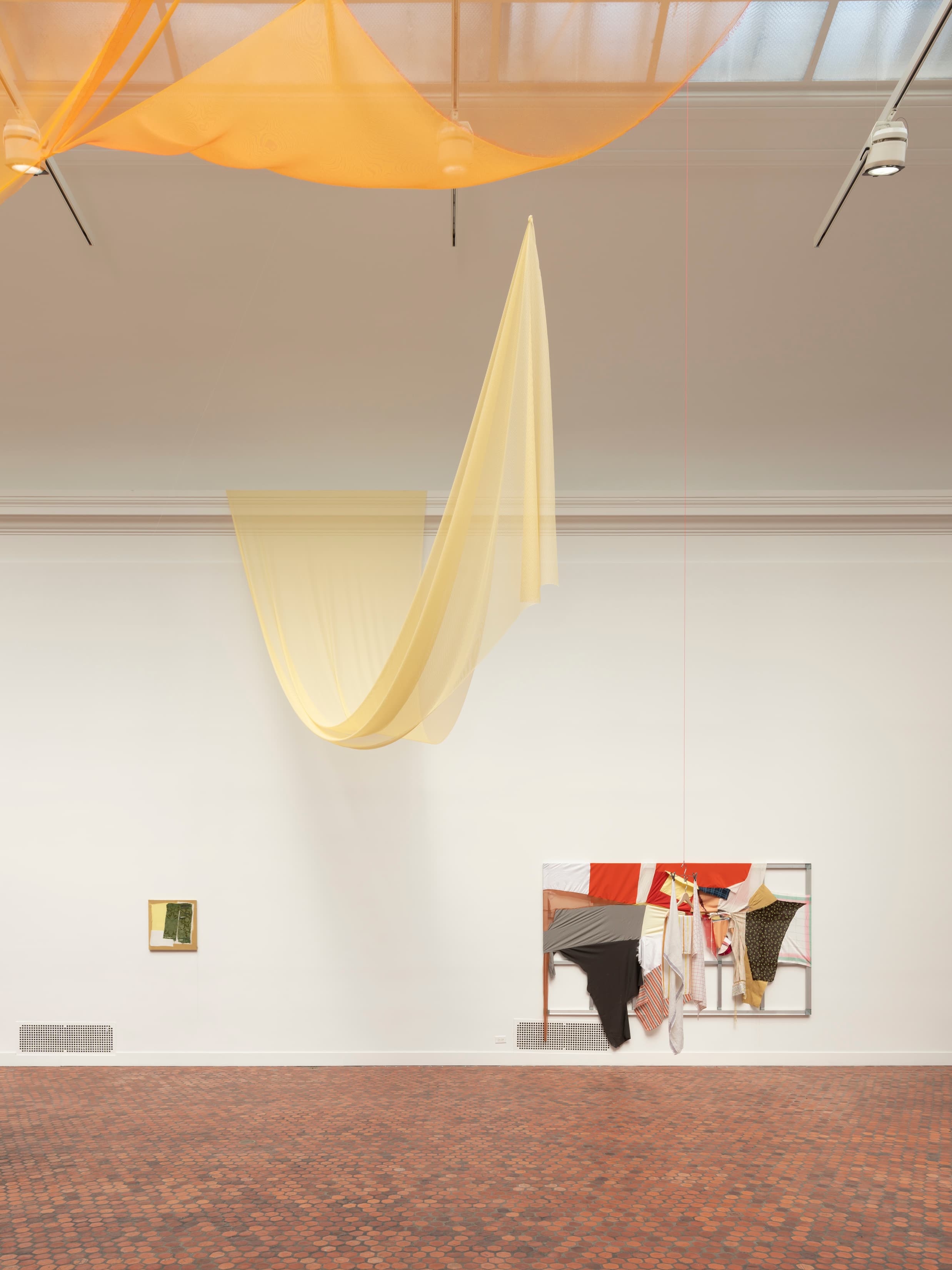
Installation view: Eric N. Mack: Fishers of Men, American Academy of Arts and Letters, 2025–26. Courtesy American Academy of Arts and Letters. Photo: Charles Benton.
Word count: 821
Paragraphs: 13
American Academy of Arts and Letters
September 27, 2025–February 8, 2026
New York
Of all of literature’s fishermen, one often forgotten is Afa—the kind of man who doesn’t soften for God or anyone else. Whether he is world-weary or simply wise, Afa, that formidable character in Derek Walcott’s Sea at Dauphin, keeps to himself, keeps to the work, and lets the sea be what it is without translating it into something kinder. Eric N. Mack’s Fishers of Men, on view at the American Academy of Arts and Letters, aspires to that same hard patience. The work hangs, leans, and waits—changed by light and air, yes, but held in a stillness that suggests caution.
The first textile portrait greets you at the threshold, suspended like a veil and a proposition. It changes the room before you’ve entered it—softening what you can see beyond, shifting the light, emphasizing the fluttering of the veils. Past that initial encounter, other works stake claims differently. Some rest their weight against walls at angles that suggest temporary agreement.

Installation view: Eric N. Mack: Fishers of Men, American Academy of Arts and Letters, 2025–26. Courtesy American Academy of Arts and Letters. Photo: Charles Benton.
Others reach out over the open floor, held by steel armatures thin enough to look provisional. A few lock into corners, gripping the room’s edges where fabric and metal and wall all meet. The exhibition asks you to navigate: your body must find its way around cloth and steel, recalibrate accordingly, keep moving. The room becomes a kind of passage—an itinerary without destination.
These are textile paintings, but the phrase doesn’t quite hold what they do in space. The steel frames aren’t supports; they are propositions, asking fabric to hold an angle and bear its own weight in air. Color appears but works atmospherically, warming one zone while leaving another cool: mustard mesh drawn out about the room, blue cloth thinning whatever light passes through, translucent material making you aware of what’s behind it without clarifying the view. These are the moments where Mack gets close to what materials do when left to their own physics, when the work feels like it is discovering rather than demonstrating.
The title summons biblical language, but nothing here converts. Fishing, as I know it, is an active adventure—a mental excursion as well as a physical one—marked by exposure and repetition and habits that require extreme grace. Mack’s nets do not close. His fabrics do not resolve into symbols or settle into stable forms. They respond to conditions: gravity pulling down, steel holding up, light changing opacity. That responsiveness is the discipline. This is endurance without transcendence.

Installation view: Eric N. Mack: Fishers of Men, American Academy of Arts and Letters, 2025–26. Courtesy American Academy of Arts and Letters. Photo: Charles Benton.
The strongest pieces are those where the materials threaten to exceed the system: where fabric pulls against steel hard enough to make the metal’s thinness matter; where cloth sags in ways that seem to question the armature’s authority; where a corner grip looks like it is testing how much pressure the junction can take. Those moments generate friction, make hard patience legible as something more than a conceptual position. But they are rare. More often, the work behaves less
like a fisherman than a well-informed observer: it presents the tools—nets, lines, knots—and then repeats them from another angle, as if repetition might substitute for risk.
Mack sets up the terms—fabric suspended, materials exposed, labor without redemption—and then restates them with the thoroughness of someone determined to be understood. The refusal to resolve becomes less a stance than a habit. The work does not risk unsoftening; it rehearses it.

Installation view: Eric N. Mack: Fishers of Men, American Academy of Arts and Letters, 2025–26. Courtesy American Academy of Arts and Letters. Photo: Charles Benton.
The nets strain just enough to show they are strained. The steel bends just enough to show it is thin. The fabrics suspend just enough to show suspension is the point. Nothing breaks, nothing fails, and nothing discovers what it could not have predicted. It is an elegant demonstration of a condition rather than a lived encounter with it.
One wants Mack to stop managing the encounter, to swim deeper, to move past demonstration into uncharted waters. Afa is compelling not because he refuses to soften but because he makes softening impossible. Mack has built an exhibition about those conditions while remaining safely ashore, describing them with great sensitivity and an equally careful restraint. He is close to something real here—on the brink of a great wave—yet the exhibition remains placid, offering at its height only a ripple.
Mack seems to believe these qualities are enough, that understanding endurance is the same as enduring, that talking about refusal is equivalent to refusing. Fishers of Men could risk more, could let the sea say what it will without preparing you for every shift, without holding the nets so steady you never wonder if they will hold. At this point, one begins to suspect the work prefers the knowing to the being—that the description of difficulty is more appealing than difficulty itself. And that, more than any failure of materials or installation, is what keeps this exhibition from the depths it claims to understand.
Killian Wright-Jackson is a contributor to the Brooklyn Rail.