Bartolomeo Sala
Bartolomeo Sala is an Italian freelance writer and publishing professional based in London. His articles and reviews have been published or are forthcoming with the Gagosian Quarterly, Jacobin, and the Literary Review.
There are not many artists who can lay claim to an imagery, let alone a landscape. But for anyone familiar with the work of Italian photographer Luigi Ghirri (b. 1943, d. 1992), driving along the Via Emilia, the artery running through the middle of Emilia Romagna, is an uncanny experience.
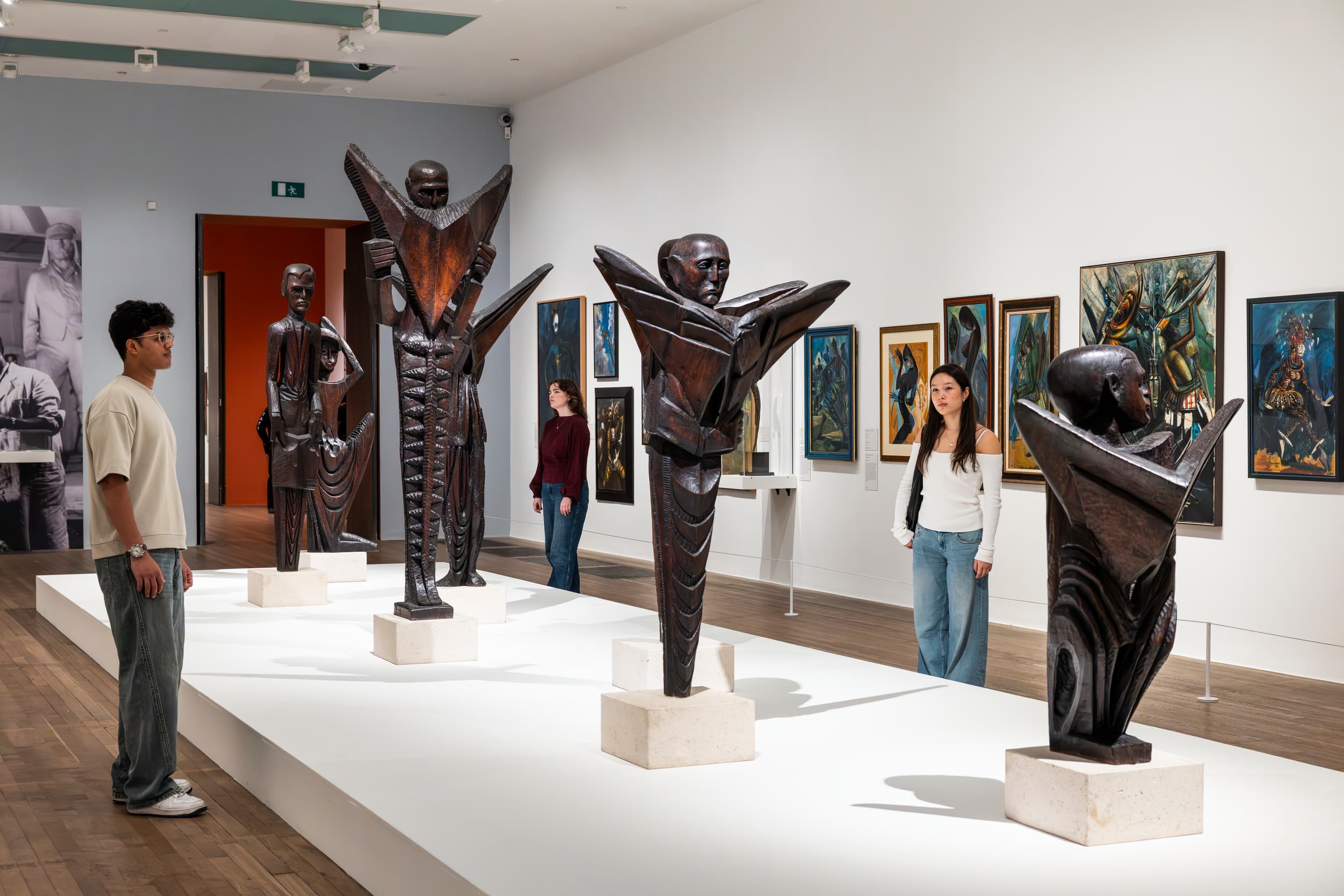
The first survey of its kind in the United Kingdom, Nigerian Modernism reunites over 250 works by fifty artists and covers a fifty year period, from the first stirrings of decolonization in the 1940s up to the 1990s. As such, the exhibition dwells less on the traumatic, long-lasting effects of colonialism.
Spanning all the five floors of WIELS, Brussels’s contemporary art museum, as well as the nearby argos centre for audiovisual arts—Magical Realism: Imagining Natural Dis/order is a survey that articulates an alternative approach, at once documenting the destruction brought about capitalism and the “Great Acceleration” of the last eighty years and offering glimpses of different modes of being.

If a wide-ranging survey such as Typologien: Photography in 20th-Century Germany, on view at Fondazione Prada until mid-July, shows anything, it is that even the most rigid and repetitive of conceits can be bent into the most surprising, diverse outcomes if it is approached with the right method and intent.

Two themes, alongside reflection on the nature of sculpture itself, dominate Giuseppe Penone's oeuvre. The first of these is an interest in nature as an intelligent design in the process of self-making, and the second is a haptic, almost osmotic, approach to artmaking that tries to establish a more horizontal, open relationship with one’s environment. These two themes are on full display in Thoughts in the Roots, on view in the Serpentine Galleries until early September.
![Giuseppe Penone, Idee di pietra [Ideas of Stone], 2010–24. Bronze and river stones. Courtesy the artist and Serpentine. © George Darrell.](/_next/image/?url=https%3A%2F%2Fstudio.brooklynrail.org%2Fassets%2F0612271f-0733-48a0-9590-5ae59940d528.jpg&w=3840&q=75)
Mario Cresci (b. 1942)—whose exciting, composite oeuvre as a conceptual artist and photographer is for the first time in the UK the subject of an exhibition, now on view at Large Glass, London—is in this sense not a curious outlier.
![Mario Cresci, Coesistenze #05 [Coexistences #05], 2024. Giclée fine art print on baryta paper from digital montage, 19 7/10 x 19 7/10 x 1 1/5 inches. Courtesy the artist and Large Glass, London. © Mario Cresci.](/_next/image/?url=https%3A%2F%2Fstudio.brooklynrail.org%2Fassets%2F3ad38d23-b8c6-4094-9456-17eaec2ecc35.jpg&w=3840&q=75)
At first glance, the work of Peter Mitchell (b. 1943) might also appear to fall into this hallowed, if slightly voyeuristic, tradition. The photos that make up Nothing Lasts Forever, an outstanding retrospective of Mitchell’s work currently on view at the Photographers’ Gallery, show all the familiar facets of dereliction.

The stated goal of Brasil! Brasil! The Birth of Modernism is no less than providing the young nation with a coherent identity, a narrative they hoped to make bigger than the sum of its (disparate) parts. For Brazil, the first decades of the twentieth century were a time of breakneck change as well as, more often than not, tumult and conflict.

Perfectly in tune with the approach that came to dominate the culture in those years, The 80s: Photographing Britain, now on view at Tate Britain, consciously adopts a “sociocultural” lens that focuses less on the work of individual geniuses and provides instead a wide, almost diffused, bird’s-eye view of the decade through the sheer variety of its photographic expressions.

Towards the end of photographer Letizia Battaglia’s (1935–2022) current exhibition at the Photographers’ Gallery, we encounter a long excerpt taken from the documentary La mia Battaglia. Here, Battaglia recounts how she felt at odds with the sensationalist attitude of her male counterparts at L’Ora, the left-wing daily in Palermo for which she photographed for over twenty years in all its sordidness and, less frequently, splendor.

Upon entering the first room of the Turner Prize exhibition—the yearly showcase that since 1984 has highlighted the work of four British artists, each nominated for a notable exhibition within the past year—the viewer is met with a wholly alien object.

Archive of Dissent, Peter Kennard’s retrospective now on view at Whitechapel Gallery, is at once an overview of the artist’s career, a sneak peek into his process, and an homage to the tradition of activism and dissidence his work was born out of.

When it was first published in New York in 1967, House of Bondage by Ernest Cole was hailed as the first all-out denunciation of the system of apartheid, produced by an artist who had witnessed it first-hand and had often experienced its violence himself. The exhibition Ernest Cole: House of Bondage, which is now on view at the Photographers’ Gallery in London, gives a comprehensive account of all of this.

Treading the fine line between document and symbol and shot in a redolent black-and-white that imbues them with a stark, dramatic quality, Graciela Iturbide’s photographs portray a version of Mexico at once recognizable in its imagery and yet completely alien, almost beyond the realm of words.


