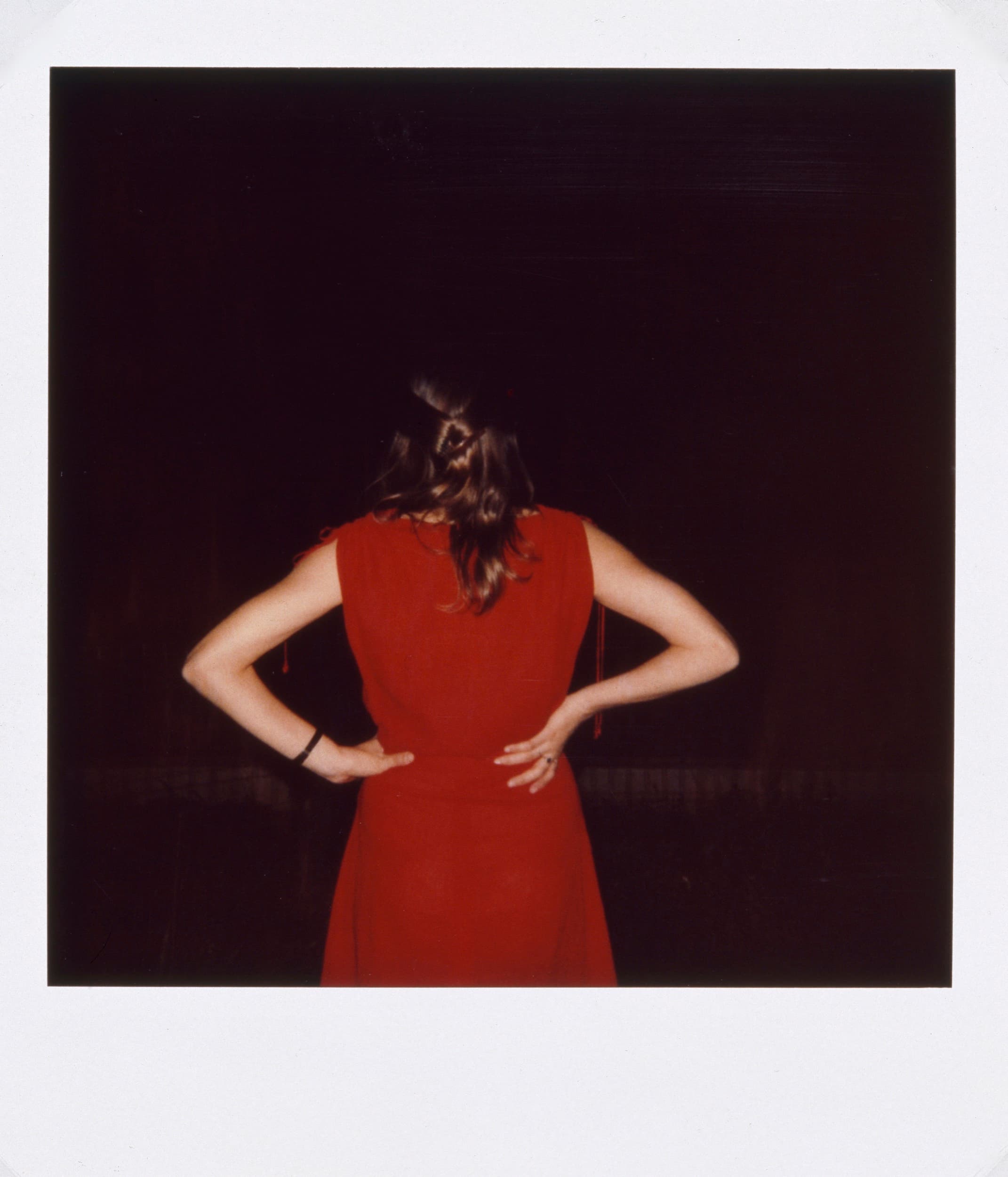
Luigi Ghirri, Formigine, Modena, 1980. Polaroid, 3 ⅛ × 3 ⅛ inches. © Courtesy Heirs of Luigi Ghirri.
Word count: 825
Paragraphs: 9
Centro Pecci per l’Arte Contemporanea
November 22, 2025–May 10, 2026
Prato, Italy
There are not many artists who can lay claim to an imagery, let alone a landscape. But for anyone familiar with the work of Italian photographer Luigi Ghirri (b. 1943, d. 1992), driving along the Via Emilia, the artery running through the middle of Emilia Romagna, is an uncanny experience. Especially when venturing into the never-ending flatlands that surround the Via Emilia on each side, a traveler often feels as though they are entering one of Ghirri’s photographs.
Ghirri was the first to put these edgelands on the map in such books as Viaggio in Italia (1984), a subversion of the trope of the grand tour. Now, it’s as if representation has swallowed the world, and his photographs of Po Valley portico-ed villages and desert roads fading into the horizon have become “realer” than their real-life referents. There is a larger irony at work here. Even if Ghirri’s work always possessed an intimate streak, his earliest projects, and especially his first photobook Kodachrome (1978), investigated the medium of photography through a post-Debordian critique of the ways spectacle and images—postcards, advertisements, travel posters—infiltrate and slowly superimpose themselves onto actual reality.

Installation view: Luigi Ghirri: Polaroid ’79–’83, Centro Pecci per l’Arte Contemporanea, Prato, Italy, 2025–26. Courtesy Centro Pecci per l’Arte Contemporanea.
Now on view at Centro Pecci per l’arte contemporanea in Prato, on the outskirts of Florence, Polaroid ’79–’83 rehearses the tension at the heart of Ghirri’s work from a point of view that is less familiar, slightly askance. Around 1980, Polaroid provided Ghirri with a generous supply of film and cameras. Initially used to support his traditional practice, this material soon became yet another way to explore his beloved vernacular scenes—a theme which was being explored around the same time by Robert Adams and other American photographers included in the 1975 landmark exhibition New Topographics, as well as, before them, Walker Evans. Not only that, between 1980 and 1981, Ghirri was invited to Polaroid’s headquarters in Amsterdam to experiment with the Polaroid 20 x 24 Instant Land Camera—a 90-kilo contraption able to produce large format prints in just over a minute.
Travelling back and forth from Amsterdam meant living out of a suitcase full of props—cutouts from magazines as well as objects Ghirri collected from flea markets. Indeed, the images featuring these props, which take up the center of the exhibition, resemble collages more than photographs in the true sense of the word.
The most striking of these works combines the engraving of a Greco-Roman statue (possibly an Amazon) wielding something overhead, one breast bare, with an curvaceous orange stencil set against a background of graph paper—a tool which Ghirri knew well from his day job as surveyor. The image looks like a Dada montage or a Surrealist exquisite corpse (quite literally). However, other pictures, such as that of Antonello da Messina’s Virgin Annunciate broken down and remade into a photographic contact sheet, betray the series’s reflection on the illusory nature of representation and the ability of images to influence and sometimes deceive our perception.

Luigi Ghirri, Formigine (Mo), 1983. Polaroid, 3 ⅛ × 3 ⅛ inches. © Courtesy Heirs of Luigi Ghirri.
Quite different are a selection of small polaroids framed by white passepartout that cover the gallery’s walls. Often portraying two-dimensional surfaces—for example, “tampered” artworks such as the fresco of a boy missing an eye—and juxtaposing incongruous elements such as kitschy paintings of flowers and actual grass, these works seem to be carrying on the same line of inquiry as their large format equivalents, bursting the illusion of the photographic image as a natural and objective reproduction of reality. More than conceptual miniatures, however, they mostly appear as Dutch vanitas: poetic reflections on the fleeting nature of existence, as well as a celebration of photography itself as the medium of the everyday, the minor, the impermanent.
Tiny and intimate, Ghirri’s small polaroids lack the romantic thirst for vanishing vistas we find in his best-known landscapes, but they share the same melancholic sensitivity. Some of these are quite literal. For instance, some images portray walls at various stages of decrepitude or kitschy reproductions of Greco-Roman busts. And yet there is something about their nature as small Polaroids that elevates them and makes them inevitably compelling. The few pictures of balloons, amusement rides, and plastic flowers that are grouped toward the end of the show—their bright natural colors dimmed by the specific chromatic range of the Polaroid film and almost imbued with a blueish patina—have a hauntingly bittersweet quality.
Focusing on a lesser-known niche of Ghirri’s larger oeuvre, Polaroid ’79–’83 ran the risk of preaching to the choir—an exhibition for the already converted, its appeal resting more on Ghirri’s cult status in Italy (and increasingly elsewhere) than the merit of the work itself. On the contrary, however, the images gathered here not only offer a capsule of Ghirri’s preoccupations as an image-maker, they also possess a power and interest of their own. In this sense, the exhibition is a novel and unexpected take on the work of one of Italy’s undisputed photographic masters.
Bartolomeo Sala is an Italian freelance writer and publishing professional based in London. His articles and reviews have been published or are forthcoming with the Gagosian Quarterly, Jacobin, and the Literary Review.