Word count: 731
Paragraphs: 6

peter campus, occurrence, 2025. 4K UHD videograph, 11:54 minutes. Courtesy the artist and Cristin Tierney Gallery.
Cristin Tierney Gallery
April 4–May 9, 2026
New York
With his new work at Cristin Tierney, peter campus, who avoids uppercase lettering, sets boldly expressive new standards for his “videographs”—videos recorded with a stationary camera, like moving photographs—which began in 2007 as modest manipulations of pixels in everyday landscapes. The four videographs in what dreams may come feature watery landscapes of Eastern Long Island displayed on enlarged flat screens; they offer intimate views of the workings of the video medium and its links to subjective vision. What, indeed, does video look like? It’s appropriate that the videos on view, running in eight to twelve-minute loops, involve water—an immersive, reflective medium.
The exhibition is buttressed by a concurrent installation at the Phillips Collection in Washington, DC, there somewhere, curated by John G. Hanhardt, who combines four recent videographs with Head of a Man with Death on His Mind from 1978, a large video projection in black-and-white. A comprehensive catalogue includes both a lengthy artist’s statement and an essay by Hanhardt that surveys campus’s career, from his projections of heads to projected images of small stones collected on his outdoor expeditions, which conflate the cosmic and personal. Telescoping decades of technical, aesthetic, and spiritual evolution, the juxtaposition points to campus’s enduring concern with selfhood. The show at Cristin Tierney affirms this trajectory, lending more dramatic scale and ambition to campus’s union of technological refinement and subjective vision. While his powerful 4K UHD technology enables us to discern tiny bubbles afloat in crystalline liquids and delicate insects skimming on the surface, his images resist full disclosure, as if retaining a hidden, personal content.

Installation view: peter campus: what dreams may come, Cristin Tierney Gallery, New York, 2026. Courtesy the artist and Cristin Tierney Gallery. Photo: JSP Art Photography.
Animated by the regular flow of water from right to left that provides a direct index of time, occurrence (all works 2025) sets a new standard with its all-over gestural energy. It harks back to the melodramatic digital photographs campus created on his computer in the 1990s. Divided diagonally by reflected branches like a cracked windowpane, occurrence glows with saturated oranges and blues, topped by the stunning red of the artist’s reflected jacket on the upper left. He pushes the limits of contrast and saturation, bleaching and flattening floating leaves into sharply etched silhouettes and transforming bubbling ripples into crazed filigrees of lacey white—abstractions frozen in temporal loops that sway in the waves. Sharply rendered grass floats on the surface; by comparison we infer that the branches are only reflections. Near the end of the loop, the artist’s shadow looms into the frame on the lower left—perhaps the “occurrence” of the title—emphasizing a bodily engagement with place that recalls Jackson Pollock’s “I am nature.” As campus puts it in his statement, “I try to use my whole self, not just the eye-brain, to do the looking. I try to mesh my inner self with what there is around me.”
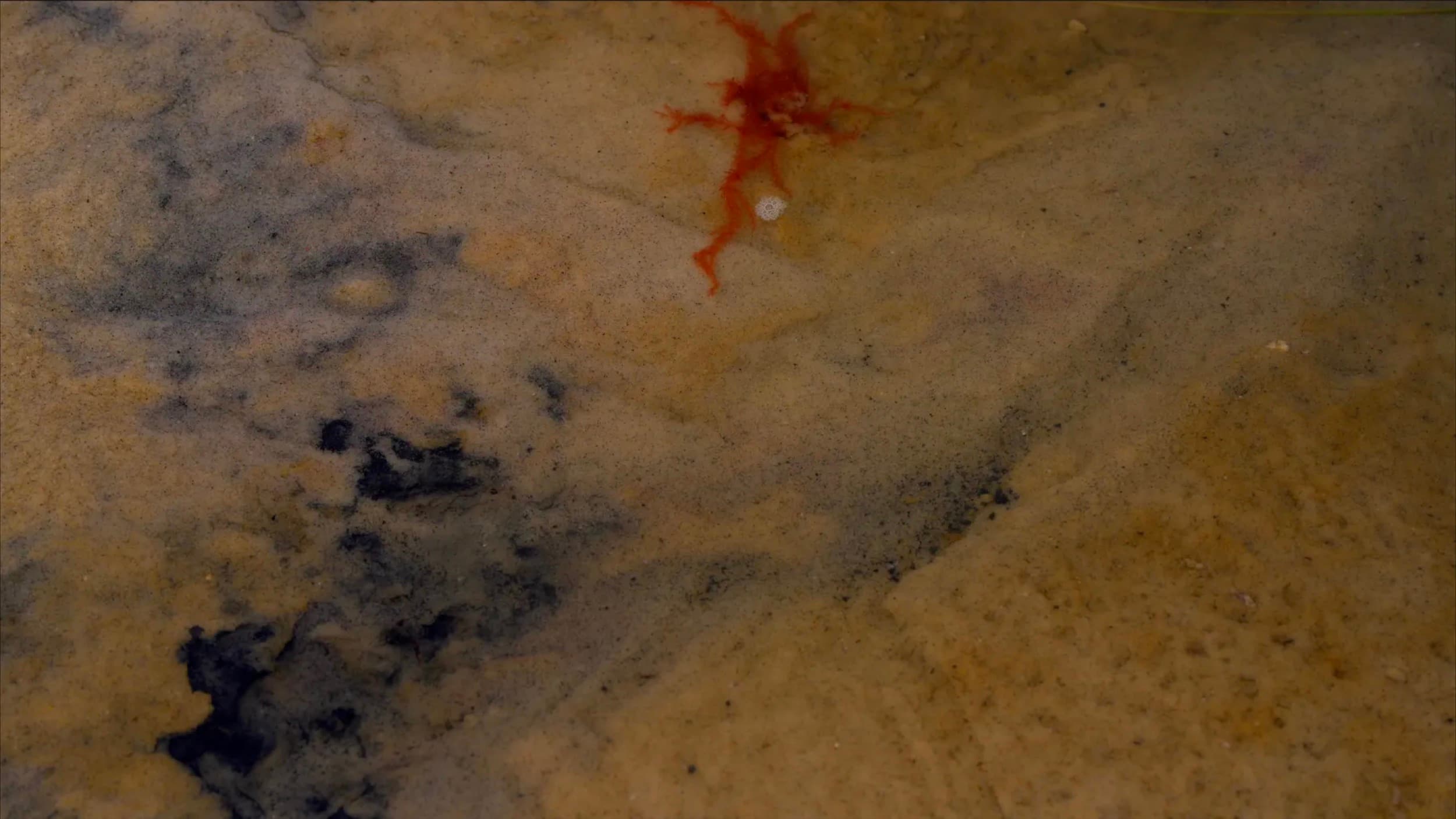
peter campus, in ponquogue bay, 2025. 4K UHD videograph, 10:56 minutes. Courtesy the artist and Cristin Tierney Gallery.
Cultivating a symbolist vagueness, campus brings high definition to inchoate masses of submerged weeds—recalling Rosalind Krauss and Yve-Alain Bois’s discussion of l’informe [the formless]—while washing out surface details to create images open to interpretation. In what dreams may come, the environment is a dark field animated by billows of submerged light, wherein a cast of undefined leaf shapes performs a slow dance in anticipation of the arrival of a floating leaf. Each videograph involves a different mise en scène. In contrast to the steady flow of occurrence, two works titled en plein air and in ponquogue bay suspend their floating subjects against dense, material grounds of murky, shallow water to establish neutral contexts for colored shapes, recalling Japanese screens. The pink and green shoots of grass in en plein air, encircled by eye-catching islands of tiny bubbles, suggest tranquility, but in drawing closer we lose our visual footing amid tremors controlled by manipulations in the playback speed. Submerged pixels, flashing lights, and fugitive reflections reinforce the ephemerality of the digital image. The spectral self-image of campus’s shadow in occurrence, like the illusion of wholeness offered by the mirror in Jacques Lacan’s “mirror stage,” provides a deceptive glimpse of wholeness amid what is otherwise a dispersal of the self. Moving closer does not reveal more detail but only moving pixels; as Rosalind Krauss has pointed out, campus short-circuits the narcissistic gaze by means of the gallery wall. Or as campus himself summarizes, “my intentions are always beyond the image.”
Hearne Pardee is an artist and writer based in New York and California. He is Professor Emeritus at UC Davis.