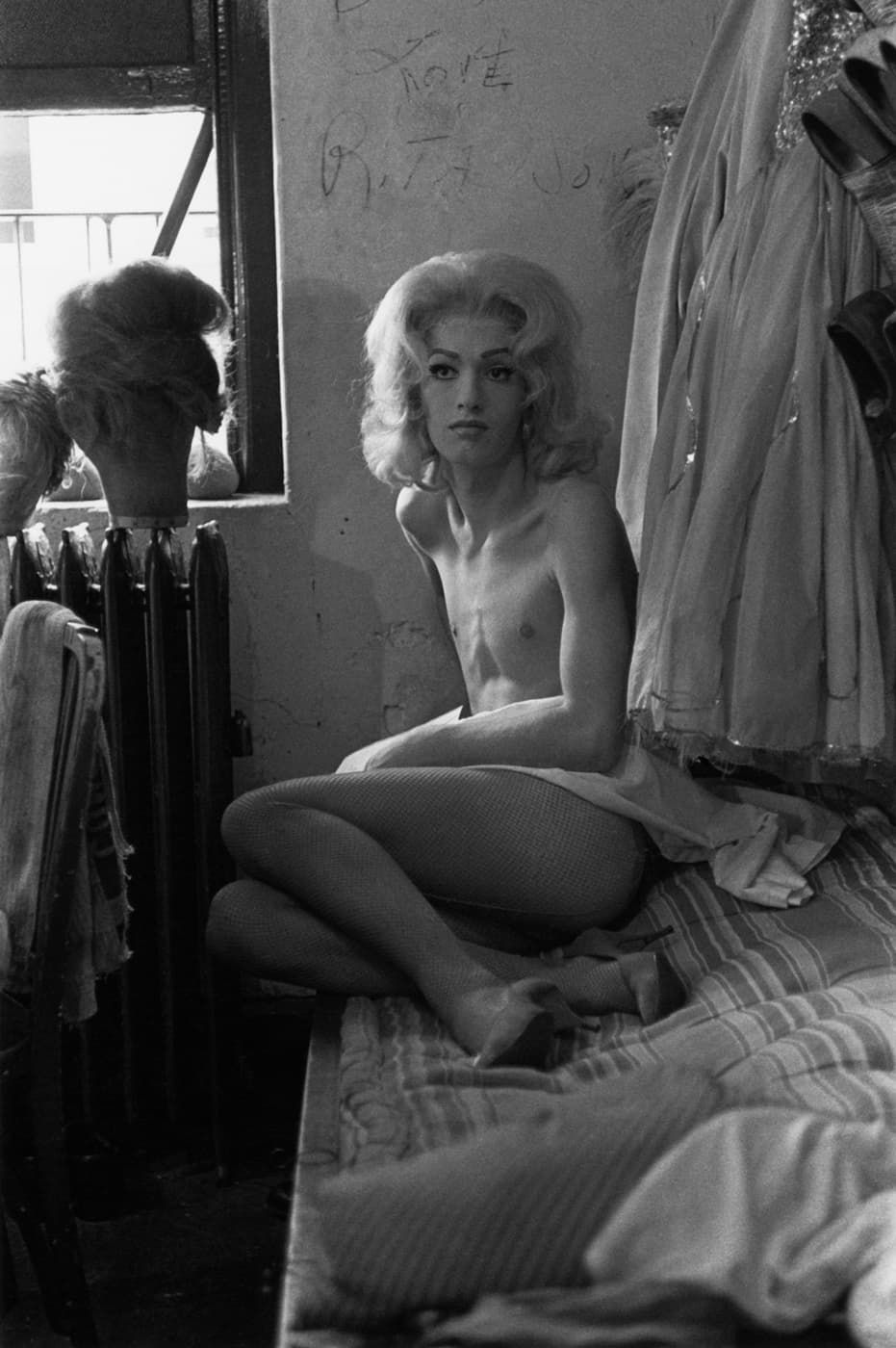
Diane Arbus, Female impersonator on bed, N.Y.C., 1961. Gelatin silver print by Neil Selkirk, 16 × 12 ¾ inches (framed). © The Estate of Diane Arbus. Courtesy Fraenkel Gallery.
Word count: 733
Paragraphs: 6
Fraenkel Gallery
March 12–May 22, 2026
San Francisco
It is well known that Diane Arbus and her husband Allan ran a successful commercial photography business in New York during the mid-1940s, a large portion of which included various portrait assignments for magazines and private clients. The problem of how to photograph subjects in relation to how they viewed themselves alongside how those people were meant to be viewed in relation to client expectations came with the territory. That problem continued to challenge Arbus long after she left the business (and later, her marriage) when she charted a new path as a fine art photographer at a time when photography was still struggling for acceptance in the art world. The difference was that Arbus herself had become the client, albeit with some very unusual expectations born of her fascination with the ways that the abnormal and the uncanny can inhabit and animate the same image.

Diane Arbus, Brenda Diana Duff Frazier, 1938 Debutante of the Year, at home, Boston, Mass., 1966. Gelatin silver print by Neil Selkirk, 24 ¾ × 20 ¾ inches (framed). © The Estate of Diane Arbus. Courtesy Fraenkel Gallery.
This is revealed in Sanctum Sanctorum, a magnificent exhibition containing forty-five photographs taken between 1961 and 1971, emphasizing figures occupying characteristic interior spaces. About half of these were printed after Arbus’s death by Neil Selkirk, the only person authorized by the Arbus estate to do so. The others were printed by Arbus herself. There is no way to discern any difference between the two groups. But there are ways to spot differences between early works and later works, because up until the middle of 1962, Arbus shot with a 35 mm camera that produced grainy prints in harsh tonalities, great for street photography but too blunt an instrument for intimate interior shots. After that, she switched to a Rolleiflex, which facilitated more precise resolution and a richer and more subtle range of grays. For example, in vertically formatted works from 1961 such as William Mack, Sage of the Wilderness, N.Y.C. 1961; Female Impersonator on bed, N.Y.C. 1961; or Backwards Man in his hotel room, N.Y.C. 1961, we see harsh shadows surrounding atypical figures that look to have been recruited from Tod Browning’s Freaks (1932), a film that Arbus’s biographer Patricia Bosworth reported the photographer to have viewed on multiple occasions.
Later images taken with the Rolleiflex are all square-formatted, emphasizing the way that we might read their subjects as specimens taken from a collection of human experiments run awry. Throughout the exhibition, we see figures positioned at the center of the camera’s gaze, as in Interior Decorator at the nudist camp in his trailer, N.J. 1963 or Topless dancer in her dressing room, San Francisco, Cal. 1968. This also holds true for some of the images featuring multiple figures, such as Russian midget friends in a living room on 100th Street, N.Y.C. 1963 (printed 1966–67), or Ozzie and Harriet Nelson on their bed, L.A. Cal. 1970. But that centrality is always balanced with a shrewd appreciation of the ways that the figures’ surrounding environments take on the role of supporting characters, oftentimes haunting their subjects with intimations of loss or outright seediness. In some works, the subjects themselves seem well-adapted to these haunts, while in other works such as Mexican dwarf in his hotel room, N.Y.C. 1970 (printed 1970–71), sitters display a mocking attitude, suggesting that their beholders are the real freaks in the transaction taking place between the viewer and the viewed.

Diane Arbus, The Backwards Man in his hotel room, N.Y.C., 1961. Gelatin silver print by Neil Selkirk, 16 × 12 ¾ inches (framed). © The Estate of Diane Arbus. Courtesy Fraenkel Gallery.
It is hard to imagine how Arbus’s career might have fared had it not been for the support that she received from John Szarkowski, who was director of photography at the Museum of Modern Art from 1962 to 1991. In addition to including Arbus’s work in the influential 1967 exhibition New Documents and giving her a posthumous retrospective in 1972, he also featured several of her images in his controversial 1978 survey of post-1960 American photography titled Mirrors and Windows. Arbus’s work became the pivot point for that controversy because, in that exhibition, there was no clear way to locate her work (or that of many of the other photographers included in the exhibition) as a mirror of any psychological interiority or a window looking out into the world. Time has proven that Arbus’s ability to do both simultaneously was and still is to her credit. When Susan Sontag wrote her disparaging essay about Surrealist photography titled “Melancholy Objects,” she pointed out that the practice of Surrealist photography was both heavy handed and redundant, because photography itself was essentially surreal, despite its implicit claims to realism. It is hard to imagine that Sontag’s essay was not in some ways prompted by Arbus’s work.
Mark Van Proyen is Associate Professor of Art and Critical Thinking at the San Francisco Art Institute.