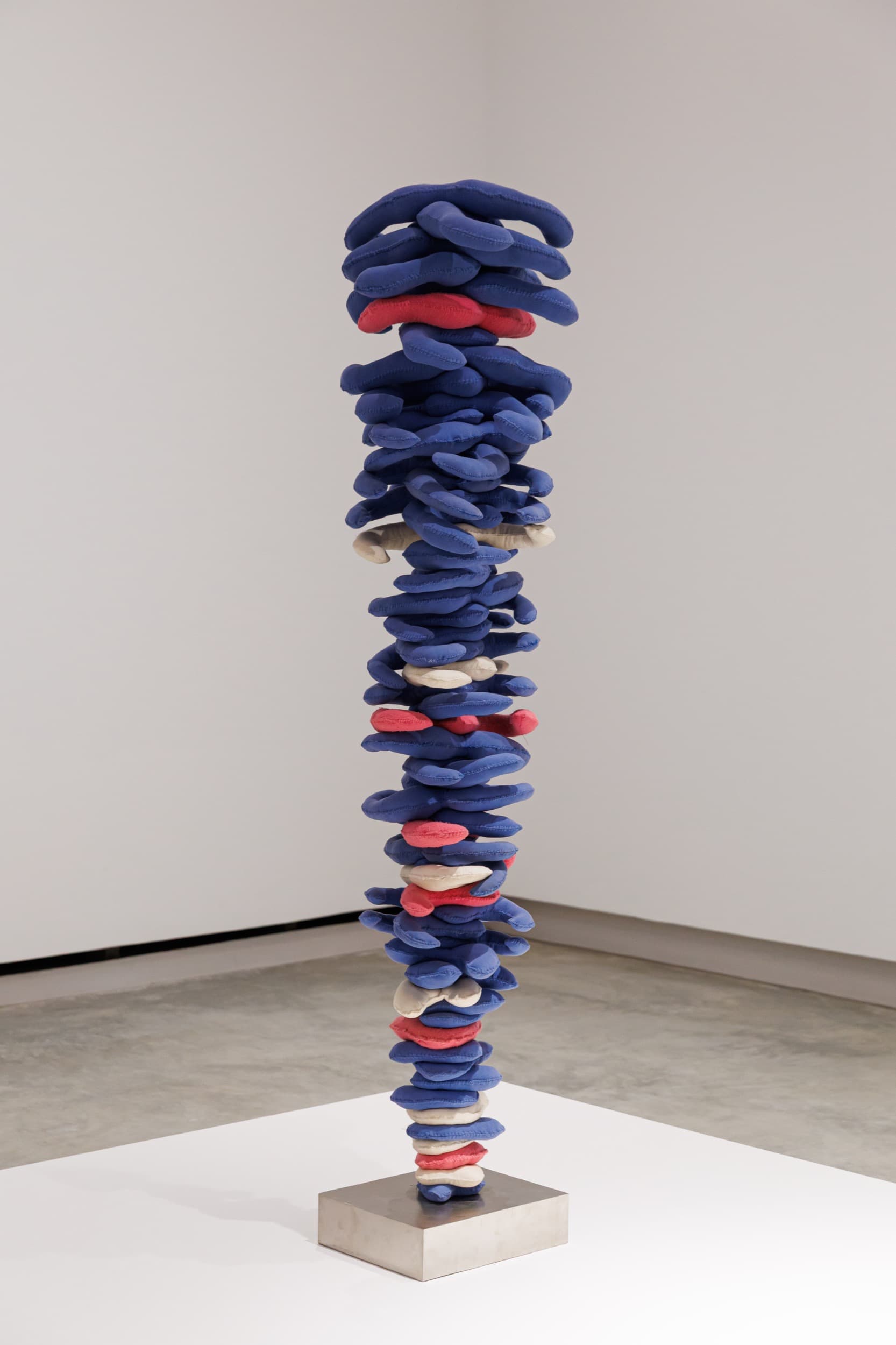
Louise Bourgeois, Untitled, 2005. Fabric, stainless steel. Courtesy of Dib Bangkok. Photo: Auntika Ounjittichai.
Word count: 984
Paragraphs: 10
Dib Bangkok
December 21, 2025–August 3, 2026
Bangkok
(In)visible Presence, the inaugural exhibition of the Dib Bangkok contemporary art museum, comprises some eighty works by forty international artists, drawn primarily from the one thousand–item private collection of its founder, Petch Osathanugrah. The show’s title evokes, in part, this extraordinary figure who modernized his family’s business holdings, reigned as a Thai pop star in the 1990s, served as president of Bangkok University, and launched social initiatives to empower the disabled. Although Petch died in 2023, his son Purat “Chang” Osathanugrah has carried through on his vision, opening the legacy museum in December 2025.
The institution, whose name means “raw” in Thai, occupies a former steel warehouse futuristically redesigned by Kulapat Yantrasast’s WHY Architecture in collaboration with the local firm Architects 49 (A49). The facility boasts three floors of exhibition space totaling 75,000 square feet, a 15,000-square-foot courtyard, a sculpture garden, and a tower housing a James Turrell sky oculus. Director Dr. Miwako Tezuka, who previously held directorial and curatorial posts at the Japan Society and the Asia Society in New York, and Thai-born curator Ariana Chaivaranon, who has extensive international training and experience, agree on Dib’s purpose. They aim to engage the local public, stimulate artistic practice and critical thinking at home, and (another aspect of the survey’s title) help insert Thai artists into the worldwide critical discourse. (In)visible Presence suggests that their mission has a high chance of success.

Anselm Kiefer, Der verlorene Buchstabe, 2019. Metal, wood, lead, photographs, resin sunflowers with shellac, plaster. Courtesy Dib Bangkok. Photo: Auntika Ounjittichai.
Consider the boldness of the show’s juxtapositions. The courtyard hosts eleven variously colored stone globes ranging in size from roughly 2 ⅓ to 8 feet in diameter, by Poland’s Alicja Kwade. Inside, one’s route begins with an interactive wall-bashing sound piece by Australian Marco Fusinato, leading to a panoply of works by international art stars: an aluminum-foil blimp by South Korea’s Lee Bul, Indian artist Subodh Gupta’s giant egg-shaped pods composed of workmen’s lunch tins, a recursively twisted wooden line sculpture by British artist Richard Deacon, Greek stalwart Jannis Kounellis’s large steel wall plaque bearing rolls of old clothes squeezed between I-beams, a quasi-abstract painting of black trees reflected in blue water by American Alex Katz, a towering stack of neck pillows by French-American Louise Bourgeois, German artist Rebecca Horn’s sickbed stripped to its frame and festooned with artificial butterflies, photostrips on a light table by Japan’s inveterate provocateur Nobuyoshi Araki, shellacked sunflowers sprouting from the ruins of a Heidelberg press by Germany’s war-haunted Anselm Kiefer, and selected sky paintings on the front pages of daily newspapers by New York-based Japanese artist Sho Shibuya.
Even though Thailand has not yet had its counterpart moment to the “Chinese wave” of the early 2000s, and even though the World Bank still classifies the country of around 71 million people as a “developing nation,” Chaivaranon has integrated thirteen Thai artists into this sophisticated global miscellany with no formal glitches and no special pleading. In the sculpture garden, body and soul are fused in several steel-framework breast stupas by Pinaree Sanpitak. Much of the ground floor is given over to Surasi Kusolwong’s totally deconstructed 1965 Volkswagen Beetle, its scattered parts accompanied by roadside vending machines. The inverted chassis, strung like a hammock for visitors, evokes the artist’s childhood on a houseboat while also inviting gently rocking road-trip fantasies—a toned-down sixties peace-and-love version of Jack Kerouac’s link between terrestrial and spiritual transport. Meanwhile, on the second floor, silently stealing the show, Somboon Hormtientong offers a room filled with salvaged temple columns, hung horizontally near the floor, bordered by several bottles and glasses for ritual libations. The hovering log-raft effect reminds viewers how spiritually adrift contemporary life can feel, bereft as it is of the once upright religious assurances of the past.

Jannis Kounellis, Untitled, 1998. Four steel panels, I-beams, lead, clothing, metal plate. Courtesy of Dib Bangkok. Photo: Auntika Ounjittichai.
The exhibition is explicitly structured to ascend, level by level, to the museum’s highly spiritualized top third floor, featuring multiple works by the famed Montien Boonma. Among them are a curved wall of stacked lotus bowls (symbols of purity, rebirth, and enlightenment), a 10 ½-foot aluminum archway filled with herbs, and Zodiac Houses (1998–99) which the devoutly Buddhist artist, who died of cancer at age forty-seven in 2000, modeled on religious and arts-related buildings in Stuttgart, Germany. Mounted on thin stilts, the structures allow visitors to place their head inside the spice-scented interiors for a contemplative respite.
This exemplary survey reminds us how seamlessly Thai artists and their country—a paradigm of modernization in dialogue with deep cultural history—have slipped into the global art system. These emissaries (one could additionally name Rirkrit Tiravanija and Araya Rasdjarmrearnsook as well as the show’s Navin Rawanchaikul, Apichatpong Weerasethakul, and Manit Sriwanichpoom) tend to bring along a belief in myriad lingering spirits—a third sense of (in)visible presence. While many viewers welcome this “open” sensibility as a counterbalance to the secularism of our age, it also highlights a certain hypocrisy or double standard in Western apprehension.
Throughout the Euro-American art world, vaguely understood forms of Eastern spiritualism, folk wisdom, and ancestor worship are praised as expressions of “cultural identity,” while any hint of sincere religious conviction by a Western artist is treated as an embarrassment, prompting dismissal from serious critical consideration. Playing ironically with religious signifiers is all well and good—consider the famous cases of Andres Serrano’s Piss Christ (1987) and Chris Ofili’s The Holy Virgin Mary (1996)—but actual religious conviction is considered either irrelevant or misguided. We’re all for zen over here, as we mangle and misinterpret it, but name six—hell, name two—living artists in the West who have risen to the top by sincerely asserting “Christ died for your sins.”
Why this inconsistency? The answer is an old one. For Western commentators to apply less intellectual rigor to Asian artists than to their own confrères is a subtle but still highly reprehensible form of patronization (“when should we tell the kids the truth about Santa Claus?”)—one replete with cultural arrogance, verging on racism.
Richard Vine is the former managing editor of Art in America and author of such studies as New China, New Art, and the crime novel SoHo Sins.