Amanda Millet-Sorsa

Amanda Millet-Sorsa is an artist and contributor to the Brooklyn Rail.

Helene Schjerfbeck is a national name and icon in Finland who achieved national recognition during her lifetime, but is an artist mostly unknown outside of her place of origin. Seeing Silence, curated by Dita Amory for the Metropolitan Museum of Art, brings Schjerfbeck global visibility as a notable modernist artist.
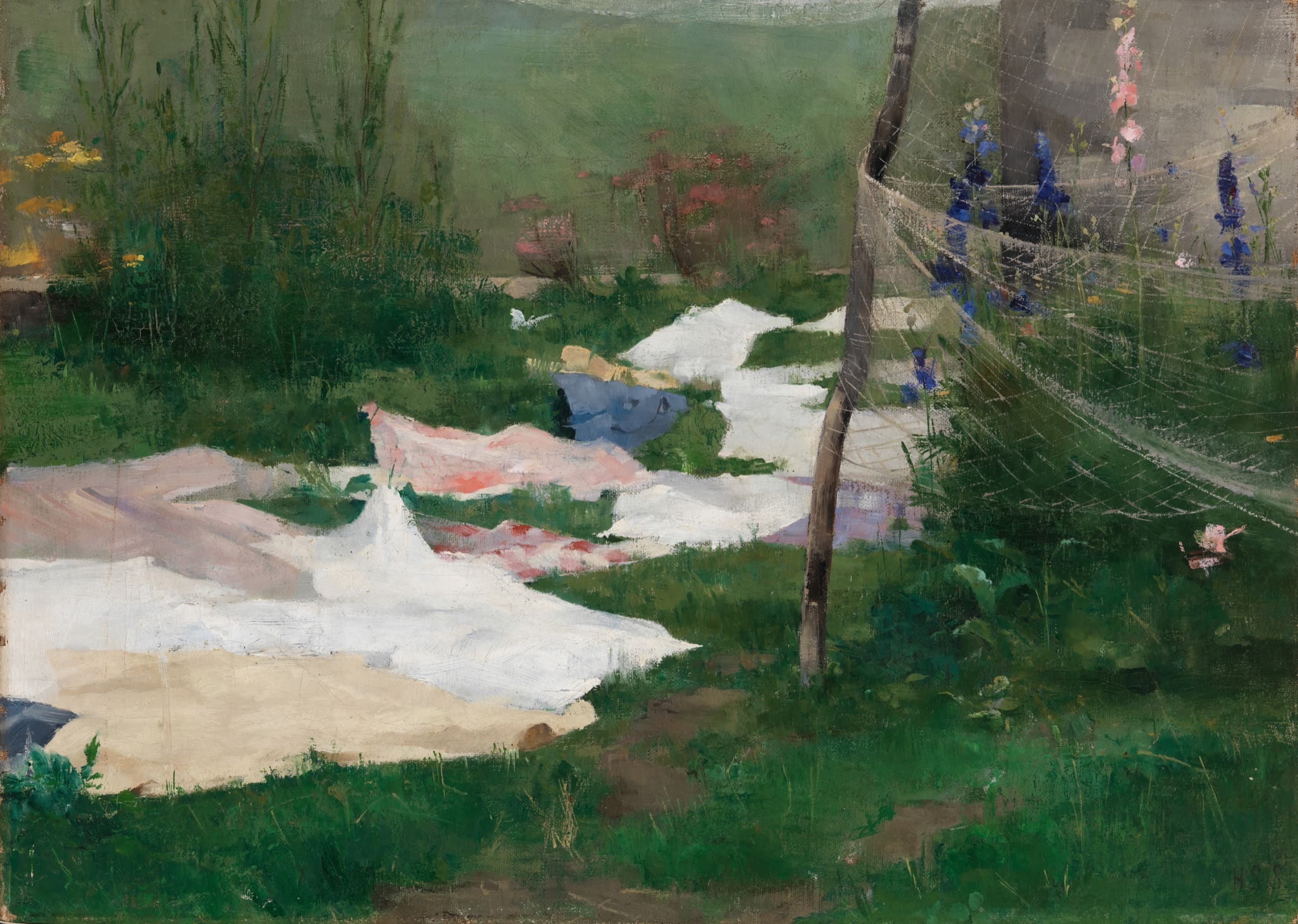
Helene Schjerfbeck, Clothes Drying, 1883. Oil on canvas, 15 ⅜ × 21 ½ inches. Courtesy Ateneum Art Museum, Finnish National Gallery, Helsinki. Photo: Finnish National Gallery / Yehia Eweis

Across Karma’s two East Village locations on East 2nd Street, new work by the artist-painter Jacob Littlejohn shines in What the Thunder Said. Littlejohn, an emerging artist originally from Scotland, presents a handful of large-scale and small paintings, the size of handheld books.

Jacob Littlejohn, Dry Bones Can Harm No One, 2024–25. Oil on panel, 96 × 60 inches. Courtesy the artist and Karma.

Madalena Santos Reinbolt is an artist who began making art in the early 1950s and continued making work until her death in 1976. She is the first self-taught Afro-Brazilian artist to have a solo survey at an American institution, the American Folk Art Museum, curated by Valérie Rousseau.

Madalena Santos Reinbolt, Untitled (Salvador), 1950–60. Oil on canvas, 27 1/2 x 22 7/8 inches. Courtesy American Folk Art Museum.

In The Appearance: Art of the Asian Diaspora in Latin America & the Caribbean, a dialogue among thirty artists’ works in sculpture, painting, photography, video, installation, and conceptual art highlights references to Eastern culture and philosophy, social marginalization, being visible and invisible, materiality and immateriality, and crossing cultures.

Albert Chong, Natural Mystic, 1982. Photograph, 39 3/4 × 39 3/4 inches. Courtesy the artist.

In the last eight years, Marcus Jahmal’s work has charmed many across the world, gaining the critical attention of global galleries and collectors.

Marcus Jahmal: Higher Animals
Deborah Buck’s first solo exhibition at Jennifer Baahng, Deborah Buck: Witches Bridge, on the Upper East Side is curated as a small survey spanning her forty-year career.
Deborah Buck, Witches Bridge, 2024. Acrylic and sumi ink on panel, 32 x 38 inches. Courtesy the artist and Jennifer Baahng Gallery.
Jeffrey Gibson (USA) and Manal AlDowayan (Saudi Arabia) present work that speaks to strong roots in materiality, stretching beyond the researched content and political dialogue of most artworks on view.
Manal Al Dowayan, Shifting Sands: A Battle Song. Pavilion of Saudi Arabia, 2024. 60th International Art Exhibition–La Biennale di Venezia. Courtesy La Biennale di Venezia. Photo: Andrea Avezzù.
Ouattara Watts is a painter whose works are infused with abstraction, symbolism, history, and alchemy, which embody a fusion of cultures throughout time and place. Painterly, gestural, and tactile, his work focuses on the crossover of semblances that we share as humans.
Portrait of Ouattara Watts, pencil on paper by Phong H. Bui.
Much has been extolled about Rothko’s retrospective at the Fondation Louis Vuitton (LVF) in Paris, but the exhibition at the National Gallery of Art (NGA), featuring work on two levels, reveals the breadth of Rothko’s painting through highlighting smaller scale works and explorations on paper in which he employs a heavy watercolor paper substrate alternating with watercolor, ink, acrylic, and oil paint.
Mark Rothko, Omen, 1946. Watercolor and ink on watercolor paper, 39 1/8 x 25 1/8 inches. The Ulla and Heiner Pietzsch Collection, Berlin. Copyright © 2023 Kate Rothko Prizel and Christopher Rothko.
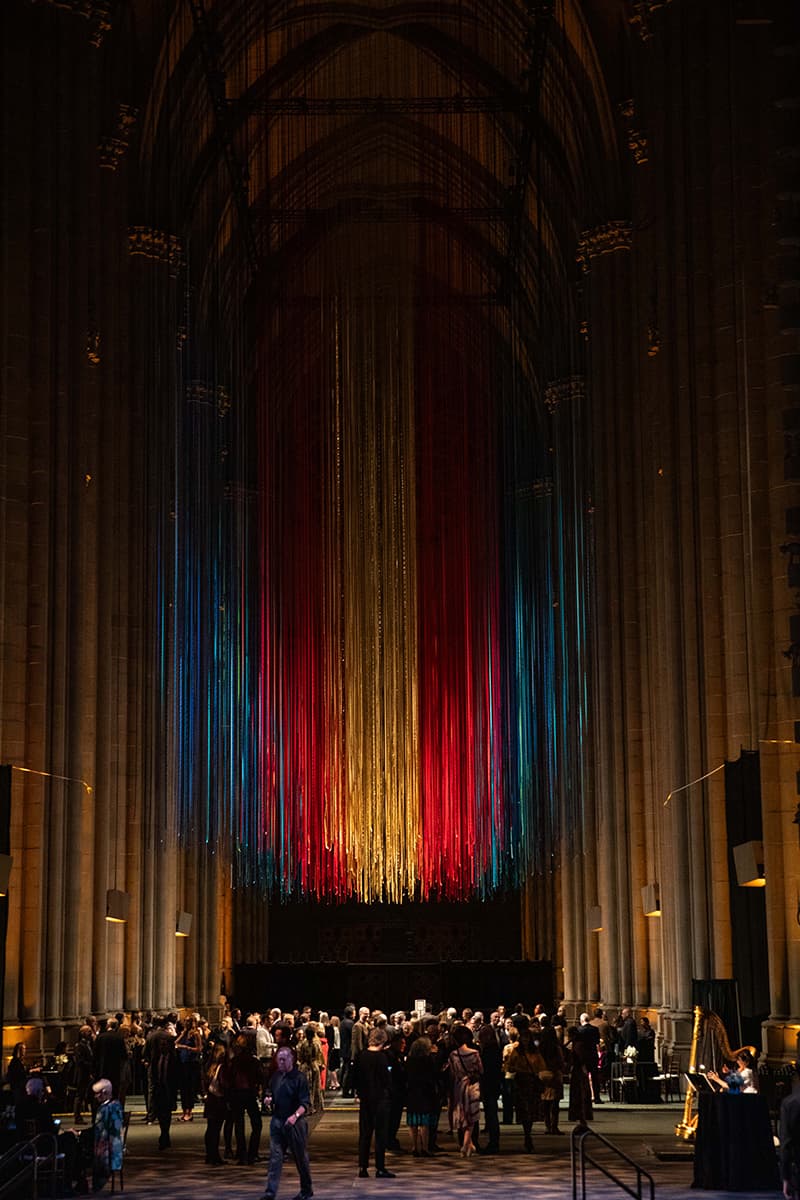
The Cathedral of Saint John the Divine on the Upper West Side of Manhattan serves both as a spiritual sanctuary and a cultural one, with a dedicated program to visual arts and music. Divine Pathways (2023) is Anne Patterson’s newest installation in a place of worship, coming ten years after Graced With Light (2013) in the Grace Cathedral of San Francisco.
Installation view: Anne Patterson: Divine Pathways, The Cathedral of Saint John the Divine, New York, 2023–2024. Courtesy the artist and The Cathedral of Saint John the Divine. Photo: Helena De Bragança.
Tribeca has been sprouting galleries every season since the COVID-19 pandemic, and Ruttkowski;68, located in the Cortlandt Alley since early 2023, is an emerging gallery active in Europe for the last decade, and is the latest addition in this sizzling neighborhood. It shows mostly European artists or artists from outside the United States. Playdate, the title of the exhibition, highlights the work of Susan Te Kahurangi King and Philip Emde.
Installation view: Susan Te Kahurangi King & Philip Emde: Playdate, Ruttkowski;68, New York, 2023. Courtesy Ruttkowski;68 and the Susan Te Kahurangi King Trust.
Sheila Pepe lives and works in Brooklyn, NY and inaugurated her first major public sculpture for the exhibition My Neighbor’s Garden at Madison Square Park, curated by Brooke Kamin Rapaport. We sat down for a conversation at ArtBuilt, which holds studios for artists at the Brooklyn Army Terminal in Sunset Park and where Pepe has had a studio for a number of years.
Portrait of Sheila Pepe, pencil on paper by Phong H. Bui.
Hauser & Wirth on 69th Street is showing the work of artist Cathy Josefowitz (1956-2014), who lived between Western Europe and the Boston and New York regions, holding family roots in Woodstock, NY where she would spend many childhood summers.
Installation view: Cathy Josefowitz. Forever Young, Hauser & Wirth, New York, 2023. © Estate of Cathy Josefowitz. Courtesy Estate of Cathy Josefowitz and Hauser & Wirth. Photo: Thomas Barratt.
Conceived by American artist and philanthropist Jerome Hill (1905–1972), the Camargo Foundation is a residency for artists, scholars, and thinkers in Cassis, France. Hill became enamored by French culture during numerous visits to Europe with his family.
Jerome Hill with camera.
We have the pleasure of experiencing new work by Andrea Marie Breiling at Almine Rech’s uptown New York location in their two main galleries. There are four paintings in each room: the main gallery, back gallery, and connecting hallway.
Installation view: Andrea Marie Breiling: Swallowtail, Almine Rech, New York, 2023. Courtesy Almine Rech. Photo: Dan Bradica.
In Lopez-Huici's work, the body is full of life, dignified like a sculpture and immortalized, both exuding poetry, calm, poise, strength, and force.
Ariane Lopez-Huici, Maria Mitchell 5, 2000–19. Pigment inkjet print on Canson Platine Paper 27 1/2 x 20 inches. Courtesy Slag Gallery and the artist.
Bruno Dunley has eleven large-scale oil paintings and eleven notebook-scale drawings on display at Nara Roesler in Chelsea, known for its roster of Brazilian artists. Much of Dunley’s new work is the result of a deep investigation into color and finding raw materials within Brazil’s rich and vast natural resources to make handmade oil paint.
Bruno Dunley, Antônio II, 2022. Oil paint and charcoal on canvas, 55.3 x 43.3 x 1.6 inches. Courtesy the artist and Nara Roesler Gallery.
With Blue River and Rainbow Waterfalls, Pat Steir has transformed Hauser & Wirth’s immense ground floor gallery in Chelsea into an arena for transcendence. We are lifted away by the gravitational pull of her monumental canvases, each awash with mesmerizing color and the movement of paint. Steir has been developing her mature work since the early 1990s, and her paintings today continue to command respect—and even awe—from their viewers. In her current exhibition, there are three bodies of work in which we are confronted with the sublime, each drawing us into its expansive space.
Installation view, Pat Steir: Blue River and Rainbow Waterfalls, Hauser & Wirth New York 22nd Street. 10 November–23 December 2022. © Pat Steir. Courtesy the artist and Hauser & Wirth. Photo: Thomas Barratt.
Carol Saft’s painting asks us to slow down, to self-reflect, and cherish the ones we hold dear. For Saft, that meant turning her gaze to her partner, Cynnie, who takes center stage in these paintings, and thus gives us an intimate view into the domestic life of a mature lesbian couple, a subject that has not often been addressed in this tender and quotidian way in art history.
Carol Saft, Sleepers, 2022. Acrylic on canvas, 14 × 18 inches. Courtesy the artist and Canada Gallery.
Last summer 2021, Jorge Galindo had his first major exhibition in the United States, and this year he returns to New York with Verbena, his first solo exhibition of his newest works, at Vito Schnabel. Since then, his work has gained in momentum and has been shown at Nino Mier in Los Angeles, the Hall Art Foundation Schloss Derneburg Museum (Germany), and the Museu Municipal Amadeo de Souza-Cardoso (Portugal), where his collaborative work with Pedro Almodóvar was exhibited.
Jorge Galindo, Esencia de Verbena, 2022. Oil and glued wallpaper on canvas, triptych, overall: 118 x 236 1/4 inches. © Jorge Galindo; Photo by Argenis Apolinario; Courtesy the artist and Vito Schnabel Gallery.
For 25 years the LeRoy Neiman Center has shown its dedication to printmaking by providing students and artists an environment to educate, learn, and work with master printers. To celebrate its long-standing collaborations with close to seventy artists, the Center invited affiliate artists to organize exhibitions highlighting work within its vast print collection. William Cordova is the first artist to organize such an exhibition.
Installation view of Can't Stop Won't Stop: Meditations on Resilience at the LeRoy Neiman Center for Print Studies, 2022. Courtesy the LeRoy Neiman Center for Print Studies.
Transmitter gallery in Bushwick, Brooklyn has put together an exhibition of works by artists Yasi Alipour and Zeshan Ahmed curated by Martha Fleming-Ives and Kate Greenberg. Both artists’ works consist of photographic images created without using a camera: Alipour favors cyanotype and inkjet prints while Ahmed uses RBG pigmented C-prints on transparency sheets. Alipour folds paper as one might origami, carving out straight horizontal, vertical, and diagonal lines that unfold geometric forms. Ahmed, on the other hand, erases printed sheets of pigment with bleach, blocking shapes using masking tape. Both artists challenge the flatness of photography and drawing, whether we’re engaging with Alipour’s reliefs of undulating paper or Ahmed’s transparent sheets, hung off the wall in layered curtains that allow light to shine through.
Zeshan Ahmed, I am sure. I am sure it's...but would it make sense?, 2019-2020. Unique digital C-prints on transparencies. 30 x 60 x 5. Courtesy Transmitter Gallery
The James Cohan Gallery has organized Naudline Pierre’s first solo exhibition in New York at its two spaces on Walker Street, featuring a selection of oil paintings on linen, painted triptych panels and three-dimensional structures adorned and supported with wrought-iron details, a room-sized iron gate, and small- to large-scale mixed-media works on paper. This exhibition affirms the presence of a promising artist whose nascent aesthetic language is becoming recognizable, with its vivid colors and mythological subjects featuring nude Black women and fantastical winged and feathered angels from religious iconography. Pierre’s spiritual upbringing with her father as a Haitian minister can be felt in the visionary and biblical subjects that weave in and out of her work.
Naudline Pierre, I, A Terror Loosed Upon Your Heels, 2022. Oil on canvas, 96 x 120 inches. Courtesy the artist and James Cohan, New York. Photo: Izzy Leung.
The Boiler in Williamsburg, Brooklyn opened during the pandemic in 2020 as an extension of the ELM Foundation’s programming, and invites contemporary artists to create installations and exhibitions in its space, previously run by Pierogi Gallery from 2009–2015. The current show, The Man Who Fell to Earth 76|22, by artist Tomas Vu, is his first solo show in New York since 2008. The raw industrial space exudes an extraterrestrial feeling, perfect for a show whose title recalls David Bowie’s central role in the eponymous 1976 movie.
Installation view, Tomas Vu: The Man Who Fell To Earth 76|22 at The Boiler, 2022. Courtesy The Boiler.
In order to understand the motivations and mission behind the Joan Mitchell Foundation, it is helpful to first understand that artist Joan Mitchell (1925–1992) placed art above all else, both at the center of her own life and through supporting her artist peers—thick in the battle and euphoria of the studio—who surrounded her during her lifetime. Mitchell was a pioneer artist in Post-War New York, earning an esteemed reputation among her Abstract-Expressionist cohort while also creating a dialogue with the French Impressionists of the previous century.
Joan Mitchell at the opening of the exhibition Joan Mitchell at the Whitney Museum of American Art, New York, 1974. Photographer unknown, Joan Mitchell Foundation Archives. The artwork visible in the photo is Les Bluets, 1973 which is in the collection of the Centre Pompidou, Paris.
Willie Birch has exhibited his work in New York for the first time since 2000 at the Fort Gansevoort Gallery located in the Meatpacking District. Originally from New Orleans, Birch is no stranger to New York City. Aside from Broken Dreams (Tattered White Picket Fence) (2020–21), the exhibition centers on Birch’s New York period (1983–1997).
Willie Birch, Lotto Dreams, 1995. Painted papier-mâché and mixed media, 57 x 18 x 15 inches. ©Willie Birch. Courtesy the artist and Fort Gansevoort, New York.
We discuss the life and work of Japanese American artist Koho Yamamoto through several conversations over sushi and tea in her apartment above Bar Pitti on 6th Avenue in Greenwich Village, in anticipation of her centennial birthday in April 2022. After seeing the artist’s first big show at the Noguchi Museum, Koho Yamamoto: Under a Dark Moon (May 2021), I started as her student to learn Japanese calligraphy. Though she is a dedicated teacher of traditional sumi-e subjects and has taught for over fifty years, her own work stems from the ideas and thoughts developed in Postwar Abstract Expressionism in New York, where she has lived since 1945 after being held in the internment camps in Utah during WWII.
Portrait of Koho Yamamoto. Pencil on paper by Phong H. Bui. Based on a photograph by Robert Banat.
Bill Jensen’s new body of work, largely made in the last three years, is displayed in all four rooms of Cheim & Read gallery in Chelsea. These paintings embody both the wisdom and maturity of a sage, while maintaining the energy and vulnerability of new life.
Bill Jensen, BLUE CUPOLA, 2020–21. Oil on linen, triptych, 59 x 120 1/4 inches. Courtesy Cheim & Read, New York.
Stanley Whitney’s recent exhibit of new paintings presents his lifelong exploration of an endless oasis of color.
Stanley Whitney, Orange Conversation, 2021. Oil on linen, 96 x 96 inches. Courtesy Lisson Gallery.
Below Grand is a gallery in the Lower East Side with a twist. This space is a closet-sized gallery nested into the storefront of Fortune Line Trading Corporation, a Chinese owned restaurant supply store. We are charmed by the concept, which is quintessentially New York in its spirit and scarcity of space, but also by the pairing of six works by artists Myeongsoo Kim and Cy Morgan and curated by Wangui Maina and Mo Kong.
Installation view: Myeongsoo Kim and Cy Morgan: Classical Mechanics, Below Grand, New York, 2021.
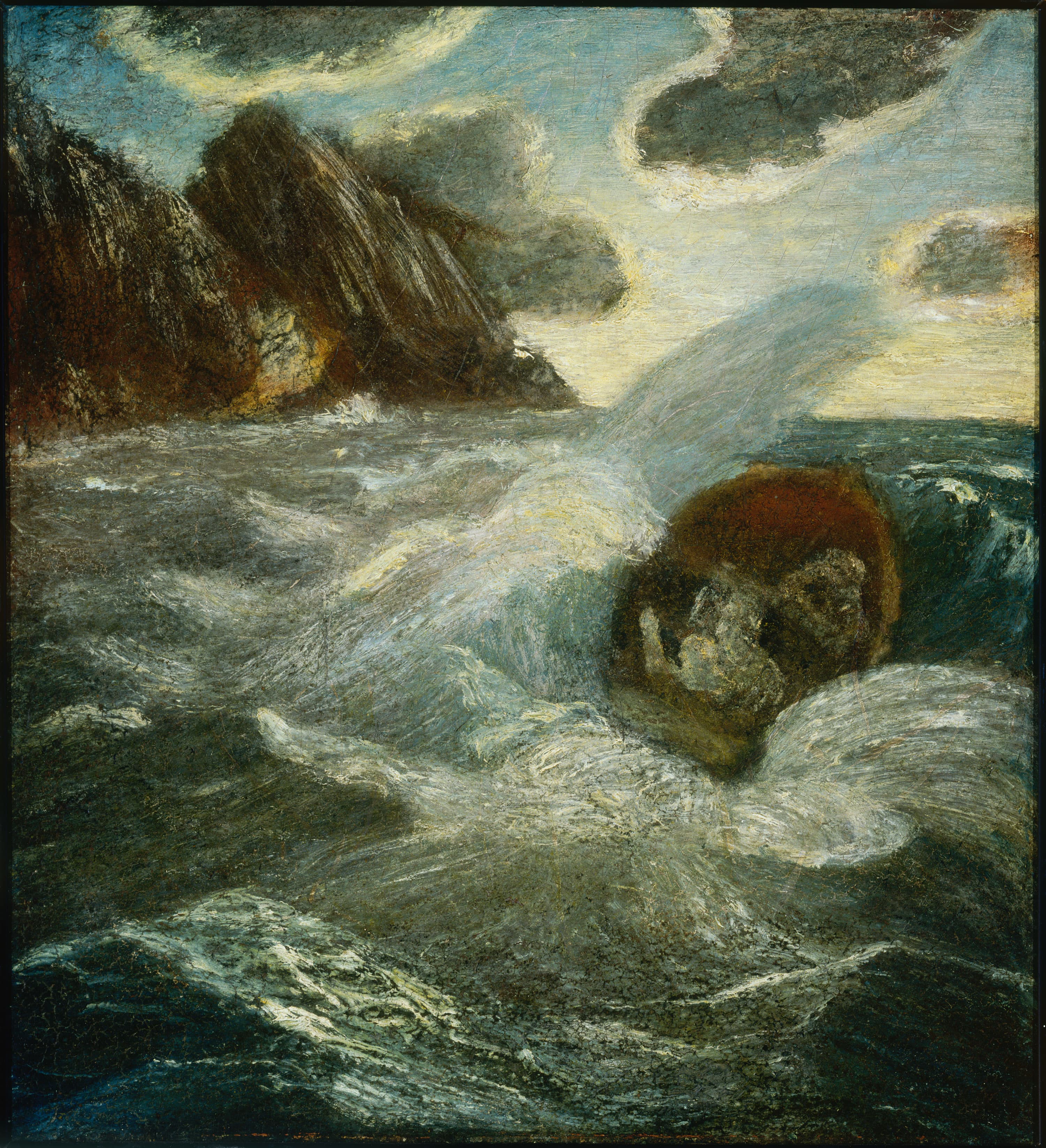
It’s heartwarming, and a real rarity, to see so many works by an artist in his hometown—and in a whaling museum, which adds context to both Ryder’s life and the seascapes prevalent in his work.
Albert Pinkham Ryder, Lord Ullin's Daughter, before 1907. Oil on canvas mounted on fiberboard, 20 1/2 x 18 3/8 inches. Smithsonian American Art Museum, Gift of John Gellatly.
Tamara Gonzales has spent her life living, experiencing, understanding, and connecting with the indigenous cultures of the Americas, spiritual and ritual practices from India and the Caribbean, and with Magick, as well as undergoing healing journeys facilitated through psychedelic plant medicines, without forgetting her early years professionally decorating cakes while being immersed in counterculture and the punk music circles of the 1970s in New York.
Tamara Gonzales, Hawk Moth, 2021. Acrylic, pastel, spray paint, fabric, sequins, and glitter on canvas 85 x 74 inches. Courtesy the artist and Klaus von Nichtssagend Gallery.
The paintings in the exhibition bring together Binion’s agility with color, a study that he has deepened for 40 years, as well as minimalism and geometric abstraction.
McArthur Binion, Modern:Ancient:Brown, 2021. Ink, oil paint stick, and paper on board, 72 x 96 x 2 inches. Courtesy the artist and Lehmann Maupin, New York, Hong Kong, Seoul, and London.
In their two-person show at Ceysson & Bénétière, the abstractions of Rosy Keyser and Joseph Montgomery take us through an eclectic journey of Constructivism, Abstract Expressionism, Arte Povera, assemblage, and Minimalism into their own personal synthesis of painting and sculpture as frictional yet unified objects.
Rosy Keyser, Metabolic Berd, 2021. Oil, medium, sawdust and pastel on waxed canvas and molded paper. 58 x 46 inches. Courtesy Ceysson & Bénétière. Photo: ©Adam Reich.
For whom are the lush roses found in Jorge Galindo and Julian Schnabel’s recent works at the Vito Schnabel Gallery painted? In this two-person exhibition, their first together, they share this subject and express their mutual love for painting and roses, yet their interpretations are drastically different from one another.
Julian Schnabel, Victory at S-chanf I, 2021. Oil, plates and bondo on wood, 72 x 60 inches. © Julian Schnabel. Courtesy the artist and Vito Schnabel Gallery. Photo: Tom Powel Imaging.
At the age of 99, master calligrapher and sumi-e artist Koho Yamamoto is having her first museum show at the Noguchi Museum. Curated by Dakin Hart, 10 paintings are exhibited in an intimate gallery and reflect a humble selection from her life-long practice.
Koho Yamamoto, Untitled, c. 1987. Ink on paper. 34 1⁄8 x 44 1⁄4 inches. Collection of the artist. Photo: Nicholas Knight. © Masako 'Koho' Yamamoto / The Noguchi Museum / ARS.

Close

Home