
Madalena Santos Reinbolt, Untitled (Salvador), 1950–60. Oil on canvas, 27 1/2 x 22 7/8 inches. Courtesy American Folk Art Museum.
Word count: 1063
Paragraphs: 9
American Folk Art Museum
February 12–May 25, 2025
New York
Madalena Santos Reinbolt is an artist who began making art in the early 1950s and continued making work until her death in 1976. She is the first self-taught Afro-Brazilian artist to have a solo survey at an American institution, the American Folk Art Museum, curated by Valérie Rousseau. Santos Reinbolt explores narrative subjects related to farm and rural life in Bahia, in the northeast region of Brazil, through remembrances of her childhood. Most of the works on view use colorful wool embroidery on burlap (“wool pictures”) alongside a handful of oil paintings on canvas. These works are the testament to the fierce determination by an analphabet and auto-didact artist who found her voice and urgency to make as she struggled with the socio-economic limitations conferred to her by society.
The iconic view of Salvador, the first colonial capital of Brazil, is recognizable in Untitled (Salvador) (1950–60). Three horizontal blocks layer the painting: the top as sky with an outsized moon and stars, the middle with houses on ascending hills, and the Bay of All Saints at the bottom with fishing and merchant boats. Dividing the painting is a vertical rectangle aligned with dashes (implying the Elevador Lacerda, a 72-meter high elevator), allowing access between the topographic “upper” city on a cliff, to the “lower” part by the water. The speed of the brush and liquidity of paint is felt in Santos Reinbolt’s percussive, curt, repeated thin lines manifest in rows of windows and the façades of houses, quickly outlined in green. Space in the painting is ordered and flat, like Byzantine and European Medieval works, or Persian miniatures, yet the looseness of her line carries the freedom and abstraction of modernism.
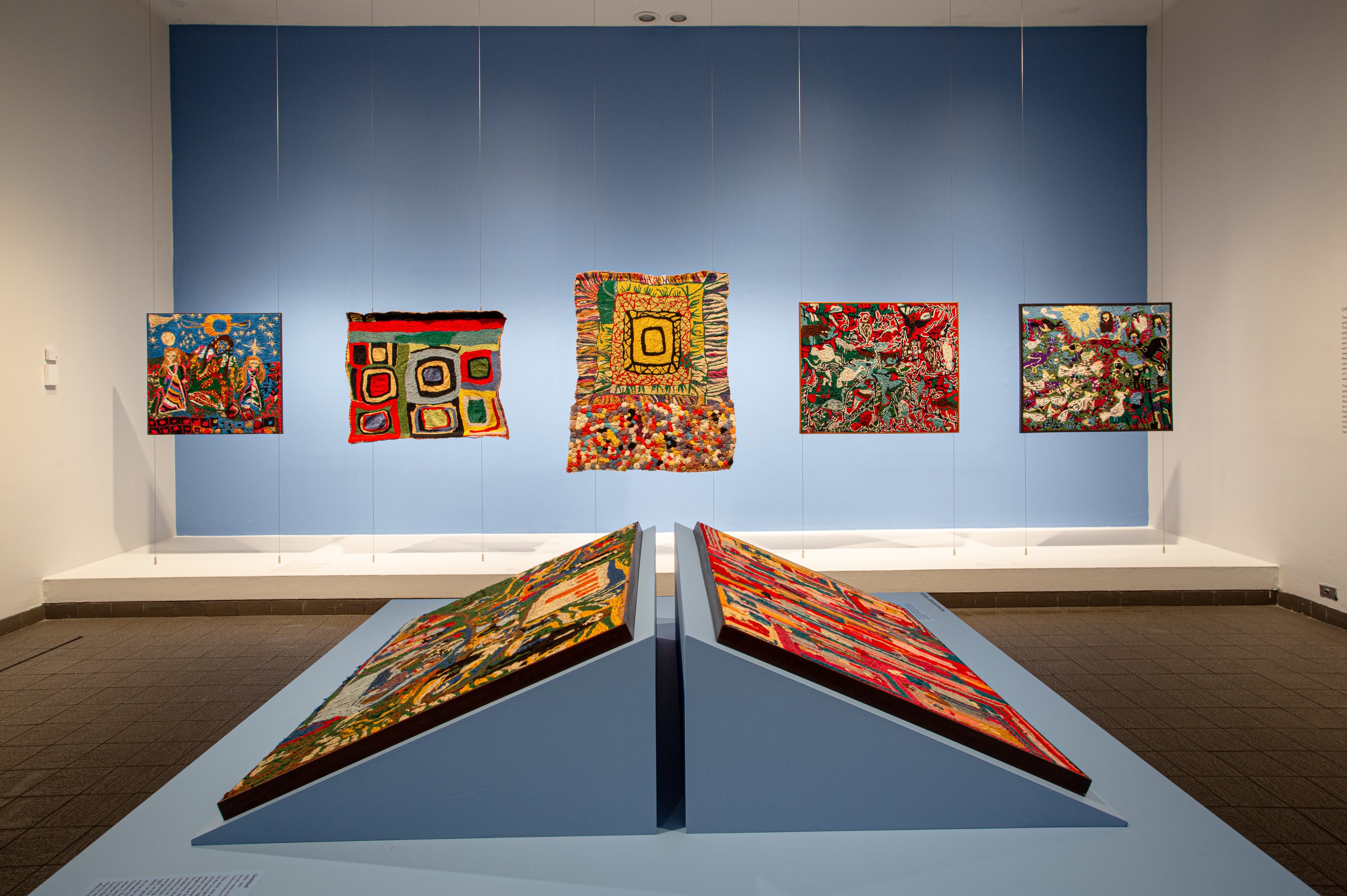
Installation view: Madalena Santos Reinbolt: A Head Full of Planets, American Folk Art Museum, New York, 2025. Courtesy American Folk Art Museum.
At Samambaia Farm, in the mountainous city of Petrópolis near Rio de Janeiro, Santos Reinbolt was encouraged to develop her craft while employed by the heiress, Lota de Macedo Soares, and poet, Elizabeth Bishop, who at first supported her impulses by providing paint and exposure to collectors. Soon, they let her go, as the artist’s work was taking over her domestic responsibilities as a house cook, but she was not deterred, and her resolve to make work continued through the remainder of her years. After leaving the farm, she began using colorful acrylic wool and embroidery thread, employing techniques she knew well from her upbringing; she also began to incorporate vibrant color. The combination of embroidery, narrative storytelling, textiles, and improvisation is felt in work such as Faith Ringgold’s story quilts, Romare Bearden’s collages, El Anatsui’s metallic tapestry-like sculptures, and many more, contextualizing Santos Reinbolt’s work within a quilting and textile art tradition prevalent in Black communities around the world.
A common occurrence is repetition. Houses, figures of men and women, and animals such as cows reoccur and are seen in several untitled works, including one from 1965–76 and a work dated 1963. Uneven triangular, oval, striped, or other unusual patches of white are threaded into the black mass of the cow, highlighting their unique qualities within the herd. Birds are visible in an untitled work from 1962 and stars or fish in a work from 1965–76. The sun and the moon appear amplified various times, with exaggerated rays sometimes transforming into the petal halos of a flower in bloom, denoting the power of the sun and the immensity of the moon to light up the night. Though landscape is prevalent, people occupy the most attention. Using a chromatic array of brown yarn for faces, Santos Reinbolt highlights communities of Black people as opposed to the few pink and white faces. Men are often depicted with farmer’s hats and women in long flamboyant dresses. The emphasis on rural narratives recalls the politics of the Barbizon school of painters who honored peasants, laborers, and ordinary people when painting subjects typically focused on the upper strata of society. In Brazil, this politic is marked by stark racial divisions.

Madalena Santos Reinbolt, Untitled, 1965–76. Wool on fabric, 33 1/8 x 41 3/8 inches. Courtesy American Folk Art Museum.
At times, Santos Reinbolt places a fish on a head in many of the works, but most noticeably in an untitled work (1965–76). In many Afro-Brazilian spiritual practices, a fish symbolizes the orixa Iemanjá, the goddess of the sea in Candomblé, and the religion considers the head a sacred place, suggesting a divine connection. Santos Reinbolt was a proud and devout Catholic, yet she was likely to have received exposure to African symbols and rites through her upbringing in Bahia, and it is perhaps through this angle we can understand the constant presence of spiritual symbols throughout the work. The two white church façades with crosses on the steeples appear in an untitled work (1965–76), resembling awkward oversized heads in white thread, with a large oblong black opening to denote the entrance. The direction of the white stitch often sways, emphasizing the verticality of architecture, the diagonal of a sloping walkway, or the curved backs of sheep. The cowboy atop the horse throws a white lasso onto a cow with yellow eyes. The path of his threaded lasso carrying so much movement as it tangles into the horns of the animal, we forget that embroidery is a craft traditionally devoted to a strict cartesian grid where well-behaved women thread perfect and decorative still images.

Madalena Santos Reinbolt, Untitled, 1965–76. Acrylic wool on burlap, 35 7/8 x 46 inches. Courtesy American Folk Art Museum.
Two tapestries, both untitled and made between 1965 and 1976, start exploring an abstract language using rectangular shapes that radiate out from a central form. In the lower part, there are rows of colorful, disheveled small bunches of wool. These have a lyrical sensibility as if in dialogue with Sonia Delaunay’s paintings and the Brazilian neo-concrete geometric works of the 1960s. Another work uses the tufts of scrunched up wool as textured foliage for trees. Santos Reinbolt would sometimes reuse scraps of fabric as collage and transform them into dresses adorned with jewelry as in Untitled (1965–76).
After a lifetime of serving others as a domestic worker, Santos Reinbolt’s choice to pursue art can be read as a political act. This rare turn of defiance against the status quo was a form of self-empowerment not only for herself, but also for the rural subjects and communities she represented in her work. Through tactility, playfulness, optimism, and freedom, she created space and light for storytelling and preserving untold legacies, while reinventing embroidery as an improvisational artform.
Madalena Santos Reinbolt: A Head Full of Planets is organized by Museu de Arte de São Paulo Assis Chateaubriand—MASP and is curated by Amanda Carneiro, Curator, MASP, and André Mesquita, Curator, MASP. The presentation at the American Folk Art Museum, New York, is curated by Valérie Rousseau, PhD, Curatorial Chair and Senior Curator of 20th-Century & Contemporary Art, with the curatorial assistance of Dylan Blau Edelstein.
Amanda Millet-Sorsa is an artist and contributor to the Brooklyn Rail.