William Blake: The Age of Romantic Fantasy
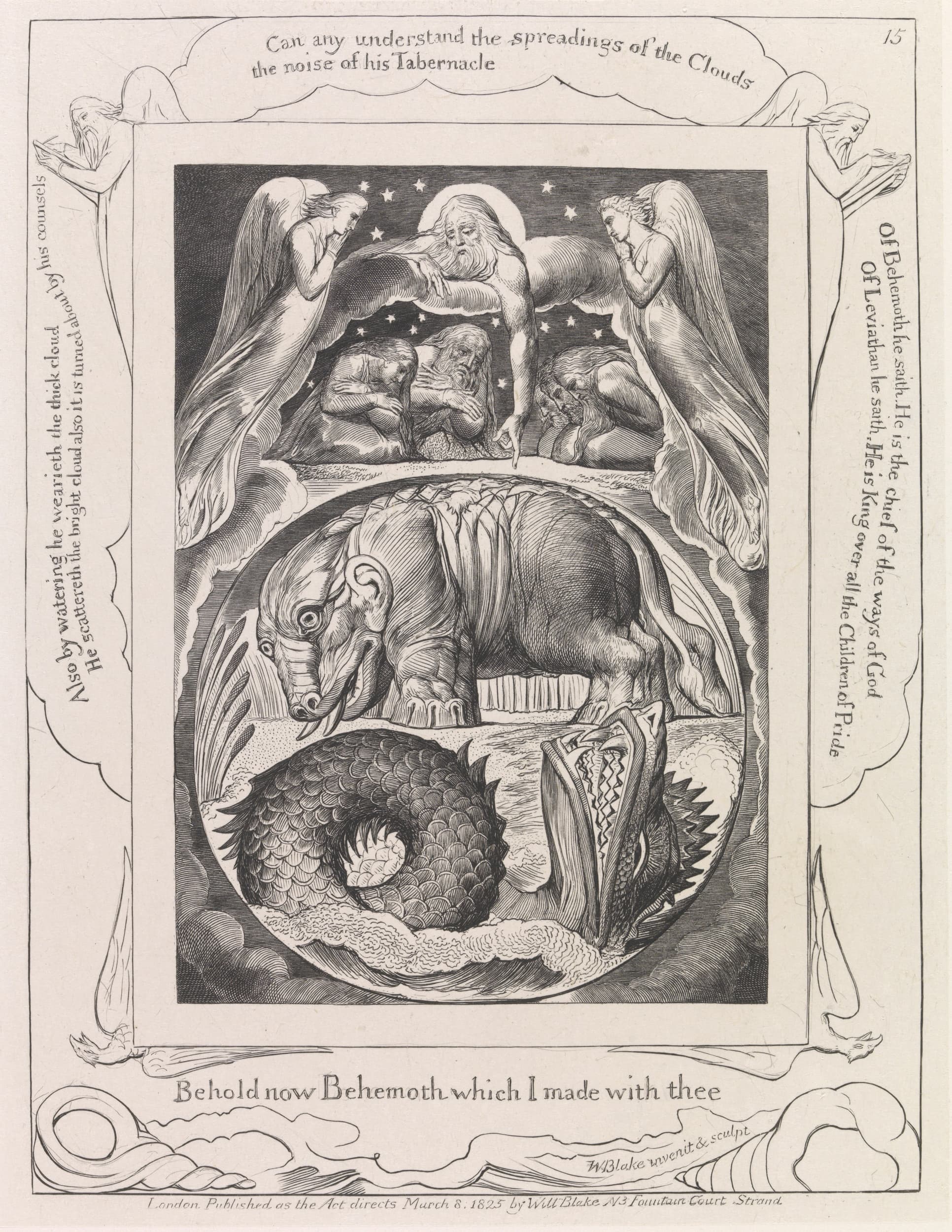
William Blake, Behemoth and Leviathan, 1825, reprinted 1874. Courtesy the Tate.
Word count: 1203
Paragraphs: 7
National Gallery of Ireland
April 16–July 19, 2026
Dublin
Since his death on August 12, 1827, William Blake has steadily acquired the kind of reverent approbation that is reserved for consideration of artistic sainthood. The passionate vision embodied in his paintings, watercolors, and drawings has inspired generations of acolytes of the Romantic persuasion. This revelatory selection of works at the National Gallery of Ireland usefully contextualizes Blake’s visionary works within a broader cultural moment. The exhibition, The Age of Romantic Fantasy allows for a more sober and historically-grounded reading of his art than is often put forth. Rather than presenting him as an isolated Romantic visionary, as is so often the case in idealized accounts of his life and work, the exhibition, that was organized in collaboration with the Tate, firmly situates Blake’s ethereal aesthetic amongst a circle of like-minded artists, including Henry Fuseli, James Barry, and J. M. W. Turner. The opportunity to view Blake’s work alongside this particular grouping encourages a more complex understanding of his achievement: an art that is both materially realized through intensely febrile and present gesture, while also ideologically driven by a prophetic profundity.

William Blake, Satan Smiting Job with Sore Boils, ca. 1826. Courtesy the Tate.
Consider the historical moment in which the artist and his contemporaries worked. England’s ambitions to become a world empire had just recently suffered a monumental setback with the American Revolution, as well as the subsequent challenge to royal sovereignty in the French Revolution. And, in light of the exhibition’s context, one has also to take into consideration the concurrent Irish rebellion against British rule of 1798. An early poem by Blake, entitled “The French Revolution” (1791), characteristically transforms this historical rupture into an allegory of spiritual survival, awakening, and hope: “Like the morning star arising above the black waves, when a shipwreck'd soul sighs for morning.” Napoleon Bonaparte subsequently ascended on the Continent, imposing a very real, existential threat to England (there are still coastal watchtowers extant on the coasts of both England and Ireland that were erected in anticipation of a Napoleonic invasion). But rather than the philosopher Edmund Burke’s transmogrification of such existential terrors into the inscrutable obscurity of the sublime, Blake chose to internalize such epochal instability as an opening for spiritual evolution and artistic epiphany. The exhibition effectively makes connections between Blake and the aesthetics of sublime upheaval that were also shared with his contemporaries by including works such as An Avalanche in the Alps (1803) by the French painter Philip James de Loutherbourg. It’s a highly theatrical scene that depicts tiny mountain trekkers being overwhelmed by a natural cataclysm. Blake, however, who famously stated, “ Where man is not, nature is barren,” wasn’t motivated by such allegories of natural power. Closer to the artist’s poetic vision is a striking painting by Turner, The Cave of Despair (ca. 1835), which depicts, in swirling and chromatically intense swathes of both very thin and very thick brushwork, what seems to be an episode from the poet Edmund Spenser’s The Faerie Queene (1596). In an earlier work also included, Sketch for ‘Ulysses Deriding Polyphemus’ (1827–28), Turner paints a fascinating maritime scene in which Ulysses’s ship sails past the blinded Cyclops. The artist directly correlates the blindness of the monster with an obscure smear of blue-gray oil paint, as it lurks over a mountain top, set against the sunny sea’s horizon that alternately promises Ulysses ship a safe passage. Less promising prospects haunt Alexander Cozens’s A Shipwreck Fantasy, ‘Inscrutable’ (n.d). Known for his innovative use of abstract ink blots to derive his imaginary landscapes, in this image Cozen employs the looming black form (perhaps developed by this method) of a thunderhead to envelope a hapless brig, which is bound for the rocks. In each of these works, one is made to sense both the mortal dangers of exploratory ambition and its potential opportunities for transformation, whether tragic or hopeful. For Blake, this was an essential quality of artistic endeavor.
A great amalgamator of ancient history, Biblical allegory, and poetic precedence, Blake often synthesized these into surprising combinations. For example, his painting The Spiritual Form of Pitt Guiding Behemoth (1805) imagines England’s then-current prime minister, William Pitt The Younger, astride a biblical beast of chaos and destruction. The physical qualities of the composition are remarkable. While the extent of Blake’s corpus is usually associated with his small to medium-sized prints, drawings, and watercolors which tend toward a delicate transparency, this larger work was heavily encrusted with multiple media, including egg tempera and gold leaf. Blake actually had ambitions that the painting would lead to a public commission reflecting “the grandeur of the nation,” yet his fervent vision could never really be properly assimilated into the service of state propaganda.

William Blake, Plate 4 of “Visions of the Daughters of Albion,” ca. 1795. Courtesy the Tate.
A representative selection of Blake’s drawings and watercolor studies for his cycle of illustrations for Dante’s Divine Comedy is included here. The Italian poet and the British visionary are perfectly matched in their powers of allegory. Blake depicts Dante and Virgil as they roam through hell, imprinting his typical form of ectoplasmic figural circulation in each scene. In The Pit of Disease: The Falsifiers (1826–27), the artist positions Dante and Virgil on a mount that overlooks a pit of writhing bodies that together morph into a stony landscape, as if they are geologically sedimented into their own calumny for eternity. In another work, The Devils with Dante and Virgil by the Side of the Pool (1824–27), Blake imagines the eighth circle of hell as a series of pneumatic arches that dominate a murky pool of fraudsters. Both this and the former study are incipient in their realization, characterized by light washes of red and black watercolor. The lightly sketched protagonists open a very intimate window into the artist’s material process. Notably, the curators of the exhibition, Anne Hodge of the National Gallery of Ireland and Alice Insley of the Tate, have presented such a range of Blake’s media here as to expand upon his legacy as an inventive “maker,” and include the aforementioned watercolor sketches with more fully-realized and comprehensively tactile works. Besides the Pitt allegory, another revelation included from Blake’s oeuvre is the relatively large painting, The Bard, From Gray (1809). The image depicts a recumbent knight/bard dreaming of a host of ancient prophets hovering above, who inspire his poetic reverie. Executed in a combination of drawing, watercolor, egg tempera, and gold leaf foil (a process which he described as “fresco”), this substantially tactile work embodies Blake’s wish to harken back to older methods of painting that were inspired by what he deemed medieval material, which he associated with spiritual sincerity. No doubt, it is Blake's adherence to an ideal of artistic sincerity through his visionary reverie that accounts for his residual popularity as an exemplar of such amidst a contemporary situation which was seemingly always headed in the opposite direction. His legacy may be deemed a poignantly naïve attempt to rescue a world, to paraphrase the words of his Romantic contemporary William Wordsworth, that is “too much with us,” from its more venal distractions. Or perhaps it is defined by the resilient spirit of hope that one can derive from the creative reimagining that other worlds are yet possible.
Tom McGlynn is an artist, writer, and independent curator based in the NYC area. His work is represented in the permanent collections of the Whitney Museum, the Museum of Modern Art, and the Cooper Hewitt National Design Museum of the Smithsonian. He is currently Adjunct Assistant Professor at Parsons/ The New School.