Lee Miller
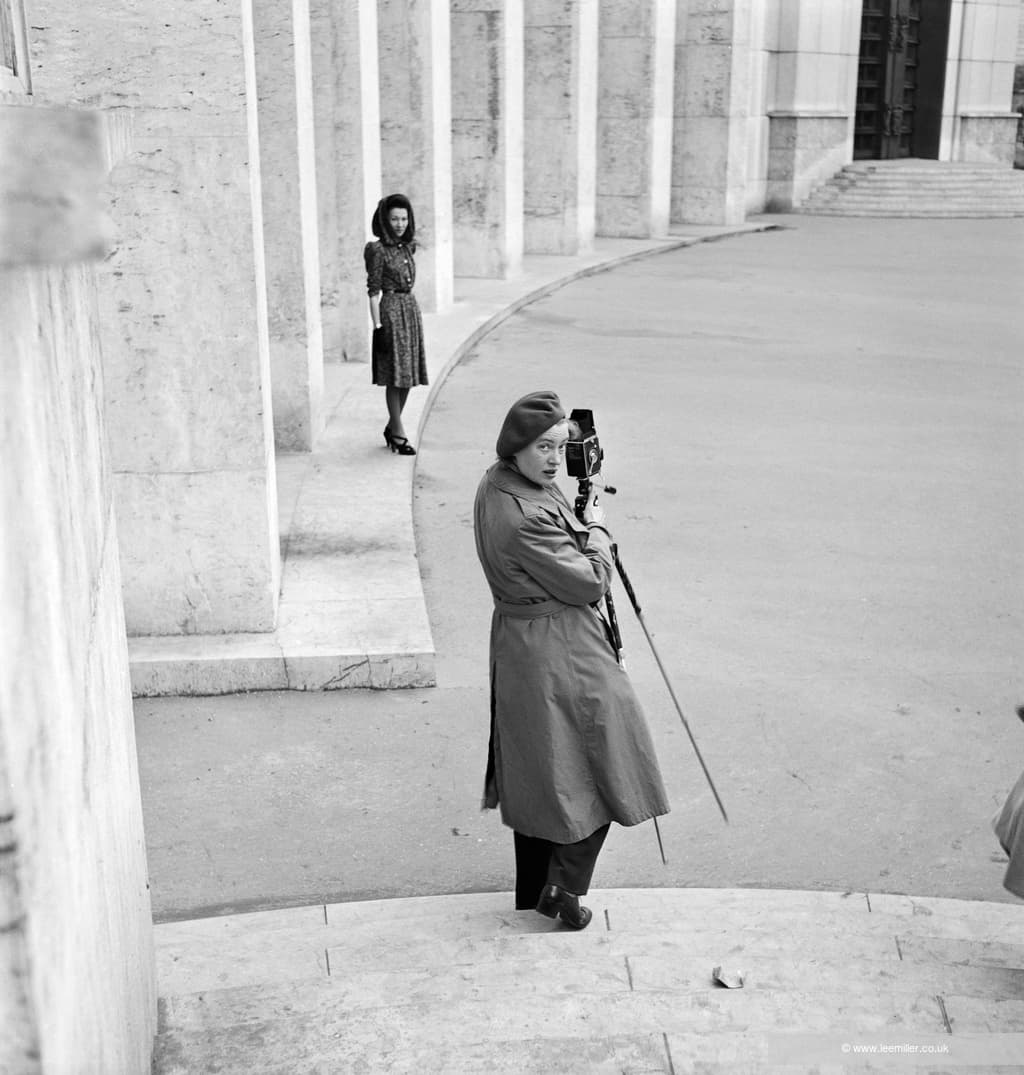
Unknown artist, Lee Miller with camera on Schiaparelli fashion assignment for Vogue Musée d’Art Moderne, 1945. © Lee Miller Archives England, 2026. All Rights Reserved.
Word count: 1335
Paragraphs: 12
April 10–August 2, 2026
Paris
The desire to merge art and life has been a compelling undercurrent in modern art, and photographer Lee Miller, whose retrospective is currently at the Musée d’Art Moderne de Paris, provides no better example. Miller’s photographic work spanned Surrealism, abstraction, portraiture, street and fashion photography, and charged, high-wire photojournalism. She seemed to know everybody worth knowing, to be everywhere all at once and, as a frontline war correspondent, ended up in places where only the brave, daring, and truly committed would volunteer to go.
The exhibition takes her various photographic modes into account, organizing them into six separate sections, arranged both thematically and chronologically, accompanied by well-researched and informative wall text. Vintage photographs are combined with modern gelatin silver and digital prints; publications in which her work appeared are also on display. Additionally, interviews with those who knew her, wall-sized blowups—including one of Miller photographing a 1945 fashion shoot in front of the Musée d’Art Moderne itself—and a dress form that displays her war correspondent’s uniform make for a comprehensive show. This curatorial approach balances Miller’s personal evolution and the tumultuous history that she lived through with a nuanced appreciation of the work itself. Focusing on the work’s aesthetic and emotional resonance as well as its innovative technique and unexpected subject matter, it successfully argues for Miller’s place in a now-expanded photographic canon, open to the medium’s diverse purposes and contexts.
Miller (b. 1907; d. 1977) was mechanically and technically adept from an early age (her father taught her to develop photographs as a very young child). Artistically-inclined, ambitious, and restless, she was also extraordinarily beautiful. Publisher Condé Nast discovered her when she was twenty, and she quickly became a top fashion model for Vogue. A favorite of the photographers Edward Steichen and George Hoyningen-Huene, the magazine cast Miller as an exemplar of the modern young woman. But her success as a model only whetted her appetite to be on the other side of the camera. With a letter of introduction from Steichen in hand, she went to Paris in 1929 and appeared unannounced at the studio of Man Ray, the avant-gardiste par excellence, and declared herself to be his student. The fact that he didn’t have students and was leaving for Biarritz the next day proved no more than a minor inconvenience to Miller, who went with him.

Lee Miller, Untitled (Man and tar), ca. 1929–31. © Lee Miller Archives England, 2026. All Rights Reserved.
A period of intense collaboration and technical experimentation followed, along with a passionate love affair. Many oddly-posed, dreamlike, and eroticized images of Miller, like Neck (Lee Miller) (1929) highlight her beauty, even in elongated and torqued positionings. In her own work, she leveraged photography’s ability to capture odd juxtapositions and strange angles, freely using cropping and darkroom manipulation to create pictures imbued with the Surrealist aura of the uncanny. We see it in stretched, rubbery, almost animate pools of tar on a city street, (Untitled [Man and tar] [ca. 1929–31]), or in a shadowed, decontextualized streetscape, (Impasse des Deux Anges [ca. 1930]), or in the mysterious darkened image of two priests standing on top of the Arc de Triomphe, back to the camera, seemingly blessing the city (Untitled [Two priests] [ca. 1930–32]).
In late 1932, Miller left Paris for New York, where she set up a successful commercial photo studio, only to leave a few years later for Cairo when she married Aziz Eloui Bey, a member of a wealthy and socially prominent Egyptian family. From the top of the Great Pyramid (ca. 1938) depicts an aerial view of a cityscape, overlaid with a giant, menacing, triangular shadow. The stark and desolate desert is there in Untitled (Funerary Towers and Roman columns) (ca. 1938) and in Portrait of Space (1937). Miller returned to France for the summer of 1937, where she spent time with Pablo Picasso (beginning a lifelong friendship), Man Ray, Max Ernst, Leonora Carrington, René Magritte, and Henry Moore. She also became romantically involved with Roland Penrose, an English painter, art collector, and proponent of Surrealism in Britain. She left Egypt and her husband in 1939, and was back in Europe to stay.
As war threatened in Europe, Miller rejected the American Embassy’s advice to return home and remained in London, working closely with British Vogue. As the city was pummeled by nine months of relentless German bombing, beginning in September 1940, Miller’s photographs of the devastation, like Discarded shop dummy (1940) or Remington Silent (1940), depicting a flattened typewriter, hover between documentary and the surreal. She also staged elegant fashion photographs among the ruins, such as in Model (Elizabeth Cowell) wearing Digby Morton suit (1941). These images served to boost British morale, while photographs of London under siege were also aimed at American audiences to encourage U.S. participation in the war effort.

Lee Miller, Model (Elizabeth Cowell) wearing Digby Morton Suit, 1941. © Lee Miller Archives England, 2026. All Rights Reserved.
After the US finally entered World War II, Miller obtained official status as a US war correspondent for Vogue, one of a very small group of similarly accredited women. Assigned to Normandy in July 1944, not long after the D-day landings, Miller jumped into the thick of it, documenting patients, doctors, and operations at field hospitals in eerie and moving photographs. Bad burns case, 44th Evacuation Hospital (1944), for example, shows a soldier swaddled in bandages, his smiling, bandaged face looking vaguely like a snowman’s. Even though women correspondents were strongly discouraged from going to the frontlines, Miller persisted, taking powerful photographs of the siege of Saint-Malo and later on, the battle for Alsace, fought during the coldest winter in memory. Miller followed the army as it moved through Germany, and the photos she took were increasingly upsetting, especially one of the young Regina Lisso, a nurse and daughter of a high Nazi official in Leipzig, who, along with her family, committed suicide in her father’s office. Carefully lighted, she is lying with her head on the arm of an overstuffed couch, her mouth slightly open, seemingly asleep, painfully bringing to mind Bernini’s Ecstasy of St. Teresa (1647–52).
However, none of these photos can match the intensity of the ones she took when she accompanied the troops as they liberated the Buchenwald and Dachau concentration camps. The abject horror of the dead and starving, the piles of bones and bodies—a photograph of one was printed in American Vogue —are the stuff of nightmares. (This section of the exhibition is in a separate darkened room, with a warning to viewers and a ban on taking photographs.) Straight after Dachau, Miller and her friend, David E. Scherman, a photographer for Life, went to Munich, and moved temporarily into Hitler’s apartment, which had been taken over by the US Army. They carefully staged a photo of Miller taking a bath in Hitler’s tub, her dirty combat boots staining the bathmat and clothes piled on a chair, symbolically washing away the filth of Dachau and cutting the mythically evil führer down to human size. The photographs were taken, as it turned out, on the day that news of broke of Hitler’s suicide in his Berlin bunker.
Miller continued to document the war’s European aftermath into 1946, including the execution by firing squad of László Bárdossy, the former Prime Minister of Hungary. She then moved back to England, married Penrose, and became involved with the early work of the Institute of Contemporary Arts, which Penrose helped found. Miller continued her assignments for Vogue and, though her photographic output slowed down, she took psychologically incisive portraits of artist friends like Picasso, Ernst, Moore, Dorothea Tanning, and Isamu Noguchi.
The war had taken its toll on her, both physically and mentally, and she found solace in country life and inventive gourmet cooking. Writing to Penrose the day before the birth of her son, she said “‘I didn’t waste a minute, all my life—I had a wonderful time,’ but I know, myself, now that if I had it over again I’d be even more free with my ideas, with my body and my affection.” The conjunction of life and art indeed!
Richard Kalina is a painter who writes about art.