Martin Puryear: Nexus
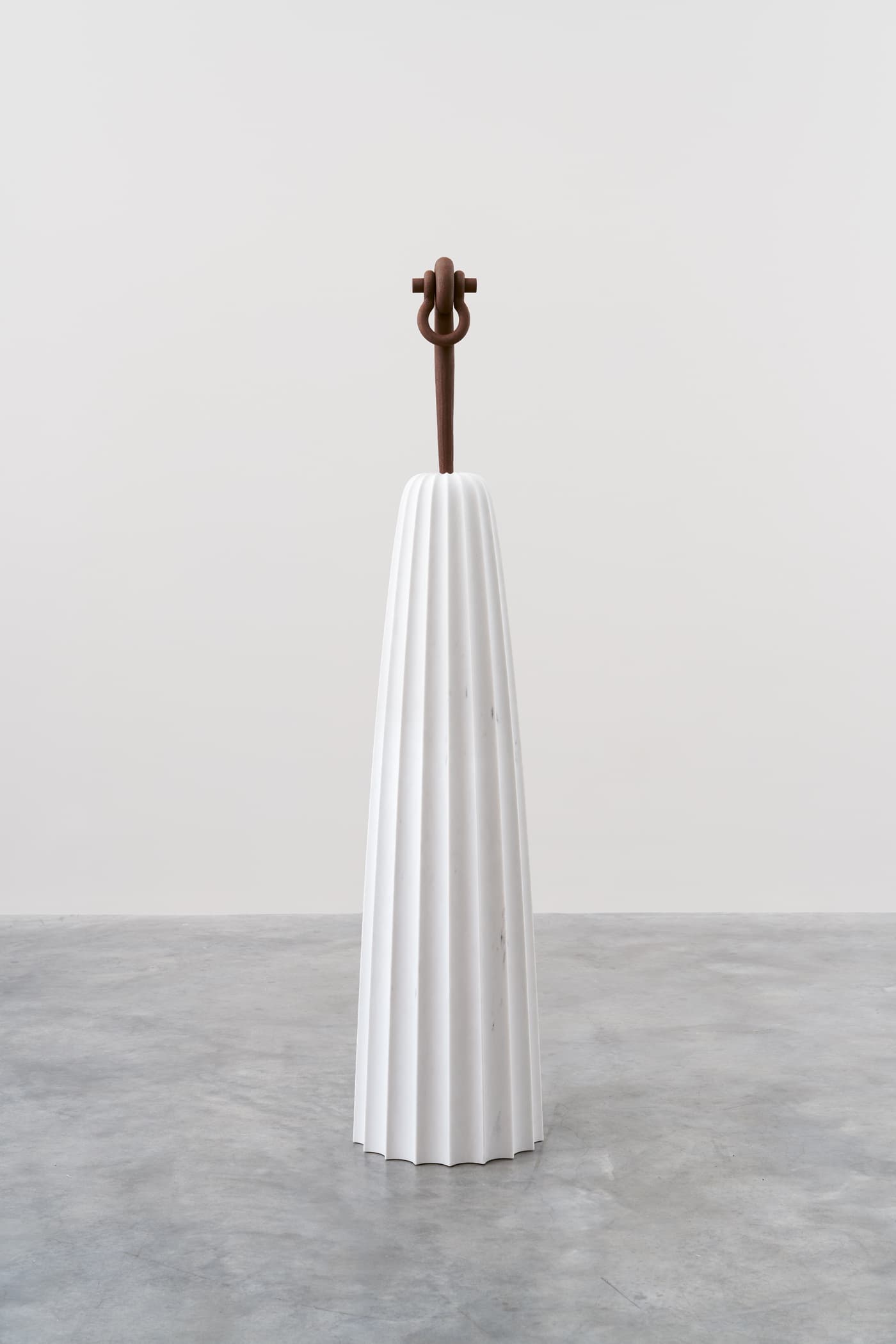
Martin Puryear, A Column for Sally Hemings, 2021. Marble, cast iron, 79 ¼ × 17 ¼ × 17 ¼ inches. © Martin Puryear. Courtesy Matthew Marks Gallery.
Word count: 1243
Paragraphs: 8
Cleveland Museum of Art
April 12–August 9, 2026
Cleveland, OH
This career survey of eighty-five-year-old Martin Puryear, America’s greatest living sculptor, is installed in roughly five overlapping sections. The large semi-divided space consists of thirty-one sculptures on the floor, plinths, and walls; two maquettes and archival ephemera related to outdoor works; two documentary films; twenty works on paper; and a complete set of prints from his book project, Cane (2000). Expertly curated by Emily Liebert, it forms a lucid, fulsome, and satisfyingly comprehensive display of this most intellectual and adventurous artist’s career. Wall texts and object labels productively explain both Puryear’s thought and physical processes; and the openwork layout, which Liebert explained was inspired by the generously proportioned Charles Ray show at the Metropolitan Museum of Art in 2022, allows for carefully organized sightlines and juxtapositions. Together, these strategies vividly illuminate the way that Puryear has consistently returned, and ever-more productively, to certain motifs and forms over his career in multiple media. The texts also include engaging responses to the works from other artists, architects, and curators, such as Ray, Billie Tsien, Maya Lin, Kerry James Marshall, and Thelma Golden, excerpted from their longer musings in the handsome and enlightening catalogue, which is also edited by Liebert. In short, this is a perfect show—an ideal introduction to his work and an expansive experience for devoted fans.
Nexus’s introductory gallery establishes three poles of Puryear’s production. At the right, just off the floor, is Bask (1976)—a low, curved, swelling slice of dark-stained pine that is over twelve feet long and resembles an overturned canoe. Made when he was thirty-five, it combines a flat plane and arc. The wall cites this as an example of “contradiction” that runs through his work. Bask seems somnolent, a recumbent form, like the Hellenistic Sleeping Cupid at the Metropolitan or one of Constantin Brancusi’s felled monumental birds. On the left wall is a graphite work on paper from 2003 with an expanding spiral motif in the form of a shell that recurs consistently in his oeuvre. It also bears a trace of the outline of a Phrygian cap, the floppy Roman head-covering associated with liberty that was later connected to the Age of Revolution and abolitionism. The striations within the shape communicate organic time, as in a clam valve or a tree trunk—markers of climate, atmosphere, age, and experience in a cumulative signature form that amalgamates the art and cultures of places he has been: from Washington, DC to Sierra Leone, Sweden, New Haven, Nashville, Manhattan, Chicago, and Accord, New York. Finally, high on the facing wall is Hibernian Testosterone (2018), a central work along with A Column for Sally Hemings (2019), which was in Puryear’s display at the United States pavilion at the Venice Biennale of 2019.2 It is a twelve-feet-wide cast aluminum rack of a long-extinct Irish elk—painted white and mounted on an inverted cross of American cypress. Christian references include St. Peter, who demanded to be crucified upside down, and the holy stag imagery of St. Hubert of Liège. Thus, three stages of the career are laid out as the early adoption of practical processes, such as shipbuilding in developing abstract forms; the mature development of signature motifs in the drawing; and then a moving idea of mortality in the mounted rack, by the Catholic-educated octogenarian artist. (There is in fact an unexpected element of faith expressed throughout the show in works such as Believer [1977–82], Reliquary [1980], Sanctuary [1982], and This Mortal Coil [1998]).

Martin Puryear, Hibernian Testosterone, 2018. Painted cast aluminum, American cypress, 57 × 141 × 44 ½ inches. © Martin Puryear. Courtesy the artist and Matthew Marks Gallery. Photo: Ron Amstutz.
“Early Travels” presents drawings and woodcuts from Sierra Leone in the mid-sixties, followed by experiments with printmaking in Sweden. Some Lines for Jim Beckwourth (1978) reflects the trend of dedicatory titles in late modernism that is also seen in the titling of Jasper Johns, Dan Flavin, and Donald Judd. The work consists of seven parallel, horizontal lines of rawhide he made in Nashville. They are justified at left but ragged at right, recalling both Andean quipus and William Logan’s description of Frank O’Hara’s poems as “lines broken like breadsticks.”3 The ropey lines alternate light and dark and may bear a racial component; as does the early etching Quadroon (1966–67) with its three curving and amorphous pale white/peach sections and one hooflike form at left that is jet black. The second section, “Material Foundations,” includes experiments with cast iron in the avian-inflected and floor-set On the Tundra (1986). In “Hands at Work” the display documents This Mortal Coil (1998–99), a complicated eighty-foot-tall curving staircase installed in a chapel in Paris, and the fascinating Bodark Arc (1982) installed in a sculpture park in Illinois. The arc is a permanent project incorporating a West African low bronze chair that is juxtaposed with Osage orange trees, a wooden bridge, and arch. Also included here is documentation of Box and Pole (1977), a temporary installation in Lewiston, New York. The latter resembles the Trylon and Perisphere from the 1939 World’s Fair and anticipates later work by the likes of Richard Serra and Andy Goldsworthy. “I wanted to engage the space by pointing to the sky,” the artist noted. Grandiose and Minimalist, it represents a path that Puryear might have pursued.
Instead, he turned to precisely wrought and designed curved, O-shaped wall sculptures, such as Nexus (1979) and Sanctuary (1982); or the astonishing and haunting arcing Night and Day (1984) of painted pine and wire. The left side of the sculpture is painted white and arcs from a tall four-square base on floor to the apex of the curve, at which point the color changes to black and the wood plunges down to terminate in a blocky nub that hovers a few inches off the floor. It has the sense of balance of a see-saw, but is there levitation or strain? Contradiction prevails in this abstraction of racial disparity, relating it visually to the earlier Quadroon.

Martin Puryear, Alien Huddle, 1993–95. Red cedar, pine, 53 × 64 × 53 inches. © Martin Puryear. Courtesy Matthew Marks Gallery and The Cleveland Museum of Art.
In “Recognition,” and a section on outdoor projects, elements such as gyrfalcons and ngil ancestral mask-forms from the Fang peoples of Gabon or Cameroon find expression in Puryear’s mature work. The latter attenuated design with a bulbous upper section, beady eyes, scalloped-out long nose, and narrowing lower segment—as if Edvard Munch’s The Scream (1895) face was stretched at bottom—perforates the flanks of Big Bling (2016, represented here by a maquette from 2014). It also emerges in the center of one of his masterpieces, C.F.A.O. [“The French Company of West Africa”] (2006–07), an important work that employs a wheelbarrow found in France. The mask form is also seen in drawings and prints, and can be traced in the wall-hung Malediction (2006–07). The show presents a rare opportunity to see this level of consistency of charged motif across a multiplicity of media. Also apparent is the planetary nature of many works, especially the exquisite blend of curving red cedar and pine that form the heavenly bodies of Alien Huddle (1993–95) from Cleveland’s own collection; and the inspiration from the animal world, whether from birds of prey or elephants—all enfolded into his particular mode of sensitively worked abstraction.
What Puryear has challenged viewers with is a range of imaginative possibilities: the dialogue between interiority and exteriority, carapace and volume, history and the present, and now the human and the artificially intelligent—as in the baroque complexities of Looking Askance (2023). The power of this show is in how it reveals his work, in all its boldness and interrelatedness, while preserving space for material and experiential wonder.
Jason Rosenfeld Ph.D., is Distinguished Chair and Professor of Art History at Marymount Manhattan College.