Mark Manders
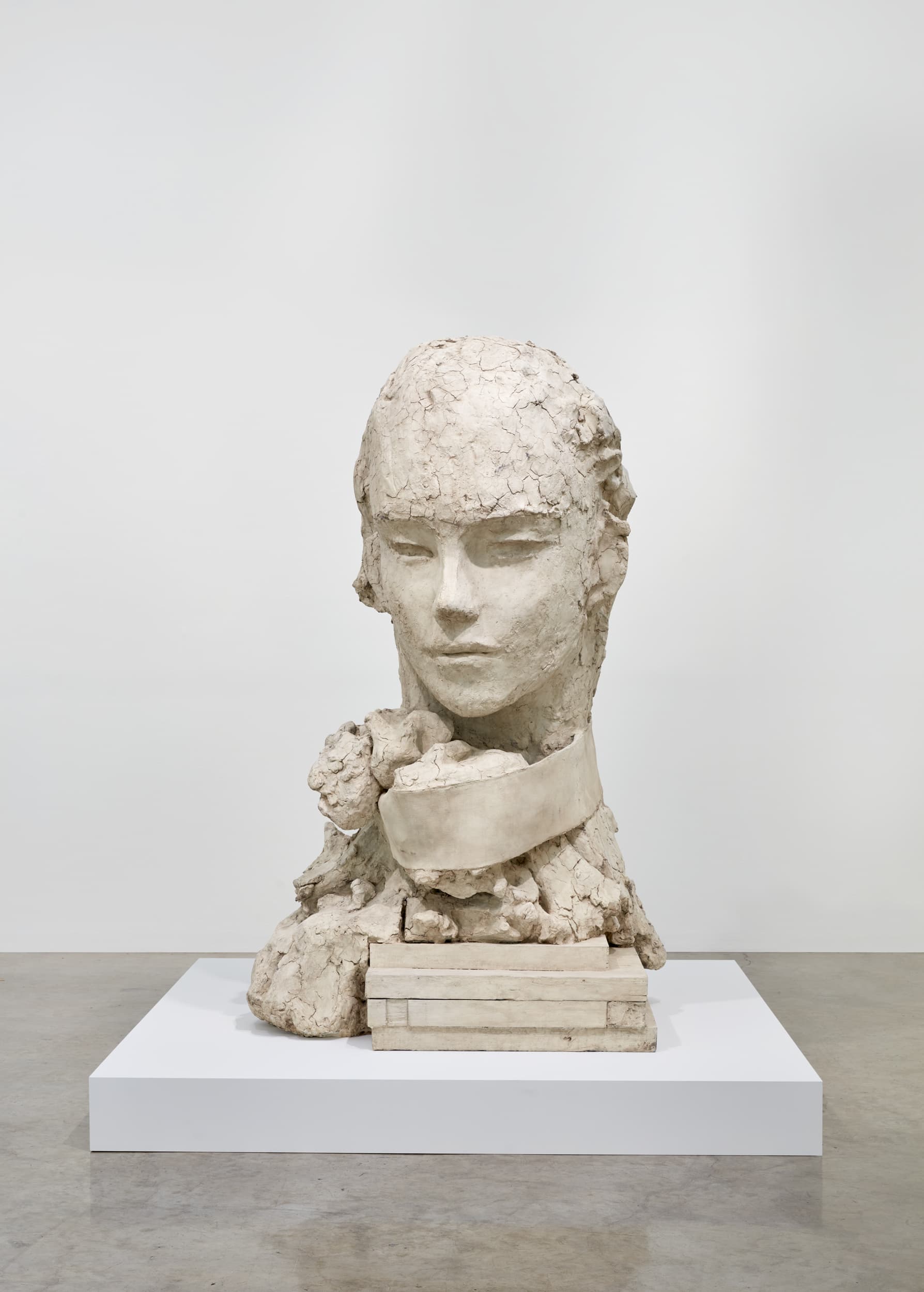
Mark Manders, Monument, 2024–25. Painted bronze, 84 ⅝ × 53 ⅛ × 55 ¼ inches. Courtesy the artist and Tanya Bonakdar Gallery, New York.
Word count: 635
Paragraphs: 6
April 30–July 31, 2026
New York
One of the pleasures of considering ancient works of art is the continual reminder that regardless of culture, time period, or geographical location, people will always be people. There’s satisfaction in looking into the eye of a slightly smirking Grecian bust, the stoic, relief gaze of an Egyptian empress, or the impish grin of a Mesoamerican ceramic figure and apprehending a shared humanity. Likewise, what a thrill to inspect the Rosetta Stone, or the Egyptian Student’s Writing Board, and understand that language is, and always has been, communion.

Mark Manders, Bonewhite Clay Head with Vertical Cloud (detail), 2024–25. Painted acrylic resin, fiberglass, aluminum, 95 ¼ × 97 ½ × 60 ⅔ inches. Courtesy the artist and Tanya Bonakdar Gallery, New York.
Mark Manders’s sculptures, now on view at Tanya Bonakdar, evoke similar appreciation. Though all were completed within the last couple of years, there is an immutable quality to the works, a sense of timelessness that’s both primordial and farsighted. Manders employs a variety of mediums like bronze, resin, wood, and epoxy (to name just a few) to create objects that so closely resemble clay sculpture the viewer is tempted to place a hand on the material to confirm the eyes’ deceit. The monumental Bonewhite Clay Head with Vertical Cloud (2024–25), which anchors the main gallery, is paradigmatic. At nearly eight feet tall, it is composed of an oversized head with serene expression, its forehead resting against an imposing slab. The head, however, is not a solid object, but seemingly propped up by thick, boxy supports that jut from behind. Though frontally formidable, Bonewhite Clay Head reveals its vulnerability from this perspective. Its susceptibility is compounded by the crumbly nature of Manders’s material. The cracks and fissures of the painted resin appear to spread away from the facial features in mimicry of earthenware; in this way, the material possesses its own agency, projecting an illusion of temporal decay and physical transience that undercuts the actual structural permanence of the substance. Nearby, a somewhat smaller, though still substantial sculpture, Monument (2024–25) is similarly exposed. Unlike Bonewhite Clay Head, the head is unobstructed, allowing the viewer full visual access to its inscrutable expression. And again, the ostensible durability of the work is belied by the craggy, cracked backside that spills over into a pool of bulbous tumors at the neckline of the bust. The tenderness of the duality—both impressive and pregnable—has a timeworn veracity that reaches across generations.

Installation view: Mark Manders, Tanya Bonakdar Gallery, New York, 2026. Courtesy the artist and Tanya Bonakdar Gallery, New York. Photo: Dan Bradica.
Elsewhere, a work like Short Sad Thoughts / All Existing Words (1990–2026) invokes the human yearning for acknowledgement, particularly as that desire relates to communication, and thus connection. Here, two canvas tablets hang side-by-side covered in a newspaper of Manders’s own making, filled with indiscriminate words pulled from the English language. A work from Manders’s ongoing series, “All Existing Words,” a project that has him endeavoring to print every word in English—randomly placed and only used one time each—these tablets from afar resemble the aforementioned Rosetta Stone both physically and conceptually. The arbitrary nature of the text suggests the impossibility for most contemporary people of comprehending the hieroglyphics of the stone, but also the urge of the maker to be understood.
The forward/backward properties of this body of work is perhaps nowhere more evident than in Landscape with Painted Heads (2026), a small but deeply poignant tabletop sculpture. Here, a sort-of bust, composed of two faces gazing in opposite directions, sits within a shadowbox-type structure. But rather than a skull to unite them, the center between the two profiles appears scooped out, each face leaning precariously outward in its own direction. I couldn’t help but think of Janus, the Roman god of transitions, beginnings, and thresholds, typically depicted with two faces situated oppositionally, looking fore and aft. Janus’s portrayal as penetrating and assured contrasts with the fragility of Manders’s Painted Heads. Its enigmatic gaze upon the past and the future foregrounds the tenuous present.
Jessica Holmes is a New York-based writer and critic. She is an Art Editor and ArTonic Editor for the Brooklyn Rail.