Anthony van Dyck: Van Dyck, the European
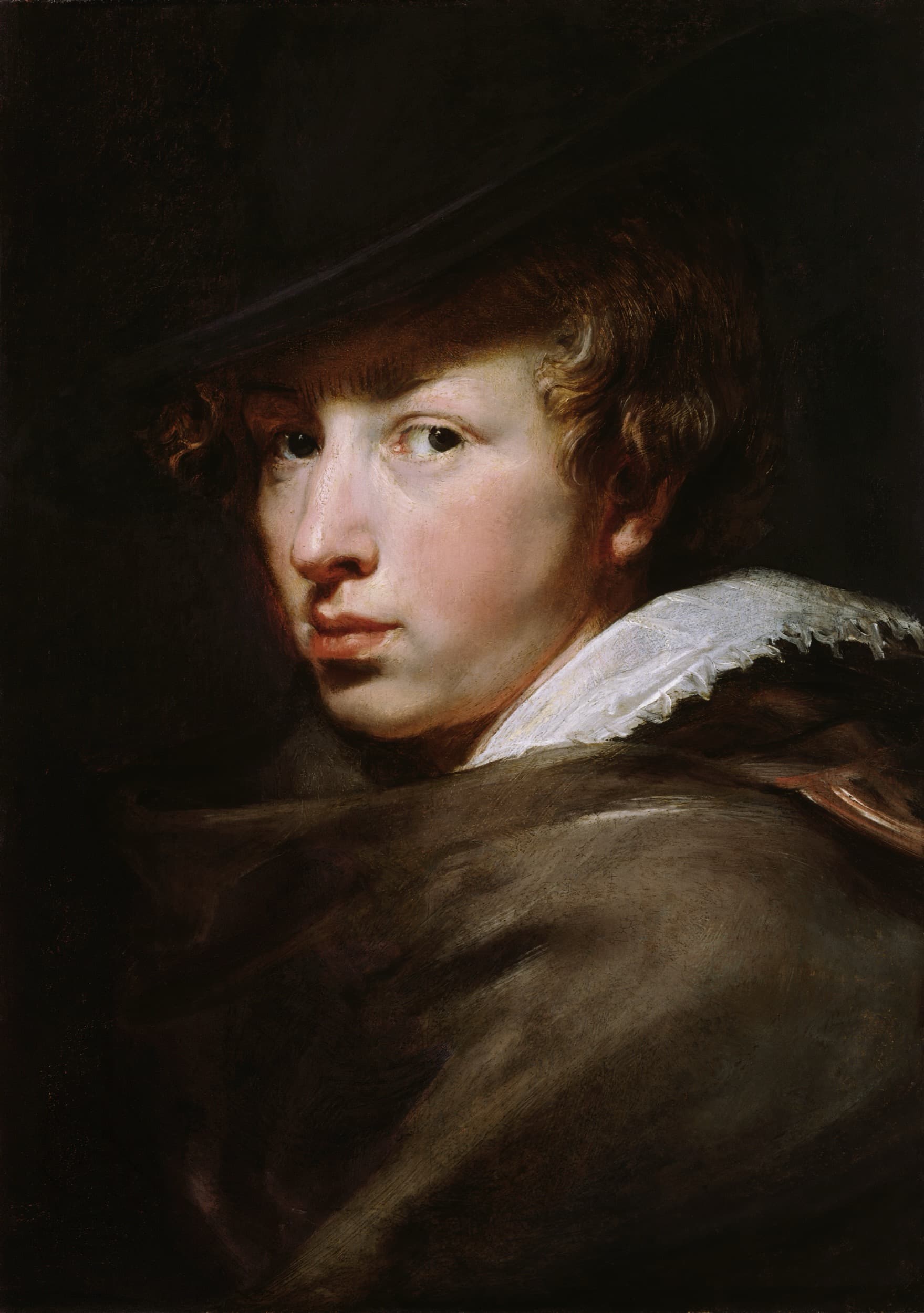
Anthony van Dyck, Self-portrait, 1616–17. Oil on panel, 14 ⅖ × 10 ⅛ inches. Courtesy Rubenshuis, City of Antwerp.
Word count: 1002
Paragraphs: 6
Palazzo Ducale di Genoa
March 20–July 19, 2026
Genova, Italy
A lone, spotlit painting beckons us down a darkened corridor. As we draw near we see, in three-quarter profile, a rakish young man wearing a fashionable hat at a sharp angle staring back at us, self-assured, confident. It is Anthony van Dyck. He was about fifteen years old when he painted this highly accomplished self-portrait in or around 1615. On closer inspection, there is already a Frans Hals-like sense of animation imbued in his nascent brushwork. Within a year or so of painting it, he had established a successful workshop. He then apprenticed for Peter Paul Rubens, becoming his chief assistant. He was “the best of my pupils,” Rubens is said to have remarked. In 1620, van Dyck struck out on his own, his profile following a meteoric arc, only to be cut short by his untimely death at the age of forty-two while working for King Charles I in London.
In the largest van Dyck exhibition for twenty-five years, Van Dyck, the European at the Palazzo Ducale, a different side to his exceptionally well-mythologized artistry is explored. As we snake throughout the palace, sixty works are refreshingly organized into thematic groupings rather than following a chronological order. By doing this, the curators seek to illuminate how, against a backdrop of widespread instability throughout Europe, van Dyck shrewdly adapted his talents to suit the artistic whims of the various courts of taste, principally Antwerp, Genoa, and London. Ultimately, by bringing these nuances to the forefront, the curators convincingly posit that the approximately six-year period from around 1621 that he was in Italy, primarily in Genoa, was the catalyst for his most ambitious artistic developments and experimentation. Italy is where van Dyck became van Dyck.

Anton van Dyck, The Mocking of Christ (‘Ecce Homo’) - Christ as a man of sorrows robed by a tormentor. Oil on canvas, 56 ¼ × 42 ⅛ inches.
In van Dyck’s Italian works, his determination to break free from the artistic trappings of Rubens is keenly felt. He is seen edging closer to fluency in his own pictorial language by voraciously learning and incorporating techniques from Raphael to Caravaggio. But one figure casts a commanding and guiding influence over van Dyck greater than any other during this time: Titian.
In particular, he looked to Titian’s use of dry, broken brushwork, which van Dyck evocatively employed in the aged skin of his sitter in Portrait of a Genoese Lady, Possibly Luigia Cattaneo Gentile (ca. 1623). It is also used noticeably in the highlights on the column in the background and on the floor of Portrait of a Genoese Nobleman in Armour (ca. 1624), areas we would expect an artist to pay significantly less attention to. But in this case, the sense of drama elicited by the brushwork is vital in fostering the work’s psychological charge, awarding it considerable staying power in our mind’s eye—tested by the large number of portraits on view throughout the exhibition.
Elsewhere, van Dyck’s dexterity in handling paint during this period continues to marvel. The flesh of the baby, seen from behind, as it lies across the men in The Three Ages of Man as Vanitas (1625–1626), is nothing short of otherworldly. He manipulates the oil paint so that it behaves like watercolour. In doing so, he is able to translate in an extraordinarily lifelike manner the resplendent breadth of colours caused by the translucency of skin. While from afar, the towering Portrait of Alessandro, Vincenzo, and Francesco Maria Giustiniani Longo (ca. 1626–1627) appears as the epitome of elegant restraint. But up close, his brushwork comes alive in the sumptuous array of fabrics and lavish detailing on the young boys’ clothes. Beautifully fervent sweeps and gestures blur the distinction between beauty in and of itself and description.

Anthony van Dyck, Portrait of Alessandro, Vincenzo and Francesco Maria Giustiniani Longo, 1626–27. Oil on canvas, 86 ⅕ × 59 ½ inches. © The National Gallery, London. All rights reserved.
Perhaps unexpectedly for an artist renowned for the outsize influence he had on the genre of portraiture, the exhibition’s most powerful room is one containing four smaller scaled, spotlit religious paintings. Madonna and Child (ca. 1624–26), attributed to the studio of van Dyck, is compelling in how it reveals a multitude of Italian influences, from Titian and Parmigianino to Orazio Gentileschi wrestling against the deeply coded Rubenesque foundations of his formative years. Similarly, in Ecce Homo (1625), exhibited publicly for the first time, the bright white wisps, used to denote the highlights of the perizoma covering Jesus’s lower torso, immediately draws attention, recalling Rubens’s habit of emphasising white highlights in his paintings. In stark relief to this, it is the partially seen devil-like figure twisting behind him that slowly steals focus, rendered in a fiery palette with visceral strokes, prefiguring Francisco Goya at his most visually arresting. Likewise, the urgency of the dry brushwork used throughout Saint Rosalie Interceding for the Plague-Stricken of Palermo (1624–1625) poetically elevates the haunting subject matter. In Dying Christ (Crucifixion) (ca. 1625–1626), van Dyck once again manipulates the oil paint to behave like watercolour, most noticeably in the atmospheric background which operates as a foil for the delicate, lifelike flesh of Jesus's body. His outstretched arms and legs are haloed by a chiaroscuro that triangulates our eye to the painful contortion of his outthrust stomach bathed in light. The sense of pathos these works create, singularly and together, is extremely affecting, and foreshadows the exhibition’s sensational centrepiece that follows: the monumental altarpiece Francesco Orero Presented to the Dying Christ by Saint Francis of Assisi and Saint Bernard of Clairvaux (ca. 1626–1627), seen in the palace’s chapel.
The altarpiece’s formidable presence and harrowing overtone is intensified by the pale blues, pinks, and ecru of the ornate frescos that cover the walls and ceiling. While there are pockets of Rubenesque colorings, the darkness of the altarpiece pre-empts the stylistic concerns that characterize van Dyck’s second stay in Antwerp, immediately following his time in Italy. The crucifixion itself is seen in profile, and its emotional impact, combined with the highly expressive, loose, and dry brushwork—yielding heavy tenebrism and at such a dramatic scale—is breathtaking, giving rise to the thought: just how stirring must it have been to experience it by flickering candlelight as a devout layperson?
William Davie is a writer based in London.