Tracey Emin: A Second Life
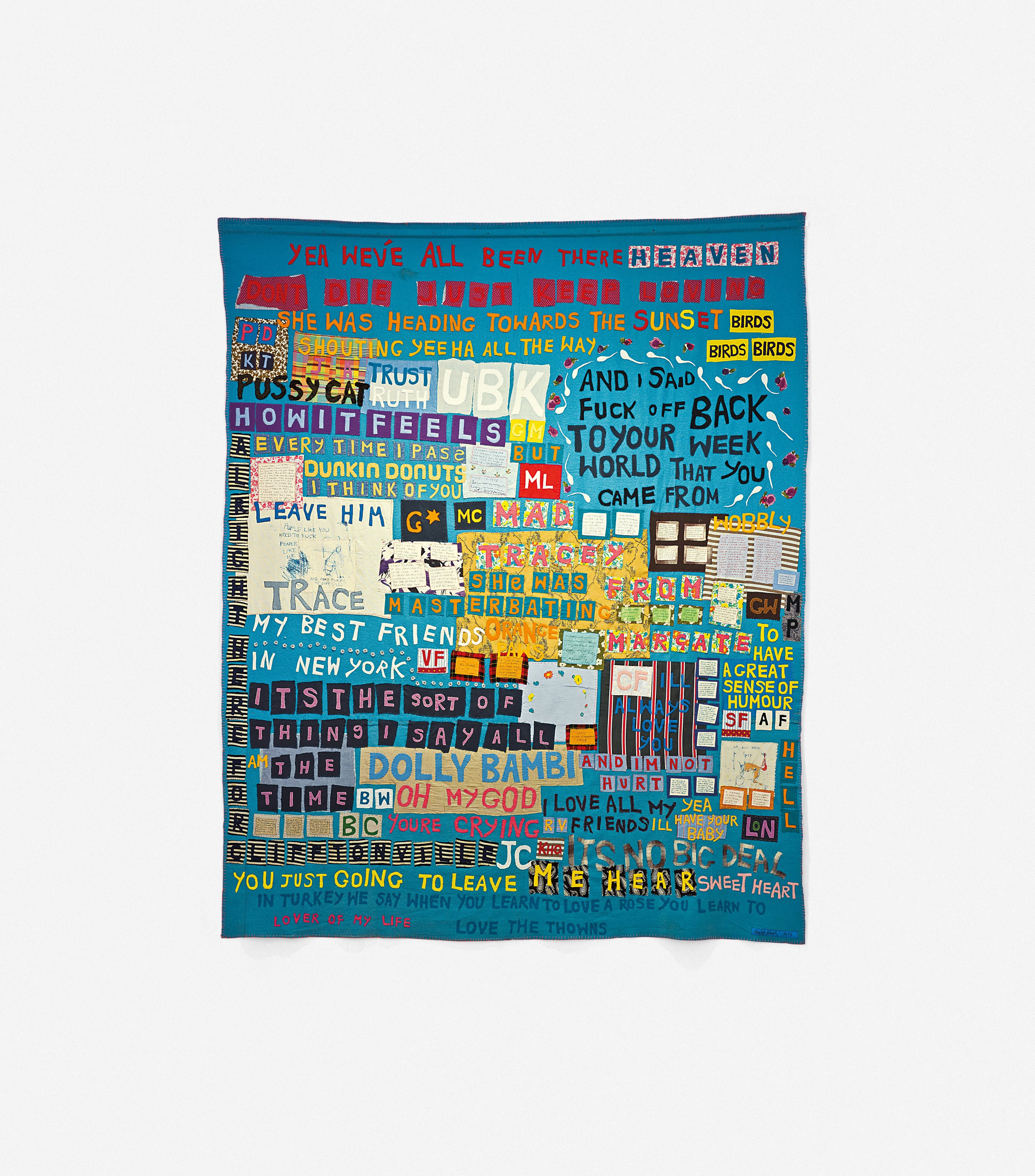
Tracey Emin, Mad Tracey from Margate. Everyone’s been there, 1997. © Tracey Emin / DACS, 2026. Courtesy Tate Modern.
Word count: 1002
Paragraphs: 13
Tate Modern
February 27–August 31, 2026
London
Still short of breath from my walk over the rain-whipped, muddy Thames, across Millennium Bridge then eastward on Bankside to the Tate Modern, I’ve reached the beginning of Tracey Emin’s blood-engorged retrospective, A Second Life. The artist offers up a spangled series of appliquéd blankets and quilts, foregrounding Hotel International (1993), fabricated stitch by stitch with textile scraps. Multicolored homemade letters adorn tapestries chronicling Emin’s Turkish-Cypriot, streetwise, squatter childhood and promiscuous school dropout teen years in the working-class neighborhood of seaside Margate. On a framed scrap of paper nearby, handwritten to appear hurried, but to me a deliberate poem, My Future (1993) captures the moment when an extracted dead tooth left “a large / ugly black hole — / But I didn’t care / I laughed out loud — And said / Brilliant / Fucking Brilliant.”
Just ahead, a huddled crowd stares at a screen emblazoned, “This is a true story, but it is my interpretation.” Before there is time to parse the ten words, a woman in her earlyish thirties, the artist herself, appears in close-up, talking to an off-camera videographer. She is smartly coiffed, lightly made-up, sporting rose-tinted glasses and a chalk-striped blazer with peaked lapels. Her dark hair frames a pale face by turns pensive, agonized, and crookedly smiling. She roams out and about through Central London, pausing at random corners to reflect upon the saga of her May 1990 near-death abortion—How It Feels (1996).
This feels like sick voyeurism, I think, immobilized with fellow gallery-goers in Beckettian frustration, wanting to “move on.” How can Tracey Emin be so un-self-pitying, never breaking beyond the verge of tears as she remembers an abstruse, paternalistic doctor and a vague, powerless boyfriend; the drab clinic waiting room with fifteen anonymous other women, eyes downcast; the ebb and flow of eviscerating pain, the botched, oozy outcome.
And one snags a tinge of regret when she enters a green park at midday, produces a crinkly packet of crisps, feeds a squirrel, purses her lips in bemusement and remarks that, “Everybody wants something small to take care of—it makes you feel more powerful.”

Installation view: Tracey Emin: A Second Life, Tate Modern, London, 2026. © Tate Modern. Courtesy Tate Modern and the artist. Photo: Jai Monaghan.
In a nearby video, a fuzzed cerulean ocean splashes in homage to a faceless man venturing toward the waves, while Emin’s voiceover, tender and evocative, speculates about intimacy truncated by thwarted affections. Just behind me are interruptions throughout the galleries—whimpering babes in arms and the occasional recalcitrant toddler, hushed and comforted by their mothers.
This haphazard chorus segues to the welcome onslaught of Tracey Emin’s paintings. While curator Maria Balshaw observes that “her work reminds us that issues around women’s rights, around their bodies and even their sexual and physical expressions, are still in great need of protection,”1 I gravitate toward visceral standouts. I needed you to love Me (2023), a nine-foot-long canvas, nakedly screams tortured abandonment in hectic black acrylic, shrouded by the blue, overwashed spirit of a recently departed partner (for lack of a better word). Depleted drips inch down the woman’s ravaged body onto the tossed ruins of a bed.
I could have Loved my Innocence (2007), in pink neon script high on a black wall, is an apt supertitle for a nude laid out on the floor, her face blotted away. A lava-like potion erupts between her legs. I write “laid out” in the passive voice. However, characteristic of Emin’s elusive/allusive syntax, perhaps she was laid out by an absent somebody, next to what, at first glimpse, I saw as an empty bathtub, but now correct into a bed, reminiscent of Emin’s post-breakdown, disheveled 1998 installation, My Bed. Shortlisted for the Turner Prize and spotlit in the current show, it persists as a longtime trope: a metaphor, critic Clair Wills points out, for “a platform”2 from which women need to rise up—resurrect—or succumb to oblivion.

Tracey Emin, Exorcism of the last painting I ever made, 1996. © Tracey Emin / DACS, 2026. Courtesy Tate Modern.
You Keep Fucking Me (2024) is another six-by-nine-foot acrylic spectacle: a prone couple sketched in crimson, the man’s face drenched red, the woman’s blank white, interlocking torqued bodies labyrinthian and boundaryless. The scrawled title recurs a dozen times in the background, words variously capitalized in cadenced emphasis. I fight the desire to synthesize all these constructs, to “make sense” out of ruptured, raw dependencies and ambivalent nostalgias. A mental echo chamber recycles an apologia on display elsewhere in the gallery that Emin dedicated to her unborn fetus following the first of her two abortions, “Forgive me tiny little thing / Your soul is free / Forgive me – leave me.” Emin told Eleanor Stanford of The New York Times, “My painting is not about whether it’s a good or bad painting. It’s about why it exists,” she said, adding, “why it had to come out of me.”3
Cancer forced Tracey Emin’s bladder to come out of her. For the last six years she has lived with an abdominal stoma and an exterior plastic pouch. A vitrine row of polaroids (2020–25) installed down a dim corridor documents the surgical ordeal, self-portraits of Emin’s torso marred by unidentifiable protrusions, swollen apertures, and inflamed flesh. Many visitors rush through the grisly gallery. I slow down, coming to terms with her mission to make embodied art out of intimate afflictions. I emerge at the end of the horror-parade squinting into the light of the “final room of paintings from Emin’s second life,” a wall-text indicates, “blurring the distinctions between life and death … and offering hope for the future.”
An ironic discordance between title and work, here is the upturned face of a bronze Death Mask (2002), cast when the artist was in her late thirties, visage at peace, eyes closed in dreaming, not mortality. The canvas behind the mask, a reclining nude, unscathed and fearless, even as a hooded specter approaches, is a consummate example of Emin’s technique, pigment dexterously applied, flirting with the surface.
Your Beautiful Soul (2024) is the valedictory work: Tracey Emin apostrophizes her adored body, standing upright, drowned in blood—except for one unblemished eye.
- Maria Balshaw, in Eleanor Stanford, “Tracey Emin Embraces her ‘Second Life,’” The New York Times, February 26, 2026: 14.
- Clair Wills, “Mighty Real,” [Tracey Emin: A Second Life], The New York Review of Books, June 11, 2026: 26.
- Tracey Emin to Eleanor Stanford, “Tracey Emin…”: 15
Neil Baldwin is an Editor-at-Large for the Brooklyn Rail.