William Davie

William Davie is a writer based in London.

In 1956, Wayne Thiebaud was at the outset of his career as a painter, soaking up the artistic atmosphere in New York while on a sabbatical from teaching at the Sacramento Junior College, when Willem de Kooning offered him a sage piece of advice.
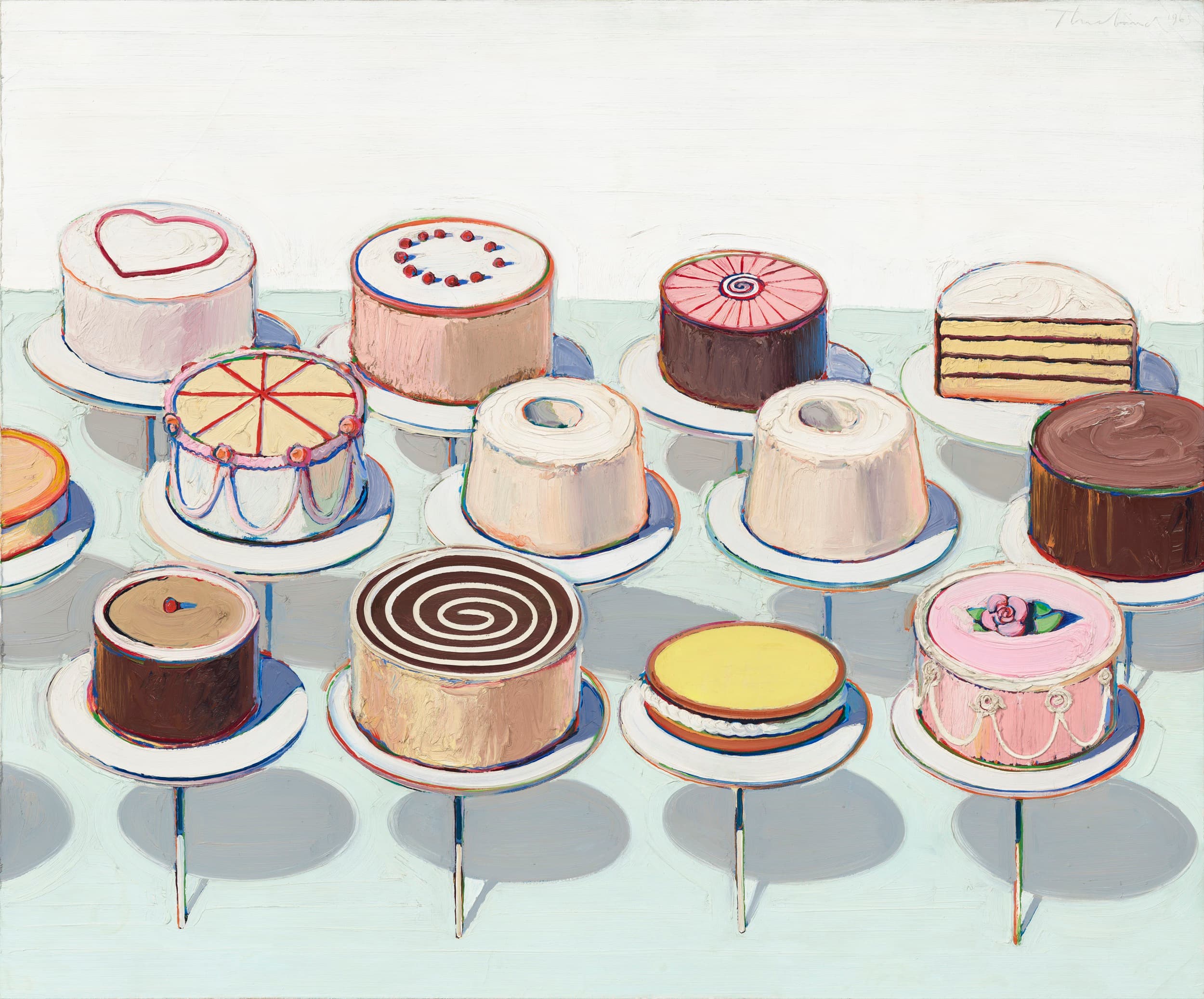
Wayne Thiebaud, Cakes, 1963. Oil on canvas, 60 × 72 inches. © Wayne Thiebaud/VAGA at Artists Rights Society (ARS), New York and DACS, London 2025. Courtesy National Gallery of Art, Washington.

As painting arguably reached its evolutionary peaks across the middle third of the twentieth century, Chaïm Soutine, active during the twenties and thirties, was canonized as the patron saint of gestural figuration for his preternatural ability to, as sculptor Jacques Lipchitz noted, “translate life into paint, paint into life. He was one of the rare examples in our day of a painter who could make his pigments breathe light.

Chaïm Soutine, Les Platanes à Céret, ca. 1920. Oil on canvas, 21 ¼ × 28 ¾ inches. Courtesy Piano Nobile, London.

From the outside, as the exhibition title suggests, the concise and ambitious Artemisia: Heroine of Art—currently on view at the Musée Jacquemart-André, the palatial Parisian house museum—sits firmly within the former framework. Inside, however, the fight is on. 

Artemisia Gentileschi, Susannah and the Elders, 1610. Oil on canvas, 67 × 46 4/5 inches. Courtesy Musée Jacquemart-André. Photo: akg-images / MPortfolio / Electa.

In the first exhibition dedicated to Krohg outside Scandinavia, on view at the Musée d'Orsay in Paris, the curators seek to bring awareness to Krohg more broadly as an artist, and to situate him within the wider context of the established canon of nineteenth-century French painting. 

Christian Krohg, Albertine to See the Police Surgeon, 1885–87. Oil on canvas, 82 7/10 × 128 inches. Courtesy Musée d’Orsay. Photo : Nasjonalmuseet / Børre Høstland.
“Frans Hals is a colourist among colourists,” enthused van Gogh in a letter to his brother Theo in 1885, “a colourist like Veronese, like Rubens, like Delacroix, like Velázquez.” With testimonials like this, it’s no wonder anticipation for the National Gallery’s recently opened Frans Hals survey was high.
Frans Hals, The Laughing Cavalier, 1624. Oil on canvas, 32.7 x 26.4 inches. Courtesy the Wallace Collection. © Trustees of the Wallace Collection, London.
Lavinia Fontana (1552–1614) is widely considered to be a woman of many firsts in western Europe. She was the first woman to achieve professional success as an artist beyond the confines of a court or a convent. She was the first woman to run her own workshop at a time when women were not allowed to conduct business of their own. She was the first woman to paint large-scale public altarpieces and nudes. All this while giving birth to eleven children, only three of whom survived her.
Lavinia Fontana, Christ in the House of Martha and Mary, ca. 1580. Oil on canvas, 101.18 x 72.4 inches. Courtesy La Quaderia di ASP Città di Bologna and the National Gallery of Ireland. Photo: Alessandro Ruggeri.
Paula Rego is one of the finest, most idiosyncratic artists of her generation.
Paula Rego, The Dance, 1988. Tate © Paula Rego.
Comprising domestic-scale, oil-on-board paintings and pencil drawings, this tight, brief overview acts as an appetizer before her first posthumous survey scheduled to take place at Kelvingrove Art Gallery and Museum
Carol Rhodes, Surface Mine, 2009–11. Oil on board, 19 3/4 x 22 3/8 inches. Courtesy Alison Jacques Gallery, London. © Carol Rhodes Estate.
In Barry Schwabsky’s Dark Laughter, Genesis Belanger’s witty sculpture The Options Are Slim, 2019, a facsimile of a plug socket with a kitchen knife jabbed into it, elicits a sardonic laugh no matter how close or far away you stand from it. However, by reducing this and other works by Belanger, Emily Mae Smith, Ellen Berkenblit and June Leaf through an all-too-familiar press release about each artist’s idiosyncratic tact in a world gone haywire—in which their dark sense of humour quietly rebels against a status quo—the individual prowess of each practice is short-changed.
Genesis Belanger, As You Please, 2019. Stoneware, porcelain, 14 x 6 x 4 inches. Courtesy the artist and Perrotin. Photo: Pauline Shapiro.
Any initial humor found in the absurdity of these two hyper-sexualized scenes, perhaps especially for straight male audiences, quickly gives way to uneasiness and introspection, resulting in a sudden and powerful realization that the only way systematic change can begin is from within the viewer.
Caroline Coon, See, He is Absolutely Gorgeous! (2002), oil on canvas 152 x 122 cm. Courtesy the artist and TRAMPS New York and London. Photo: Richard Ivey.
Before Ikon Galley’s exhibition The Aerodrome—An exhibition dedicated to the memory of Michael Stanley, Stanley’s contributions to the British arts scene were often spoken of in contemplative tones as a result of his suicide at the age of 37.
Aleksandra Mir, Plane Landing, 2003. Compton Verney. Courtesy the artist.
If curators Jonathan Benington and Brendan Rooney are right and it is time for a re-evaluation of Roderic O’Conor’s oeuvre, then the case they put forward in Roderic O’Conor and the Moderns: Between Paris and Pont-Aven, on view at the National Gallery of Ireland in Dublin, is certainly a captivating one–but not entirely without its pitfalls.
Roderic O’Conor, Young Breton Girl, c. 1895. Oil on canvas, 64.8 x 49.5 cm. National Gallery of Ireland. Purchased 1975 (Shaw Fund). Photo © National Gallery of Ireland.
The uniquely compelling factor, which keeps the viewer in front of the works, is their lack of answers. In these paintings, more so than in any previous body of work, Doig directs the oneiric overtones from the present rather than from memory.
Peter Doig, Street Scene, 2017. Oil on linen, 11 3/4 x 18 3/4 inches. Courtesy Michael Werner Gallery, New York and London.

Close

Home