Anselm Kiefer: The Women Alchemists
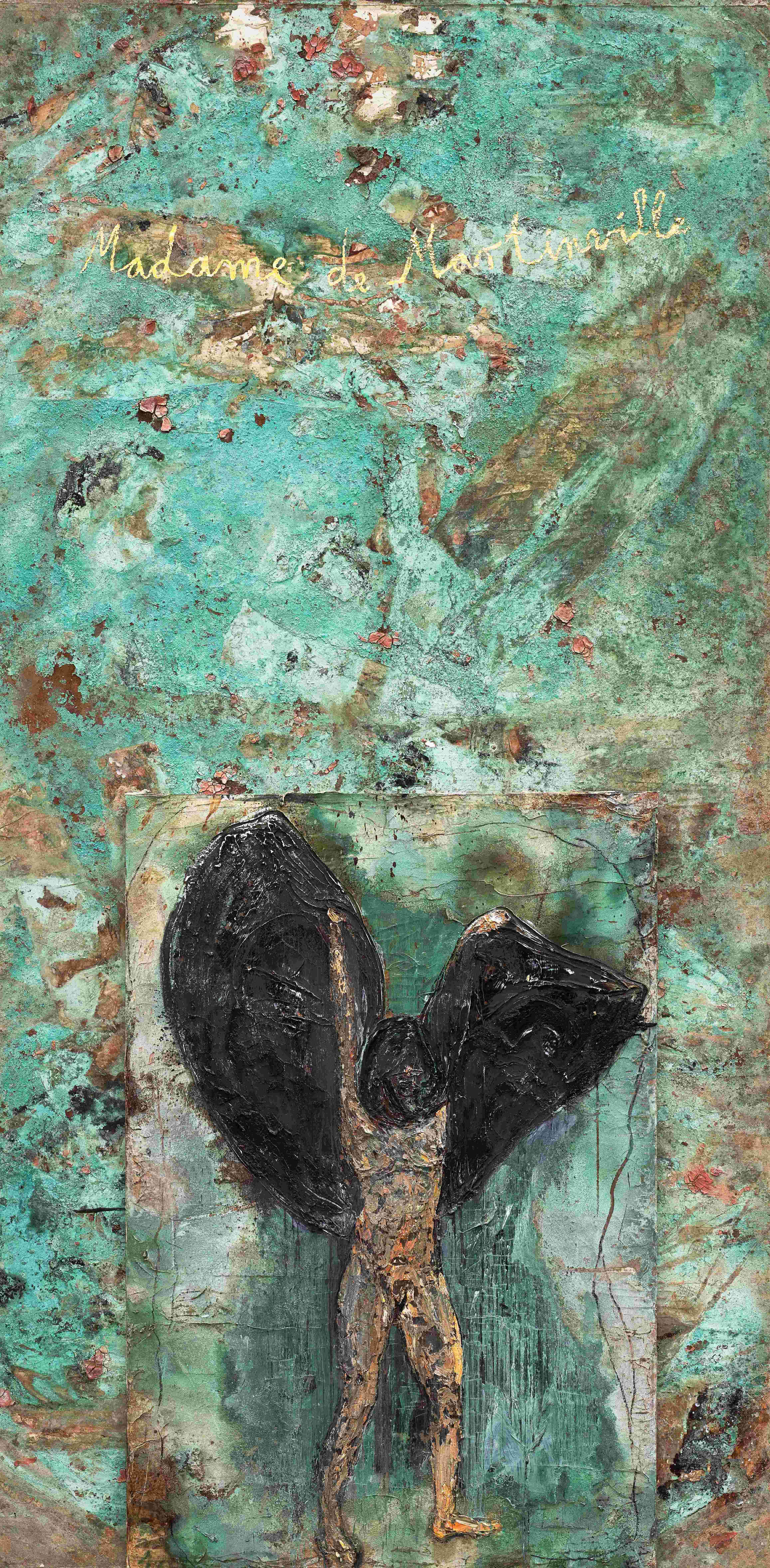
Anselm Kiefer, Madame de la Martinville, 2025. Emulsion, oil, acrylic, shellac, gold leaf, sediment of electrolysis, clay, charcoal, and collage of canvas on canvas. 224 ⅜ × 110 ¼ inches. © Anselm Kiefer. Photo: Nina Slavcheva.
Word count: 1212
Paragraphs: 9
Palazzo Reale – Sala delle Cariatidi
February 7–September 27, 2026
Milan
Anselm Kiefer has specifically chosen Milan’s Sala delle Cariatidi, a room held up by forty war-damaged Caryatid columns, to present a pantheon of female alchemists who have mostly been erased from history. Leonora Carrington’s The Chrysopeia of Mary the Jewess (1964) is a rare example of a woman alchemist celebrated in contemporary art. That a male artist has resurrected this feminine history, and the holistic mysteries it represents, is miraculous, especially in our era with its rational bias. Thirty-eight large-scale panels resembling altar pieces (all 2025), some over eighteen feet in height, unfold like screens across the great room and adjoining salon. The women’s portraits, some suspended on gold leaf surrounds like the Christ in Matthias Grünewald’s Resurrection (1510), suggest divinity. The monumental scale, metal leaf, bravura, and Kiefer’s gargantuan atelier have been employed to full effect to celebrate these forgotten practitioners of a lost art. The scarred caryatids look down upon the female alchemists whose precarious fates could include being burned at the stake.
Alchemy is far more than a precursor to modern chemistry. With the advent of modern physics and the phenomenon known as “observer shift,” we now know that the alchemists had a point—psychic processes determine outcomes. Transformation in the inner world affects transformation in the outer world. Carl Jung linked processes occurring both in the collective and personal unconscious to alchemical processes and brought this lost art into the modern world. Alchemy is all about incarnation, bringing spirit into matter, something omitted in positivist approaches. Then there is transmutation (lead into gold), where both the spiritual and the chemical move from lower to higher states. Kiefer’s art for decades has made transmutation manifest as molten crucibles of metal poured over his work produce chemical changes in situ. Here, in Lapis niger, a boulder (named after the mysterious black rock found beneath Rome) hangs precariously by a thread over a woman alchemist lugging a crucible of molten gold on her back.

Installation view: Anselm Kiefer: The Women Alchemists, Palazzo Reale – Sala delle Cariatidi, Milan, Italy, 2026. Courtesy the artist and Palazzo Reale. Photo: Ela Bialkowska, OKNO Studio.
Kiefer has grappled with theological questions throughout his career. His Catholicism has expanded to include Jewish mysticism and alchemy. Alchemy began with Egyptian funerary practices where the immortality of the soul could be achieved by transforming the body of the dead, to becoming one with the universe—Osiris represents that archetype. Kiefer’s 1985–87 works on the Osiris and Isis theme are a part of his alchemical explorations linking spiritual renewal to agricultural renewal. Osiris was the god of wheat, and ancient Egyptians impregnated mud effigies of the god with wheat kernels which sprouted during the Nile’s inundation. In his tribute to Madame d’Orbelin (a mysterious Parisian alchemist who wrote three letters to Benjamin Franklin in 1785 in which she claimed to have discovered a formula for “fixing mercury”), we see her corpse-like body sprouting a plant. Plants have been part of Kiefer’s repertoire for decades. Here we see cast sunflowers, foxgloves, and branches sprouting from the panels, reminding us that many of these women were herbalists and are precursors of 2026 Biennale artists like Annalee Davis.
Zosimos of Panopolis (300 A.D.) credits several women as being founders of the alchemical art: Maria the Hebrew (a.k.a. Maria the Jewess, Maria Prophetissa), Kleopatra, Theosebia, and Paphnutia. Seen here are Theosebia und Paphnutia and Kleopatra. Strangely, Kiefer has omitted Maria the Hebrew, often called the mother of alchemy and the inventor of chemical paraphernalia as well as the eponymous alchemical precept, the Axiom of Maria. Theosebia has been described as a soror mystica (mystic sister) or female partner to Zosimos. In a treatise addressed to her, Zosimos combines technical instructions with readings pertaining to the alchemical Magnum Opus. In alchemical texts like the 1677 Mutis Liber, we see the alchemist and his soror mystica kneeling in prayer on either side of the alchemical furnace. Psychic wholeness requires a pairing of opposites, a “mystical marriage” or coniunctio of the male and female elements. Recent publications like M. E. Warlick’s The Alchemical Feminine: Women, Gender, and Sexuality in Alchemical Images, have amplified the role of female adepts. A Greek alchemical text, Dialogues of the Philosophers and Cleopatra (attributed to Kleopatra), includes an analogy linking human birth to the formation of the philosopher’s stone. Kiefer’s pregnant Barbara von Cilli reminds us that women “birthed” the art—the uterus could become the vas hermeticum (hermetic vessel), pregnancy linked literally and figuratively to gestation. Anne Marie Ziegler (b. ca. 1550) invented an oil she called “lion’s blood.” Claiming herself to be the new Virgin Mary, “her body, united with lion’s blood, would be able to generate life to repopulate and redeem the world on the verge of collapse.”

Installation view: Anselm Kiefer: The Women Alchemists, Palazzo Reale – Sala delle Cariatidi, Milan, Italy, 2026. Courtesy the artist and Palazzo Reale. Photo: Ela Bialkowska, OKNO Studio.
The lion’s share of Kiefer’s women alchemists is from the centuries after alchemy had entered Europe by way of Arabic translations. Here we see disciples and adepts from the fifteenth, sixteenth, seventeenth, and later centuries of the brilliant nature doctor Paracelsus (b. 1493), who traveled across Switzerland, France, Germany, Portugal, Spain, and England. A late example is Susanna von Klettenberg, an alchemist from Frankfurt (1723–74), who encouraged Johann Wolfgang von Goethe’s studies of hermetic-alchemical manuscripts. Sabine Stuart de Chevalier, born in 1764, was one of the few women alchemists who wrote during the Enlightenment, publishing two volumes of Discours philosophique sur les trois principes, animal, végétal et minéral ou La Clef du sanctuaire philosophique under her own name in Paris in 1781.
Regal women seen here in panels are: Anne Marie Ziegler, court alchemist of Duke Julius of Brunswick-Lüneberg; Barbara von Cilli (b. 1392, d. 1451), queen of Hungary; Blanche von Navarra (b. ca. 1331, d. 1398), queen of France; Caterina Sforza (b. 1463, d. 1509), Countess of Forli; Elizabeth Grey (b. 1581, d. 1651), Countess of Kent; and Isabella d’Aragona (b. 1470, d. 1524), daughter of Alfonso II d’Aragona (the king of Naples), to name a few. Christina von Schweden (b. 1626, d. 1689), was a patron of alchemy, not a practitioner. This sapphic genius, portrayed by Greta Garbo in film, was tutored by René Descartes, abdicated, donned men’s clothing, and fled to Rome where she was a great patron of the arts and established an alchemical library in the Corsini Palace. The contributions of the many women seen here are too numerous to encapsulate in a short review, and the scholarly catalogue accompanying this exhibition is highly recommended for serious inquiry.
If there is a fly in the ointment it is Kiefer’s poorly drawn portraits, some of whom resemble suspended winged bats. The awkward modeling is too brute to portray these mostly gentle women. Figure-drawing is not the artist’s forte, and he is more successful when he uses appliqued nightgowns and collaged photographs as female representations. Still, this exhibition represents a great achievement. As a fifty-year student of alchemy, I was not familiar with many of these women. They often labored in obscurity, using male pseudonyms, only to see their contributions erased for history. Kiefer is to be applauded for bringing them out of obscurity. The world view they represent presents us with a path forward, linking earth to heaven, the natural world to the body, and the microcosm to the macrocosm. This is the time to reincarnate spirit into matter, rediscover feminine achievements, and revive women’s mysteries.
Ann McCoy is an artist, writer, and Editor-at-Large for the Brooklyn Rail. She was given a Guggenheim Foundation award in 2019, for painting and sculpture. www.annmccoy.com