David Hockney: Works from the Collections of Jordan D. Schnitzer and His Family Foundation
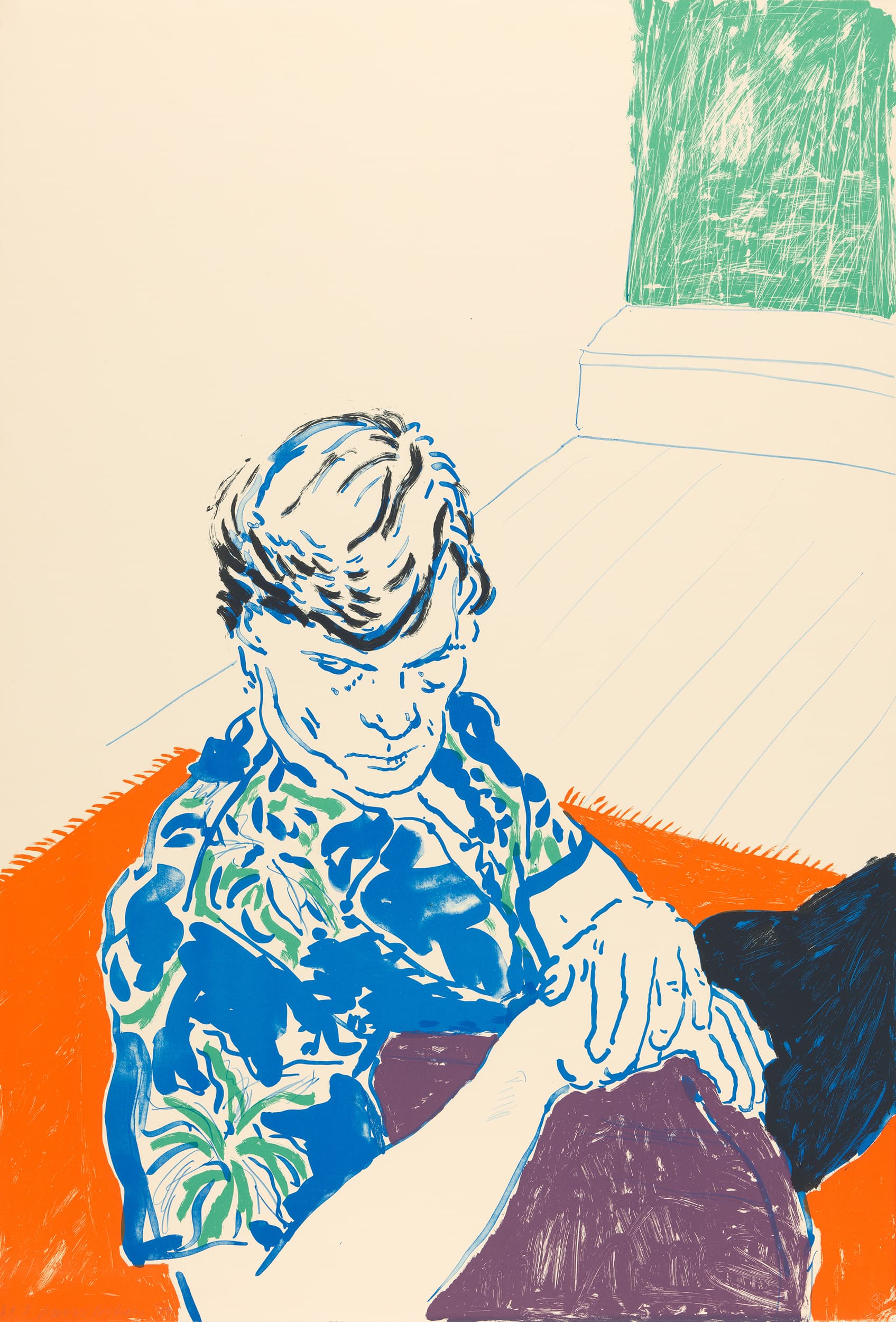
David Hockney, Joe with Green Window, 1979. Lithograph, 44 × 30 inches. © David Hockney / Tyler Graphics Ltd.
Word count: 1031
Paragraphs: 10
Portland Art Museum
February 14–July 26, 2026
Portland, OR
I entered backwards into David Hockney: Works from the Collections of Jordan D. Schnitzer and His Family Foundation at the Portland Art Museum, wandering in on the ground floor as opposed to the opulent second-story entrance, complete with the mammoth painting, Arrival of Spring in Woldgate, East Yorkshire in 2011 (twenty eleven) – 4 May (2011). I began at the end, missing the wall text that described the exhibition’s focus on the artist’s use of everyday technology, from office copiers to iPads. I skipped the timeline of Hockney’s art and career that includes the year Hockney came out. Instead, the first piece I captured with my iPhone was The Red Table (2014), a photographic drawing that features stiff figures rendered mid-conversation, their bodies assembled and replicated awkwardly across a glossy, digitized gallery with the cold feeling of a boardroom.
My entrance hiccup is on par with the nature of an exhibition that embraces artifice as much as it does the organic closeness between friends, an exhibition that celebrates touch, both human and digital, without overlooking the imperfections that infuse these works with both humor and care. Organized by Honolulu Museum of Art Director of Curatorial Affairs Catherine Whitney, David Hockney runs the gamut from Hockney’s early lithographs as an art student to prints created by a copy machine as well as his legendary iPad drawings. With these changing technologies, he captures beloved landscapes, interiors, and friends. Whether parsing the graphic geometry of The Red Table, standing in front of brilliant interiors, or staring into the crowded grid of “Dog Wall” (1998) featuring his cherished Dachshunds, to encounter Hockney from end to beginning is to see how a lifetime of social arrangements and domestic spaces carves a feedback loop within creative innovation.

David Hockney, Hotel Acatlan: Two Weeks Later, 1985. Lithograph, 28 ¾ × 74 inches. © David Hockney / Tyler Graphics Ltd. Photo: Richard Schmidt.
From his early days as a student at the Royal College of Art to his years in Los Angeles, his Yorkshire return, and move to France, Hockney’s world is a sonnet crown of influences and peers. Though his technical equipment evolves, the dialogue remains, and is perhaps loudest when he sits across from the artist ghosts that have haunted his practice. His Illustrations for Fourteen Poems from C.P. Cavafy (1966), is a collection of airy etchings that interpret the work of poet Constantine Cavafy with a mix of architecture and tenderness: men sidling into bed together, a portrait of Cavafy in front of the Alexandria seafront, the facade of a dry cleaner’s shop, one lover opening the sheets to another. Still considered controversial in the sixties for its portrayal of queer love, Hockney stole Cavafy’s work from the reserve section of the Bradford library, and his etchings were published the same year the United Kingdom passed the Sexual Offences Act, decriminalizing homosexuality.
This habit of intellectual riffing continues in his portraiture of other artistic and literary icons, from the spare print William Burroughs (1980) to a double portrait print of a young Hockney facing his idol Pablo Picasso across a table. Cheekily titled Artist and Model (1973–4), it begs the question, which is which? Hockney sits stark naked and slightly worried, the lines of his body heavily shaded, while Picasso’s figure is etched lighter as he casually reads the paper. The image is both reverent and mundane—just two artists starting the day—composed in opposing etching styles, the background environment is rendered in the soft-ground technique Picasso pioneered, a testament to Hockney’s habit of absorbing history and re-authoring it.
Parade (for the Metropolitan Opera, New York) (1981), named after the 1917 ballet choreographed by Leonide Massine, from a scenario written by Jean Cocteau and music by Erik Satie, underscores a broader, career-long exchange with an array of other mediums. In addition to the accompanying screen print poster, Hockney designed the sets and costumes for the production, as his idol Picasso had done for the original staging, with jagged, cubist sets. Hockney’s 1981 print incorporates similar jaggedness and color blocks while adding whimsy and lightness. The acrobat, bending across the poster’s frame in a white unitard spackled in green, red, and blue, dives into a mat marked with the same textured brushstrokes Hockney used in his iconic LA pool. The image’s composition and design is both vaudeville and peak eighties.

Installation view: David Hockney: Works from the Collections of Jordan D. Schnitzer and His Family Foundation, Portland Art Museum, Portland, OR, 2026. Courtesy Portland Art Museum.
“You can see the brush tool,” an artist friend, with whom I visited the show, noted with admiration about the iPad drawings. “There is no ambiguity about how it was made.” And it’s true. The gloss of the eraser tool is visible in his flower still lives, splicing through the mauve and fuchsia, the panels gleefully mismatched in the landscape iPad painting, 16th March 2021, Tulips In Cut Glass (2021). For Hockney, technology’s artifice is never a mask to hide behind but the tool that builds vortexes of intimacy with the world around him.
Hockney’s portraits of long-time friend and fellow artist Celia Birtwell map the contours of a decades-long devotion. Birtwell has long been labeled Hockney’s “muse,” a term that often diminishes the subject to a passive object of inspiration. But in Hockney’s case, one might argue that the muse is his collaborator, with each portrait reflecting the depth of her own practice as a textile designer. In the lithograph Celia, 8365 Melrose Ave., Hollywood (1973), the tonal shading of her ample, patterned sundress invites in the aesthetic language of Birtwell’s fabrics into the frame. Celia with Green Plant (1980–81) absorbs both Hockney and Birtwell’s color and pattern sensibilities. Her hands become part of the weave of her blouse, a sprig of green draws the eye away from the sunflower yellow of her skirt.
By letting the artifice of his work remain entirely intentional, Hockney doesn't just record our world; he creates entirely new ones. He proves that even as technology changes the way we see, the intimacy of a shared gaze remains the artist's most enduring, transformative act. To walk through this collection is to walk through a crowded room where every face is a friend, every pattern a memory, and every glitch a sign of an incoming innovation.
Rosa Boshier González
Rosa Boshier González is a writer and editor from Los Angeles. Her essays, fiction, and criticism have appeared in publications including Artforum, The Brooklyn Rail, the Believer, The Guardian, Guernica, Hyperallergic, Joyland, Flash Art International, the Los Angeles Review of Books, The New York Times, Ploughshares, The Rumpus, and the Washington Post. She is the recipient of a 2024 Andy Warhol Foundation Arts Writers Grant. She has taught writing and art history at the California Institute of the Arts, Otis College of Art and Design, and the Pacific Northwest College of Art. She teaches creative writing at Rice University.