Circa 1776: Jews in Colonial America
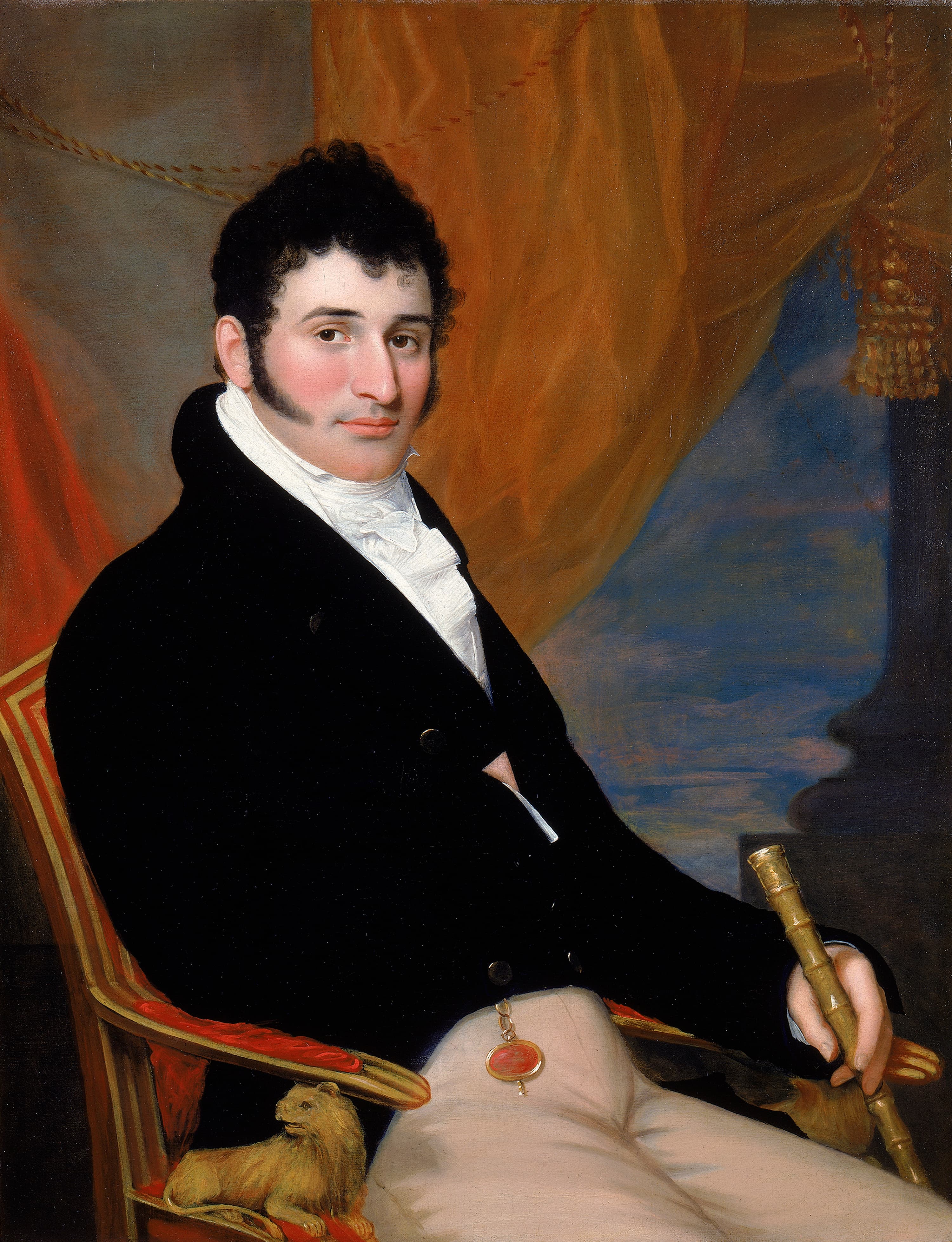
John Wesley Jarvis, Portrait of Solomon Isaacs, ca. 1813. Oil on canvas, 36 ⅝ × 28 ¼ inches. Courtesy the Jewish Museum, New York.
Word count: 871
Paragraphs: 7
The Jewish Museum
October 24, 2025–August 9, 2026
New York
I felt ashamed when I walked into the Jewish Museum and asked, “Where is the Colonial Jews exhibit?” All the while, the crowds congregating in the lobby and shedding their umbrellas and dripping coats were going to see the Paul Klee and Joan Semmel artworks. I felt like I was pursuing the least sexy museum offering. The exhibition title Circa 1776: Jews in Colonial America calls to mind images of old white men holding quill pens together with strong men riding horses seeking independence—yet, we know that there were more than just white men in colonial America. There were Black and Indigenous people, and as the Jewish Museum asserts, even Jews.
American identity has never been a concrete status. Colonial America was the crucible of the American Dream—the launchpad for acquisition of property and wealth by any means necessary. I was interested to see what the Jewish people were doing at this moment in history. Most prominent stories of Jews in America begin in the twentieth century. Klee and Semmel, just a few floors below, were creating their most recognizable works in this period. Yet, with stories told over and over there is an expected narrative (e.g., Klee’s work as a fight against fascism in 1930s Europe, Semmel’s investigation of feminism in the 1970s). What did the museum have to say in this exhibition about two slippery identities—Jewish identity and American identity—overlapping at the beginning of the precipice of the United States?

Installation view: Circa 1776: Jews in Colonial America, Jewish Museum, New York, 2026. Courtesy the Jewish Museum. Photo: Kris Graves/The Jewish Museum.
Tucked away on the third floor, Circa 1776: Jews in Colonial America looks, at first glance, like any other collection of early American portraits. Upon closer examination, we see that nearly all the portraits reflect a story of intermarrying. In this new nation, Sephardic Jews from Spain and Portugal marry and pray with Ashkenazi Jews from Eastern Europe. The exhibit focuses mainly on three wealthy families in the New World: the Seixas, Hendricks, and Gomez clans. The portrait Mrs. Aaron Lopez (Sarah Rivera) and Her Son Joshua (1772–73) by Gilbert Stuart depicts both mother and son in fine clothing. These people are confident, their gazes focused on the viewer; they clearly understand their wealth, not just in their appearance but in their choice of artist. (Stuart will go on to paint George Washington.) The gallery also features John Wesley Jarvis’s painting Solomon Isaacs (ca. 1813); Jarvis was the leading portrait painter in New York City at the time. These new Jews in America were attempting to be like their white Western European counterparts. The plaque next to Mrs. Aaron Lopez tells us that their wealth comes from the slave trade. In the center of the room is a ledger depicting the inventory of a Jewish man in the colonies, including names of the people he enslaved. The exhibit does not shy away from the complicity of these early American Jews.
For many newcomers, including these Jewish people, immigrating to a new country means they will have access to opportunities they did not have before. In the center of the room is a case displaying silverwork by the silversmith Myer Myers. Many European countries at this time did not allow Jews to work with silver and gold, but in this new world, the Jewish people were allowed to express themselves in forms previously unavailable to them. I let out a small giggle seeing the Circumcision shield and probe (1765–75), a distinctly Jewish object, displayed next to the kiddush cups. In small lettering at the top of the shield, Myers engraved his name. To me, this indicates a burgeoning confidence not only of the Jewish faith as a whole, but also of individuals claiming to be Jewish. No longer were they Conversos, practicing Judaism in private. Myers was not just making Judaica, but proclaiming himself an artisan of Jewish objects and a Jewish maker. Myers’s Coffeepot (1770–76) doesn’t have anything distinctly Jewish about it, except maybe that it reminds me of my mom’s own percolator. The pot has a carved wooden handle and spout detailed with a fluted motif. (If you told me that it had come from England, rather than a new nation, I would have believed you.) And thus, I imagine that these new Jewish silver objects were more Jewish than they were American—only American by virtue of where they were created, not by any kind of visual national identity.

Installation view: Circa 1776: Jews in Colonial America, Jewish Museum, New York, 2026. Courtesy the Jewish Museum. Photo: Kris Graves/The Jewish Museum.
The culmination of the exhibit is an exchange between George Washington and Moses Seixas, a prominent Jewish leader in colonial America. Displayed in a dark case, the letter from Seixas is looking for reassurance of the freedom to practice the Jewish religion. Washington assures that all free white men will have freedom of religion. Thus, the Jewish-American identity rooted in whiteness began to take shape. The exhibit did not offer any larger understanding of what it means to be an immigrant in America, but instead asserted that Jews have been in America since its creation and were instrumental to the revolutionary cause. I was left wondering: if we were instrumental to the revolutionary cause, how does that make us instrumental to where we are now?
Sarah Barash is a writer based in Queens, NY.