Women Across America: 1945–1979
Word count: 932
Paragraphs: 10

Lee Krasner, Present Conditional, 1976. Collage on canvas, 72 × 108 inches. Courtesy Eric Firestone Gallery.
Eric Firestone Gallery
May 12–July 31, 2026
New York
If galleries were trains, Eric Firestone Gallery would qualify as a long-distance passenger locomotive. Board through the entrance at 40 Great Jones Street, and feel history embedded in the door frame’s pebbly paint layers, reaching back to the 1896 building’s warehouse origins. Inside, Women Across America: 1945–1979, a multigenerational exhibition, traces the connections among twenty-six artists across the decades bracketed by World War II and the Vietnam War. Fellow passengers Dylan and Caitlin Thomas (in Miriam Schapiro’s fiery, pixelating 1954 portrait) wave from the window. Organized by Director of Research Maddy Henkin and Associate Director Alabel Chapin, the exhibition reveals the supportive networks and aesthetic relationships formed by artists who found connections across music, poetry, performance, science, and the feminist movement.
Retrieval and reconstruction are at the heart of Lee Krasner’s Present Conditional (1976), a monumental collage demonstrating the painter’s will to destroy her work in order to revivify it. A play on Wallace Stevens’s 1917 poem “Thirteen Ways of Looking at a Blackbird,” the work is part of Krasner’s series “Eleven Ways to Use the Words To See,” included in a 1977 solo exhibition of the same title at Pace Gallery. Divided into eighteen approximate sections (with three horizontal and six vertical registers), the work offers exquisitely trimmed and glued petal and crescent shapes, and S-curves in tones of amber, off-white, and moss. A range of velvety blacks along with smudged grays resulting from the artist’s selective erasure of her drawings evoke palimpsests. Present Conditional holds me in place with its temporal mobility; I flash back to Henri Matisse’s exquisite The Dance (1932–33) and then forward to Mary Lucier’s video work Summer, or Grief (1998), with the simultaneous pinning and scanning of her lens, capturing her husband, artist Robert Berlind as his head moves back and forth between the rural landscape and the canvas he is painting.
Visually dancing with the Krasner, Ida Kohlmeyer’s Suspended (1968) features a cinched hourglass enclosed by scalloped waves, arrows, and shapes that resemble a double-headed Minoan axe. Emerald green, pink, blue-violet, and pale, creamy yellows in this totemic image impart a feeling of festive Easter baskets or tarot cards. New Orleans-based Kohlmeyer studied in Provincetown with Hans Hofmann and knew Mark Rothko, who set up a studio in her family’s home during a visiting artist stint at Tulane University. Kohlmeyer collected pre-Columbian, Mexican, and African sculptures, which influenced her Expressionist compositions of the fifties, organic and geometric frameworks of the sixties, and contributions to the Pattern & Decoration movement.
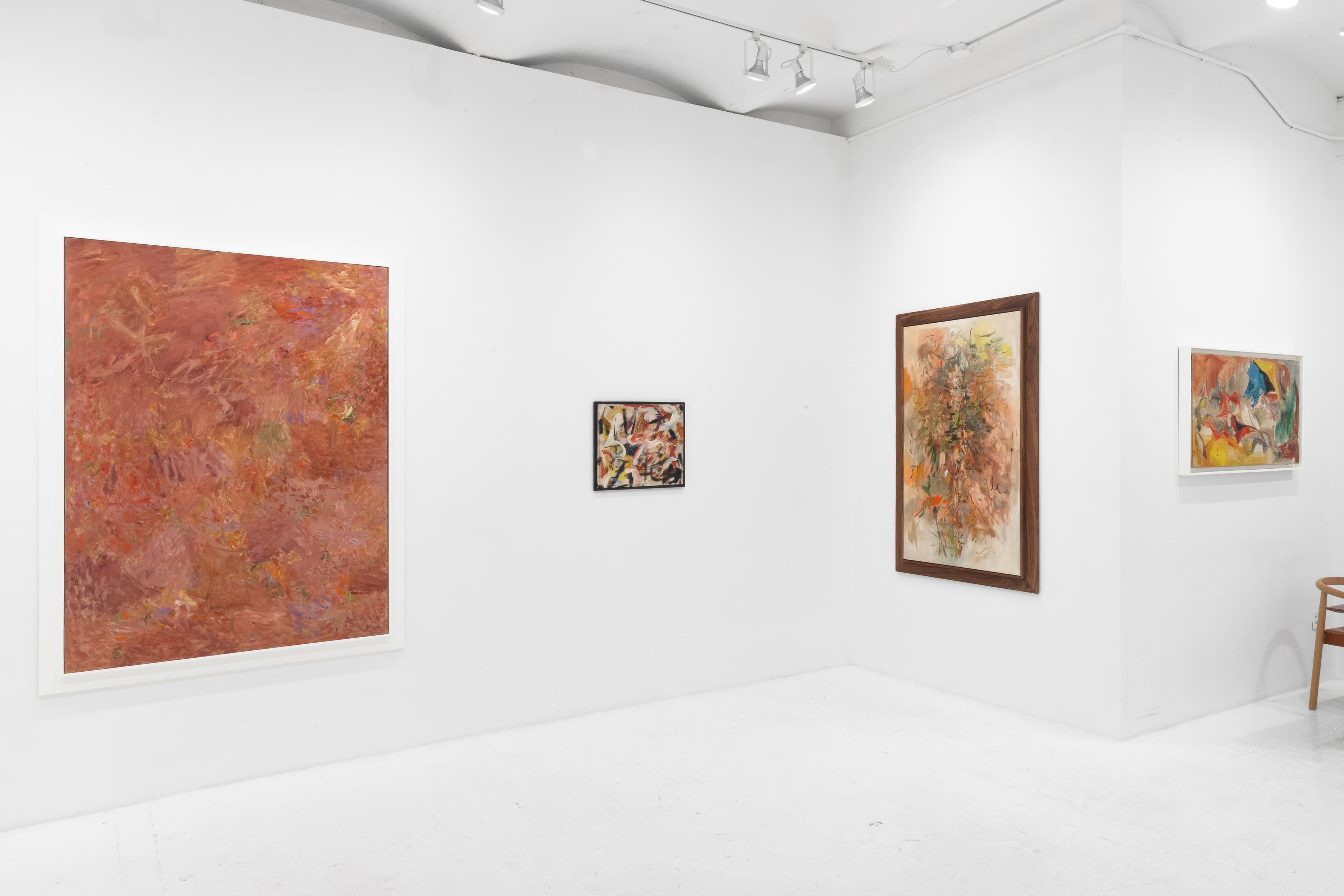
Installation view: Women Across America: 1945–1979, Eric Firestone Gallery, New York, 2026. Courtesy Eric Firestone Gallery.
Alma Thomas’s small, untitled gouache on paper (ca. 1971), exemplifies her insistence on beauty and exuberance, experiences she sought in her Washington, DC gardens, thunderstorms, or the Apollo space missions. Here, strands of cobalt blue rain down before a ground of raspberry red and paper white. Resembling mosaic tesserae, her brushstrokes swell and attenuate in bands of color, modifying the intervals of light peeking through. The year after this was painted, 1972, Thomas became the first Black woman to receive a solo exhibition at the Whitney Museum of American Art. She appears triumphant in a wonderful photograph from that opening (published in the catalogue for the 2021 exhibition, Alma W. Thomas: Everything is Beautiful), turned out in the grooviest, patchwork-printed gown.
In Helen Frankenthaler’s Night Brook (1974), crinkled rivulets of raw umber, charcoal grey, burnt orange, and violet emerge and dissolve just as beach sand changes color as it descends below the water’s surface. A rectangular portal is underscored by two horizontal ribbons of black unfurling across the scroll-like canvas. Painted the year Frankenthaler rented a house at Shippan Point, in Connecticut, it employed faster-drying acrylic paint instead of oil. The poignancy of this nocturnal abstraction washes over me in its recollection of Robert Motherwell’s “Open” series. Frankenthaler and Motherwell had divorced in 1971. It is the first time this work has ever been on view.

Betty Parsons, Summer Sun, 1957. Oil on canvas, 26 × 30 ½ inches. Courtesy Eric Firestone Gallery.
Overshadowed by her role as a preeminent mid-century art dealer, and one of few women gallerists of her era, Betty Parsons’s abstract paintings and sculpture have a frank playfulness. Often incorporating driftwood combed from the beach near her Long Island Sound studio, Parsons aimed to capture what she called the “invisible presence” in her surroundings. In Summer Sun (1957), blocky layers of tangerine orange are inscribed over an underpainting of lavender gray, while vessel-like shapes in white and turquoise bob along. Using sgraffito techniques, she scratched through the upper surfaces to reveal deeper layers in the painting.
Parsons represented Jeanne Reynal, who reinvested the ancient art of mosaic with new effects and meanings after an apprenticeship in the late 1930s with Russian mosaicist Boris Anrep. Reynal intersected with the majority of American artists of the New York School and had close friendships with Arshile Gorky and Adaline Kent. Her untitled mosaic (1966) in this exhibition contains smalti, hand-cut glass that is scattered across the surface in waves of color as a constellation of stars fills the night sky.
As a passenger manifest, the list of works comprising Women Across America: 1945–1979 elucidates the role of women in the trajectories of Surrealism, Abstract Expressionism, the Washington Color School, and the Women’s Art Movement. Mobility is the fulcrum of this presentation—geographic, psychological and professional—as a metaphor for our prerogative to think, and to pursue a life in art, with the support to do so. In spite of the erasure and suppression of their work imposed by sexism and patriarchal exclusion, these artists had the intellectual power, imagination, and productive friendships to propel themselves.
Rebecca Allan is a painter, horticulturist, and founder of Painterly Gardens, based in Mount Vernon, New York.