Terran Last Gun: Celestial Observations
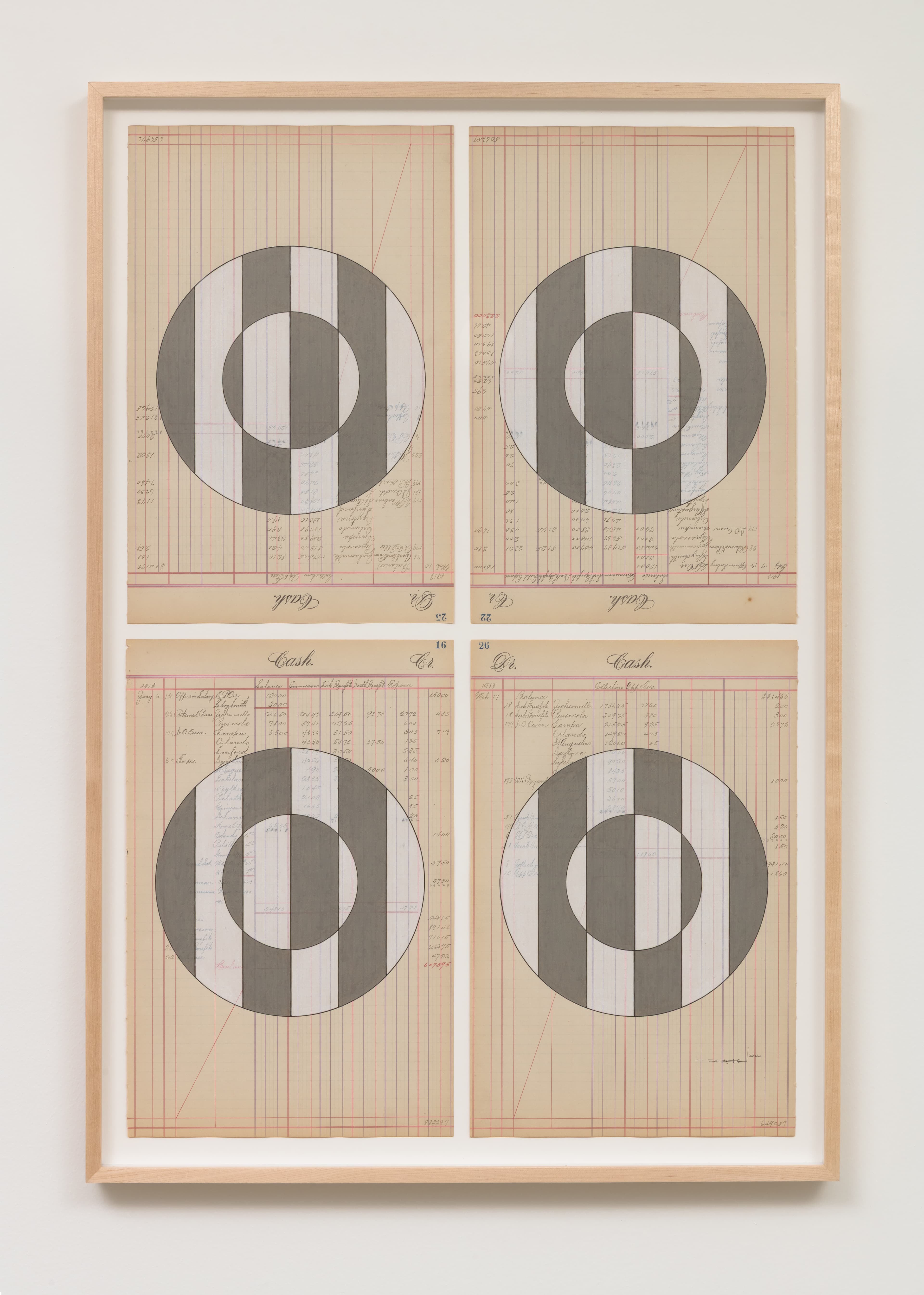
Terran Last Gun, Ancient Futurism Is Now, 2026. Quadriptych ledger drawing: ink and colored pencil on antique “cash” ledger sheets, dated 1913, 33 ¼ × 22 ½ inches. Courtesy the artist and Diane Rosenstein Gallery. Photo: Robert Wedemeyer.
Word count: 796
Paragraphs: 8
Diane Rosenstein Gallery
May 30–July 11, 2026
Los Angeles
This focused exhibition was my introduction to the work of Terran Last Gun and, among more important things, it snapped me out of the far-from-enthusiastic response to nearly all of the emails and PDFs I receive touting the next great thing. I’m a bit late to his work’s arrival, as it was included in installations such as the 12th SITE SANTA FE International Biennial last year, and this is his second solo exhibition with Diane Rosenstein Gallery. Last Gun is an enrolled citizen of the Piikani Nation, one of four nations known as the Niitsitapi [Real People], information that is visually infused into and activated by his work—somehow simultaneously quiet and vibrant drawings on paper, presented alone or in groups, made with ink and colored pencil, utilizing predominately circle and square forms.
The paper he uses is not just any paper; instead, his work exists within the tradition of Indigenous ledger art of the Great Plains from the late nineteenth and early twentieth centuries. The product of a growing scarcity of animal hides as supports, and the availability of found pages from “official” ledgers, its inventiveness and narrative sophistication remains compelling in tremendous surviving examples. At first glance, narrative seems not to be a goal for Last Gun, as his contributions to each page are unapologetically abstract. However, he extends the “story” of this way of working by carefully adding large abstract (and geometric) forms to each page. These forms themselves are divided into sections of parallel stripes and/or perpendicular squares, all infilled with care and consistency with bright, yet calm—because of the qualities of colored pencil—color.

Installation view: Terran Last Gun: Celestial Observations, Diane Rosenstein Gallery, Los Angeles, 2026. Courtesy Diane Rosenstein Gallery. Photo: Robert Wedemeyer.
Color and shape, form and structure, order and clarity all resonate in Last Gun’s drawings because of his ability to align Piikani approaches to them with key moments of geometric abstraction, whether modernist or way, way before. The hybridity of their compositions challenges, if not implicates, the facts and figures recorded on their supports in regimented penmanship. (The pages range from 1905 to 1936.) A work like Ancient Futurism Is Now (2026) infuses four ledger pages from 1913 that account for various incomes (“Officers salary,” so seemingly military) and expenses (sick and death benefits) with four circular shapes, each containing a smaller circle, all with vertical stripes (think Daniel Buren, in a way) washed onto the surface in white and an especially rich gray. Despite their subtlety, the circles are emphatic, not quite targets but definitely aims.
A superficial conclusion about a four-part drawing like Another Human Being Experience: Magnificent Cosmic Source Of Life (2025) would be that it is a reworking of the rings and chevrons of the color-field paintings of Kenneth Noland, brought to the surface of pages from the Tisch-Hine Co. of Grand Rapids, Michigan (ca. 1922). Even without the title, however, the controlled lushness of Last Gun’s “touch” triggers an exponential expansion of territory that takes in energy ranging from the Transcendental painters to the crucial work of Hilma af Klint. This is a bold claim, and while I can accept that it’s a bit too much, my goal is to acknowledge what I take as the aspirational nature of Last Gun’s endeavor.

Terran Last Gun, Discovering Insightful Purpose, 2025. Ink and colored pencil on antique “Clerk of District Court, Fee Book, Blaine County, Chinook, Montana” diptych ledger sheets, 1929, 15 ½ × 41 inches. Courtesy the artist and Diane Rosenstein Gallery. Photo: Robert Wedemeyer.
There is one two-part work that contains a different form: Discovering Insightful Purpose (2025) splits an overall trapezoidal form vertically in half, placing each section onto a separate page from a district court fee book from Chinook, Montana, Last Gun’s home state. It was this drawing that finally got me thinking about how these pages are—of course—spreadsheets, albeit without the flexibility and file sharing we take for granted today. But there it is: Last Gun’s work embodies those goals of flexibility and, most importantly, shares these ledgers that aren’t the easiest things to find amidst the didacticism and smallness slathered on large swaths of emerging art. In other words, they do tell a story.
I finished reading Rebecca Solnit’s new book about cultural change, The Beginning Comes After the End, just before seeing this exhibition. So much of her book has stayed with me, and Last Gun’s work helped make it so. Take just one sentence, positioned in the face of the death rattle gasping all around us: “I believe we’re also witnessing a shift from capitalism’s tendency to see even the living, even humans, as dead things—as objects and commodities—to Indigenous and animist worldviews that regard being, sentience, and rights as qualities of rivers and mountains, as well as of plants and animals.” For sure, there has been substantial art produced in the first quarter of this century, work that participates in the aesthetic and ideological shift Solnit outlines above. Last Gun’s work contributes a surprising yet impactful direction to all of it.
Terry R. Myers is a writer and curator based in Los Angeles, and an Editor-at-large of the Rail. His most recent books include two volumes of his collected writings: Reviews 1988–2020, and Selected Essays 1988–2024.