Terry R. Myers

Terry R. Myers is a writer and independent curator based in Los Angeles, and an Editor-at-Large of the Rail.

Arshile Gorky’s paintings and drawings were event horizons long before much was known about the outsized ones at the outer rims of black holes.
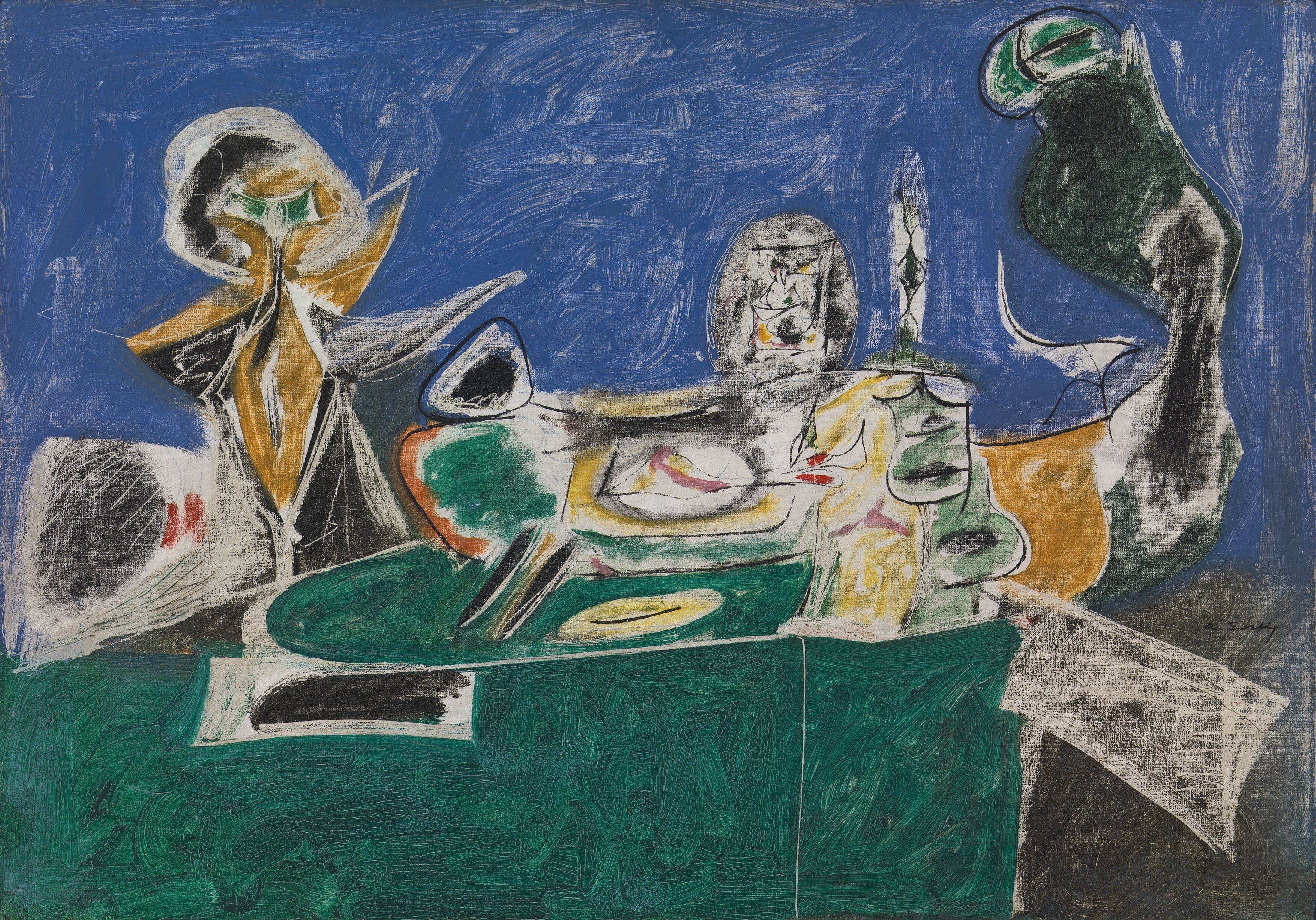
Arshile Gorky, Untitled (From a High Place II), 1946. Oil on canvas, 17 × 24 inches. © (2025) The Arshile Gorky Foundation / Artists Rights Society (ARS). Courtesy the Arshile Gorky Foundation and Hauser & Wirth. Photo: Todd-White Art Photography.

Robert Therrien lived in his story after story more completely than almost any artist I’ve had the good fortune to know. One of the things that makes his work extraordinary is that his presence permeates all of it—“the devil is in the details,” maybe—as the unexpected catalyst for keeping himself out of its way. 
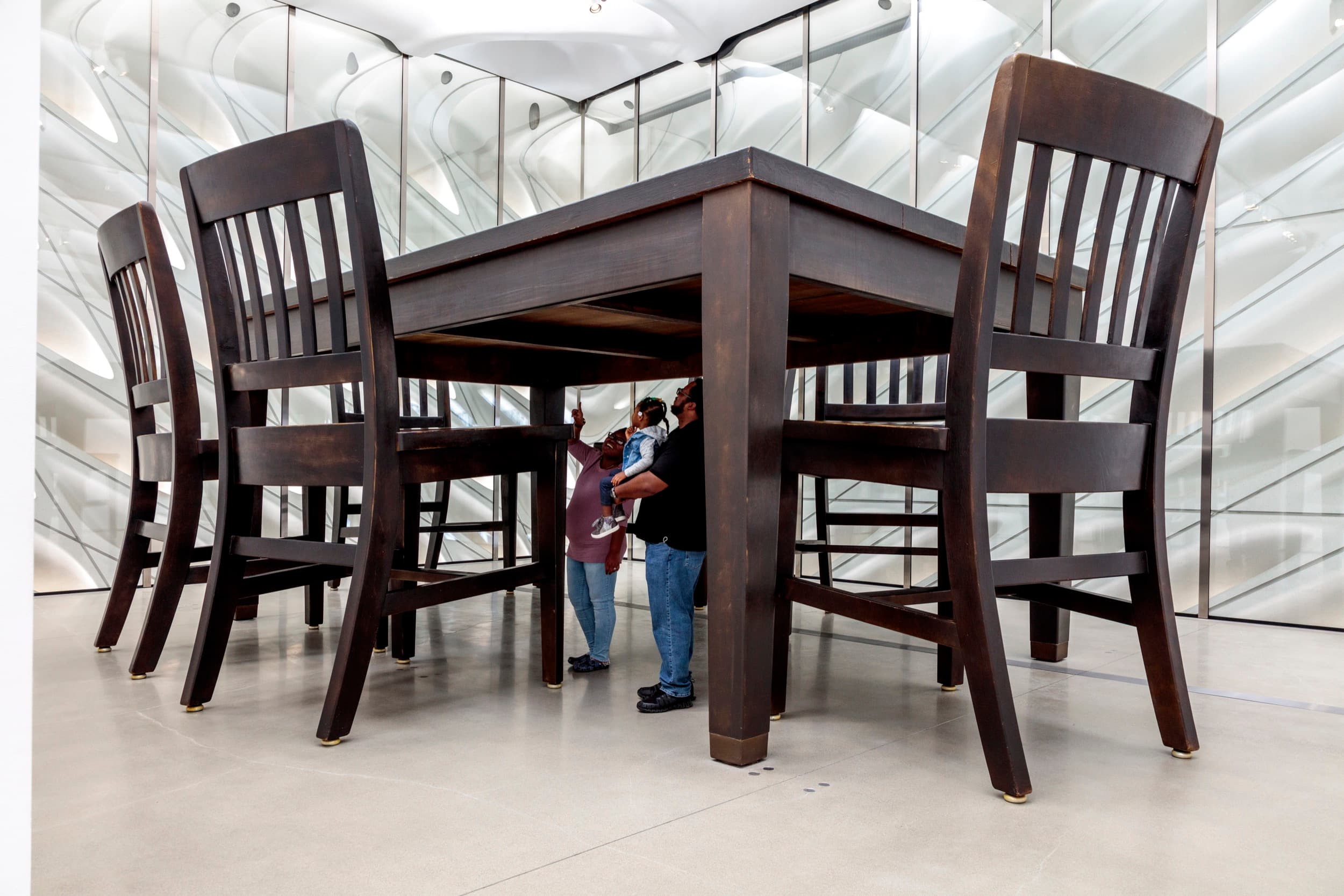
Robert Therrien, Under the Table, 1994. Wood, metal and enamel. Courtesy The Broad Art Foundation. Photo: Joshua White.

Francis Picabia: Femmes, perfectly situated in Beverly Hills, brings together paintings from 1924–49 that riff on a far-from-accidental array of divergent images of women. The earliest paintings, from his series aptly known as “Monsters,” fulfill the terms of what was once called Primitivism.

Francis Picabia, Briseis, ca. 1929. Oil, pencil on canvas, 28 ¾ × 23 ½ inches. © The estate of Francis Picabia. Courtesy Michael Werner Gallery.

Eight early works of Robert Irwin’s, ranging from 1962 to 1971, installed straightforwardly and exquisitely in Pace’s Los Angeles gallery, is just about as good as it gets. I can’t think of the early work of another artist from that time period who could embody such material range and atmospheric potential while maintaining the consistency, even strictness, of its focus.

Robert Irwin, Untitled, 1970–71. Acrylic, 144 x 9 x 5 1/2 inches. © Robert Irwin/Artist Rights Society (ARS), New York. Courtesy Pace.

Yes, it has been thirty years since there has been an exhibition of Bruce Nauman’s work in Los Angeles (the US retrospective’s stop at MOCA). It’s shocking, stupefying, and all that, but the timing of this spot-on selection of his early work in Marian Goodman’s refreshingly restrained Hollywood space could not have been better.

Bruce Nauman, Untitled (Corridor Study with Red, Yellow, Blue), 1983. Graphite and pastel on paper, 36 x 49 3/4 inches. Courtesy the artist and Marian Goodman Gallery. Photo: Elon Schoenholz.

Walking through the variety-pack of The Living End: Painting and Other Technologies, 1970–2020 triggered one déjà vu moment after another, most of them related to other attempts to survey the terrain of painting since the productive unraveling of modernism.

Installation view: The Living End: Painting and Other Technologies, 1970–2020, MCA Chicago, Chicago, 2024–25. Courtesy MCA Chicago. Photo: Robert Chase Heishman.

The pictorial and material depth of Cranston’s painting is refreshing, all the more so because the paintings can seem, at first glance, to come from decades if not centuries ago. But they are both something and somewhere else.

Andrew Cranston, The Invisible man, 2024. Oil on canvas, 39 7/8 x 36 3/8 inches. Courtesy Karma.
After a long stretch of making paintings that were non-representational and not abstract, but also not non-objective (their materiality being both object and subject), Angel Otero has been digging during the past few years to re-expose and recover the associative pictorial roots of his first mature work, front-loading images and things recalled from his childhood in Puerto Rico like those he used 15 years ago.
Angel Otero, Look out your Window, 2024. Oil paint and fabric collaged on canvas, 95 5/8 x 143 1/4 x 1 1/2 inches. Photo: Thomas Barratt.
In the end, what makes all of Ruscha’s work work is that even the rare cynical moments it might contain are always grounded by the sense of wonder he makes tangible.
Ed Ruscha, Los Angeles County Museum of Art on Fire, 1965–68. Oil on canvas, 53 1/2 × 133 1/2 inches. Hirshhorn Museum and Sculpture Garden, Collection Hirshhorn Museum and Sculpture Garden, Washington, D.C.; gift of Joseph Helman, 1972, © Ed Ruscha. Photo: Paul Ruscha.
This exhibition is much more than the sum of its parts. Entering Gagosian’s Beverly Hills gallery to experience (or, in a couple of cases, re-experience) twenty-seven works produced by Jean-Michel Basquiat between 1982 and 1984 in Venice, California—reunited not too far east of where they were made, and even less west of where they were first shown—was not what I had anticipated.
Jean-Michel Basquiat, Hollywood Africans, 1983. Acrylic and oil stick on canvas, 84 1/16 × 84 inches. Whitney Museum of American Art, New York; gift of Douglas S. Cramer. Courtesy Gagosian.
This well-deserved mid-career survey of Paul Pfeiffer’s work demonstrates how much he has been able to create compelling and timely work that engages and interrogates the ways and means of spectacle without surrendering to the cheap thrills of what is often called spectacular.
Paul Pfeiffer, Justin Bieber Head, 2018. Gmelina wood and paint, 16 1/4 x 8 1/8 x 8 3/4 inches. © Paul Pfeiffer. Courtesy the artist and carlier | gebauer, Berlin/Madrid. Photo: Bernd Borchardt.
Kay Rosen and I have been in conversation for more than thirty years, beginning soon after I first saw her work at Feature Inc. in New York at the end of the 1980s. Our connection ever since has been built around both art and life, and not only because I was born in Indiana in 1965 just a few years before Kay—a native of Corpus Christi, Texas—moved to the Hoosier State to live and work.
Portrait of Kay Rosen, pencil on paper by Phong H. Bui.
One positive outcome from the distraction of art fairs has been that more artists and their dealers are working together to make gallery solo exhibitions that juxtapose new work with early work. When done with sensitivity and a good eye, these presentations often become far greater than the sum of their parts, an achievement rarely achieved in stalls that bring to mind a county fair. And when an exhibition provides the bonus of rebuilding a historical connection to its actual location, as does this focused yet sweeping exhibition of ten works by Sean Scully (nine paintings and one sculpture installed outdoors), its use-value rises.
Installation view: Sean Scully: LA Deep, Lisson Gallery, Los Angeles, 2023. © Sean Scully. Courtesy Lisson Gallery
At first, Akunyili Crosby’s pervasive use of photographic transfer—taken from her personal archive as well as the breadth of Nigerian life as pictured in mass-media—appears to provide a literal pathway for the world outside of the work to enter: a goal of collage since at least Synthetic Cubism in which it had a certain shock value. Here, instead, the neatly arranged assortment of small images remain in the background, providing a quiet visual humming or buzzing amidst the more robust components of the work.
Njideka Akunyili Crosby, Still You Bloom in This Land of No Gardens, 2021. Acrylic, colored pencil, collage, and transfers on paper, 95 7/8 x 108 inches. © Njideka Akunyili Crosby. Courtesy the artist, Victoria Miro, and David Zwirner. Photo: Fredrik Nilsen.
Murakami has never relented from giving his work what it needs to stay, and stay for a long time.
Installation view of Takashi Murakami: Stepping on the Tail of a Rainbow at The Broad, 2022. Photo: Joshua White / JWPictures.com Courtesy The Broad.
Linda Daniels’s exhibition at Left Field in Los Osos confirms my assessment that her paintings of the past five or so years are not only the best that she has made, but also the result of the rigorous yet ebullient trajectory of her work that has transpired over the past forty years.
Linda Daniels, Red-Violet Black with White, 2019. Acrylic on canvas, 20 x 20 inches. Courtesy Left Field, Los Osos. Photo: Elliot Johnson.
Nothing in Doig’s work is ever left completely to the mercy of what memory can do to what we always try to call the past, and nowhere have I absorbed this more than I have in Japan. I would like to think that the absent presence of this exhibition will linger for me to take in the next time I am there, or at the next Doig exhibition I see, wherever it may be.
Peter Doig, Ski Jacket, 1994. Oil on canvas, 116 x 138 inches. © Peter Doig. Tate. Purchased with assistance from Evelyn, Lady Downshire’s Trust Fund 1995. All rights reserved, DACS & JASPAR 2020 C3120.
I became a painter at Cal Arts in the 1970s when there was a way of approaching the making of art just generally. One of the things that still bothers me about painting are the way that painters talk about their work or the way painting is viewed. Of all the practices, painting is the one where the viewer—both the educated and the popular viewer—essentializes or over-essentializes the relationship between the object and the person who made the object. And that, I think, is problematic.
Portrait of Lari Pittman, pencil on paper by Phong Bui.
The focus of this Guest Critic section is something I’ve been wanting to do for some time. To ask several writers whose work I respect (often by disagreeing with it, and I hope that favor has been returned) to respond to a simple prompt: “I was wrong.”
Portrait of Terry Myers. Pencil on Paper by Phong Bui.
On the occasion of her exhibition I’ve Seen Gray Whales Go By, critic and independent curator Terry R. Myers recently spoke with artist Mary Weatherford, who he has known since her first solo exhibition at Diane Brown Gallery in New York in 1990, in her studio in Los Angeles.
Portrait of Mary Weatherford, pencil on paper by Phong Bui.
Henrik Olesen, again and again, makes works that are feedback loops of the rather self-replicating and/or wormhole-y type. They convey information, and facilitate (our) understanding of it, back onto themselves, but they also threaten—rightly so—to upend the structures and/or dimensions that made such a cycle possible.
Installation view: Henrik Olesen, Reena Spaulings Fine Art, New York, January 24 – February 28, 2016. Courtesy the artist and Reena Spaulings Fine Art. Photo: Joerg Lohse.
What is “Painting 1.0?” One would think that somewhere, anywhere, in an ambitious exhibition like Painting 2.0: Expression in the Information Age an attempt would be made to answer that question with clarity and conviction, if only to anchor the curatorial pinpointing of “Web 2.0” (defined as the shift to user-generated content and increased interactivity) as the new thing that has made painting so interesting today.
Interior view with works by Manfred Kuttner and Konrad Lueg © Museum Brandhorst.
Perhaps the question that was on my mind while rereading Reinhardt’s early lecture was in the air when it was written: did Reinhardt really have the courage of his convictions in his work at that time?
Green-Violet Center, 1943, oil on canvas, 39.5 × 20". Courtesy the Ad Reinhardt Foundation.
I am indebted to the Louisiana Museum for sparking my interest in emerging Nordic art. Starting in the mid-1990s, my visits provided first encounters with the work of several artists who have held my attention ever since: Eija-Liisa Ahtila, Olafur Eliasson, Elmgreen & Dragset, Nils Erik Gjerdevik, Henrik Håkansson, Superflex, and Tal R.
Elmgreen & Dragset, "Andrea Candela, Fig. 3 (Virtual Romeo)," 2010. Wax, t-shirt, hoodie, socks. Photo: ONUK. Courtesy: Andrea Thuile & Heinz Peter Hager.
It wasn’t a wave of nostalgia that came over me entering Kavi Gupta’s gallery for Jessica Stockholder’s first solo exhibition in Chicago, probably because I had just had one upon encountering the first part of Stockholder’s A Log or a Freezer (2015).
Installation view: Jessica Stockholder, Door Hinges, Kavi Gupta Gallery, Chicago, Sep 12, 2015 – Jan 16, 2016. Courtesy Kavi Gupta and the artist. Photo: Tim Johnson.
Some of these Andreas Schulze paintings were shown in New York in late 2014, at Team Gallery in an exhibition called Traffic Jam. Now, several months later, here in Berlin, those paintings and some others are stuck again in a “stau” (translation, simply: jam).
Andreas Schulze, Untitled (New Jersey Sheep), 2014. Acrylic on nettle cloth, 78 3/4 x 86 5/8 in.   Copyright Andreas Schulze / VG Bild-Kunst, Bonn. Courtesy Spruth Magers and Team Gallery, New York.
New York didn’t get the Albert Oehlen survey it deserved. Although there are plenty of strong paintings among the twenty-five or so included in Home and Garden at the New Museum, and for the most part they are installed to sufficient impact, this show short-changes Oehlen’s crucial relationship to the legacy of New York painting since the 1940s, without which he would be far less the critical painter he has been for some time.
Albert Oehlen, Festnahme [Arrest], 1996. Oil and acrylic on canvas, 75 1/4 Ã?â?? 96 1/2 in.
“Twenty years ago all the ambitious young painters I knew in New York saw abstract art as the only way out.” This sentence, the start of Clement Greenberg’s 1962 essay “After Abstract Expressionism,” provides a particular way into William Pope.L’s determined exhibition at The Geffen Contemporary at MOCA.
William Pope.L, "Migrant" (2015). Installation shot. Courtesy of The Museum of Contemporary Art, Los Angeles. Photo: Brian Forrest.
Sadie Benning’s recent works fit together beautifully while resisting fitting in completely with other things to which they could be compared. The complexity of their situation as such is what gives them their eye-catching personality, an attitude provided mainly by the disarming procedures of their production.
Sadie Benning, "Explosion," 2014. Medite, acqua-resin, and casein, 56 × 89 ̋. Courtesy of Susanne Vielmetter Los Angeles Projects. Photo: Chris Austin.
The first installation of this exhibition of Marsden Hartley’s Berlin paintings must have been some homecoming, one that likely looked as if little or no time had passed, even though, in this case, it’s been a hundred years.
Marsden Hartley, "Portrait," c. 1914–15. Oil on canvas, 32 1/4 × 21 1/2 ̋. The Collection of the Frederick R. Weisman Art Museum at the University of Minnesota, Minneapolis. Bequest of Hudson D. Walker from the Ione and Hudson D. Walker Collection.
It could be argued that Gabriel Kuri’s approach to sculpture has been over-rehearsed during the past century, but on rare occasions art such as his demonstrates that it will always be possible to brush the formal and conceptual cobwebs off of any way of working and provoke actual surprise if not innovation.
Installation view of Gabriel Kuri at Regen Projects, Los Angeles, May 24 – June 28, 2014. Photo by Brian Forrest. Courtesy the artist and Regen Projects, Los Angeles.
At first, this retrospective of Isa Genzken’s career seemed to come together as a heterogeneous yet unyielding portrait of the artist. Later, however, I realized that portraiture is a limitation that this work refuses without regret, as piece by piece, I came to the complicated conclusion that Genzken’s works are full-bodied recreations of herself, not mere symbolic representations, and definitely not depictions of anything autobiographical.
Isa Genzken, "Weltempfanger (World Receiver)", 1982. Collection the artist. Copyright: Isa Genzken. Courtesy the artist and Galerie Buchholz, Cologne/Berlin.
Sigmar Polke was a master magician among the principal tricksters of art history, a mischief-maker of illusions of illusion itself, not to mention reality, whatever, of course, we believed prior to witnessing his slights of hand.
Sigmar Polke, Untitled, c. 1975. Gelatin silver print, 7 1/16 × 9 7/16 ̋. The Museum of Modern Art, New York. Acquired through the generosity of Edgar Wachenheim III and Ronald S. Lauder. © 2014 Estate of Sigmar Polke/ Artists Rights Society (ARS), New York / VG Bild-Kunst, Bonn.
The first line of curator Naomi Beckwith’s essay is a quote from the artist: “There was a time […] when the content of my work was coming from outside sources.” Indeed.
William J. O'Brien, "Untitled," 2011. Courtesy of the artist and Shane Campbell Gallery, Chicago. © William J. O'Brien. Photo: Tom Van Eynde, courtesy of the artist; Shane Campbell Gallery, Chicago; Marianne Boesky Gallery, New York.
I’ve written about exhibitions by two of these artists before. With Ruff, I remain captivated by what I called the “swaying” of his rigorous production, functioning as focus instead of distraction; with Tillmans it’s still about how he consistently reminds me to never take anything for granted.
Wolfgang Tillmans, "Silver 151", 2013. Emulsion on paper (unique), 61 × 50.8 cm. Courtesy Galerie
Buchholz, Berlin/Cologne.
Eberhard Havekost has always made it clear that his paintings neither stand apart nor together as a “body of work,” as that term has been overhauled since postmodernism.
Eberhard Havekost, "Ocean, B12," 2012. Oil on Canvas, 55 x 39 1/3". Courtesy Eberhard Havekost, Anton Kern Gallery, New York and Galerie Gebr. Lehmann Dresden/Berlin Photo: Werner Lieberknecht, Dresden.
Is the bracing clarity of Richard Serra’s early work capable of speaking to—if not against—the slippery ambiguity of today? More than usual, the relationship between the work and site of this exhibition set up a then-versus-now situation that it never resolved, leaving me split, but not in the material way that Serra so emphatically had in mind back in the day.
Richard Serra, "Early Work," 2013. Installation view, Richard Serra Early Work, David Zwirner, New York, 2013. Photo: Tim Nighswander © 2013 Richard Serra/Artists Rights Society (ARS), New York. Courtesy of David Zwirner, New York/London.
While messing around with the procedures of painting for the past 20-or-so years, Laura Owens has rebuilt the category of painting into something not to be messed with. Right now, she is on a tear.
12 Paintings by LAURA OWENS
Somehow the sum of 100 percent offhandedness and 100 percent calculation, Bernard Frize’s paintings continue to defy even their own expectations.
Bernard Frize, "Shanten," 2012. Acrylic and resin on canvas, 63 x 63".
No way was I anticipating coming to the conclusion that dOCUMENTA (13) is a triumph. I arrived a cynic and left a skeptic, and a joyful one at that.
Various artists, "The Brain." Photo: Roman März.
Last year, in Chicago, for the first time anywhere, I taught a course on 20th and 21st century Los Angeles art, a survey that started with artists from the 1920s. I was confident that the early stuff would be a revelation, if only because of how much effort is still put into maintaining the notion that everything started at the admittedly vital Ferus Gallery.
Cayetano Ferrer, "Quarter-Scale Grand Entrance," 2012. Installation view at the Hammer Museum, Los Angeles. Photo: Brian Forrest.
During my most recent six-week trip to Japan, with my sense of distance and displacement quickly reestablished I was struck by the serendipity of concurrent retrospectives of the, yes, groundbreaking work of Atsuko Tanaka and Jackson Pollock, at the Museum of Contemporary Art Tokyo (MoT) and the National Museum of Modern Art, Tokyo, respectively.
Atsuko Tanaka, "Work," 1957, Courtesy and the Collection of Ashiya City Museum of Art & History ©Ryoji Ito.
No contemporary painter produces overload with as much restraint as Lari Pittman. For more than 30 years the unstoppable force of his pictorial imagination has collided head-on with the immovable object of his impeccable production, over and over, to the point of what would be, in less capable hands, overkill.
Lari Pittman, "Seance," 2011. Acrylic, Cel-Vinyl, and aerosol lacquer on gessoed canvas over panel. 88 x 102". Copyright Lari Pittman. Courtesy Gladstone Gallery, New York and Brussels.
Willem de Kooning couldn’t have been more clear about what he thought of retrospectives, despite his reluctant agreement to a mid-career survey in the late 1960s: “They treat the artist like a sausage, tie him up at both ends, and stamp on the center ‘Museum of Modern Art,’ as if you’re dead and they own you.”
Willem de Kooning, "Pink Angels," c. 1945. Oil and charcoal on canvas. 52 x 40". Frederick R. Weisman Art Foundation, Los Angeles. © 2011 The Willem de Kooning Foundation/Artists Rights Society (ARS), New York.
e are told by Jennifer R. Gross, in the catalogue accompanying this focused exhibition of Jim Nutt’s work (even with 70 paintings and drawings it is not a retrospective or a survey), that the artist “has expressed surprise that his unidentified women have been seen as male rather than as the clearly female subjects he intended.
Jim Nutt, "Bump" (2008). Nelson-Atkins Museum of Art, Kansas City, MO; Courtesy David Nolan Gallery, New York.
Abandoning the diminishing returns of the “touch” of Abstract Expressionism (and, to be sure, it had run its course in his work of the 1950s), Roy Lichtenstein set out to achieve something much harder in both senses of the word.
Roy Lichtenstein, "Finger Pointing" (1961). Graphite pencil, pochoir, brush, and india ink, 76.2 x 57.2 cm. Private Collection, New York, 
© Estate of Roy Lichtenstein.
It was during my second visit to Susanne Doremus’s exhibition, open/closed, that I connected the title she gave the show to the door of the gallery. Like windows or drawers, a door has to open and close to work, and it’s clear to me that Doremus has the same expectations for her paintings, something that is nowhere near as simple as it seems.
"Allegory" (2010). Acrylic on canvas. 78 x 84 inches. Photo by Tom Van Eynde. Courtesy of Zolla/Lieberman Gallery.
Lecturer, critic, and independent curator Terry R. Myers recently spoke with artist Deborah Kass, whose forthcoming exhibition MORE feel good paintings for feel bad times will show at Paul Kasmin Gallery September 23 - October 30, 2010, about her life and work.
Portrait of the artist. Pencil on paper by Phong Bui.
“If we had the ‘Grand Jatte,’ maybe that would be the way to begin.” Unfortunately for MoMA Director Glenn Lowry—who offered this bit of wishful thinking in Arthur Lubow’s New York Times Magazine feature about the museum’s 2004 reopening and revised presentation of its impeccably well-rehearsed collection—the Seurat is not likely to leave its long-term home at the Art Institute of Chicago.
Henri Matisse. "Bathers by a River" (1909–10, 1913, 1916–17). Oil on canvas. 102 1/2 x 154 3/16 inches. The Art Institute of Chicago, Charles H. and Mary F. S. Worcester Collection, 1953.158. © 2010 Succession H. Matisse / Artists Rights Society (ARS), New York.
I didn’t make my most recent trip to Tokyo to see or write about a Gerhard Richter exhibition. It was a bonus, icing on the cake, if you will, that proved to me how important it is to take myself on occasion out of my comfort zone, especially when it comes to looking at the work of an artist who has changed art and has been heavily scrutinized for it.
Lacquer on photograph. 10x15cm.(C) Gerhard Richter. Courtesy of Wako Works of Art
With this show, Ebner has made it abundantly clear that the last thing he wants to do is let his work just be, slapping us in the face with—of all things—paintings in the shape of “surrogate” fish.
Tim Ebner, "Untitled (pink and black)" (2009). Acrylic on canvas mounted on plywood, feathers, Sculpy, mounted on found, modified metal wall bracket 203/4˝× 32˝× 31/4˝, extends 321/2˝ from wall. Courtesy of Rosamund Felsen Gallery.
Marilyn Minter doesn’t merely use photographs; she uses them up. It is critical that for the past fifteen or so years the photographs have been hers to bleed dry: this part of her process contributes greatly to the overall cycle of creation and destruction that determines how her work is made as well as how it looks.
Marilyn Minter, "Orange Crush" (2009). Enamel on metal, 108 x 180 inches (274.3 x 457.2 cm). Courtesy of Regen Projects, LA.
Even though it covers more than 25 years, this exhibition of Elizabeth Murray’s work is neither a retrospective nor a survey.
Courtesy The Arts Club of Chicago. Photograph by Michael Tropea.
I didn’t ask, but I have no doubt the title of Jeni Spota’s recent exhibition, Fool’s Small Victory, was borrowed from a compilation album by Faith No More that includes various B-sides and live recordings, five of which are different versions of a song called “A Small Victory.”
Jeni Spota, Teeth, 2009. Oil on canvas.16 x 18 inches. Courtesy of Kathryn Brennan Gallery, Los Angeles. Photo credit: Robert Wedemeyer
Roland Barthes’s description of Tokyo and its empty center could be a perfect portrayal of the work of Larry Johnson: “The entire city turns around a site both forbidden and indifferent, a residence concealed beneath foliage, protected by moats, inhabited by an emperor who is never seen, which is to say, literally, by no one knows who.”
"Untitled (Classically Tragic Story)," 1991. Color photograph. 61 x 75 3/8 in. (154.9 x 191.5 cm).
No painter since Pollock has refused to separate landscape and language more than Cy Twombly. His work is at its best when “no” withstands “yes,” when all of the things that make it beautiful to look at in the affirmative are never left to their so-called natural devices.
Cy Twombly. Untitled (detail), 2007. Collection of Mr. and Mrs. Donald B. Marron, New York. © Cy Twombly. Courtesy Gagosian Gallery.

Close

Home