Arshile Gorky: Horizon West
Word count: 843
Paragraphs: 8
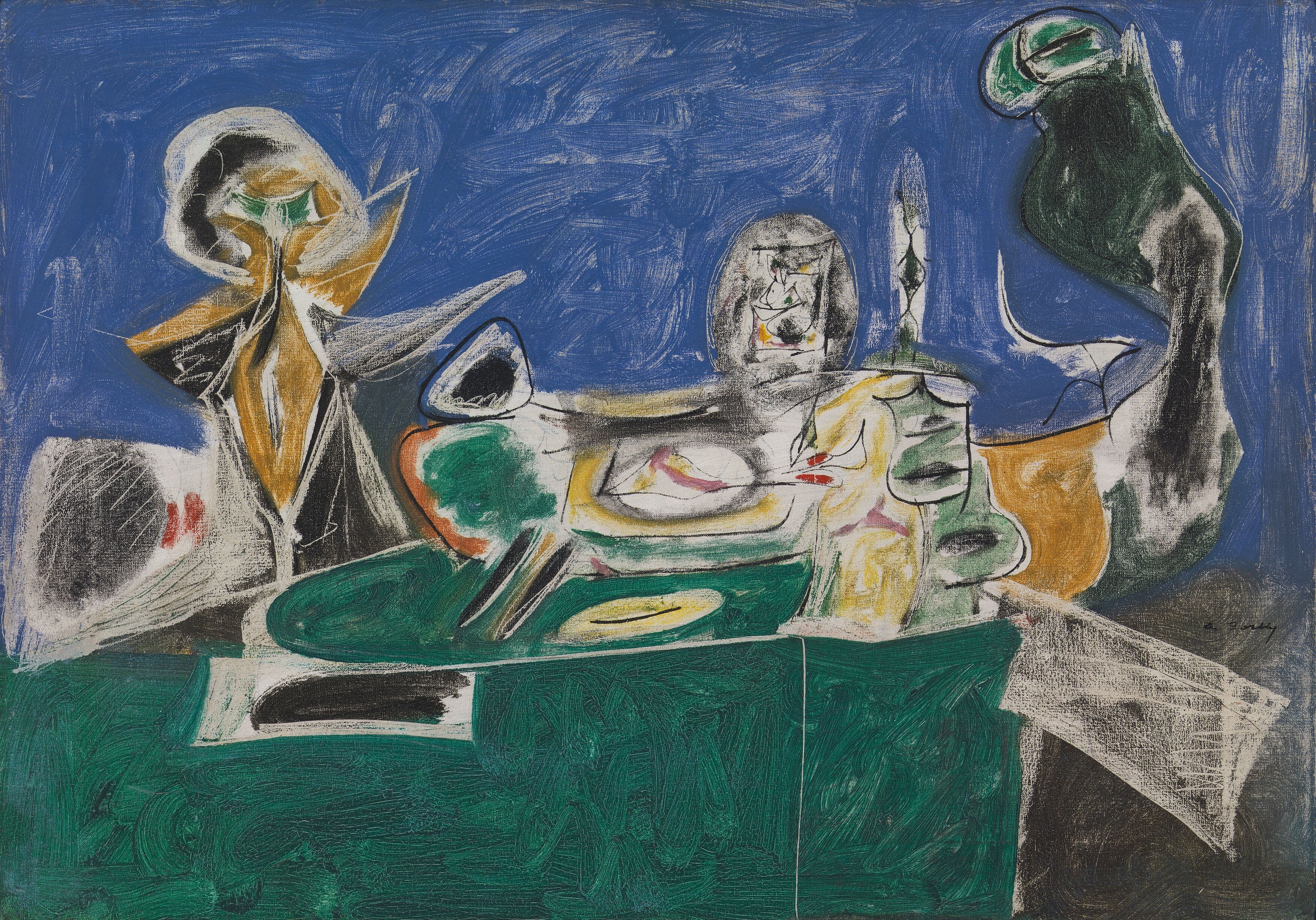
Arshile Gorky, Untitled (From a High Place II), 1946. Oil on canvas, 17 × 24 inches. © (2025) The Arshile Gorky Foundation / Artists Rights Society (ARS). Courtesy the Arshile Gorky Foundation and Hauser & Wirth. Photo: Todd-White Art Photography.
Hauser & Wirth
February 21–April 25, 2026
Los Angeles
Arshile Gorky’s paintings and drawings were event horizons long before much was known about the outsized ones at the outer rims of black holes. His far-from-outsized works generate their own formidable material and visual gravitational pull because of his striking ability to alternate their physicality between the densest overpainting (over-overpainting is more accurate) and the gaseous traces of liquid oil wiped away, both grounded by an array of drawing materials: charcoal, crayon, graphite, ink, pastel. The tangibility of everything keeps the fantastic vistas of these works firmly planted on earth as they teleport themselves to, yes, other universes, which may or may not incorporate states of mind. And while it may not be accurate to claim Gorky’s paintings have or even depict deep space, time and time again their depth manifests itself in connective ways, as in living tissue.

Arshile Gorky, Untitled (Butterfly and Leaf), ca. 1932–34. Ink on paper, 14 × 17 in. © (2025) The Arshile Gorky Foundation / Artists Rights Society (ARS). Courtesy the Arshile Gorky Foundation and Hauser & Wirth. Photo: Peter Schälchli.
Gorky could be seen as the consummate Surrealist, or, at the very least—courtesy of André Breton—as its last recognized participant. This despite, as William Rubin persuasively argued in his 1963 article “Arshile Gorky, Surrealism, and the New American Painting,” the recognition that Gorky’s unapologetic continuation of Paul Cezanne’s and even Pablo Picasso’s commitment to observation above imagination sets him apart from the rest of the card-carrying membership. Rubin’s article is, no surprise, thorough and convincing about many things, none more—germane to the works in this exhibition—than his reminder that the Surrealists had a “disdain for paint,” while “All his life Gorky nurtured a love for paint as an exquisite substance that had to be courted, cajoled, and tenderly assisted to its fullest blossoming.” Don’t forget: Joan Miró wanted to “assassinate” painting, and, according to Rubin, Roberto Matta hated the stuff.
The inclusion of the earliest work in the exhibition, an ink-on-paper drawing called Untitled (Butterfly and Leaf) (ca. 1932–34), introduces key attributes for the imminent blossoming of Gorky’s lasting endeavors. It is, in key ways, a classic surrealist juxtaposition set in a rather scratchy rendering of a barren, three-dimensional space (not unlike Giorgio de Chirico’s). Even with the inclusion of two strange, Picassoid cameo heads in the wings of the butterfly and a blank white oculus in the center of the leaf, the juxtaposition of the two living things in the work is as observable in nature as it gets.

Installation view: Arshile Gorky: Horizon West, Hauser & Wirth, Los Angeles, 2026. © (2026) The Arshile Gorky Foundation / Artists Rights Society (ARS). Courtesy the Arshile Gorky Foundation and Hauser & Wirth. Photo: Paul Salveson.
The road trip that Gorky took in 1941 from New York to California—traveling with his soon-to-be-wife Agnes “Mougouch” Magruder and Isamu Noguchi—was in part inspired by a solo exhibition of Gorky’s work upcoming at the San Francisco Museum of Art (later SFMOMA). (Premiered for this exhibition, a short film by Gorky’s granddaughter Cosima Spender and Valerio Bonelli encapsulates the legend of the trip.) Two paintings reunited from that exhibition for the first time anchor this one: Image in Khorkom (ca. 1934–36) and Tracking Down Guiltless Doves (ca. 1938–39), an exquisite, small canvas (with one hell of a title) that SFMOMA is fortunate to have kept. Helpful notes from the artist’s foundation provide a great line from Gorky: “Hundreds and hundreds of layers of paint to obtain the weight of reality.” Note the missing “sur-.” Also note that there is nothing especially “California” to see here, as Gorky stayed focused on the details that always mattered to him and his life story.
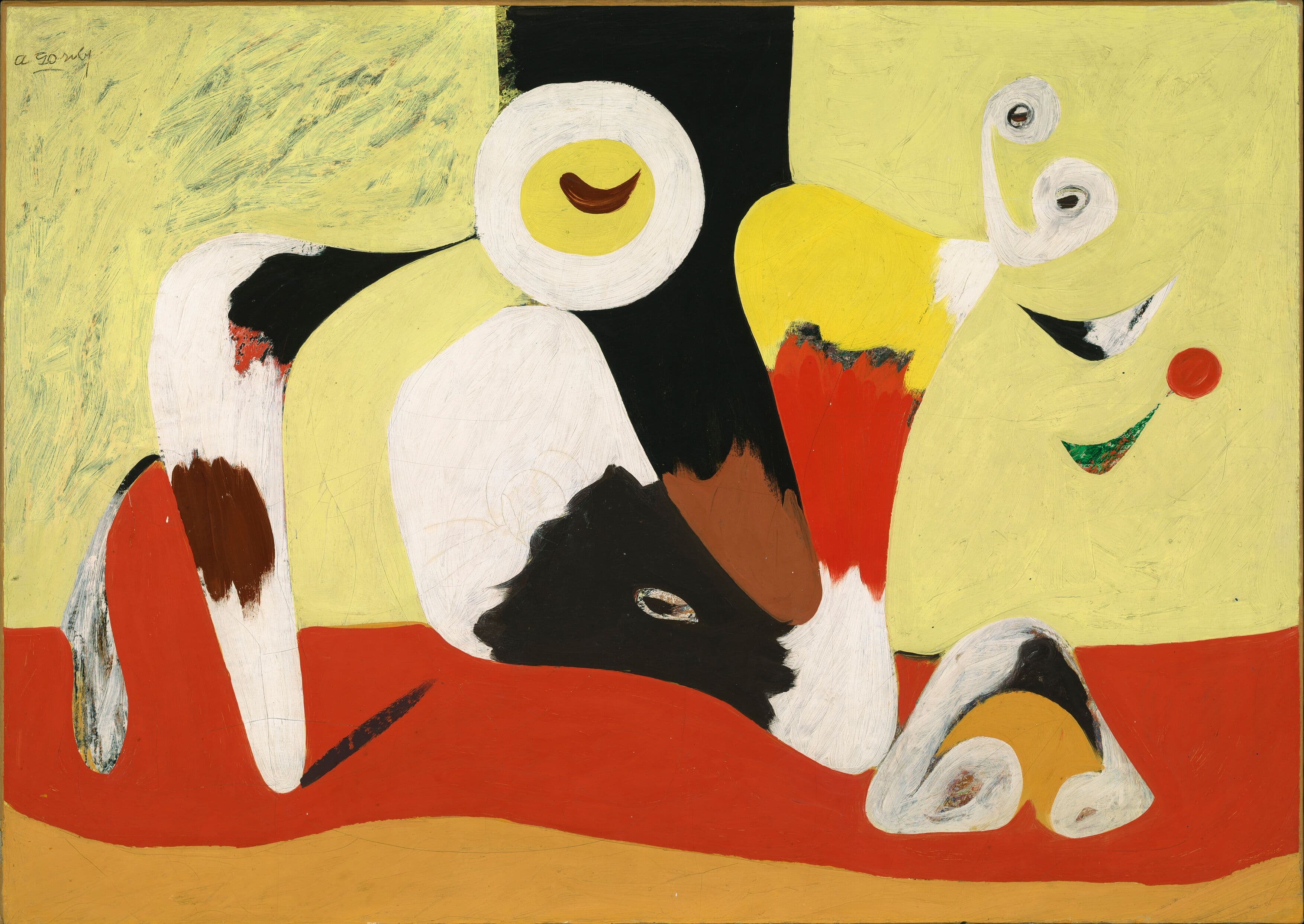
Arshile Gorky, Untitled (Mojave), 1941–42. Oil on canvas, 28 ⅞ × 40 ⅝ inches. © (2025) The Arshile Gorky Foundation / Artists Rights Society (ARS). Courtesy the Arshile Gorky Foundation and Hauser & Wirth. Photo: Museum Associates/LACMA.
The exhibition employs its key work as a dynamic pivot. Untitled (Mojave) (ca. 1941–42) was the painting produced by Gorky right after his return to New York. I want to note here that the gallery space is pretty difficult. This is the best-looking show I’ve seen in it, maybe because the relatively modest size of all the paintings and drawings provide a consistent yet engaging visual rhythm around what is a rather irregular (and large) room. One of the strongest features of this vibrant painting is its own complex visual rhythm, linking it with the paintings from his well-known “Garden in Sochi” canvases from the same period. Of everything in the room, it’s the one that dances.
The years 1943 through 1947 are represented here primarily by several works on paper that come together as proof of Gorky’s commitment to diversifying the material range and visual weight of his work overall, commanding the dynamic possibilities of absence and presence, and/or empty and full, not to mention color, line, and shape (all suggestive, often biographically so, yet still maintaining their foundation in observation). Taken together, they also deliver us to a painting that stuns, even though I’ve been fortunate to see a good share of Gorky’s work over the years. Simply titled 4 P.M. (1947), its “not-there-ness” still packs a punch. Nearly obliterated by turpentine, the remaining oil residue holds onto the canvas as if it were a point of no return. I would argue that is exactly what it is, as 1947 and 1948 reset what painting could be by way of the emerging work of, in particular, Jackson Pollock and Willem de Kooning. Without Gorky, who knows?
Terry R. Myers is a writer and curator based in Los Angeles, and an Editor-at-large of the Rail. His most recent books include two volumes of his collected writings: Reviews 1988–2020, and Selected Essays 1988–2024.