Gabriele Münter: Contours of a World
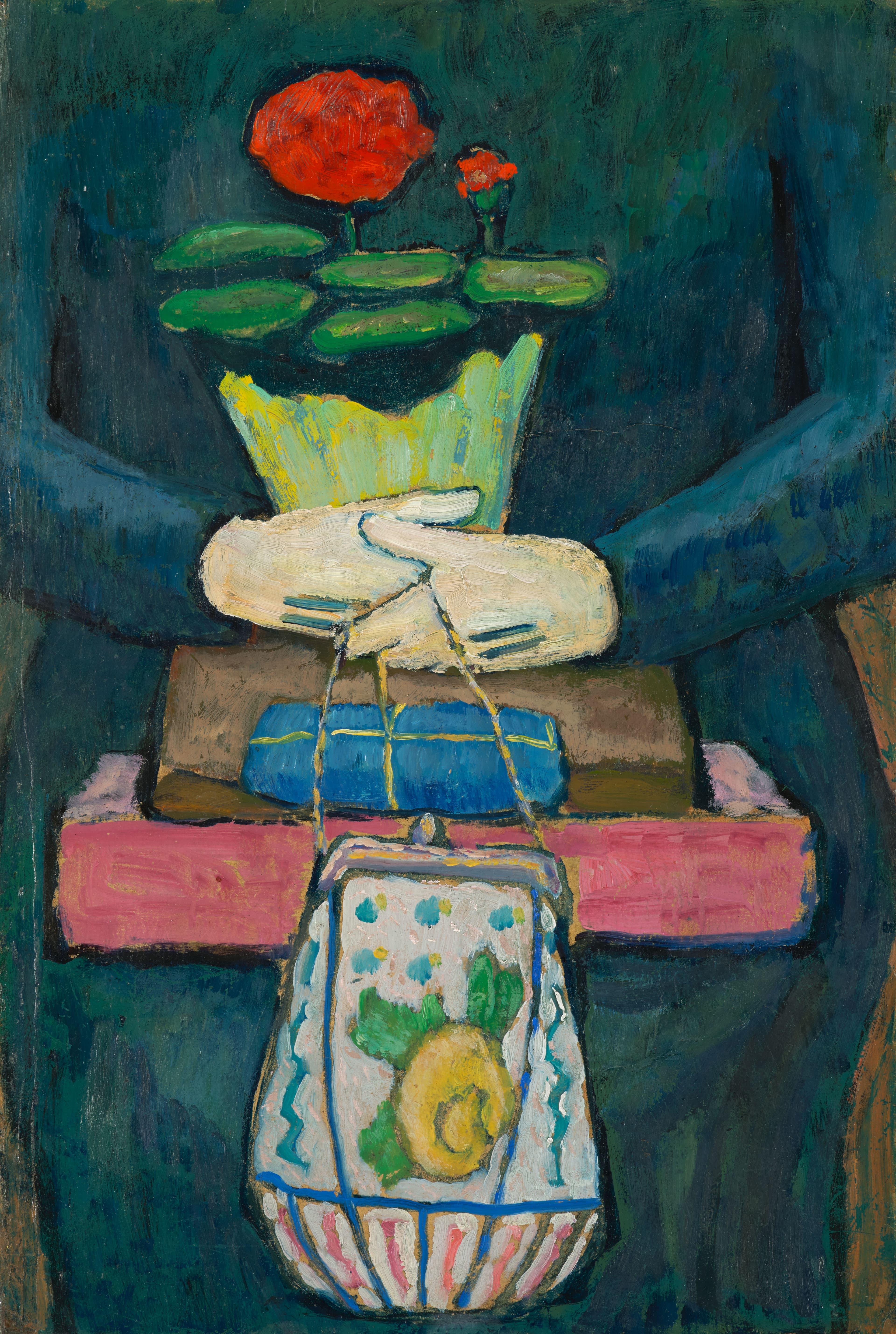
Gabriele Münter, Still Life on the Tram (After Shopping), ca. 1909–12. Painting on board, 19 ¾ × 13 ½ inches. © 2025 Artists Rights Society (ARS), New York / VG Bild-Kunst, Bonn.
Word count: 1448
Paragraphs: 11
Guggenheim Museum
November 7, 2025–April 26, 2026
New York
A visit to Munich in early 1913 prompted the American painter Marsden Hartley to write his fellow artist Alfred Stieglitz back in New York. “The new German tendency is a force to be reckoned with,” Hartley reported excitedly, “to my own taste far more earnest and effective than the French intellectual movements.” It is impossible to say with certainty which artists in the Der Blaue Reiter (The Blue Rider) circle—the nexus of Munich’s modernist fervor at the time—commanded his attention most intensely. Yet to look at Hartley’s Portrait of a German Officer (1914) or Painting No. 48 (1913) is to recognize the unmistakable echo of Gabriele Münter’s swatches of flattened color bounded by heavy black outlines. Asserting both the materiality of solid objects and load-bearing surfaces and, with the very same strokes, delighting in the pleasure of mere pigment as the agent of its own material world is the painter’s legacy.
The Guggenheim’s survey helps place Münter (1877–1962) back at the center of modernism’s early twentieth-century development—a role still frequently eclipsed by her erstwhile partnership to Wassily Kandinsky and his outsized legacy. While it possesses several dozen works by the latter, the museum owns only one canvas by Münter, the striking Snow-Covered Fir Tree (1933), duly included in the exhibition. Just as her artistic efforts pre-dated her relationship with Kandinsky, they outlasted its end. Curator Megan Fontanella goes some way in presenting the full breadth of Münter’s activity in Germany, where her career began and ended, and also Paris, Copenhagen, and the United States. The latter residency sparked notable photographic experiments at the century’s turn; examples on display here shed further light on a professional trajectory often obscured in its nuances and consequences.
Münter played prominent roles in the Neue Künstlervereinigung München (the city’s first prominent Expressionist organization) and its breakaway successor, Der Blaue Reiter. She served not merely as a painter, but as the uncredited photo editor of the group’s eponymous journal, a clearing house for a staggering range of avant-garde artists and critics both local and international. Though Hartley’s dismissal of “French movements” is somewhat subverted by the multinational cross-pollination that happened in the pages of this journal, his demotion of cold “intellect” in favor of a heartier “earnestness” underscores some undeniable dimensions of Münter and Kandinsky’s respective and influential experiments before World War I. Their visions bound up not only with landscape, but with lingering, late Romantic notions of intuition and inner experience. If Kandinsky would increasingly pare back the figurative and material vessels of the spirit, Münter kept hers doggedly rooted in what she called “the contours of a world.” Sunset over Staffelsee (ca. 1910) liberates the contours of its yellow clouds into a play of glowing bands and conflates the colors denoting water and mountain peak. Yet the stark silhouette of a lone island yanks those metaphysics back down to earth.

Gabriele Münter, From the Griesbräu Window, 1908. Painting on board, 13 × 15 13/16 inches. © 2025 Artists Rights Society (ARS), New York / VG Bild-Kunst, Bonn. Courtesy Städtische Galerie im Lenbachhaus und Kunstbau München.
The proverbial “Murnau era” refers to the period before World War I when Münter—along with Kandinsky and the fellow artist-couple Alexej von Jawlensky and Marianne von Werefkin—lived and painted in the Bavarian market town of Murnau am Staffelsee. The exhibition’s introductory selection of landscapes not only underscores the genre’s importance to Münter’s earliest work as a painter, but its enduring prominence, juxtaposing the large The Blue Gable (1911) next to Blue Lake (1954). The later painting not only echoes the earlier image’s electric blue, but reveals the reliably thick black lines with which the artist consistently organized her forms. In The Yellow House I (1911), those delineations frame a leafless tree, its trunk and branches plumb with the façade of a house, seemingly part of its very surface. A similar tree appears in the foreground of The Blue Gable, at once rising as a lone object and tessellating patches of color like stained glass.
Settling into thematic sections, the exhibition subdivides Münter’s corpus into landscapes, still lifes, and portraits, affording an in-depth look at her approach, but also strong-arming certain images into classifications they defy. Some of Münter’s titles have been taken too dutifully at their word. With its wonky green table, array of framed paintings, and pair of sculpted figures set in its right foreground, Still Life with X Beer (1914), for instance, forms more of a landscape than its title might suggest. If Still Life on the Tram (After Shopping) (ca. 1909–12) falls short of portraiture in its radical cropping of the figure’s body, the composition seems playfully and almost purposefully to flout its designation.
The exhibition sheds welcome light on Münter’s relatively understudied photographic practice, first pursued when she visited the United States in 1898 to visit extended family. Though she would later marvel at the country’s “endless landscape,” her shots home in on tightly arranged scenes and figures in Texas, Missouri, and Arkansas. During her two years residency in these states, Münter trained her camera not only on bucolic scenes and German Americans, but also Black subjects, from boys on the street in St. Louis to Three women, Marshall, Texas (ca. 1900). The medium’s intrinsic lack of color facilitates a concentration on Münter’s choices of content and form, and it is impossible not to find anticipations of subsequent paintings in her backlit pine trees or parasol-bearing lone figures along the Mississippi. Yet the exhibition makes a strong case for her photographic work bearing its own set of aesthetic, personal, and cultural contingencies. In the event, Münter also practiced drawing in her American sketchbooks and would dedicate herself fully to painting upon returning to Germany. Her stubbornly unliterary painting titles—from Interior (1908) to Snowy Landscape with a Red-Roofed House (1935) to The Blue Lake (1954)—retain a whiff of photographic matter-of-factness.

Gabriele Münter, Head of a Young Girl, 1908. Oil on board, 16 × 13 inches. Courtesy Des Moines Art Center, Mildred M. Bohen Collection. © 2025 Artists Rights Society (ARS), New York / VG Bild-Kunst, Bonn. Photo: Des Moines Art Center.
World War I, and the end of her relationship with Kandinsky after 1917 shifted Münter’s trajectory as an artist and as an individual. Though she showed one hundred and twenty works in a major Copenhagen exhibition in 1918 and continued to tackle new approaches to painting, the Guggenheim’s presentation strangely jumps from 1917 to 1930, eliding over years when Münter not only kept painting her beloved Staffelsee landscapes, but lived and worked in Berlin and Paris. 1930 formed her most productive year since 1911, however. Scaffolding (1930) comes as something of a revelation amidst this flurry of activity. Backlit against a yellow-tinged sky at dawn or dusk, a black construction platform bears workers reduced to silhouetted automata. The spindly crispness of the image’s execution, and the decidedly urban sense of unease—with individuals isolated pictorially and affectively—reveals a close proximity to the Neue Sachlichkeit (New Objectivity) tendencies then prevalent in Germany’s modernist circles. The affinity did not last long. Whether in her landscapes or portraits of the 1930s, Münter soon proved as uninterested in the movement’s “literary” inflections as in the meticulous brushwork which characterized so many of its examples.
The rise of Adolf Hitler saw Münter’s images briefly caught in the strange bureaucratic and propagandistic limbo of a regime tightening its ruthless authority. A 1936 traveling exhibition, The Streets of Adolf Hitler in Art, included one of her works, though the following year would find her former Der Blaue Reiter colleagues pilloried in the “Degenerate Art” exhibition. Münter summarily hid a large cache of her works in the basement of her Murnau home as a safeguard against Nazi confiscation. Following the regime’s downfall, her earlier work enjoyed a renewed reception at both the 1950 Venice Biennale and the 1955 edition of documenta. The exhibition does not address the later decades of her career, and one wonders what it would have made of a work like the Maschkera (1940), with its mesmerizing assortment of carnivalesque figures, defiant of anything resembling portraiture.
“I extract the most expressive aspects of reality and depict them simply, to the point, with no frills … The forms gather in outlines, the colors become fields, and contours—images—of the world emerge.” If Münter’s reflection helps guide us through the dazzling record of those forms, her words also leave us (productively, tantalizingly) uncertain as to where the weight lies in them: on the expressiveness, or the lack of frills? The claim to “simplicity” undersells her shrewd and nuanced interpretations of reality. Yet her particular modernist vision lies in the unfussy intensity of her pictures. With its striped rug and wayward slippers and a paramour loafing on the bed—visible at left almost as an afterthought —her Living Room in Murnau (Interior) (c. 1910) looks as if it could have been painted yesterday. This exhibition allows the rightful delectation of many stunning individual works, while appearing at once too rigid in its divisions and half-hearted in their upshot.
Ara H. Merjian, is an art historian and Professor of Italian Studies at New York University.