Michelle Lopez: Shadow of a Doubt
Word count: 912
Paragraphs: 11
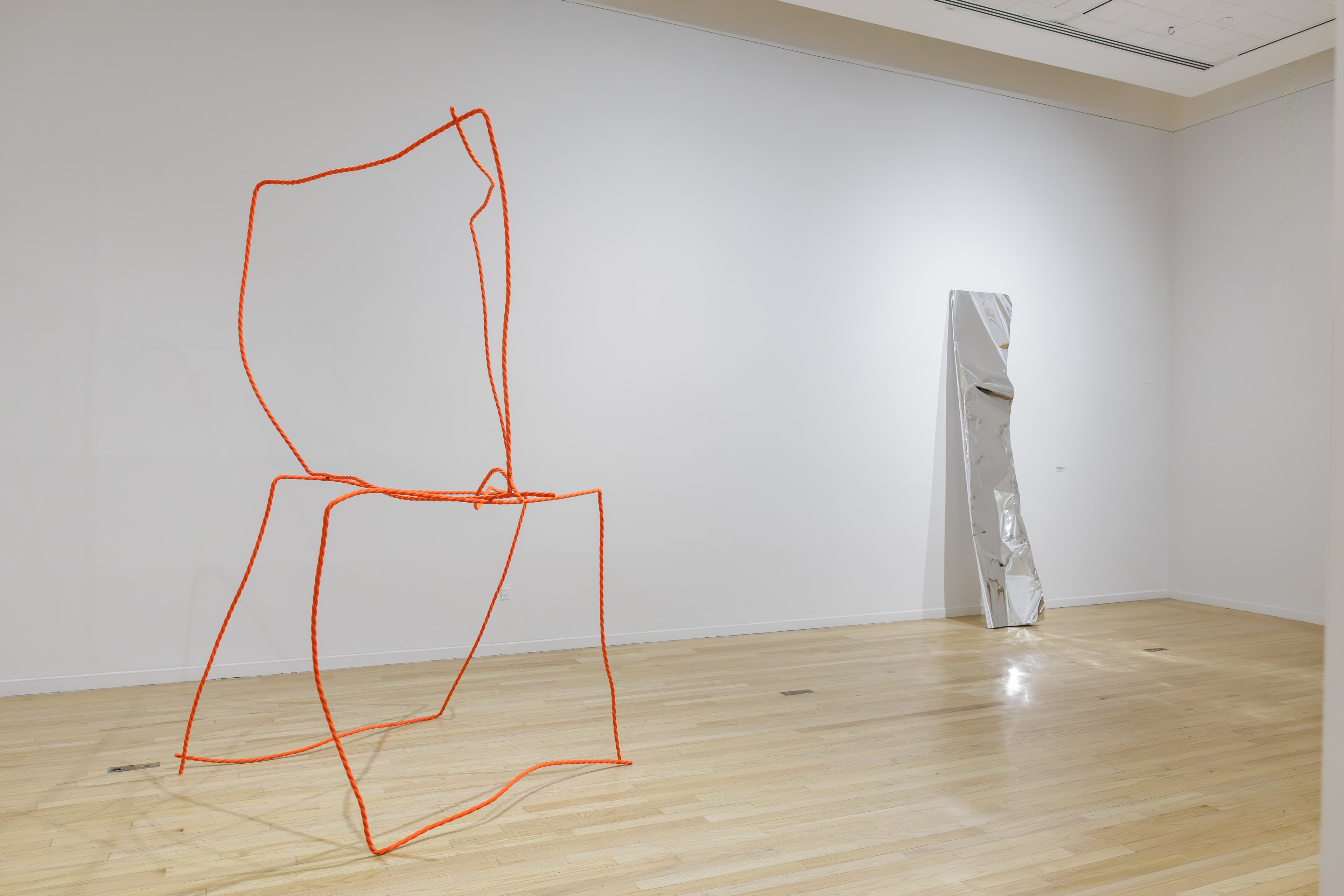
Installation view: Michelle Lopez: Shadow of a Doubt, Tufts University Art Galleries, Medford, MA, 2026. Courtesy Tufts University Art Galleries.
Tufts University Art Galleries
January 15–April 19, 2026
Medford, MA
We currently exist in a world of revved-up, petrifying anxiety. Communities of color, LGBTQ+ people, immigrants, and women have long lived with fear-inducing dread. Over the last twenty years, Michelle Lopez has addressed this inequity by infusing political content in her practice of minimalist sculpture. Michelle Lopez: Shadow of a Doubt, a mini-retrospective at Tufts University’s Aidekman Arts Center curated by its director, Dina Deitsch, takes on the duality of being visible and invisible in service to a post-capitalist world and the powers that administrate it by exposing the fragility of our systems through fragile materials that appear to be virtually indestructible.
Lopez, a woman of Filipino descent born in Bridgeport, CT, is motivated by both personal experience and historical precedence. She unmasks the plight of being seen through racist and chauvinist eyes using contemporary art genres including Minimalism, gestural drawing and painting, and Conceptual art. The resulting works are simultaneously exquisite and chilling.
Utilizing industrial materials such as metals, rope, and glass—on the supports and mediums of the male-dominated arena of Minimalism—Lopez flips the traditional practice of stripping the artwork of all human touch or emotion by imbuing each piece with its conceptual identity and emotional touch points. A virtuoso of space, her sculptures feel like fragile, three-dimensional line drawings. These are not monuments of steel—nature-defying machismo slabs—but transparent cubes that seem on the brink of collapse.

Installation view: Michelle Lopez: Shadow of a Doubt, Tufts University Art Galleries, Medford, MA, 2026. Courtesy Tufts University Art Galleries.
One of the first pieces encountered upon entering the exhibition is Smoke Cloud VIII (2016). Though the work originated ten years ago, it is impossible not to see in it the clouds of toxic chemicals sprayed at demonstrators during recent ICE raids. In this work, Lopez used silver nitrate: a substance employed in archaic photographic processes and to manufacture mirrors. Poured onto architectural glass, the nitrate was used to manipulate the surface. Lopez used an air pressure wand as a tool in a manner similar to using a brush, then exposed the surface to ultraviolet light. The finished artwork is stunning, and has all the hallmarks of painterly gestures of clouds and remnants of mirrored glass until the viewer stands in front of it. Suddenly, the viewer becomes part of the chaos. What appeared to be an abstraction becomes a realistic self-portrait of the viewer subsumed into mayhem. On the adjacent wall are two 11-by-14-inch drawings, Smoke Cloud Study (2020), created after the sculpture was finalized. Her drawings, exhibited for the first time, highlight Lopez’s facility for drawing and painting while maintaining a commitment to the nature of the materials, whether it be ink, pastel, gouache, or paint.
“Blue Angels” (2011–12) is a series composed of public art, sculptures, and drawings named after the predominately male aviation squadron formed to demonstrate the power and excellence of the US Navy while recruiting civilians. Blue Angel (Delta) (2012)—composed of mirrored stainless steel, automotive paint, and powder-coated aluminum—barely resembles a commercial sleek aircraft. Instead, what appears leaning against the gallery wall echoes a large piece of mangled refuse removed from a wreckage site. To add to the intensity, much like Smoke Cloud VIII, the viewer’s image is reflected in the mirrored stainless steel. Everyone looking at the piece is part of the work, the wreckage, and the consequences.
In the rear gallery, though, the works are listed as individual pieces. Michelle Lopez has created the quintessential installation by providing the physical sensation of walking into an artwork. Two, fifteen-foot new “Blue Angels” ultramarine drawings grab the corners of the back wall, top to bottom. Velvety flocked ropes crawl and climb through the middle of the space, creating sculptural space merely by their placement. The ropes also defy their assumed identity by the nature of their soft luxurious texture. Installed on the walls are smaller renderings, also part of the “Blue Angels” series. Each of these drawings are the epitome of minimalism, but it is clear that this work through its simplicity carries the emotional content of the larger sculptures in this series. A video further cements the importance of the audience by recording physical responses to the exhibition.

Installation view: Michelle Lopez: Shadow of a Doubt, Tufts University Art Galleries, Medford, MA, 2026. Courtesy Tufts University Art Galleries.
Most often, artists who infuse their work with a political point of view end up with didactic, preachy, and sanctimonious results. Their dogmatism takes primacy over the actual execution of the work. In Lopez’s case, she uses the essence of the materials and alters their identity to bring her sculptures to fruition.
For example, in the “Blue Angels” series, the idea of metal being a male-centric material is deconstructed by Lopez, using her body to crunch, dent, and manipulate large aluminum pieces as though they were origami. The final results evoke salvage from devastating events, such as 9/11 or plane crashes. This is the antipathy of the patriotic image of buildings and planes built to give the impression of invincibility.
Lopez sees the room, the space, the way most artists see the paper or the canvas. A mark or a line creates the work, only in her case, material placed in a space are the beginning of a 360-degree drawing that most often includes the viewer as part of the art whether through reflection or being enveloped in the work. It is the ultimate visualization of the question, “Which side are you on?” This is not an exhibit to run through. Make an effort to spend time you won’t regret it.
Sara Farrell Okamura is a contributor to the Brooklyn Rail.