Word count: 1328
Paragraphs: 14
With sufficient resolution, a snapshot of any object moving through time and space at even the highest velocity will make it look like it’s standing still. A record album is that kind of snapshot. An object with finite dimensions and duration, it freezes music in time and mostly outside of context of the musicians’ contemporary circumstances, even the session itself. The longer it’s around the further the distance from that context. That’s what makes Miles Davis’s Kind of Blue, one of the most famous albums of all time, the one jazz album that people who don’t listen to or even like jazz have in their collection, so deceptive. The focussed, obsidian gleam of the music is like a sculpture, something for the listener to circle while it remains motionless. The truth is that the album is a still image of an artist who was moving through the music toward a point several years in the future.
Kind of Blue was recorded and released in 1959, an annus mirabilis for recorded jazz, and in the context of Miles’s career is more the end of something old than the start of something new. The music that he made in the 1960s with his second Quintet is some of the most sophisticated, complex, and artful of the entire modern era of recorded music. It is also the pinnacle of what modern jazz is and can be, the unique mix of absolute popular music with absolute art music, at times equalled but never surpassed. The Quintet—Miles, Wayne Shorter, Herbie Hancock, Ron Carter, and Tony Williams—is the finest small jazz ensemble in the history of the music so far.
This group also had a relatively short, compressed duration. After John Coltrane left the first Quintet after the 1960 tour, Miles cycled through several tenor saxophonists, including George Coleman and Sam Rivers. Neither were quite right. Shorter replaced Rivers while the group was on tour in Europe, his first chronological appearance is on Miles in Berlin, recorded live September 25, 1964 and released February 1, 1965 (the twist and turns of label releasing mean the live albums that sequentially followed, My Funny Valentine and Four & More, were with Coleman, recorded February 12, 1964, and Live in Tokyo, recorded July 14, 1964, with Rivers).
These five were together for less than four years; in June, 1968, they lay down three tracks for what would be Filles de Kilimanjaro, the rest of the album complete a few months later with Chick Corea, Dave Holland, and Jack DeJohnette—with Shorter, the so-called and short-lived, but furious “Lost Quintet,” playing just a hair’s breadth from free jazz and foreshadowing the post—Bitches Brew electric bands of the 1970s.
In that window, the Quintet pioneered a type of jazz that had never been heard before and, despite many, many attempts at imitation, has never been heard since. The music was more radical than anything being made by Cecil Taylor or Ornette Coleman, and the fact that, on the surface, it doesn’t sound that way, is one of the radical features. The strange course of academic music—and the academicized critical treatment of same—in the 20th century has created the impression that avant-garde, experimental, or really any kind of adventurous music is dissonant or atonal, discontinuous, formless or chaotic in some way, challenging or even unpleasant to the ear. This can be true, but in no way has to be true, and obscures the fact that aesthetically and expressively beautiful music can also be radical.
There’s little more radical an artist can do than abandon what they’ve done and move on to something new, to fight off the past. That was Miles’s entire life as an artist, and this group was committed to that. As an art form, music is placing, ordering, and shaping sounds in time. The fundamental question is less the quality of the sound than how it’s formed. Typical songs are formed with predictable order. This group ignored all previous notions of order in jazz and most of Western music.
It wasn’t that they broke the rules, but that starting from scratch they reformulated them with non-functional harmonies that set moods and improvisatory directions without a binding form, that reduced a theme down to gestures, that took the possibilities of pre-established material as building blocks for spontaneous group compositions more seriously and far deeper than any theoretical principles argued for. Shorter and Hancock were indispensable for their modernist composing, Williams for single-handedly creating modern drumming at age seventeen. Miles, perhaps also the greatest bandleader in jazz history, edited and arranged the music with the goal of always simplifying and pointing the group toward the future.
The future was in part the modal idea he popularized with Kind of Blue. While the jazz world was trying to figure out how to follow the example of that album, he was incorporating the idea of modality into his aesthetic essence. The difference between modality and standard jazz is subtle but vast. Songwriting for practical purposes is tonal, i.e. set in key signatures like E-flat major and moving through sequences of vertically organized chords before reaching the end on the satisfaction of returning to the key. You can hear and feel the finality of the end of the final bar, sense it approaching each go round.
Tonality is vertical segments along a line, modality is horizontal movement through time anchored around a single pitch. There’s some appropriateness in Western music that modality came from an era before mechanical timekeeping, when life seemed more circular. There might be any number of measures in modal themes or bass lines, and things never have the end point finality, they keep cycling back to the fundamental note until the music stops. Tonality is a box with neat sides that holds events in, modality is like a baseball field, a two-sided triangle with an outfield fence that arbitrarily marks a stopping point.
That open-endedness, compelled forward, was Miles himself.
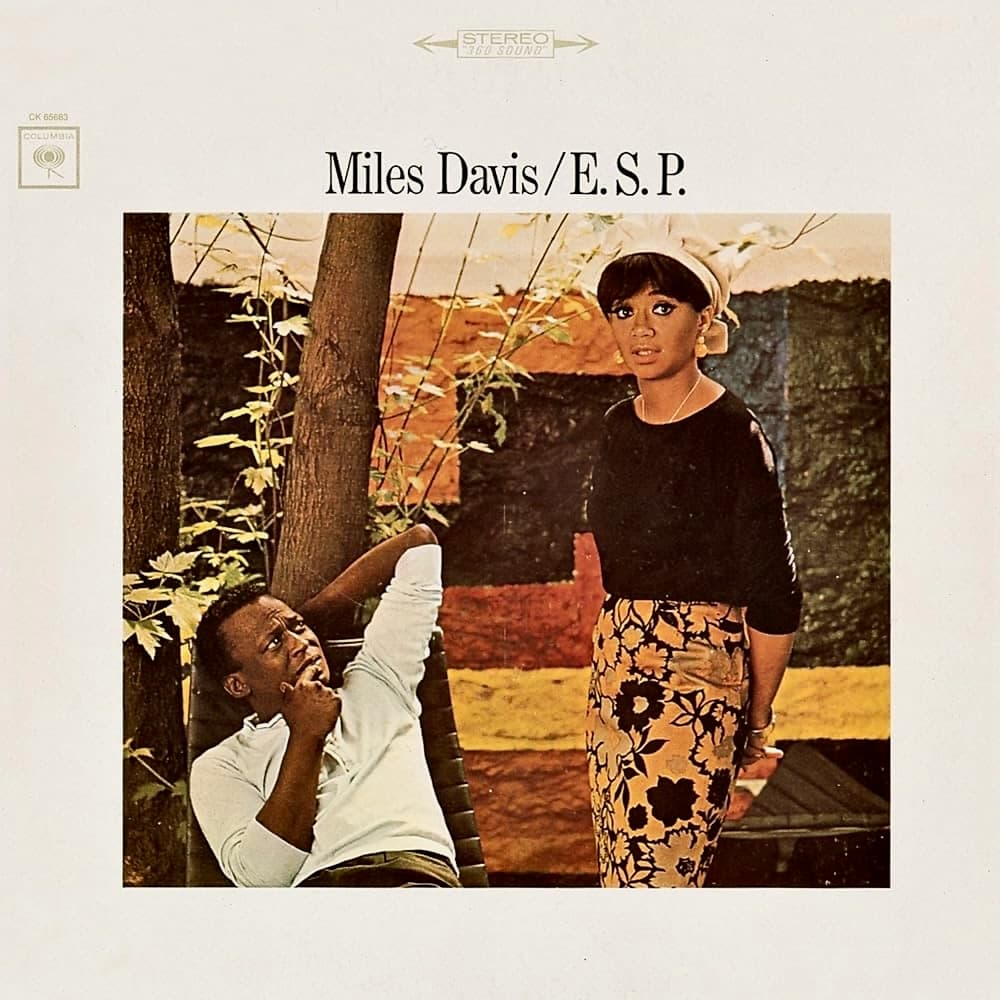
The studio albums from this period—E.S.P., Miles Smiles, Sorcerer, Nefertiti, Miles in the Sky—are deeply beautiful and expressively complex and elusive. Most of the tracks are in Miles’s favored middle register, with measured tempos (with a few faster, more aggressive tracks like "Freedom Jazz Dance"), a beguiling dark timbre, and more space inside the playing than before. There’s also a fascinating porousness between the studio music and what is now a substantial live documentation, thanks to the Columbia vaults and Sony’s reissues and Bootleg Series releases. The studio was the place for experimentation, at times extreme like in the cyclical minimalist drone piece “Circle in the Round”—recorded in 1967 but not released until the 1979 compilation of the same title—which is Miles meets Terry Riley and La Monte Young. More than adding the electric piano or the musicians of the “Lost Quintet,” this track is the bridge from 1964–68 to In a Silent Way and Bitches Brew.
Live, the band is both more traditional and even more revolutionary. Even with modal form, Miles still had his bag of favored tunes, like “I Fall in Love Too Easily” and “My Funny Valentine,” they run through the Complete Plugged Nickel, Live in Europe 1967 and Miles in France: 1963 & 1964 Bootleg sets. The other thing happening live, though, is the ongoing discovery of new ways to play jazz, especially coming from the rhythm section, and particularly Hancock. The pianist is incredible on these sets, accompanying Miles’s and Shorter’s solos by essentially creating entirely new musical forms beneath them.
The variety, imagination, and expansiveness in the Quintet’s playing and creativity is mind boggling. Live it comes bathed in fire, Miles’s own playing growing more extroverted through the years despite an accumulation of physical ailments. That the studio albums are quieter, introverted, isn’t contradictory but complementary. One listen to the Miles Smiles sessions on the Freedom Jazz Dance Bootleg reveals a relaxed, loose bunch of musicians who, when they start playing, speak with the concentrated and abstract language of historical geniuses.
George Grella is the Rail's music editor. He is the author of Minimalist Music and Miles Davis' Bitches Brew (Bloomsbury).