Word count: 1335
Paragraphs: 13
Miles in PVC. Miles sporting extraordinarily gargantuan shades. Miles with tight curl coif. Miles with a wah-wah pedal. Miles on overloaded organ. Miles entering yet another of his musical phases, although this was to be more clearly delineated, particularly by its eventual mid-1970s curtailment, as Davis’s health moved into a marked decline. The dawn of electricity was right at the close of the 1960s, as Miles turned on his sound via a trio of amplified keyboardists (Herbie Hancock, Chick Corea, Joe Zawinul), and with John McLaughlin on electric guitar. Gently hinting at soon-coming sounds, the lucidly trawling In A Silent Way was a spangled ambient entry drug for the next five or six years of transcendence, with the increasingly hectic, distorted, pulsating, intuitive work soon to follow.
Miles would create with an ever-sprawling posse of players, perfectly selected, as his music stretched out in time, grew into repetitive, compulsive vamps, reeked of free-form experimentation and sculpted surprise. Some of the gang just switched on the power, exploring serrated amp-textures, while others were newly appointed to the Miles palette of cosmic extensions. Miles was not closely composing, but rather acting as the hot-wired ringmaster, electro-prodding tigers, termites, and elephants into the ring. His ears were opening even wider, as his Karlheinz Stockhausen and Ravi Shankar listening habits infiltrated the approach to extended instant composition. These forays into the electronic side of the German composer's work, and the revered Bengali classical improvisations of the sitar maestro became key elements in the swirling panoramas. Interbred and re-born in Miles’s mind’s eye, his sound became Karlheinz Shankar and Ravi Stockhausen. Some folks might insist on using the word “jamming,” but the extra input of scissor-man producer Teo Macero inserted a hallucinatory collage of splicing dynamism. The vast majority of LP tracks hung around for twenty minutes or so, allowing a.) the savoring of amassed rhythm intensities or b.) the glorying in crackling frequency-maxed solos, particularly courtesy of incongruous axe maniac McLaughlin and Davis himself, almost going as far as disguising the very core nature of his horn, marrying with the guitar, sharing sonic crackling territories.
There were other significant movements, with the bass clarinet of Bennie Maupin adding a startling tone and texture richness. Miles also encouraged his percussionists, who arrived from Brazil (Airto Moreira, Hermeto Pascoal), the sound of the cuica magnifying the off-road freedoms. Soon, there were infusions of Indian classical music, those string sounds cumulatively lending a psychedelic aura. The Miles mix-head spanned the entire globe.
Davis seemed to be guiding, via his very studied presence, or even his absence, allowing his players free rein, presumably until they chanced upon a section that he didn't dig. Miles could only manage this through his finely-honed sense of artist selection. Other composers and songwriters have also orbited around similar spheres, with Frank Zappa, Art Blakey, Captain Beefheart, Sun Ra, and John Zorn being examples of our great manipulators. Zappa grabbed most of the open improvising space for his own guitar solos, mostly disciplining his bands into extremely structured complexities. Zorn is similar. Blakey was more of a traditional mentor-figure. Ra and Beefheart coaxed their members into domestic house-sharing, the latter allegedly a demanding dictator, although when we hear how different versions of The Magic Band adopted similar styles, we have to accept that Don Van Vliet’s methods reaped ecstatic fruitiness. Sometimes, a casual posture leans beside strict upright marshaling.
Returning to the Miles crew, McLaughlin is cutting, strafing, chirping, and churning, his guitar sounding heavy, almost lumbering, notably dominant on A Tribute To Jack Johnson. With the Silent Way keyboard build-up, had Miles heard Philip Glass, or was that ole taxi driver prompted by Miles? Jack DeJohnette drives crazily on the (excitingly) prolonged, ferocious climax of "What I Say." In the 1970s, the leader himself had been totally freed, with more time given to develop labyrinthine trumpet solos, pushing through manual deformities, but largely bending, breaking and fragmenting with the aid of effects and/or wah-wah manipulation, combining flesh and flash. His phrases have a strong rhythmic attack, almost percussive in nature, but there is also regular space for abstract paint-strokes.
As Miles laid the foundations of jazz fusion, and particularly its funk-groove direction, he would not always be matched by his successors, as many acts during the 1970s and particularly the 1980s began to dilute the template characteristics to replicate sounds heard in a music-gear shop, all mechanoid or neutered. We can confirm now that Miles made some of the most vital fusion ever, these LPs still possessing the power to thrill and excite with zero compromise. If anything is dated by passing decades, it's usually in a stylish way, but mostly the Miles seventies oeuvre has the flashfire vitality of something formed freshly in the last few months.
Jazz listeners appeared worried at the time, but in other zones there had already been even more shocking developments. Imagine hearing Freak Out!, by The Mothers Of Invention, when it first came out in 1966! Ears had also been inflamed by White Light/White Heat (The Velvet Underground, 1968), by Trout Mask Replica (Beefheart, 1969) and the first LP by The Stooges (also 1969). In jazz itself, there had been freeness aplenty, but perhaps not so much electrification. Any cautious rejections must have been due to the established mainstream popularity of Miles, or maybe the use of groove repetitions alongside improvisation.
These 1970s Miles LPs take on a heightened potency when spun in sequence, one after the other, conjuring cosmic vistas of extended musical swordplay. We can hear “Pharaoh’s Dance” as a continuation of Silent Way, opening up Bitches Brew with its dense groove, as the horns parade, not least the bass clarinet of Maupin, answered by a frazzled Miles, the substantial inter-weavings continual. Although McLaughlin is dominant on Jack Johnson, Herbie Hancock lays down some of his most wired organ ever on “Right Off.”
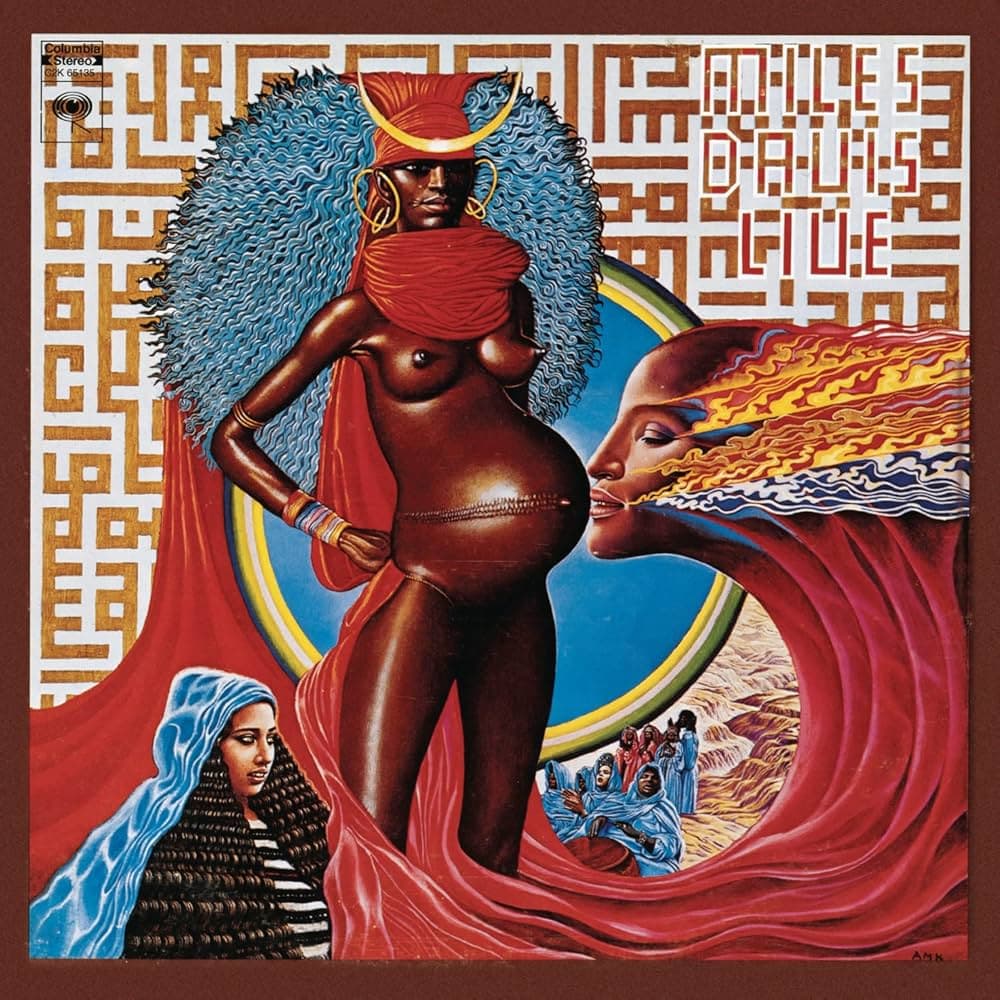
Courtesy of Macero, Live-Evil is live and not-live, as the producer/cut-up-artist splices multiple sessions. There are rapid schizo-changes on “Sivad,” from swift trio to reclined peace, and “What I Say” has no lack of cowbell or cuica. Two platters were also needed for Big Fun, which is similarly extended, sounding like the seventies concept had now evolved to something almost finished, as its instrumental array stands in an organized line, its production anticipating the 1980s. By 1974, these electro-miasma tactics had become more refined and ingrained. “Recollections” is a languid stand-out.
As the electric period came to a natural pause, Miles on the brink of a five year recovery spell, he'd ended up with the Pangaea and Agharta albums, both recorded live in Osaka, and both reeling to the deliberately out-there guitar solos of Pete Cosey and Reggie Lucas. Somehow this upset some more old listeners, doubtless bereft of the skills needed to consume slowly developed musical events. Loose, yes, but nonchalantly groovesome. Cosey had an obviously fond regard for those heady 1970s road days. “Miles was pretty much into everything,” Cosey enthused to your scribe back in 2008, “he was listening, but he would also have an understanding of other cultures.
“He was very highly educated, and he came from a family that was very highly educated. A lot of people don't know that, they just saw someone that looked cool, sitting there wearing a pair of shades, and had no idea about the depth of his perception. Miles knew so much that was happening on this planet. When he approached stuff, it was not by happenstance. He knew what he was after. In ’75, he had a ball socket operation. He had been quite ill. At the time I came in, he was still on crutches. He had a car accident in '72, and I joined in ’73. He was in a lot of pain, and a lot of people don't understand that. We toured for two years, and then he took off to have that operation.”
Martin Longley is frequently immersed in a stinking mire of dense guitar treacle, trembling across the bedsit floorboards, rifling through a curvatured stack of gleaming laptoppery, picking up a mold-speckled avant jazz platter on the way, all the while attempting to translate these worrying eardrum vibrations into semi-coherent sentences. Right now he pens for Down Beat, Jazzwise, and Songlines.