Word count: 1000
Paragraphs: 14
When Miles Davis reemerged blinking into the light after five years of, in his words, “[taking] a lot of cocaine... and [fucking] all the women I could get into my house,” he was ready for a change. As he said in his autobiography, “I wanted to play music, but I wanted to play it differently than I had in the past and I also wanted to play in big halls all the time instead of in little jazz clubs.” He was ready to be a star. And in the decade that followed, from 1980 until his death in September 1991, he didn’t just pursue stardom—he attained it.
Davis had always been hip, and had often defined the musical cutting edge, but now he wanted to be famous, a pop culture icon. He dressed in almost sci-fi fashion, appeared on talk shows and acted on Miami Vice, recorded versions of pop songs, performed with Prince, made a commercial for Honda scooters, shot a music video with Spike Lee and guest hosted on VH-1, and indeed his performances were held in theaters and stadiums, not jazz clubs. Miles Davis made it big in the eighties, and his music got bigger, too. The intimacy and subtlety of the 1950s and 1960s acoustic quintets were gone, replaced with expansive, garish, show-band gestures. But just when it seemed like he was being underestimated by jazz-snob critics, he could—and would—cut a listener to the bone with a single phrase.
The ten tracks below represent different facets of Miles Davis’s music of the 1980s, and show that he kept shifting, moving, and innovating all the way to the end:
“Fat Time” from The Man With The Horn (Columbia, 1981)
This track opens Davis’s 1981 comeback album, and it’s the sound of him severing ties with his past. Marcus Miller’s Fender bass and Al Foster’s blues-march drumming construct a thick, rumbling groove. Miles enters, playing soft and bluesy through his trademark mute. But after five minutes or so, following a soprano sax solo from Bob Berg, guitarist Mike Stern takes over, and totally transforms the music with a screaming hard-rock solo that’s pure attack.
“Jean Pierre” from We Want Miles (Columbia, 1982)
When Davis hit the road, he had a tight street gang of a band: saxophonist Bill Evans, Stern, Miller, Foster, and percussionist Mino Cinelu. “Jean Pierre,” built around a hypnotic melody as simple and memorable as a nursery rhyme, allows them to vamp for over ten minutes, with plenty of solo space granted to Stern, as Miller—the most prominent instrument in the mix—pops and booms. Davis’s playing may be minimal, but it’s got real bite.
“Speak” from Star People (Columbia, 1983)
Star People was Davis’s weakest album of the eighties, devoting a third of its running time to its aimless blues jam of a title track. Still, this is a hard funk-rock cut with a big, hooky melody and showcasing guitarist John Scofield, and it features Davis playing both trumpet and synthesizer. It would remain a fixture of his concerts throughout 1983 and 1984.
“Code M.D.” from Decoy (Columbia, 1984)
Decoy is Davis’s high eighties pop album; keyboardist Robert Irving III, drummer Foster, and percussionist Cinelu mix live and programmed rhythms, propelled by Darryl Jones’s thick, aggressive funk bass. “Code M.D.” opens with shimmering synths that could have come off Madonna’s debut album (produced by Davis’s 1970s rhythm guitarist, Reggie Lucas). Scofield solos first, then saxophonist Branford Marsalis, with Miles batting cleanup.
“Time After Time” from You’re Under Arrest (Columbia, 1985)
On You’re Under Arrest, Davis wanted hits, and he got them. His versions of Michael Jackson’s “Human Nature” and Cyndi Lauper’s “Time After Time” (set to a lightly ticking reggae beat anchored by Jones’s liquid bass) became live staples, and can still be heard on smooth jazz and Quiet Storm radio today. His way with a ballad hadn’t diminished a bit since the 1950s, and he makes this song ache.
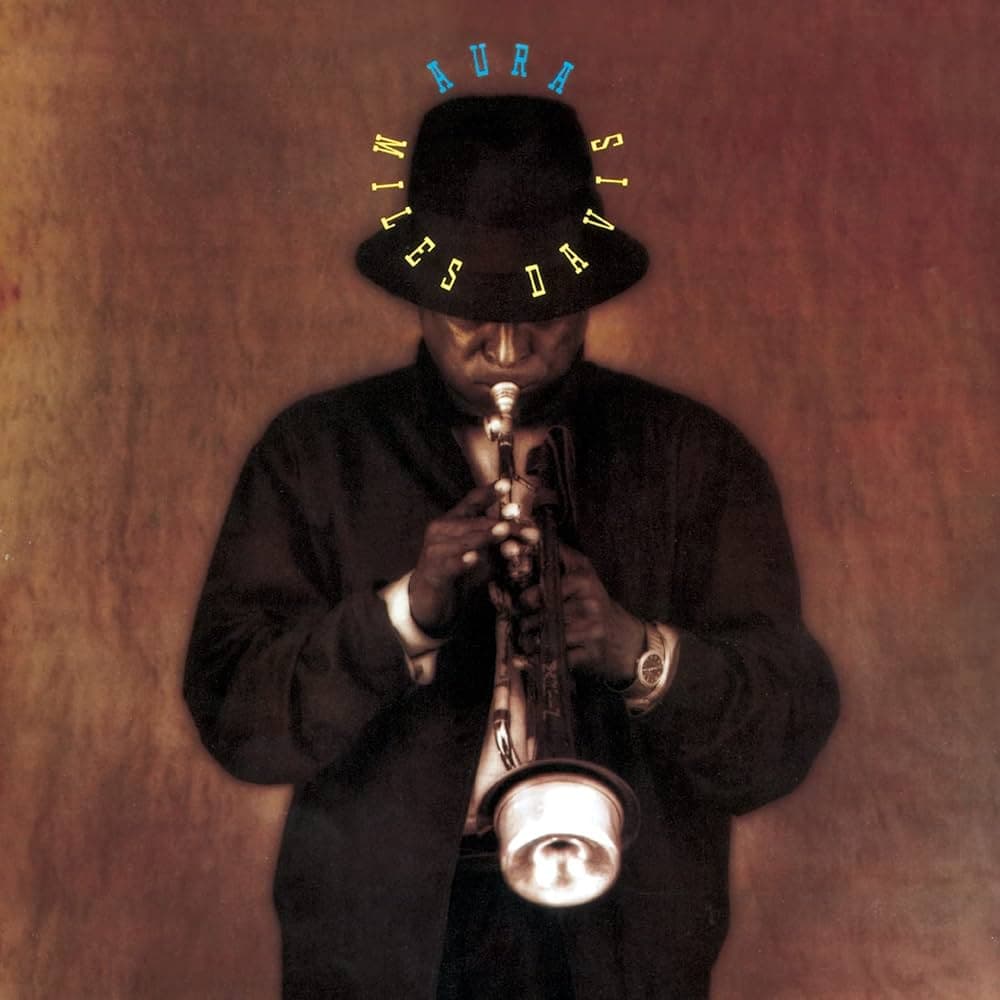
“White” from Aura (Columbia, 1989)
Recorded in 1984 but shelved until 1989, Aura was an orchestral tribute to Davis composed by Palle Mikkelborg that combines jazz, classical, rock, and surprisingly avant-garde electronic touches. On “White,” the trumpeter’s horn is isolated at first, with only a deep electronic chord or a single instrument shadowing him, but this makes his playing even more emotive and powerful. This fascinating, genre-less music is closer to the Nordic soundscapes of ECM than anything else in Davis’s catalog.
“Tutu” from Tutu (Warner Brothers, 1986)
Tutu would have been a radical gesture from anyone; coming from a sixty-year-old jazz icon, it was stunning. Entirely studio-created, the tracks feature Davis playing over synth and drum-machine grooves created by Miller. The title track simmers and bounces, so cold it’s almost post-human; you can imagine puffs of frozen breath coming from the bell of Davis’s muted horn.
“Big Time” from Amandla (Warner Brothers, 1989)
The last studio album completed in his lifetime, Amandla found Davis experimenting with rhythms from Africa and the Caribbean, and bringing more musicians into the studio than he had on the sparse Tutu. One of its strongest tracks was “Big Time,” on which his live band, most notably drummer Ricky Wellman, laid down a thick go-go beat for Davis to blow the blues over.
“Coming To Town” from The Hot Spot (Antilles, 1990)
This soundtrack to a sweaty 1990 neo-noir movie was assembled by producer Jack Nitzsche, and featured the truly inspired combination of John Lee Hooker on guitar and vocals, and Miles on trumpet. On this track, Hooker moans abstract lyrics (“Moanin’ and groanin’...That wasn’t right, that wasn’t right”) as Davis blows muted figures atop a slow-walking groove.
“Mystery” from Doo-Bop (Warner Brothers, 1992)
Davis’s hip-hop album was completed posthumously, and is consequently slagged off by many critics, but if you shave away the two tracks with vocals, you come away with a record almost as radical as Tutu or even On The Corner. On the opening “Mystery,” which is reprised at the end, Davis solos over the block-rockin’ beat from Eric B. & Rakim’s “Let The Rhythm Hit ’Em.”
Phil Freeman is the author of Running The Voodoo Down: The Electric Music of Miles Davis and In The Brewing Luminous: The Life & Music of Cecil Taylor. He lives in Montana.