Word count: 5974
Paragraphs: 28
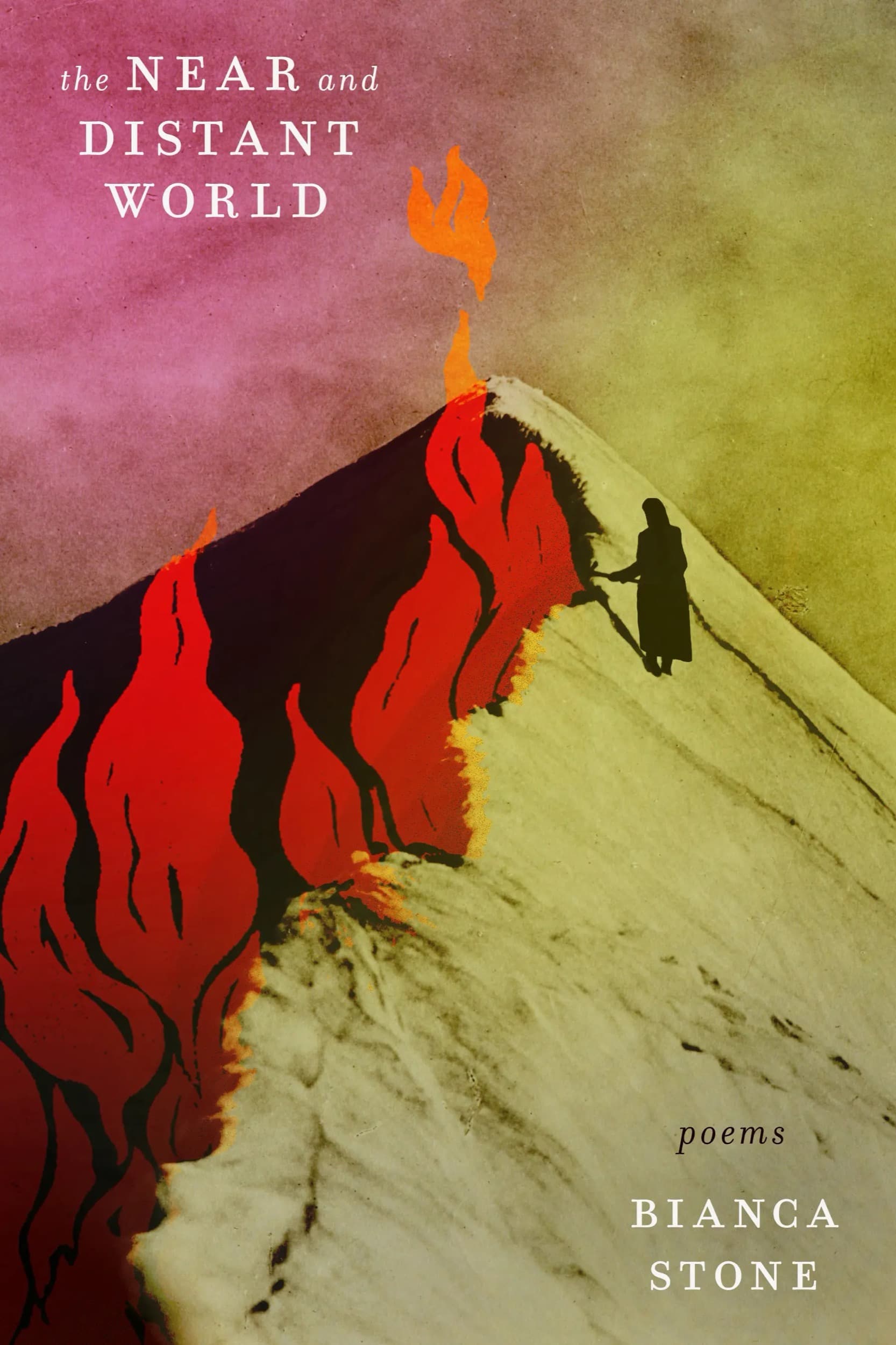
The Near and Distant World
Tin House, 2026
“I’m interested / in the innate paradoxes / of the human soul.” So declares Bianca Stone in “Reality 2!”—one of many dense, excursive, intricately-woven poems from her fourth book, The Near and Distant World. In fact, those three lines could serve as a thematic core for the entire collection, where Stone engages in earnest with theodicies, philosophies, aporias, psychoanalysis, and poetry’s “bittersweet suicidal explosions / on the tongue” (“What’s Poetry Like?”) to arrive at a greater, though never conclusive, sense of the self. “Who I am?” she asks in “On the Nature of Things” and responds: “the word nothing / always comes to mind. / Dwindling to the great phenomenological drama.” Complex but never abstruse, these poems map Stone’s unending quest to reach clarities that do not terminate in some final arrival. “One moment I am returned, then gone, then returned…” she claims in “Nothing Is Ever Finished or Abandoned.” The honesty of this admission not only honors the poet’s interior work but acknowledges that such work is intricately tied to the life force. While suicide, as a word and as a subject of contemplation, occurs in the collection with startling frequency, it’s very mention is undermined by the rigor of Stone’s insistent search for meaning and the seemingly endless fecundity of her imagination. All of this is managed with expert balance. Just when a reader might start to reel from the poet’s metaphysical interrogations, she opens the poem to life and its brilliant particulars, often ushered into the work with tidal wave force. My own experience with the collection was dizzying and enormously satisfying—a visceral thrill.
For our discussion below, Bianca Stone consented to an email exchange that lasted nine days. Her responses were so rich and fulfilling that I felt a certain sadness when mutual commitments forced our dialogue to come to an end. The discussion below certainly sheds light on Stone’s thematic preoccupations and her creative process. Throughout our collaboration, she was—alluding to a foundational work in Stone’s personal canon—Virgil to my Dante, guiding me through the hells and purgatories that frequent existence. However, when we “concluded” the project, I felt we were only just getting started. By Stone’s own admission, beyond this book, she is now engaging in areas of non-western thought. So, like Odysseus in Nikos Kazantzakis’s The Odyssey: A Modern Sequel, the poet herself is constantly transforming, exchanging one mask for another, reemerging in ways that speak not only to the past but to the concerns and anxieties of this world, a world where “You must find some current event in your gaze. / You must look up / at the eternal stranger / there….”
Tony Leuzzi (Rail): Good morning, Bianca. Congratulations on the success of The Near and Distant World, which has received some really positive endorsements and press. It’s a lovely, substantial collection of poems. I have a number of questions to ask and observations to make. But before we delve into specifics, I am hoping you can provide an overview of the book for the benefit of readers here who have not yet opened it. If you were to summarize it in a paragraph, what would say are the overriding themes or concerns of the book?
Bianca Stone: I am wary to summarize what I still feel ignorant of. Once you begin naming it changes it. And when you begin saying what something means, it limits it to that meaning. But that, in itself, is a theme! The way we try to name and speak to our lives, our desires, our memories. I might begin with the title: the paradox of nearness and distance. This was born out of articulating more fully issues of feeling isolated and cut-off from the world and the self. And at the same time, a specific intensity of wanting more from connection to self, world, and other. The book wrestles with words, and language itself. So it talks about the art of poetry as something sacred and strange in the work of silence and speech, seen and unseen, desire and memory. I’m interested in remembrance and the immemorable; the idea of truth and lie that poetry heightens. It’s a book about poetry dealing in words—but how do we communicate in words? And who is the one who speaks them? These poems look at the self as persona directly, the stage of the self. This was deepened by the event of psychodynamic psychoanalysis and issues of the unutterable; issues of longing and love and the other. I was interested in the edges of desire and language itself—this book is devoted to questions in that area. I speak in my poems of grief for our world and human destruction. I speak of my private torment and the larger collective torment of consciousness. I speak to psychoanalytical ideas of the unconscious directly: affects of anxiety and depression. But I go beyond that, and I bring in the spiritual and questions about meaning, reality, and how to live. I am in agreement with the filmmaker Andrei Tarkovsky, who I also write about in the book: these are the questions of the artist. They must take spiritual questions very seriously. I have always been drawn to that naturally, perhaps because I didn’t grow up with an oppressive sense of God, and since I grew up with so much poetry around me, I was imbued with a sense of that embrace of the unseen, and inarticulable, still held in words. I speak much in this book of words, and what they hide. This would often come to me in pre-dawn dreams. Those are the times the prophetic words come, which Dante knew well in the Divine Comedy!
Rail: Despite being your fourth book of poems, it’s my first encounter with your work. In what ways do you consider The Near and Distant World a departure from and/or continuation of your previous work?
Stone: I hope everything is a departure and a continuation in my books. Yes, this book is another canto in my own Divina Comedia. Sometimes our writing seems like one endless project, but there are important endings we come to. We must let things go. Or take them up otherwise. I think in this book I was moving away from a certain focus on narrative into another kind of narrative positioning. This book is more of a distilled experience of the self and the other in a more fundamental way; which is why I dedicated it to “Thou,” in honor of Martin Buber’s I and Thou. It continues the conversation around the disturbed psyche, God, and nearness and distance. My last book title is a clear connection to ideas of human infinitude and self-limitation. These poems continue to look at conflicts of repetition and self-hatred, wound and cure, but I wanted to find some movement into the real heart-work, death, how to resurrect. I use many themes of desire and perhaps intimating what is beyond desire—it is a threshold in this book. There is a kind of constant attention to the mask of self. All my books are a meta conversation about the poem itself. I push and push against the “Ars Poetica,” but perhaps in a way I see Robert Frost or Wallace Stevens at it, and to me that means the poem can’t really set out an “Ars Poetica;” it’s more the reverse: the poem informs the reader of the experience of language-speaking creatures in the world, as a possibility for poesis, which is an intentional act. You read the poem and see how the poem is a living representation of a human in the world. It is as close to actual movements of consciousness in language; it is a detachment from the real, but it shows how language is impossible to be all true, all known. It shows the truth in the lie, and the lyricism. It shows beauty as having truth without meaning; meaning is found in ignorance in the poem. It is a slow lifetime of coming to understand. This book plucked more from contained lines from dreams. I was really interested in words that felt like they were mine and not mine; received language. What is, as Rainer Maria Rilke said, “spoken to us before we [started].” I want to hold that language.
Rail: What full, generous considerations of the themes and concerns of your poetry in The Near and Distant World—and how the new poems connect and depart from earlier work. Thank you! You say:
I’m interested in remembrance, the immemorable, and the idea of truth and lie that poetry heightens. It’s a book about being a person, a poet, who deals in words—but how do we communicate? These poems look at the self as persona directly, the stage of the self. This was heightened by the event of psychodynamic psychoanalysis, and issues of the unutterable; issues of longing and love and the other.
Two of my three favorite poems of the book, “Civilization and Its Discontents” and “The Circuitous Path Towards Inertia,” speak to these themes in such powerful, memorable ways. Each poem engages Sigmund Freud and Freudian concepts and each involves a moment spent with your daughter. In both cases, the self who articulates the moment experiences time in—and forgive me if my terminology is inaccurate—linear and recursive ways. “Civilization” begins with the “I” regarding the apple trees in her yard, a reverie that opens the door to a memory of a classmate who both rescues a dog and eventually stops coming to class, presumably out of anger over another incident not addressed in the memory. Memory, reflection on memory, other memories—all of this delicious inner life is occurring while the speaker’s daughter chases bubbles in the yard and role plays as a dog. My summary does not do any justice to this, nor would it do any justice to “The Circuitous Path of Inertia,”where the speaker, once again with her daughter, drives to a reading in Salem, Massachusetts. During this drive, the mind moves forward, towards the anticipated event, while also registering the “thisness”/“hereness” of the present moment, but also detours into memory via certain associations. Your record of the mind’s fluctuations and oscillations, its consideration of what’s ahead and its inclination to dip down through time to savor the layers and textures of the past—all of this makes for a thrilling reading experience. It also reminds me of a couplet from “An Hour,” in which you write: “And between each [second], the split second, and so on and so on, / infinite in its never-wholeness.” I sense here a connection to Zeno’s paradox, of the infinite space between two points in space and time. Would it be fair to say that your poems—often as full as they are—are in themselves metaphors of the mind? That they represent the impossibility of bridging the space between moments?
Stone: I think this is a beautiful observation and comes to an important aspect of poetry which I hold dear, that is, an attempt at mapping the cosmos of the mind itself, beyond its conscious surface language it is able to articulate. It is, as you say this, and as I say this, something like a scene of a field, with many kinds of plants and flowers; it is a place where one goes, like this Robert Frost poem I’ve been reading: “Tuft of Flowers.” How odd that all that time I saw his poems as too aggressively formal. I see now his way was a meandering of consciousness given enormous restraint, so as to counteract the intensity of the moment, a moment of great solitude, simultaneously coming to terms with a multiplicity around itself. Yes, that’s it. The poem maps an intenseness too big to fathom, but distilled down to such a strong tea… How one can focus in on the bewildered butterfly, “Seeking with memories grown dim o’er night / Some resting flower of yesterday’s delight,” and survive another day staving off suicide?
Yes, I realized I reference Zeno’s paradox in my first book, too. These echoes return for a reason. There’s a kind of madness to it, but we’re trying to get it right. Or I should say near. Maybe we can never really get near to what we grasp at. In Zeno’s paradox the whole issue is no matter how close you get, there’s always another allotted space between, and in that logic, even touching something is still at a relative distance. But maybe it’s those interstices that are really the thing we should arrive at: the Between. That’s what I might call my next book… I had a dream line that came to me that said “God is between.” But when I tried to write it down, I put “Go Dis d between.” We’re always dealing with Dis–, which is one of Dante’s names for Satan in Inferno. Those metaphors you mentioned are so important; perhaps there’s something between the comparison, something between the paradox, that is not dividable. Ever-near. Near-distance. There’s an infinite unknowable thing there. I think the poet intuits this, at their most prophetic. But it seems to come for the poet through the attention to the world, its beauty and grief and strangeness. I can talk about my daughter doing something ordinary like playing in the yard, Frost can talk about mowing the lawn, Stevens’s “An Ordinary Evening in New Haven”—and there’s an intensity hidden behind it all, that’s beyond utterance, that would burn us beyond all recognition if we were to turn to it directly. How can something so big be hidden behind such gentleness? And perhaps the opposite is true too: the violence we display in poems—the kind we’re able to look at in poems—hides a fragility beyond comprehension. The poem is the veil over those things. It is a sacred work. With all its tragicomedy and gleemanship.
Rail: My other favorite poem from the new book is “The Annunciation,” a love poem (“for Ben”) in which the paradox of separation and togetherness is explored so vividly through an ekphrastic engagement with Botticelli’s painting on Gabriel’s visitation with Mary. The poem offers such an affirmative perspective on love and distance. The ending, addressed to the absent lover, slayed me:
I love to look at what you love to look at.
See how she is alone with yet another?
I long for how she yields,
even in her fear, she yields to it—
distance which
nevertheless
is touch.
So gorgeous and moving! I am wondering if you could discuss this poem, and the themes it addresses, in some depth.
Stone: In following the theme of the I/Thou and issues of desire I find I’m drawn back to theistic narratives for their psychological insights, which take personal experience to open them. I mean, we wrestle with these stories in art as a way to understand our relation to existence, which is a dynamic action. It’s an intimate thing I was considering in this poem, love. One thinks, on one hand, of love as this social and erotic event—and certainly we understand that aspect of it, but there’s a deeper truth there. It is true, too—my husband collects art of the Annunciation, which was part of the inspiration. The people in our lives and out work together, and apart, looking. In my journey, it’s like I had to really come to terms with issues of love and intimacy anew—this was really brought about through psychoanalysis. For some of us there is a profound fragmentation of knowing what attachment and detachment means. We end up faced with Freud’s summary of analysis as, “essentially a love cure.” And what does that mean? What is love? What is cure? These are deeply important questions. I expanded the questions in my book. For me, the more I looked at Mary in the Annunciation imagery, the more I saw real issues of intimacy and distance that felt important for these questions. It’s hard having these hidden conversations in a room, speaking what you’ve never spoken to anyone. Intense anxiety and feeling is not just an affect, it’s a letter, a sign, a message. And you have these feelings, and they’re fiercely boundaried before another who is just looking, who is distanced. Adam Phillips famously said, “Psychoanalysis is about what two people can say to each other if they agree not to have sex.” Yet, to have to say that means a lot about what therapy coaxes up. What happens when we surrender to the other without the physical? Issues of infancy and the erotic are given formal constraints in analysis. But the poet has long let that be present and hidden in language. So, if love is the cure, what does that kind of touch look like? I began to investigate different intimacies that rejected the physical, yet seemed to penetrate at the deepest level and hold an enormous amount of erotic tension. And how does touch play into it? That’s why the Annunciation comes up, as well as my long poem “The Temptation of St. Anthony.” These are both instances of choice, surrender, touch, not-touch—the immaterial touch over the material, really. They live on, they are human. Mary and Saint Anthony, Echo and Narcissus—they deal in matter, and longing. These are moral teachings that the human must wrestle. Each of us must interact with these texts; parables and poems. I will spend my life looking at single passages of the poems, and of texts like the Qur’an now—it’s the work. An analysis of a single line could fill a whole book, and a whole lifetime with its continued messages and meanings—and also be held in total silence. Let it be so. Yes, in the Annunciation one must yield and allow the other in: this is the fate that comes with choice. This comes with the work of boundary and faith; it comes with trust and autonomy. Love is just that, is it not? That’s what you learn in the dyadic event. There’s suffering and frustration too. Psychotherapy can only go so far in what it can speak to, and I had to bring the religious, the phenomenological, and poetic in on my own, in some ways. I had to find other means to push that exploration—the analyst is limited by his professional laws. But it helped me in the conversation so much, it opened a door to the next place. I am in the next phase of it all now, having reached the limit of the West. I only now can point to the studying I need to do. The analysis never ends, they say. It just changes. It measures out new caesuras. I love that you never come to an end, and yet you get to begin again.
Rail: Many of your poems allude to performance, conceptually or as a specific instance of “theater” captured in detail. “In Shadow, Who Made These Words” appears to be structured around a play—but what kind of play? In the second stanza, the speaker says: “Behind my head, heads begin to nod. / They doze in the surgical amphitheater behind my eyes.” In “The Temptations of St. Anthony,” a painting depicts a “gleeful orgy” of corpses “rearing over” the saint as they “perform for him.” In the aforementioned “The Circuitous Path Toward Inertia,” the “original,” six-winged angels “carry important messages for a silent God” as they cry and perform “paraplegia, blindness, and deference….” Meanwhile, “On the Nature of Things” articulates the speaker’s quest of self (“Who am I?”) as a kind of “phenomenological drama.” And the opening image from “Trying to Make Sense is the Worse Madness” is of “Gleeman,” a theater actor who reverse-steps from the stage with his back towards the exit; this image is later connected to “the man / on the open-door psyche ward / who, when asked why he stood contorted / and upright in the middle of his room / four hours, said he was trying to / work backward through a thought.” The list I cite here, while not exhaustive, does suggest the breadth of your use of performance as a metaphor. I also suspect there is a thematic connection as well between performance and persona—as well as mask, another image that recurs in many of your poems. What insights can you offer as to the prevalence of performance and theater in your poems? In what ways might the performance metaphors you work with here prove a valuable key to your conception for the book as a whole?
Stone: When Hamlet says “The play’s the thing / Wherein I’ll catch the conscience of the king,” I pause over the possibility that we need art in order to see ourselves—and others—ethically. But this ethics is one that demands interpretation on an individual level, because it’s in art. It demands an intimate relationship with the words and images themselves. We cannot, and should not, come to consensus about meaning in art, right? The world is multiplicity—we’re condemned to dualism at birth. But what is an ethical lesson with multiple interpretations? What are the ethics of a paradox? It can’t work in regular law; it is the poetic itself. In one sense, law cannot be poetic. But then I think of the Qur’an or the Bible, which are filled with laws on how to live socially and privately—and these texts without a doubt contain poetry, beauty, artistry, ambiguity, parables, stories—which have meaning which must be interacted with, which take effort of mind, and surrender of mind. What is written, and what humans make with their modes of communication, is always a performance of consciousness, perhaps. But when does the performance fall away to unveil what is beyond it? And what is this play, indeed? What is “the real” to “the play”? There’s a part of me that is desperate for the real, that is not performance. I know in psychodynamic therapy the pain of feeling one needs to perform for the other: it feels like you’re not “yourself,” and you cannot authentically be-with…that’s the death of art, as well—to write how you think the other wants you to write. It’s about finding the “whole puppet” as Rilke would say in the “Fourth Elegy”: “I won’t endure these half-filled masks; / better, the puppet. It at least is full.” (Stephen Mitchell translation). So, this is a big part of what I was exploring in my book. Many, many cultures use masks and veiling of the face to explore aspects of reality.
All language is a performance. Paradoxes seem to contain the answer here, sorry to be redundant—but the performance itself, acknowledged and embraced in the full puppet, is where we’re able to pass through. Or “glimpse God beyond the atom.” Yes, there’s this aspect of persona in poetry that is far beyond a decorative decision, or Iowa-workshop rhetoric “speaker” formality: it’s a display of consciousness’ modality itself. That’s why Emily Dickinson spoke of “telling all the truth,” but slant. It’s not just about not being able to accept the intensity of truth, but maybe that the artist understands that the art is one step removed from the real, and that it knows that. Art is an echo that doesn’t say “I know.” It knows it is not what made the cry. It knows that to say “who if I cried out” is not only not the cry it is speaking of, but that the voice that made that first cry was not the cry. Where is the cry? Somewhere in the unseen, in silence? That isn’t helpful in terms of making art, which is a social event, really. It’s a result of solitude and grief at that solitude; it’s the result of a language-animal articulating “where is the beloved who has died?” Is it the dance of the erotic, before that which it cannot ever fully penetrate? An echo can still tell us a lot about voice. It can tell us where the boundaries are and can perhaps make contours. Where’s the body? As a professional poet, one is often performing in front of people! We arrive with the body. These intimate displays of the interior seem insane sometimes. I am a puppet, but I have will to take up. I am most certainly a Gleeman. Yet I often feel more real, more myself in those moments with my poems. In those moments that they surprise me, and feel unfamiliar.
Everyone’s unconscious is in a room together, the connections like nerves activating between. I had a dream once of the words “nerves of the floor,” as if it was so profound. But it’s like that: like roots in the room. I mix the metaphors. It’s sometimes excruciating to perform. Sometimes we ruin it with too much self-consciousness: “Can you hear me?” “Sorry, I’m losing my voice today.” “I’m sick today. Please excuse my cough drop.” (I keep hearing that!) “Is my time ok?” “Let’s see, sorry these aren’t funny poems…” Those are the moments I think to myself “you are performing what you think we need: your deference and wretchedness to our judgment.” But we are here for the poems. Somehow the super-ego’s awkwardness needs to step aside; we need the full puppet. What a strange and imperfect effort it is. Humor is important for the gleeman obviously: the fool is the one who starts the journey, undertakes the endeavor. But it’s a serious and sober business. I see the performance as the song to remember what is behind it. Perhaps this book I made is a meta-guide to others on that task.
Rail: An intriguing subset of prose poems, many of which first appeared together in a chapbook, are interspersed throughout The Near and Distant World. Given that so many of them were initially grouped together in that chapbook, and given that their style and patterning differ from some of your more elaborately constructed, lineated work, I’m wondering if you see these prose pieces forming a kind blueprint for themes you engage in the verse poems. Can you talk about these prose pieces?
Stone: I like that in the last answer I proposed I was making a guide, and then here you introduce the idea too! It is interesting to think of form, of moving language from the body to paper, and back again. Prose but still poetry, to be sure. Yet why did I make that decision? Perhaps a nod to all the nonfiction books I’ve been reading. My desire to write my own book in prose; this was my little way to begin that. I was just looking at these prose poems wondering if it was a mistake to keep them in prose. But no. No, that’s how they came to me, and so I stand with it. I was inspired by Franz Wright’s incredible book Kindertotenwald, which is all prose poems, except for the last poem. Lineation is actually a result of the changing medium of poetry: the printing press, the paper shape and size, etc. But also verse, the memorization of it. These poems were the first I made that became the book, and I called them “The Black House Poems.” The box of the prose form is like the box that seems to hold the unconscious; the black house. Maybe they do become more “instructive,” but I don’t know. I think the most important element of their form is the epistolary in them. At first, they were all meant to be letters, in the persona of a president, running a country he didn’t want to run, hiding in the Black House instead of the White House. Literally, I had our house painted an espresso bean brown, and all the doors red. And right when they finished the last door, I had one of the worst emotional collapses of my life—I could barely eat or drink anything but water for weeks. The most ineffable unconscious material was being stirred in me. The letter form was all I could bear. I think this is important. It cannot have enjambment in the same way. Maybe I was too torn, disturbed by language itself, I couldn’t bear the splitting of the line. I needed it to be a letter. It felt gentle as a letter. To have this address to the “people” in a letter I wouldn’t send. To be honest, it was a way to stave off suicide, a kind of final letter that I refused to send. I wanted to write a letter to the possibility of life, to a part of what was beyond me. It was an act of great solitude, that was beginning to understand surrender.
Rail: Bianca, you have been such a generous participant in this discussion. As much as I would love to ask you several more questions about the poems in The Near and Distant World, I will ask you just one more. I would be remiss if I didn’t mention the collection’s most famous poem, “What’s Poetry Like?” which was originally published in The New Yorker. In this poem, the teenage apprentice to an internet technician sees a book of Tomas Tranströmer’s poetry in the speaker’s living room. When he asks the question that serves as this poem’s title, one of the many unusual and often startling (yet also logical) possible definitions provided is: “poetry, whose rare geniuses come / as bittersweet suicidal explosions / on the tongue….” This not the only time you mention suicide in the collection, though here the tongue’s self-destructive “explosions” are connected to generative impulses, to creation, to—among other things—“detonations of precision,” as well as Coke cans. In other words: everything? Eventually, after long deliberation on how to respond to the naked simplicity of his question, you hand him the book. It’s a moment of generosity—but is it also not a kind of conspiratorial recklessness to initiate one into the world of poetry, to the kind of language that will wait to “torment” and “change” the young man’s life? Could you discuss the ethics of the speaker’s decision to let the apprentice discover and engage with the alluring, ineffable and even dangerous language of poetry?
Stone: Once again I preempted your question. This is a testament to our conversation and I deeply appreciate your attention to these poems; literally no one else has publicly engaged at this level with the words. So, you are my first true critic of this book: let it be known! Yes, I think of John Berryman’s “These Songs are not meant to be understood, you understand. / They are only meant to terrify & comfort.” We come again to the importance of contradiction being held in this form. It is very sentimental to say that poetry is something that “brings us together,” because I think it is also something that brings us our solitude. Contradictions continue: having another voice more intimately present in our solitude; solitude which brings us much closer to ourselves, and others. And it can be a terrifying experience. Or at least uncomfortable. When I spoke above about that terrible mental collapse, it was me doing the work. It wasn’t me having an illness to be fixed. Anxiety means you’re approaching something, there’s huge feeling behind it. You’ve approached desire itself, the utmost edges of it. I realize that now. After all this time. I’ve done much work in the dyad with some truly important people in my life, some truly good ordinary people. I hope to give back to them too, we give to one another in this work, as Frost said, “‘Men work together,’ I told him from the heart, / ‘Whether they work together or apart.’” Facing that which you’ve worked so hard to repress…we all have this. Not just the chosen affected few trotting behind the cannibalistic sow of sorrow! No, this is about reflection and the difficult suffering of existence. Remember, we come to joy through this. We want ideally to face the pleasure our suffering gives us, and find suffering that you can pass through into happiness. That’s the trick, and “If this trick works we can rub our hands / together, maybe,” James Tate said, “start a little fire / with our identification papers.” Poetry can burn our identification papers. Find the real beyond it. If it brings comfort, it is in our shared situation at the fire. We leave the illusion of comfort as a way to exist in repose, indolence, avoidance, or demand. Rub our hands together at the fire in the dark wood.
In “What’s Poetry Like,” I think it’s telling that this poem talks about the “apprentice,” the “student.” It’s all predicated on a question, and the question is poised as a simile. In that moment, I, who is the kind of teacher in the scene, realized that my knowing has a limit in terms of explaining something about poetry—it must be experienced. And if I speak of it, I speak of not what it is, but what it is like. The guide is there, but the book must be taken up by the student and the words surrendered to. It’s not about knowing what it is, but the joy of taking up the task of metaphor.
Poetry—may it shatter ideals, bewilder and baffle and haunt. It will bring one to the very edge of bearability. For the traumatized ones have been forced to adapt, forced into internal realities, and deal with demons, finding allies. This means there’s been a journey to speak of. We found ourselves in a dark wood and our only choice is to “press on,” as Rilke would say. “No feeling is final.” That’s the moment you decide to live, because you remember there are other feelings; there’s multiplicity, action. To stay stuck in with Dis in hell is to lack that idea of suffering towards something real. I have great empathy for what a mind can handle, of course. But I want out of that hell, for obvious reasons. To be seduced by our own victimhood is more real that we care to admit. But it cannot end in the wound. We must pass through. Refuse to make monsters out of those who are troubled, even the most heinous people in the world are in us too. We must face that. I wrote this book about that exact threshold, passing out of the stone doorway and seeing suddenly the stars of Purgatorio—surely that’s all you can offer another person. Here is the poetry, you must make meaning with it, as I did.
Poetry is about allusion to poetry that’s come before, it’s a long line of those who remember the words that were spoken to them and forgot. Just as you and I have begun webbing through language a shared understanding, and yet are strangers. It’s the gift of the echo between people. The world is here, and we need not seek it. Paul Celan said a poem is a handshake, but it’s the book that’s the hand. Whose hand? We take it up, but we don’t know. Our hands are occupied elsewhere—let them be in prayer, or our face buried in them, or the simple pleasure of pouring tea with another. All will dissolve anyway. What stays? I don’t know. Whatever the wind chimes said, about being able to contain the secret seems to be what’s happening here. We make the flute, we are the flute, but what blows through is less clear. We cannot know the word that endures, we can only stand in the theater and accept the role to say them in a certain order in front of one another; try and remember our lines. The audience will turn away and they will not understand always. I certainly turn away and do not always understand. But that’s what’s electric and dynamic. We are all the apprentices in this near and distant world.
Tony Leuzzi is an author. His books include the poetry collections Radiant Losses, The Burning Door, and Meditation Archipelago, as well as Passwords Primeval, a collection of his interviews with American poets.