Word count: 1432
Paragraphs: 9
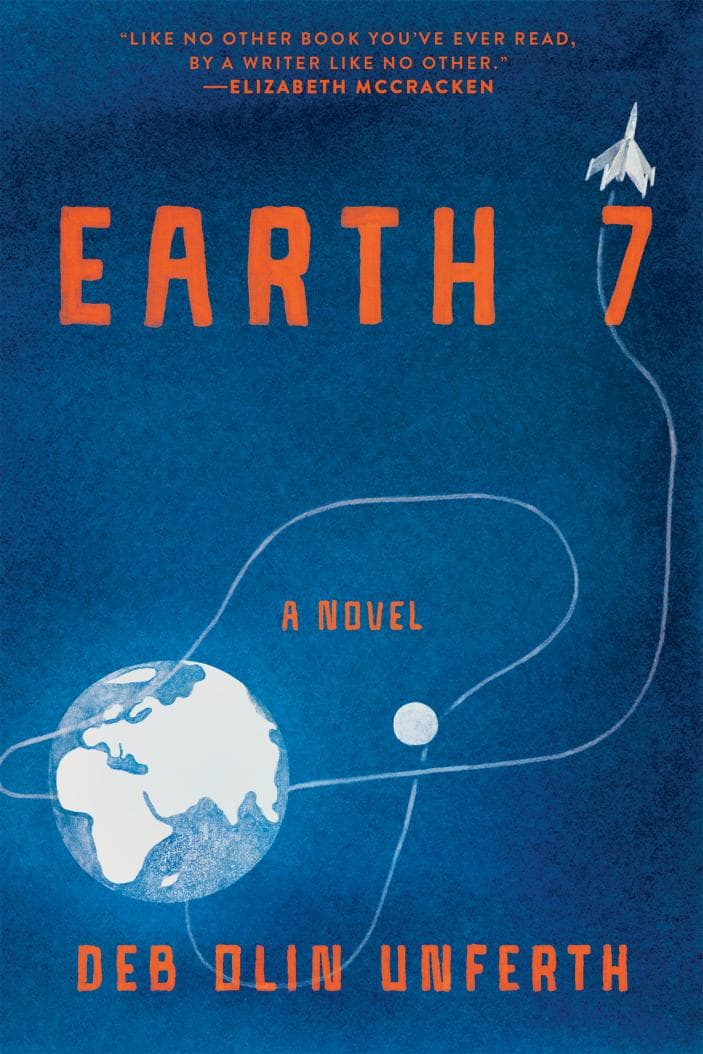
Earth 7
Graywolf Press, 2026
On my regular walks around New York, I sometimes pass the Climate Clock in Union Square telling us how much time we have left and sometimes a piece of graffiti on Houston Street telling us simply “It’s Too Late.” Balanced with those dire images are the recent images from the Artemis II mission full of glorious beauty and hope. In these times of both climate disaster and our ability to embrace infinite hope, Deb Olin Unferth’s new novel holds particular resonance. From the sheer glory of the opening words: “In those years, the sky was full of sulfur and diamonds, shot into the air by cannons to scatter the sunlight,” to the depth of grief as it becomes clear that in this future it is too late to stop the destruction of our planet and most life. But that doesn’t keep some people from trying. The novel is set in a future where humanity is in decline—some gone off to Mars, and those few left on Earth post “depop” (depopulation) struggling to survive within or without a system referred to only as “the company.” There are references to mass extinctions and also scientists desperate to somehow preserve and recreate life on Earth as it once was. One of these scientists, Rosemary, is a researcher so determined to concentrate that she moves to an undersea colony with her five-year-old daughter.
Rosemary raises her daughter, whom she has named “XY,” in an undersea pod, but is so enmeshed in her research that she hardly has time to care for the girl. Focused on a study of consciousness, Rosemary seems to forget the essential nature of being human: the joy we derive from connection. As “XY” grows from a small child of five to a teenager and beyond, she is our guide through much of the novel. She has renamed herself Dylan (because XY is a “bonkers” name), and it is perhaps Dylan’s humanity, her fallibility that makes her the novel’s most compelling character. Trapped in an incredibly limited environment, she dreams of life on the surface: throwing tantrums until her mother finally relents. At one point, Dylan manages to connect online with someone who claims to be a Martian named Zee. We feel for Dylan as she crushes on this exotic online stranger who shows more interest in her than her own mother does. After Dylan reveals secrets to Zee about her mother’s research, a ship shows up in the undersea world. But to her despair, none of these Martians is Zee, and the Martians don’t find what they’re hoping for either.
Eventually, Dylan leaves the pod, the ocean, and her mother, finding a place at a molecular collections lab in the desert—the research station where her mother works for the director, Dr. Das. Serving as a glorified janitor, Dylan immerses herself in the study of sand. As she discovers that even the tiniest grains of sand contain glorious, resilient life (tardigrades!), Dylan also begins to form her own dreams of a future for our worlds’ creatures. Sand, we learn, is “the raw material for every great design.” But Dylan, like her mother before her, becomes dangerously immersed in her work. Dr. Das forces her to take time off, gifting her two weeks at an expensive curated “fully terraformed” resort including ridiculously fake sand. And while Dylan is at first horrified at having to spend time at a “Vacationland for Singles,” it’s here that Dylan meets Melanie and falls in love. Dylan isn’t comfortable with other humans, but she’s been told by another vacationer that Melanie is a robot. With Melanie’s glittering skin and too-perfect features, Dylan is inclined to believe the lie.
As the novel slides into Melanie’s story, we learn more about this future Earth: a place where you’re either part of the system or destroyed by the system—in essence our present. Melanie becomes a victim of reality TV gone horribly wrong (yes, reality TV can actually get worse). Undergoing repeated and invasive plastic surgeries leaving her technically beautiful (and looking like a robot) but also containing a time bomb of genetic material that will either keep her alive forever or explode. She becomes a bartender at a tacky “beach” resort, and it’s here that she meets Dylan. At first Melanie is hesitant about the future: “She didn’t know what she was doing with this girl…” but then we’re given a hint to the deep shining core of the novel, “Maybe she’d always had a thimbleful of hope.” The two become lovers, and when Dylan’s money runs out, she asks Melanie to come back with her to the research compound. But Melanie runs away, heading back to the edges of civilization where she came from—the “last outpost in the desert.” She finds her place back among “beautiful wrecked humanity, the also-rans, their infection rising and settling like a cloud, falling like drizzle over a contaminated desert.” Here Melanie struggles with her sadness. We learn more about the society of nomads and also Melanie’s internal surgically implanted “Regenerator” that has made her “an immortality project.” While the world is dying around her, Melanie is facing an eternity of surviving. After some time back “home,” she drives alone out into the desert.
Meanwhile, when Dylan returns from the resort, she learns that her mother has chosen to upload herself into a microchip that was sent into space. Dylan’s anger is palpable as she struggles to understand that this was her mother’s research project all along: the transfer of human consciousness. Despite her grief, Dylan goes back to “landscape duty” at the compound. And then she sees “sand people” out in the desert and follows them. The novel shifts again to one of the followers of the group Dylan has joined and we learn that this group has a mission: “Stop repop. Finish the job.” They move deep into the desert, a world of sand: “Sand, the origins, arrived here in meteorites containing all the ingredients needed to make us. Still living, full of gifts, nutrients.” They stop and their leader hands out capsules for each of them to end their lives. But Dylan chooses life and rides away on the leader’s bike. In her time in the desert, she has decided to live. She buys herself a bungalow in the desert made out of an old storage container and focuses on her research project. And then Melanie shows up, driving through the desert to the lab on a giant cement mixer.
Dylan is reprimanded for revealing the location of the compound, but she’s already ready to leave. Together Dylan and Melanie make a life together. Dylan shares her research project (Earth 7) with Melanie, and we learn that Earth 7 is an amalgamation of geologic traces of life that will prove more successful at saving our fellow earthlings than the work of the research station’s scientists. Dylan’s drive to hide her work ultimately saves it when the research station is blown up. But eventually Dylan dies, as humans do, leaving Melanie alone. Zee the Martian reappears with his crew and as a last ditch attempt before he’s sent back to Mars to retire, he finds Dylan. Only Dylan is long dead. Melanie gives him Earth 7, and he takes it onto his spaceship to bring it back to Mars presumably to recreate Earth’s creatures in a new environment.
But we don’t get that ending and neither does Dylan’s project. This isn’t Star Trek. There will be no repopulation of our Earth which has become nothing more than a lump of coal by the end of the novel. Melanie’s consciousness lives on in “soul globules” that help tell the rest of the story of Zee and Dylan and the dream of recreating our fellow earthlings. Nothing turns out the way you might hope. This isn’t that story. Instead, it’s a story of coming to terms with the grief of climate disaster, of the resiliency of love between two people, and the ridiculousness of imagining that we might survive the destruction we’ve wrought on our planet. Dylan chooses to embrace life in a way that her mother, having encoded herself into a digital object flung out into space, could never understand. Dylan and Melanie both know that we must love what we have right now, right here as much as we work for a dreamed of and likely impossible future. This is a truly glorious novel rife with the grief and loss of climate disaster and a deep love for humanity and our planet.
Yvonne C. Garrett (she/her) holds an MLIS, an MFA-Fiction, two MAs (NYU), a Ph.D. (with a dissertation focused on women in Punk), and recently completed an M.Div. and Certificate in Chaplaincy (Starr King).