Word count: 1360
Paragraphs: 13
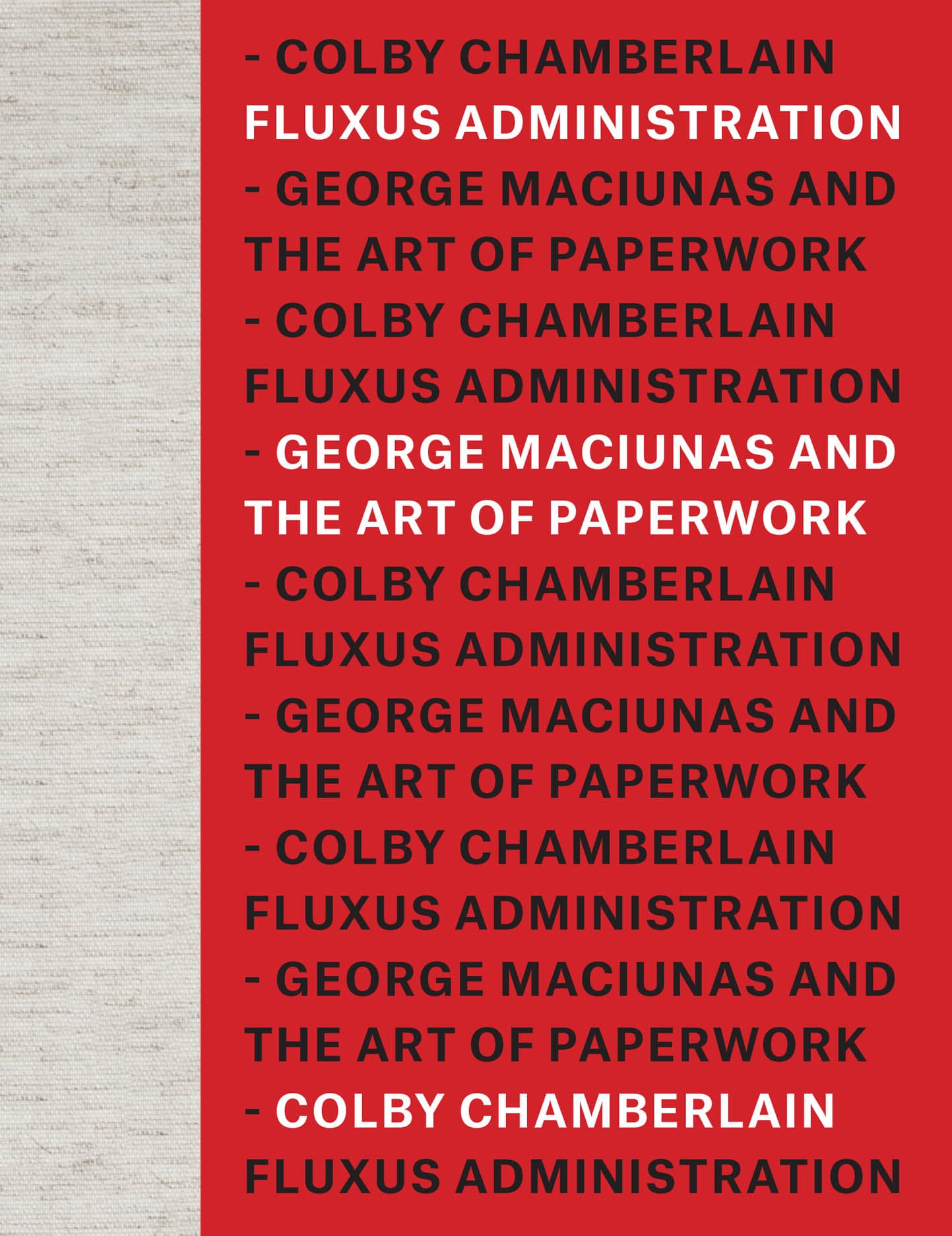
Fluxus Administration: George Maciunas and the Art of Paperwork
The University of Chicago Press, 2024
George Maciunas and his Fluxus have been on my mind recently owing to the big exhibition of Marcel Duchamp at the Museum of Modern art, making Duchamp (barely mentioned here) topical (yet) again, while we are still figuring out whether, or to what extent, Maciunas’s works managed to extend the territory of art. Even now, when it seems we have seen everything at least twice, the artworld seems to expect us to be “excited” (foolish term) by that. Then again, the charmingly lazy Duchamp would have been the last artist capable of organizing the campaign to turn a neighborhood (SoHo) of disused sweatshops into artist’s housing and studio space in New York, as Maciunas did.
Face it, there may be something wrong with our “imperial” aggrandizement trope of “pushing the boundaries” after all. Theoretically, we take the fine arts as consisting of the arts of design (which rest on drawing): painting, sculpture, and buildings worthy of the name architecture. But “art” per se, as known to the Romans, included all sorts of efficacy in worldly affairs, including governmental administration. Consider the primary meaning of the word as: “Skill in joining something, combining, working it, etc., [which] with the advancement of Roman culture, carried entirely beyond the sphere of the common pursuits of life, into that of artistic and scientific action” (Harpers’ Latin Dictionary).
Fluxus Administration attracted my attention for general-purpose art-historical reasons as well as for possibly clearing up some of the historical fog that for me surrounds Fluxus. I knew that George Maciunas had studied Eurasian Migrations Period art under Alfred Salmony at the Institute of Fine Arts at New York University, and that Ad Reinhardt had already done the same thing. And my own first professor of art history, only a little younger than Reinhardt, was also a Salmony student: John F. Haskins. But Migration Period art is notoriously difficult to pin down, not only chronologically but for the complexity of its influences. Years ago, I saw a gallery exhibition of the large illustrated historical charts made by Maciunas growing out of his Salmony course work: fanatically elaborate studies of all sorts of very similar metalwork pieces, all displaced almost by definition between their sites of origin and their eventual loss or interment. (At a certain point in his classic 1901 book Late Roman Art Industry, Aloïs Riegl once provoked in me the thought, “What if all these Roman army buckles, from far-flung sites, all came from the same factory in Rome?!”)
Fluxus Administration is exceedingly archival, even as it belongs to our age. That is almost a stylistic feature, because everything Maciunas did, objects or social interface alike, was mediated by elaborate paperwork, to a point where one has to sympathize with Chamberlain for thinking that the paper trail itself, as a chronicle just implicitly waiting to become history, was the real game. It wasn’t really. Because even it implied a common cause with Productivism on the social side, even more than, on the artist’s side, Duchamp mocked art’s serving as so much merchandise—including the Duchamps that, like so many Maciunases, look pretty much like ordinary print-shop stuff.
The fanaticism of Maciunas’s ancient Eurasian charts was only the start of a contemporary arts career obsessively concerned with paperwork as the residuum of arts administration—an occupation usually taken up as an ancillary occupation, like art therapy. But it was Maciunas’s center, and he was a captain at it, even if, as a sort of middle-class captain, pretending at first that utopian ideas don’t cost money, as utopians need to do, while somehow just managing to hang on financially “in the event.” Maciunas’s father was a middle-class engineer and architect; but, perhaps as with Buckminster Fuller’s Navy experience in engineering, Maciunas’s becoming an artist of a special sort may derive from discovering a graphic design capability, not to mention, for him, the happy excesses of paperwork, while working for the US Army in Europe.
By calling Maciunas a special sort of artist, I mean to stress especially that anyone aware of how Theodor Adorno, notably, took “administration” as a dirty word, might have to wonder why a leftist artist would want to be tops in precisely that. But this was artistically motivated social administration, and the title captain, which, apart from the military, also suggests a sports team, was the preferred sense of oversight as quite various types of artist joined Maciunas’s loosely organized “Fluxus” movement (the four last words here are subject to dispute but that seems alright for everybody).
Politically, Maciunas can be said to have found his feet in between the fall of McCarthy and Vietnam. He did have the kind of contentious mind that, in reading, one wants to egg on, even though at other times he seems like a fussy mamma’s boy playing “office.” But the hipster just won’t go away: shy guys don’t usually wind up getting married by exchanging clothes with their wives (ten points for the Duchamp parallel of cross-dressing?). There is no space here to get involved with the genesis of the “Fluxus” label. Suffice it to say that it connotes flow and has a lot to do with music. But the primary impetus for this scholarly book is to extricate Maciunas, the individual, from the assumed synonymy of Fluxus as a movement if not exactly a tendency.
Chapter one concerns “Card Files & Charts.” Anyone who might have enjoyed those art history charts inspired by Salmony might (or might not) necessarily be rewarded here: you have to love data. Many who saw the brilliant show Analog City: NYC BC (Before Computers), curated by Lilly Tuttle at the Museum of the City of New York in 2022, could get into this. The graphic designer in Maciunas obviously loved adjusting the rigorous graphic blocks and striations into which his data could logically be organized. But not data in anything like the (otherwise clever) mode of Otto Neurath’s numerical isotype graphs. Of the twenty-five illustrations here, all are verbal—most entirely so—except for one architectural model and a Hydrokinetic-Osmotic Painting (1961). Peering out from his screwy pince-nez spectacles, I imagine Maciunas thinking of numerical data as inferior, almost as more vulgar than words with their distinct evocative qualities.
Chapter two covers “Newsletters & Postcards.” People who hold onto all the exhibition announcements they have ever received will love it. The intensively archival approach here mimics Maciunas’s own precepts and obsessional preoccupations. In truth, this does make for more of a reference work; it’s certainly not beach reading.
Remaining chapters are: “Registrations & Catalogs,” “Plans & Budgets,”and “Prescriptions & Certificates,” plus a conclusion. Okay, there is a certain tedium in this; but the result may draw interest to Maciunas in ways not yet framed. For instance, what part did Maciunas play in a once ubiquitous “late modern” typographic mode—let me call it the Beatnik style—in which various typefaces, helter-skelter as to capitals and lower-case, were used with an emphasis on those big wooden letters that letterpress printers used to use for posters? In the late seventies I once came upon the sidewalk studio, in Jamaica, Queens, of an artist making art prints from such lettering. The style was at home basically on jazz record jackets and intellectual paperbacks; but it was so much Maciunas’s “bag,” that I now have to wonder, “Was this a case of Fluxus on the march, in Jamaica?”
Allow me to note in closing that Alfred Salmony, Maciunas’s teacher, in the introduction to his own book Sino-Siberian art in the collection of C.T. Loo (1933), himself takes his ancient artworks as “documents” to be “classified in some way.” So one wonders if the vexed histories of the teacher’s “documentary” ancient metalwork studies weren’t curiously compatible with the complex hassles that Maciunas had to negotiate in the realization of his wider, social art that the Romans would have recognized as such. And after all, from the ancient Roman point of view, which does seem akin to Maciunas, “fine art” is really something that stretches the meaning of just-plain art.
Joseph Masheck is an art historian-critic whose most recent book is Faith in Art (Bloomsbury Academic, 2023).