Word count: 2107
Paragraphs: 28
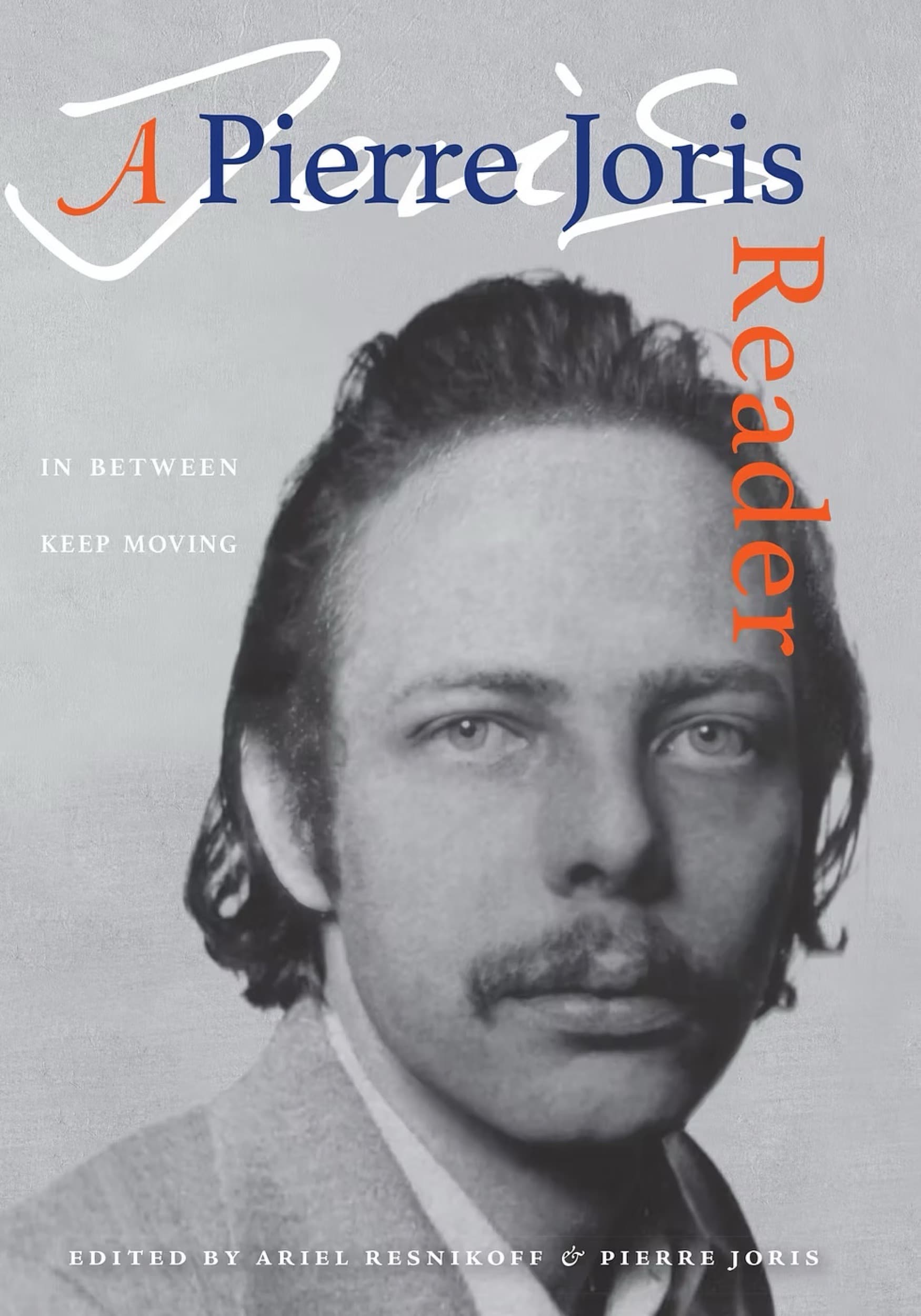
In Between, Keep Moving: A Pierre Joris Reader
Contra Mundum Press, 2026
In order to develop his well-known poétique de la relation, and the politics escorted by a subversion of monolingualism, Édouard Glissant had first to distinguish between one’s langue (as fixed system) and langage (as creative relation), a negotiation that could allow the flowering of an expression that was inherently composite, reflecting, in camouflage, the colonial language back to empire in order to remake its departments of identification and transparency under the de/sign of our “right to opacity.” Although they never encountered one another except on the page, among Glissant’s contemporary accomplices in the project of destabilizing (m)other tongues to understand multilingualism as inherent and translation as its first form was Pierre Joris, the nomadic polylingual poet, editor, anthologist, and translator born in Luxembourg, who lived and wrote across borders: France, Germany, England, the Maghreb, and the United States, exchanging, as Glissant did, standardization for polyphony and polysemy in the production of a new English, not just his adopted language but his language of adoption, through which he would fashion another American English.
In Between, Keep Moving: A Pierre Joris Reader (Contra Mundum Press, 2026), edited by Ariel Resnikoff and Joris and published on the anniversary of Joris’s death in February of last year, collects for the first time poems, interviews, notebook extracts, philosophical manifestos, translator introductions, dedications and commemorations of poetic forebearers, performance scores, and the forewords of other books—a dense, promiscuous, and rewarding tome spanning more than half a century that demonstrates Joris’s lifelong commitment to and astute awareness of the aural discrepancies and adjustments between languages, each of which are redeemed, in verse, as uncontaminated originals through the poet’s characteristic open structure and playful enjambment. How did he learn to write in this listening manner—hearing or mishearing—his new American poetics as nomadic and panoramic as his person, against site/sight specificity and representation? One of the many merits of this book is the opportunity for readers to witness Joris’s development as a thinker and reader and writer across six “diwans,” or what we might think of as chambers of flight between spaces and time, beginning with the hypnotically arresting prologue—what Joris will later refer to as his “memoir,” unfinished at the time of his death—in which he immediately enmeshes reading, childhood, and dreaming as the origins of sentient experience—“Is there,” he asks in the opening page, “life before reading?”
You are not certain—& grow less certain as time passes, as you grow old & memory, like nostalgia, isn’t what it used to be. So if you ask what it was like to be a child, you will have a hard time answering—and not just because you do not remember it as being the best time of your life. Not that you wouldn’t be interested in finding out for yourself. But how to be a historian of one’s own past, if istorin—the Greek word for history—means for the one historian you trust (because you love to read him) to find out for oneself. How can you go there from now? Maybe you can write yourself there, i.e. activate dreaming and reading and come back forward.
Even in this introductory passage, we see Joris’s affinity for etymological tracing and wordplay, foundations of the poet’s oeuvre as both writer and theorist, reader and translator, and Joris’s larger endeavor to undermine logocentric assumptions of Western philosophy typical of deconstruction and its preeminent theorist, Jacques Derrida, whose De la grammatologie Joris intended to translate, having sent ten pages to several publishers in New York while at Bard. (“I am still, half a century later,” he writes, “waiting for an answer.”) Of course, most readers are familiar with Pierre Joris by way of Paul Celan, whose “untranslatable” Atemwende [Breathturn] Joris ferried, alongside many other works by Celan, into English. If translation can be considered, in the Benjaminian sense, as both liberation and expansion of the original, Celan’s original served Joris, too, as a gateway to poetry, of learning to become a poet, and tuning one’s life to unsettlement, a resistance to familiarity and complacency and certitude. Joris writes:
If lucky enough, something will happen that opens you, or the world, a door, into the one of the other, between the two, maybe just a small opening, a slit you can slip through, maybe not as narrow as the birth canal that gave you first entrance, but possibly as blinding when you or it opens your eyes.
Hearing Celan’s “Todesfuge” recited by a classroom guest when he was fourteen years old was Joris’s epiphanic moment:
Without knowing anything more about the poem or the poet, I suddenly realized that there was something else, an other language, or use of language that had nothing to do with the so-called language of communication, of everyday usage, nor with what we had been taught under the name of “literature”—something that did not pass through the mediation of what I later learned to call “representation.”
In fact, Joris’s discovery is also a recovery, making good on childhood lessons of “the pure jouissance of a sound now arising from the very chora of language,” as well as the inherited multilingualism of being raised to speak Luxembourgish at home, and German and French, in alternating hierarchies, in school. His prologue’s rolling narrative, mixing bodily memories with cultural fragments (“memory & movies, the m&m’s of childhood”), advances as if a nesting doll, each layer summoning nascent perspectives, whose chain-like unearthing feels fresh, almost improvised, a writing on the go, the unassumed clarity of layovers and overnighting. Compare his impression of the local poetry scene upon arriving on the Hudson—“Ah, I thought, here is a wider, more democratic community in which various groupings with differing aesthetics are able to co-exist, without the excommunication-mani & internecine fighting habits of European avant-garde groupings”—with his understanding of the Warholian “Big Shitty” and art’s commercialization in the capital of arts and letters some years after, “where money & art had been fist-fucking each other from the start.”
Casual revelations abound as Joris consummates the ideas of another mentor, Robert Kelly, to locate the function of a thing in the structure of process, in his own practice. Consider how the aforementioned anecdote about encountering Celan’s poem “Todesfuge” for the first time leads to a discussion of his own typographical error in later translating Celan (mistaking an “a” for an “e”), which leads to an examination of American English and his coming-into it as a poet, which leads to a theorization of translation, of the role of translator as a (borrowing Celan’s own phrase in German) “witnessing for the witness.” Like his conceptualizations of poetry and translation, Joris’s prose is unfastened, constantly unfolding into the plenitude of the past as viewed from the dizzying nearness of the author’s presence: the story disappearing into its possibilities through the telling. I admire Joris’s candor and generosity; his prologue isn’t interested in periodizing a life that resists demarcation so much as expressing gratitude to the many people that have shaped such a fluid way of living, prone to the inspiration of others and equipped with the necessary faculty to surrender, to place faith in risk. The first and earliest poem in the book, “After Rereading Celan’s Atemwende,” dated March 19, 1969 and composed at Bard, where he completed his undergraduate studies, demonstrates Celan’s influence on Joris’s poetics, both immanent and kinetic, embodied and oracular, a devotion to foraging for mystery, not to grasp any assumed essence but rather deepen it—a charge that Joris would sustain throughout all the work he collected and composed thereafter:
Icebergspeech . snowscript
wanting
to break thru the un
singable remnant.foundlingpoem.
sevenedged
dice freed from the
harnesshurdle
between out- & in-sidetreat me to snow—
(let me know
you, penetrated one.)
…
(oh, to have
that distance—
distance in closeness
distance is closeness—
a different identity)
yours is that distance’s
eye eroding
last year’s snow from your
forehead.
We can read this poem as both art object and evidence of art’s capacity to remake us, reminded, pages and years earlier, of Joris’s profound experience upon first hearing Celan’s words in the mouth of another. In Between Keep Moving, as its title suggests, provides readers with the means to shuttle between eras and geographies, registers of language and thinking that are truly experimental—one example among several is the essay “Nomadics: Allen Fisher // Toward Health,” in which Joris, cutting again into his past (“Later, I’ll call it a poetry of use. But I want to go back to first takes, circa 73–75”), attempts to map migraines as a mode of analogical thinking. “Tracing such maps on paper can offer structures that become poems.” And two sentences later, entangling metaphysics and capitalism in the writing of health: “We have to believe again against the linear oversimplifications, against the materials offered by industry & commerce.” Joris was interested in revolution; he was, indeed, as Charles Bernstein suggests in the book’s afterword, a revolutionary of “rhythmic intensities,” even if Joris may have never described himself as such, though the ways in which he characterizes his contemporaries might also get us closer to Joris’s own poetics, his own desire to inaugurate a mode of alphabetical text that draws from other art forms to confound both binaries and allegiances: “The thrust is therefore,” he writes in “Eulogy for Jerome Rothenberg,” “from the very start, towards a transformational poetics, a poetics of changes” in which the poem could be treated “as a mapping for ritual, a score for live performance.”
How are we to understand this heady commemoration of his beloved friend’s life/work, serving, as it does, as the book’s conclusion, except as a testament, moreover, to the author’s own drive toward a deep vision that is nevertheless non-prescriptive? One of the most breathtaking (breath-turning) moments of this encyclopedic collection occurs in the sixth and final diwan. “Tenebrae,” one of the last poems included here, returns us to Celan, or his ghost, Joris revisiting Celan revisiting Joris, and I can’t help but marvel at the rare opportunity to hold both of these poems—the opening “After Rereading Celan’s Atemwende” and this one, culled from his translation of Celan’s Memory Rose into Threshold Speech—original and translation, writing as reading, bookending In Between Keep Moving, as they nearly bookend this essay:
We are near, Lord,
near and graspable.Grasped already, Lord,
clawed into each other, as if
each of our bodies was
your body, Lord.Pray, Lord,
pray to us,
we are near.Windbent we went there,
we went there to bend down
over crater and maar.To the trough we went, Lord.
It was blood, it was
what you spilled, Lord.It shone.
It cast your image into our eyes, Lord.
Eyes and mouths gape, so open and empty, Lord.
We have drunk, Lord.
The blood and the image that was in the blood, Lord.Pray, Lord.
We are near.
Many pages earlier, in the prologue that remains uncompleted and productively incomplete, Joris writes poignantly about the state of paradise that exists as such precisely because it is forgotten. Despite or perhaps because of this, he confronts the aporia with courage and persistence, channeling the wonder and unabashed unreservedness of childhood.
Why can’t paradise remain, be, at the beginning, as we open our eyes to the world—and see the world for the first time? We’d see that this is paradise, this here and now, our childhood, not so much as a fixed place, but as the process of marveling at the world unfolding. Paradise as the ongoing discovery and unveiling of a world always stretching further out and beyond what we’ve been limited to.
Writing at the edge, to which he was long accustomed, writing from his home in Brooklyn at the very end of his life, perhaps Joris was conscious of this desire to retroactively create the conditions for a paradise that comes before all and for all in deciding to preface his own life’s work by writing through his past, not to make amends but to further engage displacement—“but it is there,” he reminds us, and himself, “in the faultlines that writing starts” (“A Poem or Something, a Gift, A Song, for Paul Celan at 100”)—allowing us to compass, without capture or conquest, the necessary movements—in between and beyond—that will follow.
Chris Campanioni was born in Manhattan and grew up in New Jersey. His research connecting migration and media studies has been recognized with the Calder Prize and two Mellon Foundation fellowships, and his writing has received the Pushcart Prize, International Latino Book Award, and Academy of American Poets College Prize. His essays, poetry, and fiction have been translated into Spanish and Portuguese and have found a home in several venues, including Best American Essays and Latin American Literature Today. Recent books include the novel VHS (CLASH Books, 2025), a creative nonfiction called north by north/west (West Virginia University Press, 2025), a monograph on works of art born in translation called Drift Net (Lever Press, 2025), and the poetry collections Windows 85 (Roof Books, 2024) and Rolling Windows (Roof Books, 2026).